Relevance: Prelims facts: APPSC Group-1 Mains: Paper-III – Governance, Urban Local Bodies and Municipal Administration.
For Prelims:
- Operation Clean Sweep, 123 Urban Local Bodies, Swarna Andhra–Swachh Andhra, Solid Waste Management, Garbage Black Spots, Storm Water Drains, Source Segregation, Bulk Waste Generators, Geo-tagged Reporting, Municipal Commissioners
For Mains:
- Urban sanitation, mission-mode governance, civic responsibility, behavioural change, solid waste management, monsoon preparedness, decentralised implementation, urban public health
Why in News?
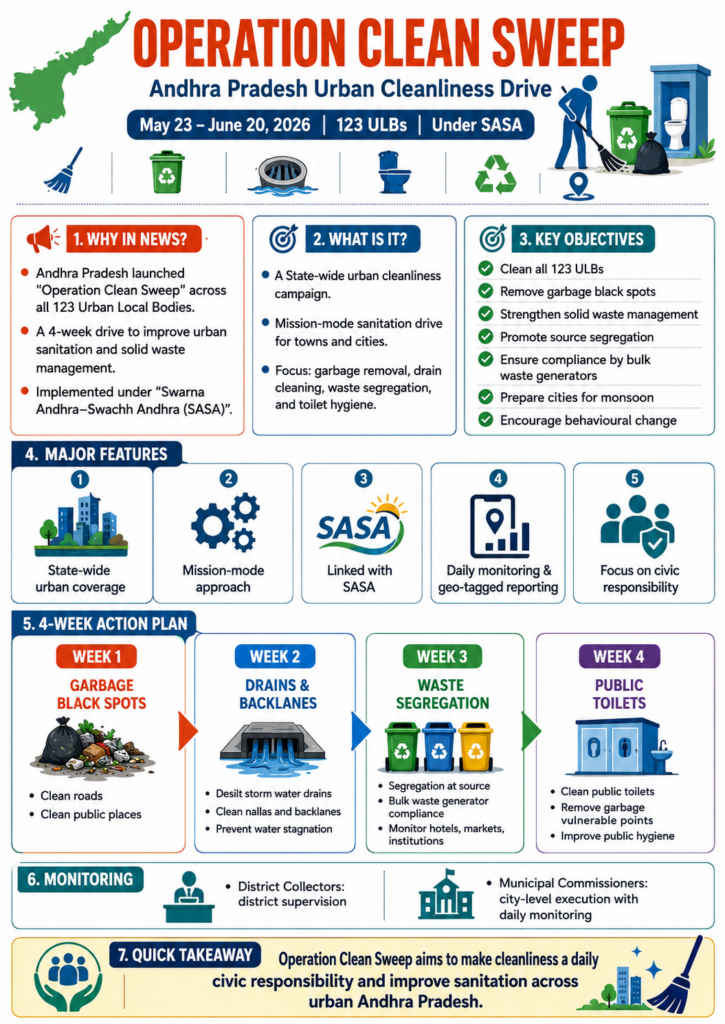
- The Andhra Pradesh government has announced the launch of Operation Clean Sweep across all 123 Urban Local Bodies (ULBs).
- The campaign will be conducted from May 23 to June 20, 2026. It is a four-week intensive cleanliness drive aimed at improving urban sanitation and strengthening solid waste management practices.
- The initiative will be implemented under the broader Swarna Andhra–Swachh Andhra (SASA) programme.
What is Operation Clean Sweep?
- Operation Clean Sweep is a State-wide urban cleanliness campaign launched by the Andhra Pradesh government.
- It aims to improve sanitation in towns and cities through a mission-mode approach. The campaign focuses on removing garbage points, cleaning public places, improving waste segregation, desilting drains, and strengthening public toilet cleanliness.
- The main idea is to make cleanliness a daily civic responsibility, not just a routine municipal activity.
Key Objectives
The main objectives of Operation Clean Sweep are:
- To improve cleanliness across all 123 ULBs in Andhra Pradesh.
- To remove garbage black spots and garbage vulnerable points.
- To strengthen solid waste management in urban areas.
- To promote waste segregation at source.
- To ensure compliance by bulk waste generators.
- To prepare urban areas for the monsoon by cleaning drains and nallas.
- To encourage sustained behavioural change among citizens.
Major Features
1. State-wide Urban Coverage
- The campaign will cover all 123 Urban Local Bodies of Andhra Pradesh, including municipal corporations, municipalities, and nagar panchayats.
2. Mission-Mode Approach
- The campaign moves beyond routine sanitation work. It follows a target-based and result-oriented approach.
3. Link with SASA Programme
- The drive is linked with the Swarna Andhra–Swachh Andhra programme, which focuses on public participation in cleanliness.
4. Daily Monitoring
- Implementation will be monitored regularly through daily reporting and geo-tagged reporting systems.
5. Focus on Behavioural Change
- The campaign aims to make cleanliness a regular public habit and promote citizen responsibility.
Week-wise Action Plan
Week 1: Removal of Garbage Black Spots
In the first week, authorities will focus on:
- Removing garbage black spots
- Cleaning roads
- Improving cleanliness in public places
Week 2: Cleaning of Drains and Backlanes
The second week will focus on:
- Desilting storm water drains
- Cleaning nallas
- Cleaning backlanes
- Preventing water stagnation before the monsoon
Week 3: Waste Segregation and Bulk Waste Generators
The third week will focus on:
- Segregation of waste at source
- Compliance by bulk waste generators
- Monitoring hotels, markets, institutions, and other large waste producers
Week 4: Public Toilets and Garbage Vulnerable Points
The final week will focus on:
- Cleaning public toilets
- Removing garbage vulnerable points
- Improving hygiene in public sanitation spaces
Implementation and Monitoring
- The campaign will be implemented through a clear administrative structure.
- District Collectors will supervise the implementation of the drive at the district level.
- Municipal Commissioners will oversee city-level execution.
- Daily monitoring and geo-tagged reporting systems will be used to track progress and ensure accountability.
- This structure helps in improving coordination between district administration and municipal bodies.
Significance
1. Improves Urban Sanitation
- The campaign can improve cleanliness in roads, markets, drains, public places, and residential areas.
2. Strengthens Solid Waste Management
- By focusing on source segregation and bulk waste generators, the initiative supports better waste collection, processing, and disposal.
3. Helps in Monsoon Preparedness
- Desilting drains and nallas before the monsoon can reduce water stagnation, urban flooding, and mosquito-borne diseases.
4. Promotes Public Health
- Cleaner surroundings reduce the spread of diseases caused by garbage accumulation, stagnant water, and poor sanitation.
5. Encourages Civic Responsibility
- The campaign aims to make citizens active participants in cleanliness activities.
6. Improves Urban Governance
- Daily monitoring, geo-tagged reporting, and clear responsibility of officials can improve accountability in municipal administration.
Challenges
- Maintaining cleanliness after the four-week campaign may be difficult.
- Waste segregation at source requires continuous public awareness.
- Some ULBs may face shortage of sanitation workers, vehicles, and equipment.
- Bulk waste generators may not comply without strict monitoring.
- Garbage black spots may reappear if citizens continue open dumping.
- Urban drains may again get blocked due to plastic waste and construction debris.
- Behavioural change requires long-term efforts, not only short campaigns.
Way Forward
- ULBs should conduct regular cleanliness audits even after the campaign.
- Waste segregation should be made compulsory at household and commercial levels.
- Strict action should be taken against open dumping and non-compliance by bulk waste generators.
- Citizen groups, resident welfare associations, schools, colleges, and market bodies should be involved.
- Geo-tagged reporting should be linked with public grievance redressal.
- Sanitation workers should be provided proper safety equipment and training.
- The campaign should be converted into a long-term urban sanitation movement.
Conclusion
Operation Clean Sweep is an important step towards cleaner and healthier urban areas in Andhra Pradesh. Its success depends on effective municipal action, citizen participation, strict monitoring, and sustained behavioural change.
If implemented properly, the campaign can strengthen urban governance, improve public health, and support the goal of a cleaner Swarna Andhra–Swachh Andhra.
CARE MCQ
Q. With reference to Operation Clean Sweep, consider the following statements:
- It is a cleanliness campaign launched by the Andhra Pradesh government across all Urban Local Bodies.
- It will be implemented from May 23 to June 20, 2026.
- It focuses only on cleaning public toilets.
Which of the statements given above is/are correct?
A. 1 and 2 only
B. 2 and 3 only
C. 1 and 3 only
D. 1, 2 and 3
Answer: A
Explanation
Statement 1 is correct:
Operation Clean Sweep will be implemented across all 123 Urban Local Bodies in Andhra Pradesh.
Statement 2 is correct:
The campaign will run from May 23 to June 20, 2026.
Statement 3 is incorrect:
The campaign does not focus only on public toilets. It also includes removal of garbage black spots, drain cleaning, waste segregation, and monitoring of bulk waste generators.
Additional Information
Operation Clean Sweep is linked with the Swarna Andhra–Swachh Andhra programme and follows a mission-mode approach.
FAQs
1. What is Operation Clean Sweep?
Operation Clean Sweep is a four-week cleanliness campaign launched by the Andhra Pradesh government to improve sanitation in urban areas.
2. Where will Operation Clean Sweep be implemented?
It will be implemented across all 123 Urban Local Bodies in Andhra Pradesh.
3. What is the duration of the campaign?
The campaign will be held from May 23 to June 20, 2026.
4. What is the first week’s focus?
The first week will focus on removing garbage black spots and cleaning roads and public places.
5. Who will monitor the campaign?
District Collectors will supervise at the district level, while Municipal Commissioners will monitor implementation at the city level.
6. Why is the campaign important?
It is important because it improves urban sanitation, supports solid waste management, prepares cities for the monsoon, and promotes civic responsibility.
Relevance: UPSC GS Paper III: Economy, Agriculture, Crop Diseases, Food Security, Pest Management, Sustainable Agriculture
For Prelims:
- Southern Rice Black-Streaked Dwarf Virus, White-backed Plant Hopper, Paddy Dwarfing Disease, PAU Ludhiana, Insect Vector, Persistent Propagative Transmission, Yellow-light Trap, Alternate Grassy Hosts, Paddy Nursery, Transplantation Schedule
For Mains:
- Crop disease management, farmer livelihood security, preventive agriculture, pest surveillance, monocropping risk, agricultural extension, climate-resilient farming, food security
Why in News?
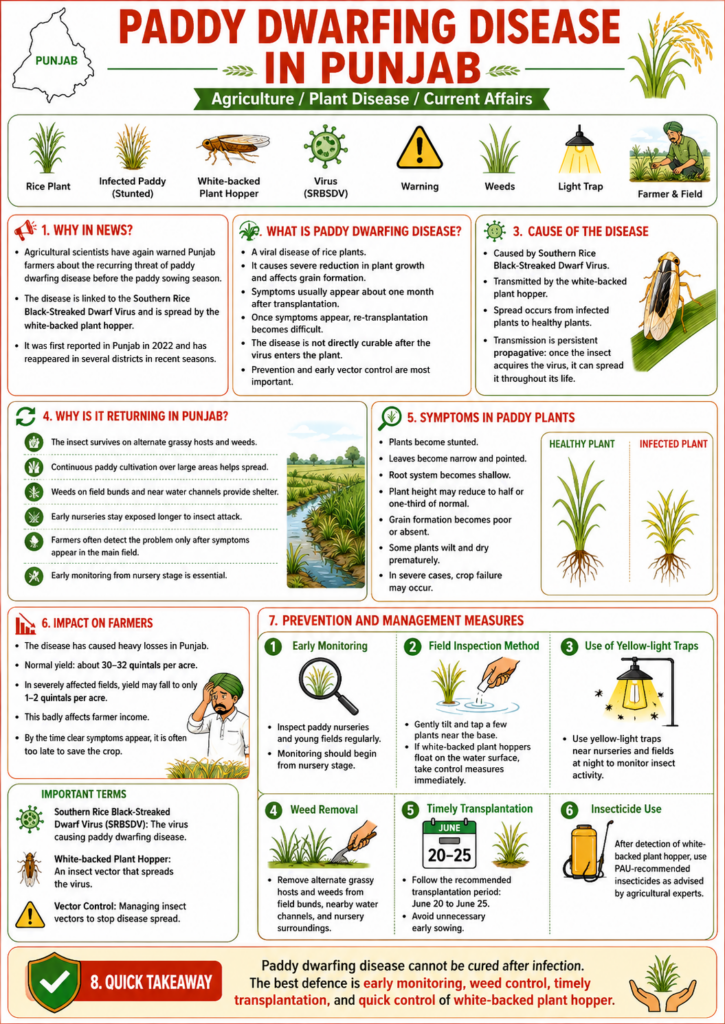
- Agricultural scientists have again warned Punjab farmers about the recurring threat of paddy dwarfing disease before the paddy sowing season.
- The disease is linked to the Southern Rice Black-Streaked Dwarf Virus and is spread by the white-backed plant hopper. It was first reported in Punjab in 2022 and has reappeared in several districts in recent seasons.
What is Paddy Dwarfing Disease?
- Paddy dwarfing disease is a viral disease of rice plants. It causes severe reduction in plant growth and affects grain formation.
- The disease is dangerous because clear symptoms usually appear around one month after transplantation. By that time, farmers often cannot re-transplant fresh paddy due to shortage of time.
- The disease is not directly curable after the virus enters the plant. Therefore, prevention and early control of the insect vector are the most important measures.
Cause of the Disease
- The disease is caused by the Southern Rice Black-Streaked Dwarf Virus.
- It is transmitted by the white-backed plant hopper, an insect that carries the virus from infected plants to healthy plants.
- The transmission happens in a persistent propagative manner. This means that once the insect acquires the virus, it can continue spreading it throughout its life.
Why is the Disease Returning in Punjab?
The disease keeps returning mainly because the insect vector survives between cropping seasons.
Important reasons include:
- The insect survives on alternate grassy hosts and weeds.
- Continuous paddy cultivation over large areas helps the disease spread.
- Weeds on field bunds and near water channels act as shelter for insects.
- Early nurseries remain exposed for a longer time to insect attack.
- Farmers often notice the disease only after symptoms appear in the main field.
This makes early monitoring from the nursery stage very important.
Symptoms in Paddy Plants
Infected plants show clear dwarfing symptoms.
Major symptoms include:
- Plants become stunted.
- Leaves become narrow and pointed.
- Root system becomes shallow.
- Plant height may reduce to half or one-third of normal plants.
- Grain formation becomes poor or absent.
- Some plants wilt and dry prematurely.
In severe cases, the crop may fail almost completely.
Impact on Farmers
- The disease has caused heavy losses in Punjab.
- Normally, paddy yield is around 30 to 32 quintals per acre. In severely affected fields, farmers reported yield of only one or two quintals per acre in some cases.
- This badly affects farmer income because once symptoms appear clearly, it becomes too late to save the crop or re-transplant paddy.
Prevention and Management Measures
1. Early Monitoring
- Farmers should inspect paddy nurseries and young fields regularly. Monitoring should start from the nursery stage, not after symptoms appear.
2. Field Inspection Method
- A few plants should be gently tilted and tapped near the base. If white-backed plant hoppers are seen floating on the water surface, control measures should be taken immediately.
3. Use of Yellow-light Traps
- Yellow-light traps can be used near nurseries and fields at night to monitor insect activity.
4. Weed Removal
Farmers should remove alternate grassy hosts and weeds from:
- Field bunds
- Nearby water channels
- Nursery surroundings
This reduces the shelter and breeding space for insects.
5. Timely Transplantation
- Farmers should follow the recommended transplantation period of June 20 to June 25.
- Unnecessary early sowing should be avoided because early nurseries remain exposed to insects for a longer period.
6. Insecticide Use
- After detection of white-backed plant hopper, farmers should use PAU-recommended insecticides as advised by agricultural experts.
Significance
- The issue is important because Punjab is one of India’s major rice-producing states. A serious disease in paddy can affect farmer income, food supply and procurement systems.
- It also shows the importance of scientific pest surveillance, early warning systems, and farmer awareness programmes in Indian agriculture.
Challenges
- Symptoms appear late in the field.
- There is no direct cure after viral infection.
- Farmers may delay monitoring until visible damage appears.
- Weeds and grassy hosts help the insect survive.
- Continuous paddy cultivation increases disease risk.
- Small farmers may lack awareness about scientific monitoring methods.
Way Forward
- Strengthen village-level awareness camps by agricultural universities.
- Promote regular monitoring from nursery stage.
- Train farmers to identify white-backed plant hopper.
- Encourage weed-free field bunds and water channels.
- Follow recommended transplantation dates.
- Develop local pest surveillance and early warning systems.
- Promote crop diversification to reduce risks linked to continuous paddy cultivation.
Conclusion
Paddy dwarfing disease in Punjab is a serious agricultural concern because it directly affects yield and farmer income. Since there is no curative treatment after infection, prevention is the best strategy. Early monitoring, removal of weeds, control of the white-backed plant hopper and timely transplantation can help reduce crop losses and protect farmers’ livelihoods.
CARE MCQ
Q. With reference to Paddy Dwarfing Disease, consider the following statements:
- It is linked to the Southern Rice Black-Streaked Dwarf Virus.
- It is transmitted by the white-backed plant hopper.
- It can be completely cured after the virus enters the plant.
Which of the statements given above is/are correct?
A. 1 and 2 only
B. 2 and 3 only
C. 1 and 3 only
D. 1, 2 and 3
Answer: A
Explanation:
Statement 1 is correct: Paddy dwarfing disease is linked to the Southern Rice Black-Streaked Dwarf Virus.
Statement 2 is correct: The virus is transmitted by the white-backed plant hopper, which acts as the insect vector.
Statement 3 is incorrect: Once the virus enters the plant, there is no direct curative treatment. Prevention and early vector control are the main strategies.
Additional Information:
The disease was first reported in Punjab in 2022 and has since reappeared in several districts.
FAQs
1. What is paddy dwarfing disease?
Paddy dwarfing disease is a viral disease of rice plants. It reduces plant growth, makes plants stunted, and affects grain formation.
2. Which virus causes paddy dwarfing disease?
It is caused by the Southern Rice Black-Streaked Dwarf Virus (SRBSDV).
3. How does the disease spread?
The disease spreads through the white-backed plant hopper, an insect vector that carries the virus from infected plants to healthy plants.
4. Why is this disease dangerous for farmers?
Symptoms usually appear nearly one month after transplantation. By that time, it becomes difficult for farmers to re-transplant fresh paddy, leading to heavy yield loss.
5. What are the major symptoms of paddy dwarfing disease?
The major symptoms are stunted plants, narrow and pointed leaves, shallow roots, poor grain formation, wilting, and premature drying of plants.
6. How can farmers prevent paddy dwarfing disease?
Farmers should follow early monitoring, weed removal, timely transplantation, yellow-light traps, field inspection, and use PAU-recommended insecticides after detecting white-backed plant hopper.
Relevance: GS Paper II – Federalism, Centre-State Relations, Cooperative Federalism, Constitutional Bodies and Governance.
For Prelims:
- Federalism, Quasi-Federalism, Article 1, Article 200, Article 263, Article 270, Article 280, Article 356, Inter-State Council, GST Council, Finance Commission, Rajya Sabha, Delimitation, Cesses and Surcharges.
For Mains:
- Cooperative Federalism, Fiscal Federalism, Democratic Self-restraint, Regional Autonomy, Demographic Penalty, Governor’s Discretion, Centre-State Trust, Concurrent List, Asymmetric Federalism, Consensus-building.
Why in News?
Indian federalism is witnessing renewed stress due to issues such as demographic change, fiscal imbalance, centralisation, delimitation concerns, Governor-State conflicts and weak Centre-State consultation.
These developments have created tension between national unity and regional autonomy. The debate highlights the need for democratic restraint, institutional consultation and cooperative federalism.
What is Indian Federalism?
- Federalism means a system where political power is divided between the national government and regional governments.
- India does not use the word “Federation” in the Constitution.
- Article 1(1) says: “India, that is Bharat, shall be a Union of States.”
- Dr. B.R. Ambedkar used the term Union because:
- Indian States did not join the Union through a voluntary agreement.
- States do not have the right to secede.
- India is an indestructible Union of destructible States.
- Indian federalism is called quasi-federal because it combines:
- A strong Centre
- Constitutionally recognised States
- Division of powers
- Unitary features during emergencies
Key Federal Features in India
|
Unitary Bias in Indian Federalism
- Residuary powers are with the Union under Article 248.
- India has single citizenship.
- The Centre can alter State boundaries.
- All India Services function under Article 312.
- Emergency provisions, especially Article 356, strengthen the Centre.
- Union law prevails in case of conflict on Concurrent List subjects.
Major Challenges to Indian Federalism
1. Demographic Penalty and Delimitation
- The post-2026 delimitation exercise may readjust parliamentary representation.
- Southern States have achieved lower fertility rates and better population control.
- Some northern States continue to have higher population growth.
- If seats are redistributed only on the basis of population, States that controlled population may lose political weight.
- This creates fear of a demographic penalty.
2. North-South Political Imbalance
- A purely population-based formula may shift greater representation towards populous northern States.
- Southern and western States may feel politically marginalised.
- This can create a democratic deficit because better-performing States may lose voice in Parliament.
3. Fiscal Asymmetry
- High-performing States often contribute more to national revenue.
- Poorer States require greater fiscal support.
- Balancing contribution and redistribution has become a sensitive issue.
- This creates tension between fiscal equity and fiscal performance.
4. Shrinking Divisible Pool
- The Centre increasingly uses cesses and surcharges.
- These are not shared with States under the divisible pool.
- Although vertical devolution is formally 41%, the actual share reaching States becomes lower.
- This weakens State finances and fiscal federalism.
5. Finance Commission Frictions
- The 16th Finance Commission framework mentioned in the content gives weight to Contribution to GDP.
- Industrialised States may see this as recognition of their contribution.
- Poorer States fear that reduced weight for redistributive criteria may weaken fiscal justice.
- Thus, the Finance Commission must balance:
- Equity
- Efficiency
- Demographic performance
- Development needs
6. Conditional Borrowing Limits
- States are concerned about strict limits on borrowing.
- Linking extra borrowing space to specific reforms, such as power sector privatisation, is seen as interference in fiscal autonomy.
- States argue that such conditions restrict their ability to fund welfare and infrastructure.
7. Central Legislation on Concurrent List Subjects
- The Centre has the power to legislate on Concurrent List subjects.
- However, States argue that major reforms are sometimes passed without adequate consultation.
- Criminal law reforms, agricultural reforms and labour codes are cited as examples where State participation was considered limited.
- This affects the spirit of cooperative federalism.
8. Dormant Inter-State Council
- Article 263 provides for the Inter-State Council.
- It is meant to discuss Centre-State and inter-State issues.
- Its underuse weakens pre-legislative consultation and dispute resolution.
- As a result, States often approach the Supreme Court after disputes arise.
9. Governor-State Friction
- The Governor should act as a constitutional bridge between the Centre and the State.
- In practice, the office has often become a point of political conflict.
- Delays in giving assent to State Bills create legislative uncertainty.
- Indefinite delay acts like a pocket veto, weakening elected State legislatures.
10. Use of Central Agencies
- States have raised concerns over the use of agencies such as CBI and ED.
- Deployment of Central Armed Police Forces without State concurrence can also create friction.
- Such actions may affect trust between the Centre and States.
11. “One Nation” Approach and State Autonomy
- Policies like One Nation, One Market, One Nation, One Ration Card and One Nation, One Election aim at uniformity.
- However, States fear that excessive uniformity may reduce regional policy space.
- States have historically acted as laboratories of innovation.
- Example: Tamil Nadu’s Mid-Day Meal Scheme later influenced national policy.
12. Education and PM SHRI Concerns
- Some opposition-ruled States expressed concern over the PM SHRI Schools scheme.
- Their concern was that centrally designed conditions may limit State autonomy in education.
- Since education is in the Concurrent List, proper Centre-State consultation is necessary.
13. Asymmetric Federalism and State Reorganisation
- India’s diversity requires special arrangements for some regions.
- Demands continue for:
- Sixth Schedule status in Ladakh
- Special Category Status for Bihar and Odisha
- Centre’s power to reorganise States can create a sense of insecurity among regions.
14. Horizontal Federalism Issues
- Federal stress is not only between Centre and States.
- State-State conflicts also create pressure.
- Examples include:
- Cauvery water dispute
- Mahadayi water dispute
- Assam-Mizoram border conflict
- Boundary disputes
- River water-sharing issues
15. Language Concerns
- Language remains a sensitive issue in Indian federalism.
- Perceived imposition of Hindi creates anxiety in southern and north-eastern States.
- Debates on language in education and official communication can affect national cohesion.
16. Weakening Federal Role of Rajya Sabha
- Rajya Sabha was designed as the Council of States.
- Its purpose is to represent State interests in Parliament.
- Removal of domicile requirement for Rajya Sabha membership in 2003 weakened its federal character.
- Voting often follows party lines rather than State interests.
| Landmark Judgments
State of West Bengal v. Union of India, 1962
S.R. Bommai v. Union of India, 1994
State of Punjab v. Principal Secretary to the Governor, 2023
|
Why Consensus is Essential
- India’s diversity cannot be managed through centralisation alone.
- Issues such as delimitation, fiscal devolution, language and regional autonomy require negotiation.
- Historical experience shows that accommodation strengthens unity.
- The Linguistic Reorganisation of States, 1956 is an example of resolving regional aspirations through democratic adjustment.
- The GST Council shows that consensus-based decision-making can work in Centre-State fiscal matters.
- Cooperative decision-making improves outcomes in health, climate, migration, agriculture, disaster management and internal security.
Measures Needed to Strengthen Federalism
1. Revitalise the Inter-State Council
- It should meet regularly.
- It should become a mandatory forum for Centre-State dialogue.
- It should help prevent disputes before they reach courts.
2. Expand the GST Council Model
- The consensus model can be used in areas like:
- Internal security
- Infrastructure planning
- Climate governance
- Migration
- Agriculture
3. Rebalance Fiscal Federalism
- Cesses and surcharges should be rationalised.
- States must receive a fair share of tax revenues.
- Fiscal discipline and performance should be rewarded.
- State Finance Commissions should be strengthened.
4. Define Governor’s Discretion
- Governor’s discretionary powers should be clearly listed.
- Governors should act on the aid and advice of the Council of Ministers except in limited constitutional situations.
- Recommendations of the Sarkaria Commission and Punchhi Commission should be implemented.
5. Reform Governor Appointment
- The Chief Minister should be consulted before appointment.
- Governors should be eminent persons from outside the State.
- They should act impartially and maintain regular communication with the Chief Minister.
6. Strengthen Consultation on Concurrent List
- States should be consulted before Parliament legislates on Concurrent List subjects.
- This will improve legitimacy and implementation.
7. Adopt a Balanced Delimitation Formula
- Representation should not be based only on population.
- A hybrid formula may include:
- Population
- Demographic performance
- Human development
- Federal balance
- States that controlled population should not be politically punished.
8. Restore Rajya Sabha’s Federal Role
- Rajya Sabha should work as a true Council of States.
- State-specific concerns should receive stronger space in national law-making.
Challenges
- Regional inequalities are increasing.
- Delimitation may create North-South political tension.
- State fiscal space is shrinking.
- Governor-State conflicts are rising.
- Inter-State Council remains weak.
- Inter-State water and boundary disputes remain unresolved.
- Language concerns continue to generate political anxiety.
- Centralisation may reduce State autonomy.
Way Forward
- Federalism must be based on consultation, compromise and mutual respect.
- The Centre should practise democratic self-restraint.
- States must cooperate in national goals while protecting regional interests.
- Institutions like the Inter-State Council, GST Council and Rajya Sabha should be strengthened.
- Fiscal devolution must balance equity and performance.
- Delimitation must avoid penalising States that achieved better demographic outcomes.
- Governor’s office must function as a constitutional institution, not a political tool.
Conclusion
Indian federalism is not a fixed arrangement; it is a living process that must constantly adjust to changing political, economic and social realities.The present stress over delimitation, fiscal sharing, centralisation, Governor’s role, language and inter-State disputes shows that federal trust needs urgent repair. A strong Union is necessary for national unity, but strong States are equally necessary for democracy and development. India can preserve the spirit of the Union of States only through dialogue, accommodation, fair fiscal sharing and democratic self-restraint.Top of Form
UPSC PYQ
Q. Which one of the following is not a feature of Indian federalism? [UPSC CSE 2017]
A. There is an independent judiciary in India.
B. Powers have been clearly divided between the Centre and the States.
C. The federating units have been given unequal representation in the Rajya Sabha.
D. It is the result of an agreement among the federating units.
Answer: D
Explanation
- Option A is correct as a feature: India has an independent judiciary, which protects the Constitution and settles Centre-State disputes.
- Option B is correct as a feature: Powers are divided between the Centre and States through the Union List, State List and Concurrent List under the Seventh Schedule.
- Option C is correct as a feature: States have unequal representation in the Rajya Sabha based mainly on population.
- Option D is not a feature: Indian federalism is not the result of an agreement among States. India is described as a Union of States under Article 1, and States do not have the right to secede.
Care MCQ
Q. With reference to Indian federalism, consider the following statements:
- The term “Federation” is explicitly mentioned in the Indian Constitution.
- Article 1(1) describes India as a “Union of States.”
- Indian federalism is often described as quasi-federal because it combines a strong Centre with constitutionally autonomous States.
Which of the above statements are correct?
A. 1 and 2 only
B. 2 and 3 only
C. 1 and 3 only
D. 1, 2 and 3
Answer: B
Explanation
- Statement 1 is incorrect: The term “Federation” is not mentioned in the Indian Constitution.
- Statement 2 is correct: Article 1(1) states that “India, that is Bharat, shall be a Union of States.”
- Statement 3 is correct: Indian federalism is called quasi-federal because it has federal features such as division of powers, written Constitution and independent judiciary, but also has a strong Centre.
Additional Information
Dr. B.R. Ambedkar used the term “Union” to show that India is not the result of an agreement among States and that States do not have the right to secede. India is therefore described as an indestructible Union of destructible States.