Table of Contents
Relevance: UPSC GS Paper III: Economy, Agriculture, Crop Diseases, Food Security, Pest Management, Sustainable Agriculture
For Prelims:
- Southern Rice Black-Streaked Dwarf Virus, White-backed Plant Hopper, Paddy Dwarfing Disease, PAU Ludhiana, Insect Vector, Persistent Propagative Transmission, Yellow-light Trap, Alternate Grassy Hosts, Paddy Nursery, Transplantation Schedule
For Mains:
- Crop disease management, farmer livelihood security, preventive agriculture, pest surveillance, monocropping risk, agricultural extension, climate-resilient farming, food security
Why in News?
- Agricultural scientists have again warned Punjab farmers about the recurring threat of paddy dwarfing disease before the paddy sowing season.
- The disease is linked to the Southern Rice Black-Streaked Dwarf Virus and is spread by the white-backed plant hopper. It was first reported in Punjab in 2022 and has reappeared in several districts in recent seasons.
What is Paddy Dwarfing Disease?
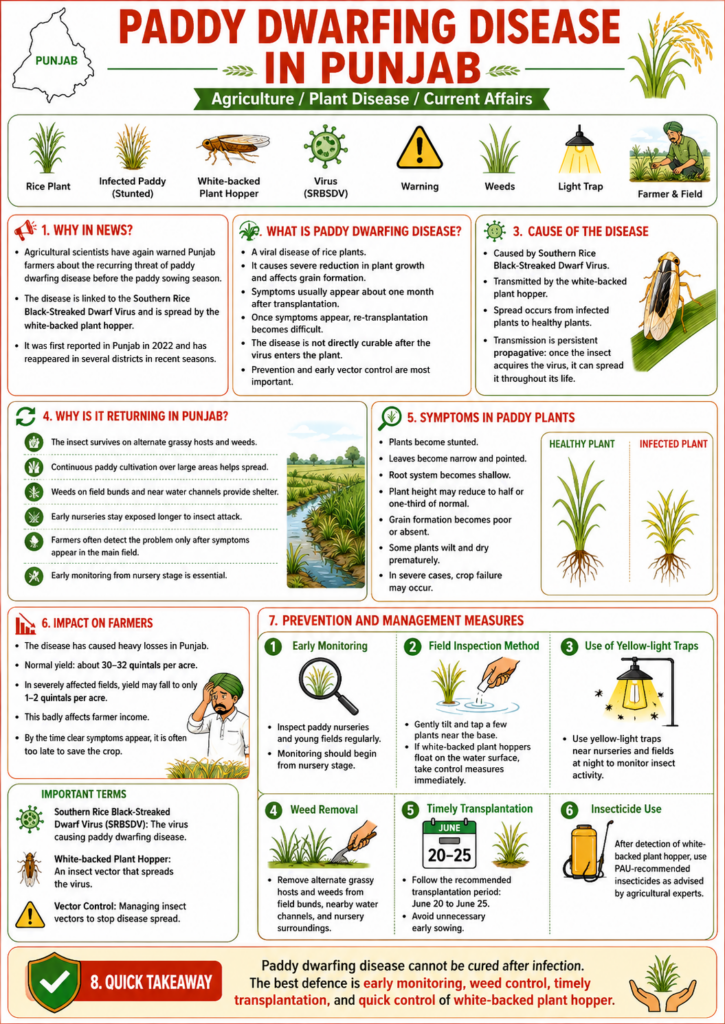
- Paddy dwarfing disease is a viral disease of rice plants. It causes severe reduction in plant growth and affects grain formation.
- The disease is dangerous because clear symptoms usually appear around one month after transplantation. By that time, farmers often cannot re-transplant fresh paddy due to shortage of time.
- The disease is not directly curable after the virus enters the plant. Therefore, prevention and early control of the insect vector are the most important measures.
Cause of the Disease
- The disease is caused by the Southern Rice Black-Streaked Dwarf Virus.
- It is transmitted by the white-backed plant hopper, an insect that carries the virus from infected plants to healthy plants.
- The transmission happens in a persistent propagative manner. This means that once the insect acquires the virus, it can continue spreading it throughout its life.
Why is the Disease Returning in Punjab?
The disease keeps returning mainly because the insect vector survives between cropping seasons.
Important reasons include:
- The insect survives on alternate grassy hosts and weeds.
- Continuous paddy cultivation over large areas helps the disease spread.
- Weeds on field bunds and near water channels act as shelter for insects.
- Early nurseries remain exposed for a longer time to insect attack.
- Farmers often notice the disease only after symptoms appear in the main field.
This makes early monitoring from the nursery stage very important.
Symptoms in Paddy Plants
Infected plants show clear dwarfing symptoms.
Major symptoms include:
- Plants become stunted.
- Leaves become narrow and pointed.
- Root system becomes shallow.
- Plant height may reduce to half or one-third of normal plants.
- Grain formation becomes poor or absent.
- Some plants wilt and dry prematurely.
In severe cases, the crop may fail almost completely.
Impact on Farmers
- The disease has caused heavy losses in Punjab.
- Normally, paddy yield is around 30 to 32 quintals per acre. In severely affected fields, farmers reported yield of only one or two quintals per acre in some cases.
- This badly affects farmer income because once symptoms appear clearly, it becomes too late to save the crop or re-transplant paddy.
Prevention and Management Measures
1. Early Monitoring
- Farmers should inspect paddy nurseries and young fields regularly. Monitoring should start from the nursery stage, not after symptoms appear.
2. Field Inspection Method
- A few plants should be gently tilted and tapped near the base. If white-backed plant hoppers are seen floating on the water surface, control measures should be taken immediately.
3. Use of Yellow-light Traps
- Yellow-light traps can be used near nurseries and fields at night to monitor insect activity.
4. Weed Removal
Farmers should remove alternate grassy hosts and weeds from:
- Field bunds
- Nearby water channels
- Nursery surroundings
This reduces the shelter and breeding space for insects.
5. Timely Transplantation
- Farmers should follow the recommended transplantation period of June 20 to June 25.
- Unnecessary early sowing should be avoided because early nurseries remain exposed to insects for a longer period.
6. Insecticide Use
- After detection of white-backed plant hopper, farmers should use PAU-recommended insecticides as advised by agricultural experts.
Significance
- The issue is important because Punjab is one of India’s major rice-producing states. A serious disease in paddy can affect farmer income, food supply and procurement systems.
- It also shows the importance of scientific pest surveillance, early warning systems, and farmer awareness programmes in Indian agriculture.
Challenges
- Symptoms appear late in the field.
- There is no direct cure after viral infection.
- Farmers may delay monitoring until visible damage appears.
- Weeds and grassy hosts help the insect survive.
- Continuous paddy cultivation increases disease risk.
- Small farmers may lack awareness about scientific monitoring methods.
Way Forward
- Strengthen village-level awareness camps by agricultural universities.
- Promote regular monitoring from nursery stage.
- Train farmers to identify white-backed plant hopper.
- Encourage weed-free field bunds and water channels.
- Follow recommended transplantation dates.
- Develop local pest surveillance and early warning systems.
- Promote crop diversification to reduce risks linked to continuous paddy cultivation.
Conclusion
Paddy dwarfing disease in Punjab is a serious agricultural concern because it directly affects yield and farmer income. Since there is no curative treatment after infection, prevention is the best strategy. Early monitoring, removal of weeds, control of the white-backed plant hopper and timely transplantation can help reduce crop losses and protect farmers’ livelihoods.
CARE MCQ
Q. With reference to Paddy Dwarfing Disease, consider the following statements:
- It is linked to the Southern Rice Black-Streaked Dwarf Virus.
- It is transmitted by the white-backed plant hopper.
- It can be completely cured after the virus enters the plant.
Which of the statements given above is/are correct?
A. 1 and 2 only
B. 2 and 3 only
C. 1 and 3 only
D. 1, 2 and 3
Answer: A
Explanation:
Statement 1 is correct: Paddy dwarfing disease is linked to the Southern Rice Black-Streaked Dwarf Virus.
Statement 2 is correct: The virus is transmitted by the white-backed plant hopper, which acts as the insect vector.
Statement 3 is incorrect: Once the virus enters the plant, there is no direct curative treatment. Prevention and early vector control are the main strategies.
Additional Information:
The disease was first reported in Punjab in 2022 and has since reappeared in several districts.
FAQs
1. What is paddy dwarfing disease?
Paddy dwarfing disease is a viral disease of rice plants. It reduces plant growth, makes plants stunted, and affects grain formation.
2. Which virus causes paddy dwarfing disease?
It is caused by the Southern Rice Black-Streaked Dwarf Virus (SRBSDV).
3. How does the disease spread?
The disease spreads through the white-backed plant hopper, an insect vector that carries the virus from infected plants to healthy plants.
4. Why is this disease dangerous for farmers?
Symptoms usually appear nearly one month after transplantation. By that time, it becomes difficult for farmers to re-transplant fresh paddy, leading to heavy yield loss.
5. What are the major symptoms of paddy dwarfing disease?
The major symptoms are stunted plants, narrow and pointed leaves, shallow roots, poor grain formation, wilting, and premature drying of plants.
6. How can farmers prevent paddy dwarfing disease?
Farmers should follow early monitoring, weed removal, timely transplantation, yellow-light traps, field inspection, and use PAU-recommended insecticides after detecting white-backed plant hopper.