Relevance: Paper-III: Indian Society, Constitution and Governance
For Prelims:
- Young India Integrated Residential Schools, YIIRS, Asian Development Bank, Asian Infrastructure Investment Bank, Department of Economic Affairs, FRBM Act, 50-year Interest-Free Loans, Human Resource Development, SC/ST/BC/Minority Education.
For Mains:
- Education Infrastructure, Socially Inclusive Development, Multilateral Funding, Fiscal Federalism, Capital Expenditure, Human Capital Formation, Educational Empowerment, State Finances, Welfare and Development
Why in News?
The Centre has approved Telangana’s proposal to secure external multilateral funding from the Asian Development Bank and the Asian Infrastructure Investment Bank for two major education infrastructure projects. The approval is significant because the projects are aimed at strengthening school infrastructure, improving educational access and supporting the educational empowerment of SC, ST, BC and minority communities in Telangana.
What has the Centre Approved?
The Department of Economic Affairs under the Union Finance Ministry cleared external funding for two major projects.
- ₹4,049.11 crore for the Young India Integrated Residential Schools project through ADB assistance.
- ₹4,903.44 crore for the Telangana Education Infrastructure Upgradation Mission through AIIB support.
Deputy Chief Minister Mallu Bhatti Vikramarka met Union Finance Minister Nirmala Sitharaman in New Delhi and thanked the Centre for granting the approvals.
About Young India Integrated Residential Schools
- Young India Integrated Residential Schools are planned as major educational institutions for providing quality education.
- The project aims to provide world-class education to students.
- It is especially linked with the educational empowerment of:
- SC communities
- ST communities
- BC communities
- Minority communities
- The project is part of Telangana’s broader focus on human resource development and inclusive growth.
Telangana Education Infrastructure Upgradation Mission
- This mission aims to strengthen education infrastructure across Telangana.
- It is expected to support:
- School infrastructure development
- Better learning facilities
- Improved access to quality education
- Long-term human capital formation
- The project is supported through AIIB funding.
Role of ADB and AIIB
Asian Development Bank
- ADB is a multilateral development bank.
- It supports development projects in areas such as infrastructure, education, health and poverty reduction.
- In this case, ADB assistance will support the YIIRS project.
Asian Infrastructure Investment Bank
- AIIB is a multilateral financial institution focused mainly on infrastructure and sustainable development.
- Its support will be used for the Telangana Education Infrastructure Upgradation Mission.

FRBM Exemption Demand
- The Telangana government urged the Centre to exempt the ADB and AIIB loans from the State’s borrowing limits under the Fiscal Responsibility and Budget Management Act.
- The State argued that these loans are not routine expenditure. They are long-term capital investments in education, human resource development and social empowerment.
- The demand is important because FRBM limits restrict how much a State can borrow. Excluding these education loans from the borrowing limit would give Telangana more fiscal space for development spending.
| Asian Infrastructure Investment Bank (AIIB)
|
50-Year Interest-Free Loans to States
- The deputy Chief minister thanked the Centre for extending 50-year interest-free loans to States.
- Telangana has already received ₹4,208 crore during the 2025–26 financial year under this support.
- The State sought more financial support to continue development works and welfare programmes.
Link with Human Resource Development
The Telangana government is also undertaking major initiatives such as:
- Establishing new medical colleges district-wise.
- Expanding rural healthcare services.
- Strengthening educational infrastructure.
- Investing in education, healthcare and rural infrastructure.
These initiatives are expected to contribute to sustainable and socially inclusive development.
Fiscal Context of Telangana
Telangana has stated that it is one of the fast-growing newly formed States.
However, the State is facing financial pressure due to:
- Debts raised through Special Purpose Vehicles between 2014 and 2023.
- Repayment obligations.
- Continued spending needs for welfare and development programmes.
Despite this, the government is continuing investments in education, healthcare, rural infrastructure and human resource development.
Challenges
- External loans need proper utilisation and repayment planning.
- FRBM limits may restrict the State’s borrowing space.
- Project implementation must avoid delays and cost escalation.
- Quality of infrastructure must match educational outcomes.
- Residential schools need trained teachers, good management and student support systems.
- Coordination between State departments, Centre and multilateral agencies may be complex.
- Financial pressure from past liabilities may affect future spending capacity.
Way Forward
- Ensure transparent utilisation of ADB and AIIB funds.
- Prepare strong project monitoring mechanisms.
- Link infrastructure investment with learning outcomes.
- Focus on teacher recruitment, training and student welfare.
- Ensure timely completion of school buildings and facilities.
- Use technology and digital learning tools in residential schools.
- Provide special support for SC, ST, BC and minority students.
- Maintain fiscal discipline while protecting development expenditure.
- Strengthen Centre-State coordination for education and infrastructure financing.
Conclusion
The Centre’s approval of ADB and AIIB funding will strengthen Telangana’s education infrastructure. The Young India Integrated Residential Schools and infrastructure mission can promote quality education and social inclusion. These projects can support human resource development and long-term growth. Success will depend on timely execution, transparent fund use and strong academic support.
CARE MCQ
Q. Where is the headquarters of Asian Development Bank? [CAPF – 2008]
A. Jakarta
B. Manila
C. Singapore
D. Bangkok
Answer: B
Explanation
- The Asian Development Bank (ADB) is headquartered in Manila, Philippines.
- It is a multilateral development bank established in 1966.
- Its main aim is to promote inclusive and sustainable development in the Asia-Pacific region.
Additional Information
- Full Form: Asian Development Bank
- Headquarters: Manila, Philippines
- Established: 19 December 1966
- Members: 69
- Major Shareholders: Japan, USA, China, India and Australia
FAQs
1. What did the Centre approve for Telangana?
The Centre approved external multilateral funding from ADB and AIIB for two major education projects in Telangana.
2. How much funding was approved for YIIRS?
₹4,049.11 crore was cleared for the Young India Integrated Residential Schools project through ADB assistance.
3. What is the Telangana Education Infrastructure Upgradation Mission?
It is a project to strengthen education infrastructure in Telangana, supported by AIIB funding of ₹4,903.44 crore.
4. What is FRBM?
FRBM means Fiscal Responsibility and Budget Management. It sets limits on government borrowing and fiscal deficit.
5. Why did Telangana seek FRBM exemption?
Telangana argued that the ADB and AIIB loans are long-term capital investments in education and human resource development, not routine expenditure.
Relevance: UPSC GS Paper III: Economy, Agriculture, Crop Diseases, Food Security, Pest Management, Sustainable Agriculture
For Prelims:
- Southern Rice Black-Streaked Dwarf Virus, White-backed Plant Hopper, Paddy Dwarfing Disease, PAU Ludhiana, Insect Vector, Persistent Propagative Transmission, Yellow-light Trap, Alternate Grassy Hosts, Paddy Nursery, Transplantation Schedule
For Mains:
- Crop disease management, farmer livelihood security, preventive agriculture, pest surveillance, monocropping risk, agricultural extension, climate-resilient farming, food security
Why in News?
- Agricultural scientists have again warned Punjab farmers about the recurring threat of paddy dwarfing disease before the paddy sowing season.
- The disease is linked to the Southern Rice Black-Streaked Dwarf Virus and is spread by the white-backed plant hopper. It was first reported in Punjab in 2022 and has reappeared in several districts in recent seasons.
What is Paddy Dwarfing Disease?
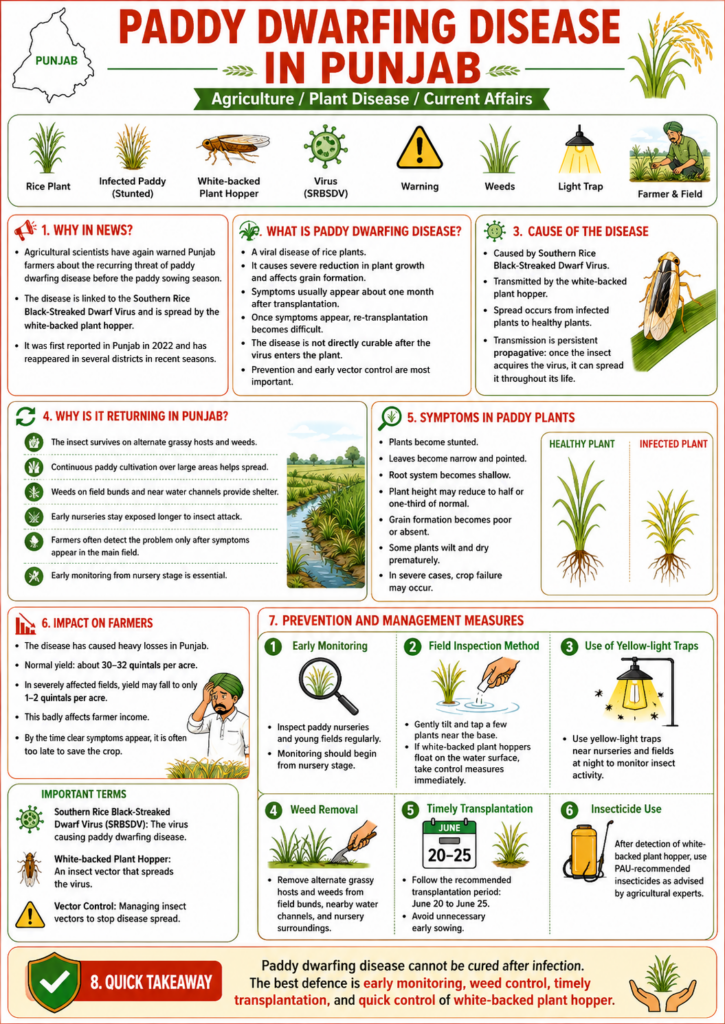
- Paddy dwarfing disease is a viral disease of rice plants. It causes severe reduction in plant growth and affects grain formation.
- The disease is dangerous because clear symptoms usually appear around one month after transplantation. By that time, farmers often cannot re-transplant fresh paddy due to shortage of time.
- The disease is not directly curable after the virus enters the plant. Therefore, prevention and early control of the insect vector are the most important measures.
Cause of the Disease
- The disease is caused by the Southern Rice Black-Streaked Dwarf Virus.
- It is transmitted by the white-backed plant hopper, an insect that carries the virus from infected plants to healthy plants.
- The transmission happens in a persistent propagative manner. This means that once the insect acquires the virus, it can continue spreading it throughout its life.
Why is the Disease Returning in Punjab?
The disease keeps returning mainly because the insect vector survives between cropping seasons.
Important reasons include:
- The insect survives on alternate grassy hosts and weeds.
- Continuous paddy cultivation over large areas helps the disease spread.
- Weeds on field bunds and near water channels act as shelter for insects.
- Early nurseries remain exposed for a longer time to insect attack.
- Farmers often notice the disease only after symptoms appear in the main field.
This makes early monitoring from the nursery stage very important.
Symptoms in Paddy Plants
Infected plants show clear dwarfing symptoms.
Major symptoms include:
- Plants become stunted.
- Leaves become narrow and pointed.
- Root system becomes shallow.
- Plant height may reduce to half or one-third of normal plants.
- Grain formation becomes poor or absent.
- Some plants wilt and dry prematurely.
In severe cases, the crop may fail almost completely.
Impact on Farmers
- The disease has caused heavy losses in Punjab.
- Normally, paddy yield is around 30 to 32 quintals per acre. In severely affected fields, farmers reported yield of only one or two quintals per acre in some cases.
- This badly affects farmer income because once symptoms appear clearly, it becomes too late to save the crop or re-transplant paddy.
Prevention and Management Measures
1. Early Monitoring
- Farmers should inspect paddy nurseries and young fields regularly. Monitoring should start from the nursery stage, not after symptoms appear.
2. Field Inspection Method
- A few plants should be gently tilted and tapped near the base. If white-backed plant hoppers are seen floating on the water surface, control measures should be taken immediately.
3. Use of Yellow-light Traps
- Yellow-light traps can be used near nurseries and fields at night to monitor insect activity.
4. Weed Removal
Farmers should remove alternate grassy hosts and weeds from:
- Field bunds
- Nearby water channels
- Nursery surroundings
This reduces the shelter and breeding space for insects.
5. Timely Transplantation
- Farmers should follow the recommended transplantation period of June 20 to June 25.
- Unnecessary early sowing should be avoided because early nurseries remain exposed to insects for a longer period.
6. Insecticide Use
- After detection of white-backed plant hopper, farmers should use PAU-recommended insecticides as advised by agricultural experts.
Significance
- The issue is important because Punjab is one of India’s major rice-producing states. A serious disease in paddy can affect farmer income, food supply and procurement systems.
- It also shows the importance of scientific pest surveillance, early warning systems, and farmer awareness programmes in Indian agriculture.
Challenges
- Symptoms appear late in the field.
- There is no direct cure after viral infection.
- Farmers may delay monitoring until visible damage appears.
- Weeds and grassy hosts help the insect survive.
- Continuous paddy cultivation increases disease risk.
- Small farmers may lack awareness about scientific monitoring methods.
Way Forward
- Strengthen village-level awareness camps by agricultural universities.
- Promote regular monitoring from nursery stage.
- Train farmers to identify white-backed plant hopper.
- Encourage weed-free field bunds and water channels.
- Follow recommended transplantation dates.
- Develop local pest surveillance and early warning systems.
- Promote crop diversification to reduce risks linked to continuous paddy cultivation.
Conclusion
Paddy dwarfing disease in Punjab is a serious agricultural concern because it directly affects yield and farmer income. Since there is no curative treatment after infection, prevention is the best strategy. Early monitoring, removal of weeds, control of the white-backed plant hopper and timely transplantation can help reduce crop losses and protect farmers’ livelihoods.
CARE MCQ
Q. With reference to Paddy Dwarfing Disease, consider the following statements:
- It is linked to the Southern Rice Black-Streaked Dwarf Virus.
- It is transmitted by the white-backed plant hopper.
- It can be completely cured after the virus enters the plant.
Which of the statements given above is/are correct?
A. 1 and 2 only
B. 2 and 3 only
C. 1 and 3 only
D. 1, 2 and 3
Answer: A
Explanation:
Statement 1 is correct: Paddy dwarfing disease is linked to the Southern Rice Black-Streaked Dwarf Virus.
Statement 2 is correct: The virus is transmitted by the white-backed plant hopper, which acts as the insect vector.
Statement 3 is incorrect: Once the virus enters the plant, there is no direct curative treatment. Prevention and early vector control are the main strategies.
Additional Information:
The disease was first reported in Punjab in 2022 and has since reappeared in several districts.
FAQs
1. What is paddy dwarfing disease?
Paddy dwarfing disease is a viral disease of rice plants. It reduces plant growth, makes plants stunted, and affects grain formation.
2. Which virus causes paddy dwarfing disease?
It is caused by the Southern Rice Black-Streaked Dwarf Virus (SRBSDV).
3. How does the disease spread?
The disease spreads through the white-backed plant hopper, an insect vector that carries the virus from infected plants to healthy plants.
4. Why is this disease dangerous for farmers?
Symptoms usually appear nearly one month after transplantation. By that time, it becomes difficult for farmers to re-transplant fresh paddy, leading to heavy yield loss.
5. What are the major symptoms of paddy dwarfing disease?
The major symptoms are stunted plants, narrow and pointed leaves, shallow roots, poor grain formation, wilting, and premature drying of plants.
6. How can farmers prevent paddy dwarfing disease?
Farmers should follow early monitoring, weed removal, timely transplantation, yellow-light traps, field inspection, and use PAU-recommended insecticides after detecting white-backed plant hopper.
Relevance: GS Paper II – Federalism, Centre-State Relations, Cooperative Federalism, Constitutional Bodies and Governance.
For Prelims:
- Federalism, Quasi-Federalism, Article 1, Article 200, Article 263, Article 270, Article 280, Article 356, Inter-State Council, GST Council, Finance Commission, Rajya Sabha, Delimitation, Cesses and Surcharges.
For Mains:
- Cooperative Federalism, Fiscal Federalism, Democratic Self-restraint, Regional Autonomy, Demographic Penalty, Governor’s Discretion, Centre-State Trust, Concurrent List, Asymmetric Federalism, Consensus-building.
Why in News?
Indian federalism is witnessing renewed stress due to issues such as demographic change, fiscal imbalance, centralisation, delimitation concerns, Governor-State conflicts and weak Centre-State consultation.
These developments have created tension between national unity and regional autonomy. The debate highlights the need for democratic restraint, institutional consultation and cooperative federalism.
What is Indian Federalism?
- Federalism means a system where political power is divided between the national government and regional governments.
- India does not use the word “Federation” in the Constitution.
- Article 1(1) says: “India, that is Bharat, shall be a Union of States.”
- Dr. B.R. Ambedkar used the term Union because:
- Indian States did not join the Union through a voluntary agreement.
- States do not have the right to secede.
- India is an indestructible Union of destructible States.
- Indian federalism is called quasi-federal because it combines:
- A strong Centre
- Constitutionally recognised States
- Division of powers
- Unitary features during emergencies
Key Federal Features in India
|
Unitary Bias in Indian Federalism
- Residuary powers are with the Union under Article 248.
- India has single citizenship.
- The Centre can alter State boundaries.
- All India Services function under Article 312.
- Emergency provisions, especially Article 356, strengthen the Centre.
- Union law prevails in case of conflict on Concurrent List subjects.
Major Challenges to Indian Federalism
1. Demographic Penalty and Delimitation
- The post-2026 delimitation exercise may readjust parliamentary representation.
- Southern States have achieved lower fertility rates and better population control.
- Some northern States continue to have higher population growth.
- If seats are redistributed only on the basis of population, States that controlled population may lose political weight.
- This creates fear of a demographic penalty.
2. North-South Political Imbalance
- A purely population-based formula may shift greater representation towards populous northern States.
- Southern and western States may feel politically marginalised.
- This can create a democratic deficit because better-performing States may lose voice in Parliament.
3. Fiscal Asymmetry
- High-performing States often contribute more to national revenue.
- Poorer States require greater fiscal support.
- Balancing contribution and redistribution has become a sensitive issue.
- This creates tension between fiscal equity and fiscal performance.
4. Shrinking Divisible Pool
- The Centre increasingly uses cesses and surcharges.
- These are not shared with States under the divisible pool.
- Although vertical devolution is formally 41%, the actual share reaching States becomes lower.
- This weakens State finances and fiscal federalism.
5. Finance Commission Frictions
- The 16th Finance Commission framework mentioned in the content gives weight to Contribution to GDP.
- Industrialised States may see this as recognition of their contribution.
- Poorer States fear that reduced weight for redistributive criteria may weaken fiscal justice.
- Thus, the Finance Commission must balance:
- Equity
- Efficiency
- Demographic performance
- Development needs
6. Conditional Borrowing Limits
- States are concerned about strict limits on borrowing.
- Linking extra borrowing space to specific reforms, such as power sector privatisation, is seen as interference in fiscal autonomy.
- States argue that such conditions restrict their ability to fund welfare and infrastructure.
7. Central Legislation on Concurrent List Subjects
- The Centre has the power to legislate on Concurrent List subjects.
- However, States argue that major reforms are sometimes passed without adequate consultation.
- Criminal law reforms, agricultural reforms and labour codes are cited as examples where State participation was considered limited.
- This affects the spirit of cooperative federalism.
8. Dormant Inter-State Council
- Article 263 provides for the Inter-State Council.
- It is meant to discuss Centre-State and inter-State issues.
- Its underuse weakens pre-legislative consultation and dispute resolution.
- As a result, States often approach the Supreme Court after disputes arise.
9. Governor-State Friction
- The Governor should act as a constitutional bridge between the Centre and the State.
- In practice, the office has often become a point of political conflict.
- Delays in giving assent to State Bills create legislative uncertainty.
- Indefinite delay acts like a pocket veto, weakening elected State legislatures.
10. Use of Central Agencies
- States have raised concerns over the use of agencies such as CBI and ED.
- Deployment of Central Armed Police Forces without State concurrence can also create friction.
- Such actions may affect trust between the Centre and States.
11. “One Nation” Approach and State Autonomy
- Policies like One Nation, One Market, One Nation, One Ration Card and One Nation, One Election aim at uniformity.
- However, States fear that excessive uniformity may reduce regional policy space.
- States have historically acted as laboratories of innovation.
- Example: Tamil Nadu’s Mid-Day Meal Scheme later influenced national policy.
12. Education and PM SHRI Concerns
- Some opposition-ruled States expressed concern over the PM SHRI Schools scheme.
- Their concern was that centrally designed conditions may limit State autonomy in education.
- Since education is in the Concurrent List, proper Centre-State consultation is necessary.
13. Asymmetric Federalism and State Reorganisation
- India’s diversity requires special arrangements for some regions.
- Demands continue for:
- Sixth Schedule status in Ladakh
- Special Category Status for Bihar and Odisha
- Centre’s power to reorganise States can create a sense of insecurity among regions.
14. Horizontal Federalism Issues
- Federal stress is not only between Centre and States.
- State-State conflicts also create pressure.
- Examples include:
- Cauvery water dispute
- Mahadayi water dispute
- Assam-Mizoram border conflict
- Boundary disputes
- River water-sharing issues
15. Language Concerns
- Language remains a sensitive issue in Indian federalism.
- Perceived imposition of Hindi creates anxiety in southern and north-eastern States.
- Debates on language in education and official communication can affect national cohesion.
16. Weakening Federal Role of Rajya Sabha
- Rajya Sabha was designed as the Council of States.
- Its purpose is to represent State interests in Parliament.
- Removal of domicile requirement for Rajya Sabha membership in 2003 weakened its federal character.
- Voting often follows party lines rather than State interests.
| Landmark Judgments
State of West Bengal v. Union of India, 1962
S.R. Bommai v. Union of India, 1994
State of Punjab v. Principal Secretary to the Governor, 2023
|
Why Consensus is Essential
- India’s diversity cannot be managed through centralisation alone.
- Issues such as delimitation, fiscal devolution, language and regional autonomy require negotiation.
- Historical experience shows that accommodation strengthens unity.
- The Linguistic Reorganisation of States, 1956 is an example of resolving regional aspirations through democratic adjustment.
- The GST Council shows that consensus-based decision-making can work in Centre-State fiscal matters.
- Cooperative decision-making improves outcomes in health, climate, migration, agriculture, disaster management and internal security.
Measures Needed to Strengthen Federalism
1. Revitalise the Inter-State Council
- It should meet regularly.
- It should become a mandatory forum for Centre-State dialogue.
- It should help prevent disputes before they reach courts.
2. Expand the GST Council Model
- The consensus model can be used in areas like:
- Internal security
- Infrastructure planning
- Climate governance
- Migration
- Agriculture
3. Rebalance Fiscal Federalism
- Cesses and surcharges should be rationalised.
- States must receive a fair share of tax revenues.
- Fiscal discipline and performance should be rewarded.
- State Finance Commissions should be strengthened.
4. Define Governor’s Discretion
- Governor’s discretionary powers should be clearly listed.
- Governors should act on the aid and advice of the Council of Ministers except in limited constitutional situations.
- Recommendations of the Sarkaria Commission and Punchhi Commission should be implemented.
5. Reform Governor Appointment
- The Chief Minister should be consulted before appointment.
- Governors should be eminent persons from outside the State.
- They should act impartially and maintain regular communication with the Chief Minister.
6. Strengthen Consultation on Concurrent List
- States should be consulted before Parliament legislates on Concurrent List subjects.
- This will improve legitimacy and implementation.
7. Adopt a Balanced Delimitation Formula
- Representation should not be based only on population.
- A hybrid formula may include:
- Population
- Demographic performance
- Human development
- Federal balance
- States that controlled population should not be politically punished.
8. Restore Rajya Sabha’s Federal Role
- Rajya Sabha should work as a true Council of States.
- State-specific concerns should receive stronger space in national law-making.
Challenges
- Regional inequalities are increasing.
- Delimitation may create North-South political tension.
- State fiscal space is shrinking.
- Governor-State conflicts are rising.
- Inter-State Council remains weak.
- Inter-State water and boundary disputes remain unresolved.
- Language concerns continue to generate political anxiety.
- Centralisation may reduce State autonomy.
Way Forward
- Federalism must be based on consultation, compromise and mutual respect.
- The Centre should practise democratic self-restraint.
- States must cooperate in national goals while protecting regional interests.
- Institutions like the Inter-State Council, GST Council and Rajya Sabha should be strengthened.
- Fiscal devolution must balance equity and performance.
- Delimitation must avoid penalising States that achieved better demographic outcomes.
- Governor’s office must function as a constitutional institution, not a political tool.
Conclusion
Indian federalism is not a fixed arrangement; it is a living process that must constantly adjust to changing political, economic and social realities.The present stress over delimitation, fiscal sharing, centralisation, Governor’s role, language and inter-State disputes shows that federal trust needs urgent repair. A strong Union is necessary for national unity, but strong States are equally necessary for democracy and development. India can preserve the spirit of the Union of States only through dialogue, accommodation, fair fiscal sharing and democratic self-restraint.Top of Form
UPSC PYQ
Q. Which one of the following is not a feature of Indian federalism? [UPSC CSE 2017]
A. There is an independent judiciary in India.
B. Powers have been clearly divided between the Centre and the States.
C. The federating units have been given unequal representation in the Rajya Sabha.
D. It is the result of an agreement among the federating units.
Answer: D
Explanation
- Option A is correct as a feature: India has an independent judiciary, which protects the Constitution and settles Centre-State disputes.
- Option B is correct as a feature: Powers are divided between the Centre and States through the Union List, State List and Concurrent List under the Seventh Schedule.
- Option C is correct as a feature: States have unequal representation in the Rajya Sabha based mainly on population.
- Option D is not a feature: Indian federalism is not the result of an agreement among States. India is described as a Union of States under Article 1, and States do not have the right to secede.
Care MCQ
Q. With reference to Indian federalism, consider the following statements:
- The term “Federation” is explicitly mentioned in the Indian Constitution.
- Article 1(1) describes India as a “Union of States.”
- Indian federalism is often described as quasi-federal because it combines a strong Centre with constitutionally autonomous States.
Which of the above statements are correct?
A. 1 and 2 only
B. 2 and 3 only
C. 1 and 3 only
D. 1, 2 and 3
Answer: B
Explanation
- Statement 1 is incorrect: The term “Federation” is not mentioned in the Indian Constitution.
- Statement 2 is correct: Article 1(1) states that “India, that is Bharat, shall be a Union of States.”
- Statement 3 is correct: Indian federalism is called quasi-federal because it has federal features such as division of powers, written Constitution and independent judiciary, but also has a strong Centre.
Additional Information
Dr. B.R. Ambedkar used the term “Union” to show that India is not the result of an agreement among States and that States do not have the right to secede. India is therefore described as an indestructible Union of destructible States.