Table of Contents
Relevance: Prelims facts: APPSC Group-1 Mains: Paper-III – Governance, Urban Local Bodies and Municipal Administration.
For Prelims:
- Operation Clean Sweep, 123 Urban Local Bodies, Swarna Andhra–Swachh Andhra, Solid Waste Management, Garbage Black Spots, Storm Water Drains, Source Segregation, Bulk Waste Generators, Geo-tagged Reporting, Municipal Commissioners
For Mains:
- Urban sanitation, mission-mode governance, civic responsibility, behavioural change, solid waste management, monsoon preparedness, decentralised implementation, urban public health
Why in News?
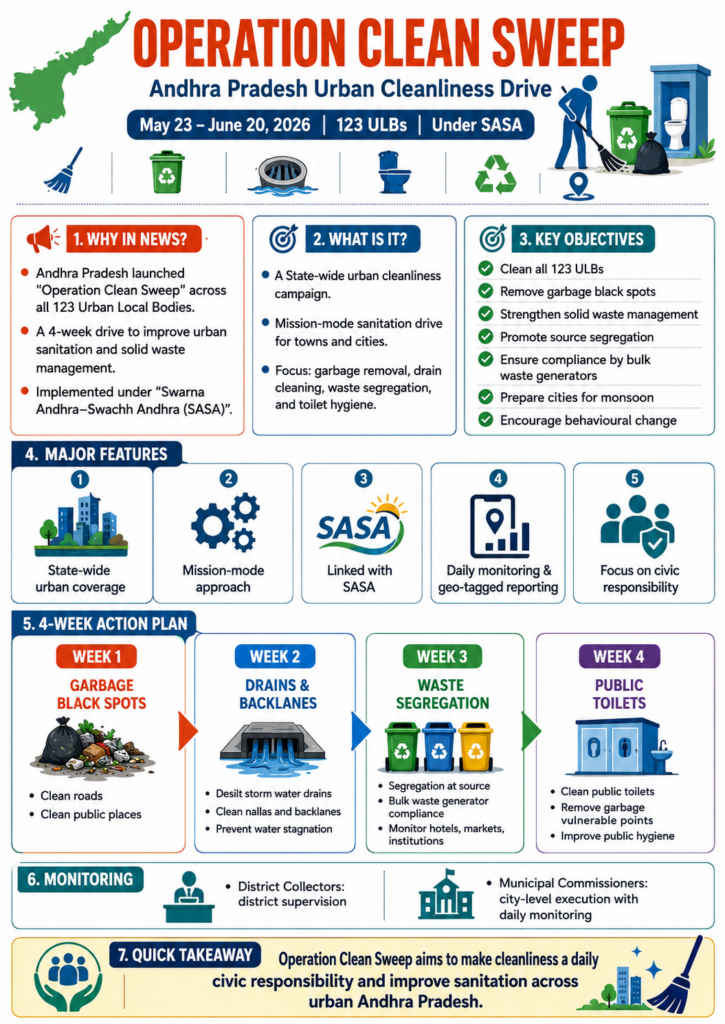
- The Andhra Pradesh government has announced the launch of Operation Clean Sweep across all 123 Urban Local Bodies (ULBs).
- The campaign will be conducted from May 23 to June 20, 2026. It is a four-week intensive cleanliness drive aimed at improving urban sanitation and strengthening solid waste management practices.
- The initiative will be implemented under the broader Swarna Andhra–Swachh Andhra (SASA) programme.
What is Operation Clean Sweep?
- Operation Clean Sweep is a State-wide urban cleanliness campaign launched by the Andhra Pradesh government.
- It aims to improve sanitation in towns and cities through a mission-mode approach. The campaign focuses on removing garbage points, cleaning public places, improving waste segregation, desilting drains, and strengthening public toilet cleanliness.
- The main idea is to make cleanliness a daily civic responsibility, not just a routine municipal activity.
Key Objectives
The main objectives of Operation Clean Sweep are:
- To improve cleanliness across all 123 ULBs in Andhra Pradesh.
- To remove garbage black spots and garbage vulnerable points.
- To strengthen solid waste management in urban areas.
- To promote waste segregation at source.
- To ensure compliance by bulk waste generators.
- To prepare urban areas for the monsoon by cleaning drains and nallas.
- To encourage sustained behavioural change among citizens.
Major Features
1. State-wide Urban Coverage
- The campaign will cover all 123 Urban Local Bodies of Andhra Pradesh, including municipal corporations, municipalities, and nagar panchayats.
2. Mission-Mode Approach
- The campaign moves beyond routine sanitation work. It follows a target-based and result-oriented approach.
3. Link with SASA Programme
- The drive is linked with the Swarna Andhra–Swachh Andhra programme, which focuses on public participation in cleanliness.
4. Daily Monitoring
- Implementation will be monitored regularly through daily reporting and geo-tagged reporting systems.
5. Focus on Behavioural Change
- The campaign aims to make cleanliness a regular public habit and promote citizen responsibility.
Week-wise Action Plan
Week 1: Removal of Garbage Black Spots
In the first week, authorities will focus on:
- Removing garbage black spots
- Cleaning roads
- Improving cleanliness in public places
Week 2: Cleaning of Drains and Backlanes
The second week will focus on:
- Desilting storm water drains
- Cleaning nallas
- Cleaning backlanes
- Preventing water stagnation before the monsoon
Week 3: Waste Segregation and Bulk Waste Generators
The third week will focus on:
- Segregation of waste at source
- Compliance by bulk waste generators
- Monitoring hotels, markets, institutions, and other large waste producers
Week 4: Public Toilets and Garbage Vulnerable Points
The final week will focus on:
- Cleaning public toilets
- Removing garbage vulnerable points
- Improving hygiene in public sanitation spaces
Implementation and Monitoring
- The campaign will be implemented through a clear administrative structure.
- District Collectors will supervise the implementation of the drive at the district level.
- Municipal Commissioners will oversee city-level execution.
- Daily monitoring and geo-tagged reporting systems will be used to track progress and ensure accountability.
- This structure helps in improving coordination between district administration and municipal bodies.
Significance
1. Improves Urban Sanitation
- The campaign can improve cleanliness in roads, markets, drains, public places, and residential areas.
2. Strengthens Solid Waste Management
- By focusing on source segregation and bulk waste generators, the initiative supports better waste collection, processing, and disposal.
3. Helps in Monsoon Preparedness
- Desilting drains and nallas before the monsoon can reduce water stagnation, urban flooding, and mosquito-borne diseases.
4. Promotes Public Health
- Cleaner surroundings reduce the spread of diseases caused by garbage accumulation, stagnant water, and poor sanitation.
5. Encourages Civic Responsibility
- The campaign aims to make citizens active participants in cleanliness activities.
6. Improves Urban Governance
- Daily monitoring, geo-tagged reporting, and clear responsibility of officials can improve accountability in municipal administration.
Challenges
- Maintaining cleanliness after the four-week campaign may be difficult.
- Waste segregation at source requires continuous public awareness.
- Some ULBs may face shortage of sanitation workers, vehicles, and equipment.
- Bulk waste generators may not comply without strict monitoring.
- Garbage black spots may reappear if citizens continue open dumping.
- Urban drains may again get blocked due to plastic waste and construction debris.
- Behavioural change requires long-term efforts, not only short campaigns.
Way Forward
- ULBs should conduct regular cleanliness audits even after the campaign.
- Waste segregation should be made compulsory at household and commercial levels.
- Strict action should be taken against open dumping and non-compliance by bulk waste generators.
- Citizen groups, resident welfare associations, schools, colleges, and market bodies should be involved.
- Geo-tagged reporting should be linked with public grievance redressal.
- Sanitation workers should be provided proper safety equipment and training.
- The campaign should be converted into a long-term urban sanitation movement.
Conclusion
Operation Clean Sweep is an important step towards cleaner and healthier urban areas in Andhra Pradesh. Its success depends on effective municipal action, citizen participation, strict monitoring, and sustained behavioural change.
If implemented properly, the campaign can strengthen urban governance, improve public health, and support the goal of a cleaner Swarna Andhra–Swachh Andhra.
CARE MCQ
Q. With reference to Operation Clean Sweep, consider the following statements:
- It is a cleanliness campaign launched by the Andhra Pradesh government across all Urban Local Bodies.
- It will be implemented from May 23 to June 20, 2026.
- It focuses only on cleaning public toilets.
Which of the statements given above is/are correct?
A. 1 and 2 only
B. 2 and 3 only
C. 1 and 3 only
D. 1, 2 and 3
Answer: A
Explanation
Statement 1 is correct:
Operation Clean Sweep will be implemented across all 123 Urban Local Bodies in Andhra Pradesh.
Statement 2 is correct:
The campaign will run from May 23 to June 20, 2026.
Statement 3 is incorrect:
The campaign does not focus only on public toilets. It also includes removal of garbage black spots, drain cleaning, waste segregation, and monitoring of bulk waste generators.
Additional Information
Operation Clean Sweep is linked with the Swarna Andhra–Swachh Andhra programme and follows a mission-mode approach.
FAQs
1. What is Operation Clean Sweep?
Operation Clean Sweep is a four-week cleanliness campaign launched by the Andhra Pradesh government to improve sanitation in urban areas.
2. Where will Operation Clean Sweep be implemented?
It will be implemented across all 123 Urban Local Bodies in Andhra Pradesh.
3. What is the duration of the campaign?
The campaign will be held from May 23 to June 20, 2026.
4. What is the first week’s focus?
The first week will focus on removing garbage black spots and cleaning roads and public places.
5. Who will monitor the campaign?
District Collectors will supervise at the district level, while Municipal Commissioners will monitor implementation at the city level.
6. Why is the campaign important?
It is important because it improves urban sanitation, supports solid waste management, prepares cities for the monsoon, and promotes civic responsibility.