
Relevance: APPSC – Group I Mains Paper III - Governance, digital governance, rural development, telecom infrastructure, Andhra Pradesh development
For Prelims:
- Digital Bharat Nidhi (DBN), Universal Service Obligation Fund (USOF), Amended BharatNet Programme (ABP), Department of Telecommunications (DoT), Andhra Pradesh BharatNet Infrastructure Limited (APBIL), BSNL, Andhra Pradesh State FiberNet Limited (APSFL), Gram Panchayat broadband connectivity, Ring topology, State-led model
For Mains:
Rural digital infrastructure, Last-mile connectivity, Digital inclusion, E-Governance delivery, Digital divide, Telemedicine and online education, Knowledge economy, Inclusive digital growth
Why in News?
Digital Bharat Nidhi under the Department of Telecommunications signed an agreement for the implementation of the Amended BharatNet Programme in Andhra Pradesh.
The agreement was signed between DBN, DoT, Government of Andhra Pradesh, APBIL, BSNL and APSFL. The programme will be implemented in Andhra Pradesh under the State-led model.
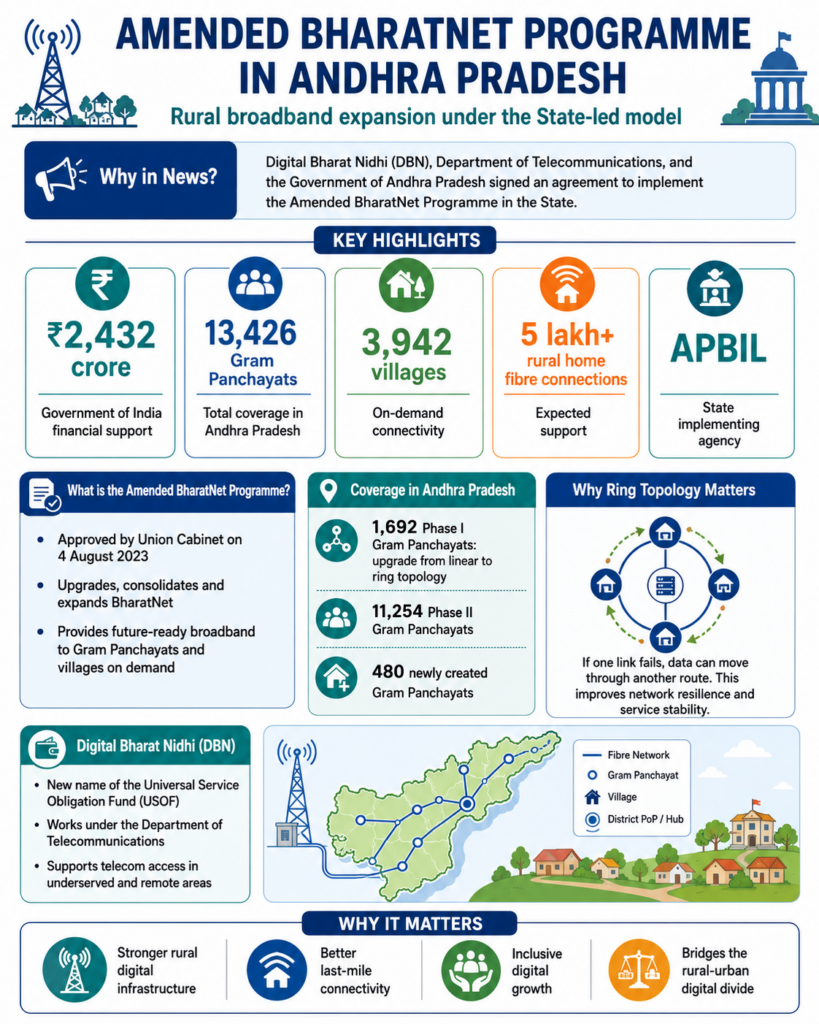
The Government of India has approved ₹2,432 crore financial support for the rollout of the programme in Andhra Pradesh.
About the Agreement
- The agreement aims to strengthen and upgrade rural telecom infrastructure in Andhra Pradesh. It focuses on improving broadband connectivity in Gram Panchayats and providing on-demand connectivity to villages.
- The agreement reflects the joint commitment of the Central Government and the Government of Andhra Pradesh towards rural digital infrastructure, last-mile connectivity and inclusive digital growth.
What is the Amended Bharat Net Programme?
- The Amended Bharat Net Programme (ABP) was approved by the Union Cabinet on 4 August 2023.
- Its main objective is to upgrade, consolidate and expand the existing Bharat Net network. It aims to provide strong and future-ready broadband connectivity to all Gram Panchayats and villages on a demand basis.
- Bharat Net is one of India’s major rural broadband infrastructure programmes. It seeks to bridge the digital divide between rural and urban India.
Key Features of ABP in Andhra Pradesh
- Implementing Agency
- In Andhra Pradesh, the project will be implemented through Andhra Pradesh BharatNet Infrastructure Limited (APBIL).
- Financial Support
- The Government of India has approved ₹2,432 crore for implementation of the Amended BharatNet Programme in Andhra Pradesh.
- Gram Panchayat Coverage
- The programme will cover a total of 13,426 Gram Panchayats in Andhra Pradesh.
This includes:
- 1,692 Phase I Gram Panchayats to be upgraded from linear topology to ring topology
- 11,254 Phase II Gram Panchayats
- 480 newly created Gram Panchayats
- On-Demand Village Connectivity
- The programme will provide on-demand connectivity to 3,942 villages.
- This will help improve last-mile connectivity in rural and remote areas.
- Rural Home Fibre Connections
- The initiative is expected to support more than five lakh rural home fibre connections with financial support from the Government of India.
Meaning of Ring Topology
- Ring topology is a network design in which connections are arranged in a circular form.
- In simple terms, if one part of the network faces disruption, data can still move through another route. This improves network resilience and reduces the risk of complete service failure.
- In rural broadband networks, ring topology can help provide more stable internet connectivity.
About Digital Bharat Nidhi
- Digital Bharat Nidhi (DBN) is the new name of the Universal Service Obligation Fund (USOF).
- The USOF was established under the Indian Telegraph (Amendment) Act, 2003, with effect from 1 April 2002.
- Under the Telecommunications Act, 2023, the Universal Service Obligation Fund became Digital Bharat Nidhi.
- DBN functions as an attached office of the Department of Telecommunications, Ministry of Communications.
- Its mandate is to support universal access to telecommunication services in underserved rural, remote and urban areas.
Major Schemes Supported by DBN
Digital Bharat Nidhi supports several telecom connectivity projects, including:
- BharatNet
- 4G Saturation Project
- Mobile service in uncovered areas of Aspirational Districts
- Connectivity in Left Wing Extremism-affected areas
- Telecom services in Himalayan and border areas
- Connectivity in Islands
- Telecom projects in the North-Eastern Region
Significance of the Initiative
- Strengthening Rural Digital Infrastructure
- The programme will improve broadband infrastructure in rural Andhra Pradesh. Better connectivity will help villages access digital services more effectively.
- Promoting Digital Inclusion
- Many rural areas still face poor internet access. The programme will help reduce the digital divide and bring remote communities into the digital economy.
- Improving E-Governance
- Strong broadband connectivity can improve delivery of government services such as certificates, welfare benefits, land records, pensions and grievance redressal.
- Supporting Online Education
- Rural students can benefit from online classes, digital libraries, skill courses and competitive exam resources.
- This is especially important for students in remote villages.
- Strengthening Telemedicine
- Improved internet connectivity can support online medical consultations, health records, remote diagnosis and digital health services.
- This can reduce the need for rural people to travel long distances for basic medical advice.
- Promoting Digital Payments
- Better connectivity can expand the use of UPI, Aadhaar-enabled payments and digital banking services in rural areas.
- Boosting Rural Economy
- Internet connectivity can help farmers, small traders, women entrepreneurs and rural youth access markets, government schemes and digital platforms.
- Supporting Knowledge Economy
- The programme supports the vision of a digitally empowered society and knowledge economy, where information, skills and technology become tools of development.
Challenges in Implementation
- Last-Mile Connectivity Issues
- Providing broadband to Gram Panchayats is important, but the real challenge is to ensure that households, schools, health centres and small businesses actually receive reliable connectivity.
- Maintenance of Infrastructure
- Rural telecom infrastructure requires regular maintenance. Fibre cuts, power issues and equipment damage can affect service quality.
- Affordability
- Even if internet infrastructure is available, rural households may not use it fully if data plans, devices or service charges are costly.
- Digital Literacy Gap
- Many rural citizens may not know how to use online services. Without digital literacy, connectivity alone may not produce full benefits.
- Coordination Among Agencies
- The programme involves several agencies such as DBN, DoT, State Government, APBIL, BSNL and APSFL. Effective coordination is necessary for timely implementation.
- Quality of Service
- Rural users need stable speed, low downtime and reliable network service. Poor quality may reduce trust in digital services.
Way Forward
- Strengthen Last-Mile Delivery
- Connectivity should reach schools, Anganwadi centres, health centres, Panchayat offices, Common Service Centres and rural households.
- Ensure Timely Implementation
- Clear timelines, monitoring systems and accountability mechanisms are needed to avoid delays.
- Promote Digital Literacy
- Training programmes should be organised for students, women, farmers, self-help groups and small entrepreneurs.
- Improve Service Affordability
- Affordable broadband plans and support for low-cost digital devices can increase adoption in rural areas.
- Encourage Local Entrepreneurship
- Village-level entrepreneurs can be encouraged to provide fibre connections, repair services and digital assistance.
- Integrate with Public Services
- The network should be linked with e-Governance, telemedicine, online education, digital agriculture and welfare delivery platforms.
- Focus on Network Maintenance
- Regular maintenance, local technical support and quick grievance redressal will be essential for reliable service.
Conclusion
The agreement for implementing the Amended BharatNet Programme in Andhra Pradesh is an important step towards strengthening rural digital infrastructure.
With ₹2,432 crore financial support, coverage of 13,426 Gram Panchayats, and on-demand connectivity to 3,942 villages, the programme can significantly improve digital access in rural Andhra Pradesh.
However, the success of the programme will depend not only on laying fibre networks but also on ensuring affordable access, digital literacy, reliable service and effective use of digital platforms. If implemented properly, it can transform rural connectivity into a powerful tool for inclusive development.
CARE MCQ
Q.Consider the following items in the context of the Amended Bharat Net Programme in Andhra Pradesh:
- Upgradation of Phase I Gram Panchayats from linear to ring topology
- Coverage of Phase II Gram Panchayats
- On-demand connectivity to villages
- Replacement of all private telecom operators by a single government operator
Which of the above are part of the programme?
A. 1, 2 and 3 only
B. 2, 3 and 4 only
C. 1 and 4 only
D. 1, 2, 3 and 4
Answer: A
Explanation:
- Item 1 is correct: Phase I Gram Panchayats will be upgraded from linear to ring topology.
- Item 2 is correct: Phase II Gram Panchayats are included in the programme.
- Item 3 is correct: Villages will receive connectivity on an on-demand basis.
- Item 4 is incorrect: The programme does not aim to replace private telecom operators.
Additional Information:
Ring topology improves network resilience by providing alternate routes for data flow.
FAQs
Q.What is the Amended BharatNet Programme?
The Amended BharatNet Programme is an initiative to upgrade, consolidate and expand BharatNet for broadband connectivity to Gram Panchayats and villages.
Q. How much financial support has been approved for Andhra Pradesh?
The Government of India has approved ₹2,432 crore for the implementation of ABP in Andhra Pradesh.
Q. How many Gram Panchayats will be covered in Andhra Pradesh?
The programme will cover 13,426 Gram Panchayats in Andhra Pradesh.
Q.What is Digital Bharat Nidhi?
Digital Bharat Nidhi is the renamed form of the Universal Service Obligation Fund. It supports telecom services in underserved rural, remote and urban areas.
Q.Why is this programme important?
It is important because it can improve rural broadband connectivity, support e-Governance, online education, telemedicine, digital payments and inclusive development.
Relevance: UPSC GS Paper II – Education, Governance, Centre-State Relations, Welfare Schemes, Social Sector Development.
For Prelims:
PM-SHRI, Pradhan Mantri Schools for Rising India, NEP 2020, Exemplar Schools, UDISE+, School Quality Assessment Framework, Samagra Shiksha, Challenge Mode, Smart Classrooms, Atal Tinkering Labs, PARAKH, PM e-VIDYA, SWAYAM.
For Mains:
School Transformation, Cooperative Federalism, Education Reform, Learning Outcomes, Competency-Based Learning, Digital Education, Multilingualism, Centre-State Dispute, Inclusive Education, Quality Public Schooling.
Why in News?
- The Union Ministry of Education issued a fresh reminder to West Bengal, Kerala and Tamil Nadu regarding pending implementation of the PM-SHRI scheme.
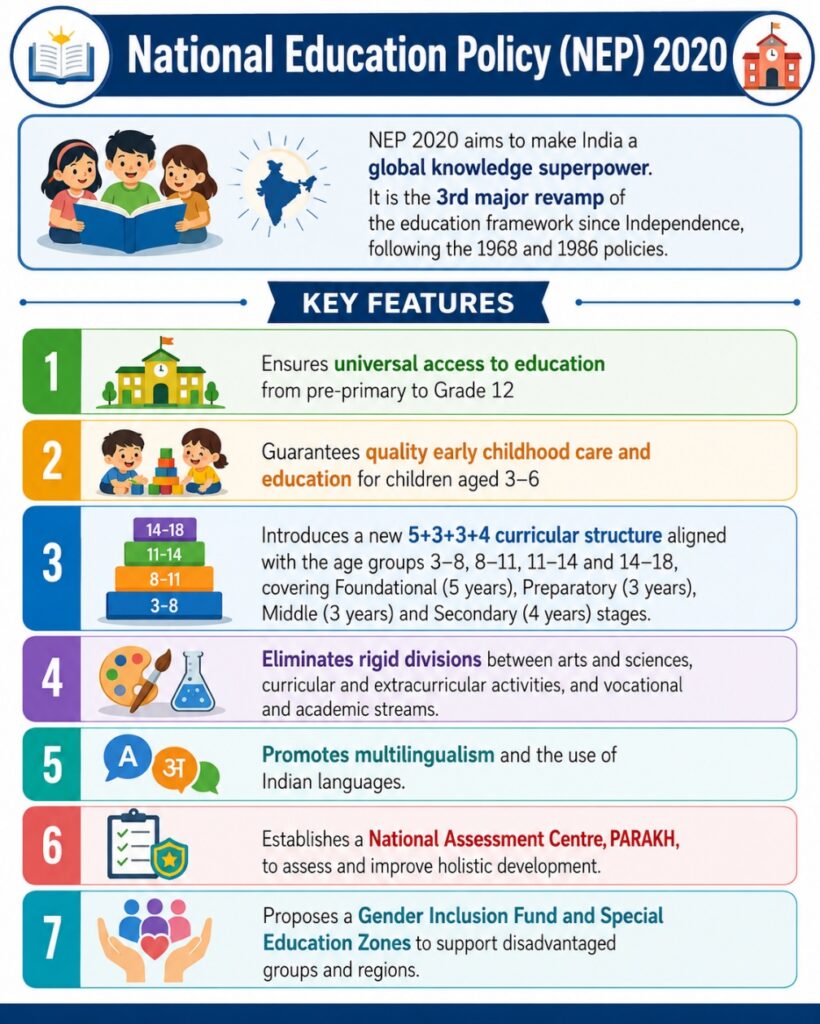
- The scheme aims to transform over 14,500 schools into exemplar institutions for implementing the National Education Policy, 2020.
- The Ministry stated that only limited time is left for the scheme to complete its five-year duration.
What is PM-SHRI?
- PM-SHRI stands for Pradhan Mantri Schools for Rising India.
- It was launched in 2022 as a Centrally Sponsored Scheme.
- The scheme aims to upgrade more than 14,500 existing schools into model institutions.
- These schools will showcase the implementation of NEP 2020.
- The scheme runs from 2022–23 to 2026–27.
- After the scheme period, maintenance responsibility will lie with the respective States and Union Territories.
- The scheme is designed to directly benefit more than 18 lakh students.
Funding Pattern
- The usual funding pattern is 60:40 for general States and Union Territories with legislature.
- For North-Eastern States, Himalayan States and Jammu and Kashmir, the funding pattern is 90:10.
- For Union Territories without legislature, the scheme is fully funded by the Centre.
Selection Process
- Schools are selected through a competitive Challenge Mode process.
- The process has three stages.
- First, States and Union Territories sign an MoU with the Union government.
- Second, eligible schools are identified based on minimum benchmarks using UDISE+ data.
- Third, shortlisted schools compete on specific criteria.
- Claims are verified through physical inspection.
- An expert committee makes the final selection.
- A maximum of two schools per block or urban local body may be selected.
Key Features of PM-SHRI Schools
- PM-SHRI schools aim to provide a safe, inclusive and stimulating learning environment.
- Important features include:
- Smart classrooms
- Computer labs
- Integrated science labs
- Atal Tinkering Labs
- ICT facilities
- Digital libraries
- Vocational labs
- Sports and arts for every student
- Early childhood care and education
- STEAM education
- Student registry to track enrolment and learning progress
- The scheme promotes competency-based learning and real-life application of knowledge.
- Pedagogy will be experiential, inquiry-driven, holistic, flexible and learner-centred.
- PM-SHRI schools also promote green initiatives such as:
- Water conservation
- Solar energy use
- Waste recycling
- The School Quality Assessment Framework will monitor school performance and support continuous improvement.
Status in West Bengal, Kerala and Tamil Nadu
West Bengal
- West Bengal has not signed the MoU for PM-SHRI implementation.
- The Centre has sent several reminders to the State.
- The delay has postponed the selection and development of PM-SHRI schools.
Kerala
- Kerala signed up for the scheme after a period of resistance.
- Later, the agreement was paused due to opposition from a coalition partner in the ruling government.
- The State formed a committee to examine implementation concerns.
Tamil Nadu
- Tamil Nadu had earlier given an undertaking to introduce the scheme.
- However, implementation remains incomplete.
- The Centre has sent repeated official requests to the State.
Reasons for State-Level Concerns
- West Bengal has raised concerns about funding and branding.
- Its objection is that States have to bear 40% of the cost, while the scheme carries the PM-SHRI name.
- Tamil Nadu has concerns over the three-language formula under NEP 2020.
- The State sees it as linked to possible Hindi imposition.
- Kerala has raised ideological concerns over NEP 2020 and its implementation through PM-SHRI.
- Some States also object to the requirement that selected schools must carry the PM-SHRI prefix.
Link with Samagra Shiksha Funding
- PM-SHRI implementation has become linked with the release of funds under Samagra Shiksha.
- Samagra Shiksha is an integrated school education scheme covering pre-school to Class XII.
- It combines earlier schemes such as:
- Sarva Shiksha Abhiyan
- Rashtriya Madhyamik Shiksha Abhiyan
- Teacher Education
- Delays in MoU signing have created tensions between the Centre and some States over school education funding.
Other Education Initiatives National Education Policy 2020
Samagra Shiksha
Mid-Day MealScheme
Beti Bachao Beti Padhao
PM e-VIDYA
SWAYAM
|
Significance
- PM-SHRI can improve the quality of public school education.
- It can create model schools for wider education reform.
- It supports implementation of NEP 2020 at the school level.
- It promotes digital learning, vocational education and competency-based learning.
- It supports green practices and modern infrastructure in schools.
- It can improve learning outcomes through continuous assessment.
- It highlights the need for Centre-State cooperation in education.
Challenges
- Political differences may delay implementation.
- NEP-linked conditions may create resistance in some States.
- Branding and cost-sharing issues may create federal tensions.
- Delays in signing MoUs reduce the effective implementation period.
- Students may lose intended benefits due to administrative delays.
- Linking Samagra Shiksha funding with PM-SHRI may create governance disputes.
- Different States may have different language, curriculum and education-policy priorities.
Way Forward
- Centre and States should resolve concerns through dialogue.
- Student welfare and learning outcomes must remain the main priority.
- States’ concerns on language, curriculum and branding should be addressed.
- The scheme should allow space for State Curriculum Frameworks within broad NEP goals.
- Fund release should be transparent and predictable.
- PM-SHRI schools should become genuine model schools, not merely renamed institutions.
- Monitoring should focus on learning outcomes, inclusion, infrastructure and school quality.
Conclusion
PM-SHRI is an important school transformation scheme aimed at creating exemplar institutions for NEP 2020 implementation. It can improve public school quality through smart infrastructure, competency-based learning, digital tools and green initiatives.
However, the delay in West Bengal, Kerala and Tamil Nadu shows that education reform needs cooperative federalism. The scheme can succeed only if Centre-State differences are resolved through flexibility, dialogue and a student-centred approach
UPSC PYQ
Q.Consider the following statements concerning the National Education Policy, 2020: (CDS-I/2023)
- At least 50 percent of the learners through the school and higher education system should get exposure to vocational education by 2025.
- Secondary schools should collaborate with ITIs, Polytechnics and local industries.
- Vocational education should be exclusively provided by NGOs.
Which of the statements given above is/are correct?
A. 1 only
B. 1 and 2 only
C. 2 and 3 only
D. 1, 2 and 3
Answer: B. 1 and 2 only
Explanation:
Statement 1 is correct.
The National Education Policy, 2020 aims to expose at least 50% of learners in school and higher education to vocational education by 2025. This is intended to reduce the social status hierarchy attached to vocational learning.
Statement 2 is correct.
NEP 2020 encourages secondary schools to collaborate with Industrial Training Institutes, Polytechnics and local industries. This helps students gain practical skills and real-life work exposure.
Statement 3 is incorrect.
Vocational education is not exclusively provided by NGOs. NEP 2020 seeks to integrate vocational education into the mainstream curriculum through schools, colleges, ITIs, polytechnics, industries and other stakeholders.
CARE MCQ
Q.With reference to the PM-SHRI scheme, consider the following statements:
- It was launched in 2022.
- It aims to upgrade more than 14,500 existing schools.
- It is linked with implementation of NEP 2020.
Which of the above statements are correct?
A. 1 and 2 only
B. 2 and 3 only
C. 1 and 3 only
D. 1, 2 and 3
Answer: D
Explanation:
- Statement 1 is correct: PM-SHRI was launched in 2022.
- Statement 2 is correct: It aims to upgrade more than 14,500 schools.
- Statement 3 is correct: These schools are expected to showcase NEP 2020 implementation
FAQs
1.What is PM-SHRI?
PM-SHRI stands for Pradhan Mantri Schools for Rising India. It is a Centrally Sponsored Scheme launched to upgrade existing schools into model institutions that showcase the implementation of NEP 2020.
2.When was PM-SHRI launched?
PM-SHRI was launched in 2022.
3.What is the main objective of PM-SHRI?
The main objective is to transform more than 14,500 existing schools into exemplar institutions with better infrastructure, learning methods and student outcomes.
4.What is the duration of the scheme?
The scheme runs from 2022–23 to 2026–27. After this period, maintenance responsibility will lie with the respective States and Union Territories.
5.What is the funding pattern of PM-SHRI?
The funding pattern is 60:40 for general States and UTs with legislature, 90:10 for North-Eastern and Himalayan States and Jammu & Kashmir, and 100% Central funding for UTs without legislature.
Relevance: UPSC GS Paper III: Science and Technology, Agriculture, Disaster Management, Climate Change
For Prelims:
- IMD, Ministry of Earth Sciences, Bharat Forecast System, Indian Institute of Tropical Meteorology, National Centre for Medium Range Weather Forecasting, Block-Level Forecast, Hyper-Local Forecast, 1-km Resolution Forecast, 6-km Resolution Forecast, Artificial Intelligence, Arka, Arunika, Monsoon Core Zone, Automatic Weather Stations, Southwest Monsoon, Weather Forecasting Model,
For Mains:
Climate-Resilient Agriculture, Impact-Based Forecasting, Decision-Support System, Monsoon Variability, Disaster Risk Reduction, Rainfed Agriculture, Agricultural Advisory Services, Digital Public Infrastructure for Agriculture, Localised Climate Adaptation, Farmer-Centric Forecasting, Precision Weather Services, Sowing Decision Support, Extreme Weather Preparedness, Climate-Smart Governance, Rural Livelihood Security
Why in News?
- The India Meteorological Department has unveiled a new weather forecast system to provide block-level forecasts of the monsoon’s journey.
- This is a major step towards hyper-local weather forecasting in India. The system will help farmers know the likely arrival and progress of the monsoon at a smaller administrative level.
- The main objective is to help farmers decide the correct time for sowing, especially in rainfed regions.
- IMD also launched a 1-km resolution forecast pilot for Uttar Pradesh, which can provide highly localised weather forecasts up to 10 days in advance.
Background
- The southwest monsoon is very important for India’s agriculture, water resources and rural economy. A large part of Indian agriculture still depends on rainfall.
- Earlier, monsoon arrival estimates were mostly available at the level of States or districts. For example, the monsoon usually reaches Mumbai around June 10 and Delhi around June 29.
- However, rainfall is not uniform everywhere. Even within the same district, some blocks or villages may receive rainfall, while others may remain dry.
- This creates difficulty for farmers. If farmers sow seeds just because the monsoon has officially reached the district, but their local area does not receive enough rainfall, they may suffer seed loss and crop damage.
- Therefore, IMD has been working to provide more localised and farmer-friendly forecasts.
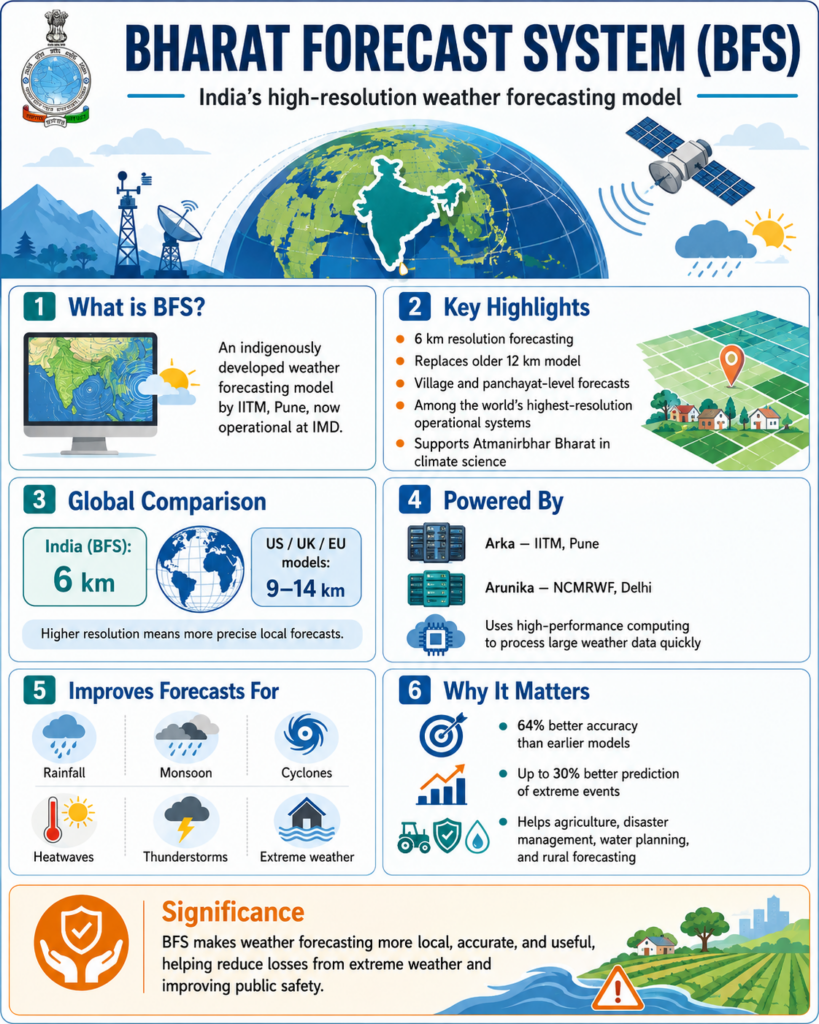
Bharat Forecast System (BFS) What is BFS?· Bharat Forecast System (BFS) is India’s new high-resolution weather forecasting model developed indigenously by the Indian Institute of Tropical Meteorology (IITM), Pune. · It is now operational at the India Meteorological Department (IMD). Key Features
Global Comparison
How BFS Works
What Can BFS Forecast?BFS can improve forecasts related to:
Accuracy of BFS
Importance of BFS for IndiaBFS is useful for many sectors:
SignificanceThe Bharat Forecast System is an important step in making weather forecasting more local, accurate and useful. It can help reduce losses from extreme weather and support better planning in agriculture, disaster management and public safety.Top of FormBottom of Form |
Key Highlights of the New Forecast System
- Block-Level Monsoon Forecast
- The new forecast system will generate forecasts at the block level. A block is an administrative unit below the district level.
- This is important because weather conditions can vary even within the same district.
- Coverage Across Several States
- The system can currently provide forecasts for 3,196 blocks across 15 States and one Union Territory.
- These regions are mainly part of the monsoon core zone, where agriculture is largely rainfed and highly dependent on the southwest monsoon.
- Four-Week Forecast Window
- The system can issue probabilistic forecasts for the next four weeks.
- This can help farmers and agriculture departments plan sowing, irrigation and other farm operations in advance.
- Blended Forecasting Models
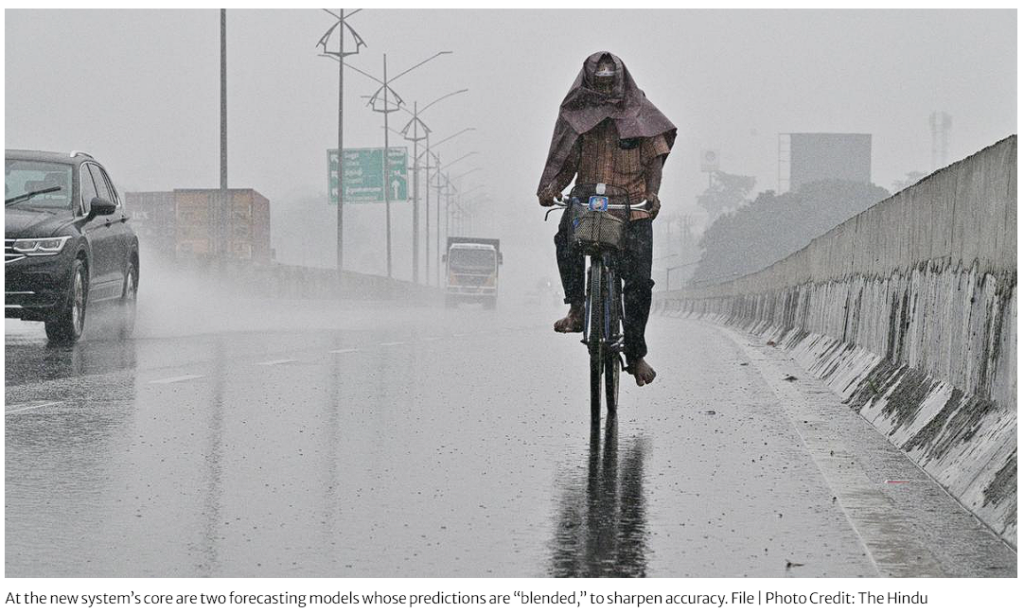
- At the core of the system are two forecasting models. Their predictions are blended to improve accuracy.
- This blending framework has been developed by the Indian Institute of Tropical Meteorology.
- Use of AI and Historical Data
- The system uses artificial intelligence, IMD’s long-term meteorological data and global weather models.
- This helps in understanding the likely movement of the monsoon in a more detailed manner.
- Support to Agriculture Advisory System
- The system was developed at the request of the Ministry of Agriculture and Farmers’ Welfare.
- It is designed to directly support the existing weekly agriculture advisory system.
- 1-km Forecast Pilot in Uttar Pradesh
- IMD has launched a special monsoon forecast model for Uttar Pradesh with 1-km resolution.
- This pilot is valid for 10 days and provides highly localised forecasts.
- It became possible due to the strong network of automatic weather stations in Uttar Pradesh.
Significance
- Helps Farmers Time Sowing
- The biggest benefit of the system is for farmers. It can help them decide the right time to sow crops.
- This is especially important in rainfed regions, where farmers depend mainly on monsoon rainfall.
- Reduces Crop Losses
- If farmers sow before sufficient rainfall, seeds may fail to germinate. This causes financial loss.
- Block-level forecasts can reduce such risks by giving more precise rainfall information.
- Supports Climate-Resilient Agriculture
- Climate change has made rainfall patterns more uncertain. Localised forecasting can help farmers adapt to changing monsoon behaviour.
- Improves Disaster Preparedness
- Accurate local forecasts can help authorities prepare for heavy rainfall, floods, heatwaves and other extreme weather events.
- This can reduce loss of life, crops, livestock and property.
- Strengthens Impact-Based Forecasting
- The new system marks a shift from general weather prediction to impact-based and decision-support forecasting.
- It provides information that can be used by farmers, administrators, disaster managers and citizens.
- Improves Water Management
- Local rainfall forecasts can help in better planning of irrigation, reservoirs, groundwater use and watershed management.
- Promotes Indigenous Technology
- The Bharat Forecast System reflects India’s progress in indigenous weather modelling and high-performance computing.
- It also supports the idea of self-reliance in climate science and disaster management.
- Useful for Local Governance
- Panchayats, district officials and agriculture extension officers can use local forecasts for planning and public advisories.
Challenges
- Need for More Observational Data
- Hyper-local forecasting requires dense and reliable local weather data.
- Many areas still need more automatic weather stations, Doppler weather radars and rainfall monitoring systems.
- Forecasting Sudden Weather Events
- Sudden thunderstorms, cloudbursts and highly localised extreme rainfall are difficult to predict accurately.
- Communication Gap
- Forecasts must reach farmers in a simple and timely manner. Technical forecasts may not be useful unless they are converted into practical advisories.
- Digital Divide
- Many farmers may not have smartphones, internet access or digital literacy. This can limit the benefits of advanced forecasting systems.
- State-Level Data Sharing
- High-resolution forecasting needs good data from States. Other States must improve and share local weather station data.
- Regional Diversity
- India has mountains, deserts, coasts, plains and plateau regions. A single model may need continuous improvement to suit different climatic regions.
Way Forward
- Expand Weather Observation Network
- India should increase the number of automatic weather stations, rainfall gauges and Doppler weather radars.
- This will improve the accuracy of local forecasts.
- Link Forecasts with Farm Advisories
- Weather forecasts should be converted into crop-specific advisories.
- Farmers should receive guidance on sowing, irrigation, fertiliser application, pest control and harvesting.
- Use Local Languages
- Forecasts should be shared in simple local languages through SMS, mobile apps, radio, television and Panchayat-level systems.
- Strengthen Krishi Vigyan Kendras
- Krishi Vigyan Kendras and agriculture extension officers should help farmers understand and use weather advisories.
- Improve Digital Access
- Rural internet connectivity and digital literacy should be improved so that farmers can access timely weather information.
- Expand 1-km Forecasting to Other States
- The Uttar Pradesh pilot should be extended to other States after strengthening local weather data networks.
- Continuous Model Improvement
- AI-based models should be regularly updated with fresh data to improve accuracy and reliability.
Conclusion
IMD’s new block-level monsoon forecast system is an important step towards precision weather forecasting in India.
The Bharat Forecast System, block-level monsoon forecasting and 1-km pilot in Uttar Pradesh can help farmers, administrators and disaster managers take better decisions.
For a monsoon-dependent country like India, accurate and localised forecasts are essential for agriculture, water management and disaster preparedness.
However, the success of the system will depend on strong data networks, simple communication, digital access and effective use of forecasts at the local level.
UPSC PYQ
Q.With reference to ‘Indian Ocean Dipole (IOD)’ sometimes mentioned in the news while forecasting Indian monsoon, which of the following statements is/are correct? (2017)
- IOD phenomenon is characterised by a difference in sea surface temperature between tropical Western Indian Ocean and tropical Eastern Pacific Ocean.
- An IOD phenomenon can influence an El Nino’s impact on the monsoon.
Select the correct answer using the code given below:
A. 1 only
B. 2 only
C. Both 1 and 2
D. Neither 1 nor 2
Answer: B
Explanation
Statement 1 is Incorrect
- The Indian Ocean Dipole (IOD) is characterised by the difference in sea surface temperature between the western tropical Indian Ocean and the eastern tropical Indian Ocean.
- It is not between the Western Indian Ocean and the Eastern Pacific Ocean.
- The Eastern Pacific Ocean is mainly linked with the El Niño–Southern Oscillation (ENSO)
Statement 2 is Correct
- The IOD can influence the impact of El Niño on the Indian monsoon.
- Normally, El Niño weakens the Indian summer monsoon and may cause deficient rainfall. However, a positive IOD can sometimes reduce or balance the negative impact of El Niño by supporting better rainfall over India.
CARE MCQ
Q.With reference to the Bharat Forecast System, consider the following statements:
- It is an indigenously developed high-resolution weather prediction model.
- It was developed by the Indian Institute of Tropical Meteorology.
- It works at a 6-km resolution.
How many of the above statements are correct?
A.Only one
B. Only two
C. All the three
D. None
Answer: C
Explanation:
- Statement 1 is correct: The Bharat Forecast System is an indigenously developed high-resolution weather prediction model.
- Statement 2 is correct: It was developed by the Indian Institute of Tropical Meteorology, Pune.
- Statement 3 is correct: It works at a 6-km resolution, which helps provide more localised forecasts.
Additional Information:
The Bharat Forecast System supports short- and medium-range forecasts and improves local-level weather prediction.
FAQs
Q.What is the Bharat Forecast System?
The Bharat Forecast System is India’s indigenously developed high-resolution weather prediction model. It works at a 6-km resolution.
Q.Why is block-level monsoon forecasting important?
It is important because rainfall may vary within the same district. Block-level forecasts help farmers make better sowing and irrigation decisions.
Q.What is the 1-km forecast pilot?
It is a highly localised rainfall forecast pilot launched for Uttar Pradesh. It can provide weather forecasts for very small areas.
Q.How does AI help in weather forecasting?
AI helps analyse large weather datasets, identify patterns and improve prediction accuracy.
Q.How can farmers benefit from this system?
Farmers can use local rainfall forecasts to plan sowing, irrigation, fertiliser application and crop protection.