Table of Contents
Relevance: UPSC GS Paper II – Education, Governance, Centre-State Relations, Welfare Schemes, Social Sector Development.
For Prelims:
PM-SHRI, Pradhan Mantri Schools for Rising India, NEP 2020, Exemplar Schools, UDISE+, School Quality Assessment Framework, Samagra Shiksha, Challenge Mode, Smart Classrooms, Atal Tinkering Labs, PARAKH, PM e-VIDYA, SWAYAM.
For Mains:
School Transformation, Cooperative Federalism, Education Reform, Learning Outcomes, Competency-Based Learning, Digital Education, Multilingualism, Centre-State Dispute, Inclusive Education, Quality Public Schooling.
Why in News?
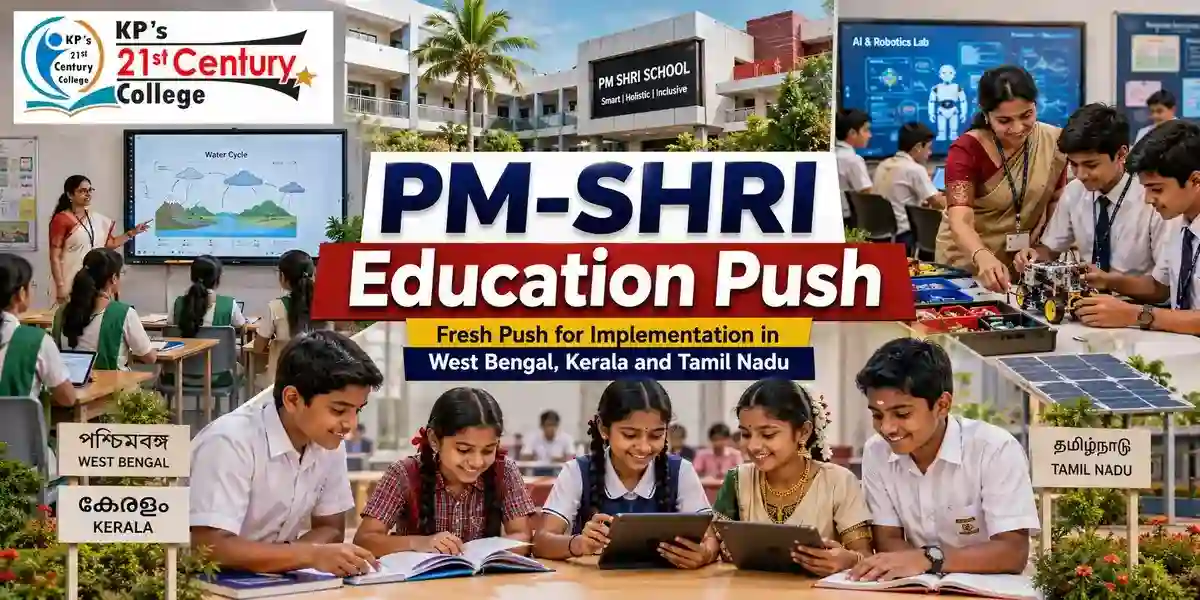
- The Union Ministry of Education issued a fresh reminder to West Bengal, Kerala and Tamil Nadu regarding pending implementation of the PM-SHRI scheme.
- The scheme aims to transform over 14,500 schools into exemplar institutions for implementing the National Education Policy, 2020.
- The Ministry stated that only limited time is left for the scheme to complete its five-year duration.
What is PM-SHRI?
- PM-SHRI stands for Pradhan Mantri Schools for Rising India.
- It was launched in 2022 as a Centrally Sponsored Scheme.
- The scheme aims to upgrade more than 14,500 existing schools into model institutions.
- These schools will showcase the implementation of NEP 2020.
- The scheme runs from 2022–23 to 2026–27.
- After the scheme period, maintenance responsibility will lie with the respective States and Union Territories.
- The scheme is designed to directly benefit more than 18 lakh students.
Funding Pattern
- The usual funding pattern is 60:40 for general States and Union Territories with legislature.
- For North-Eastern States, Himalayan States and Jammu and Kashmir, the funding pattern is 90:10.
- For Union Territories without legislature, the scheme is fully funded by the Centre.
Selection Process
- Schools are selected through a competitive Challenge Mode process.
- The process has three stages.
- First, States and Union Territories sign an MoU with the Union government.
- Second, eligible schools are identified based on minimum benchmarks using UDISE+ data.
- Third, shortlisted schools compete on specific criteria.
- Claims are verified through physical inspection.
- An expert committee makes the final selection.
- A maximum of two schools per block or urban local body may be selected.
Key Features of PM-SHRI Schools
- PM-SHRI schools aim to provide a safe, inclusive and stimulating learning environment.
- Important features include:
- Smart classrooms
- Computer labs
- Integrated science labs
- Atal Tinkering Labs
- ICT facilities
- Digital libraries
- Vocational labs
- Sports and arts for every student
- Early childhood care and education
- STEAM education
- Student registry to track enrolment and learning progress
- The scheme promotes competency-based learning and real-life application of knowledge.
- Pedagogy will be experiential, inquiry-driven, holistic, flexible and learner-centred.
- PM-SHRI schools also promote green initiatives such as:
- Water conservation
- Solar energy use
- Waste recycling
- The School Quality Assessment Framework will monitor school performance and support continuous improvement.
Status in West Bengal, Kerala and Tamil Nadu
West Bengal
- West Bengal has not signed the MoU for PM-SHRI implementation.
- The Centre has sent several reminders to the State.
- The delay has postponed the selection and development of PM-SHRI schools.
Kerala
- Kerala signed up for the scheme after a period of resistance.
- Later, the agreement was paused due to opposition from a coalition partner in the ruling government.
- The State formed a committee to examine implementation concerns.
Tamil Nadu
- Tamil Nadu had earlier given an undertaking to introduce the scheme.
- However, implementation remains incomplete.
- The Centre has sent repeated official requests to the State.
Reasons for State-Level Concerns
- West Bengal has raised concerns about funding and branding.
- Its objection is that States have to bear 40% of the cost, while the scheme carries the PM-SHRI name.
- Tamil Nadu has concerns over the three-language formula under NEP 2020.
- The State sees it as linked to possible Hindi imposition.
- Kerala has raised ideological concerns over NEP 2020 and its implementation through PM-SHRI.
- Some States also object to the requirement that selected schools must carry the PM-SHRI prefix.
Link with Samagra Shiksha Funding
- PM-SHRI implementation has become linked with the release of funds under Samagra Shiksha.
- Samagra Shiksha is an integrated school education scheme covering pre-school to Class XII.
- It combines earlier schemes such as:
- Sarva Shiksha Abhiyan
- Rashtriya Madhyamik Shiksha Abhiyan
- Teacher Education
- Delays in MoU signing have created tensions between the Centre and some States over school education funding.
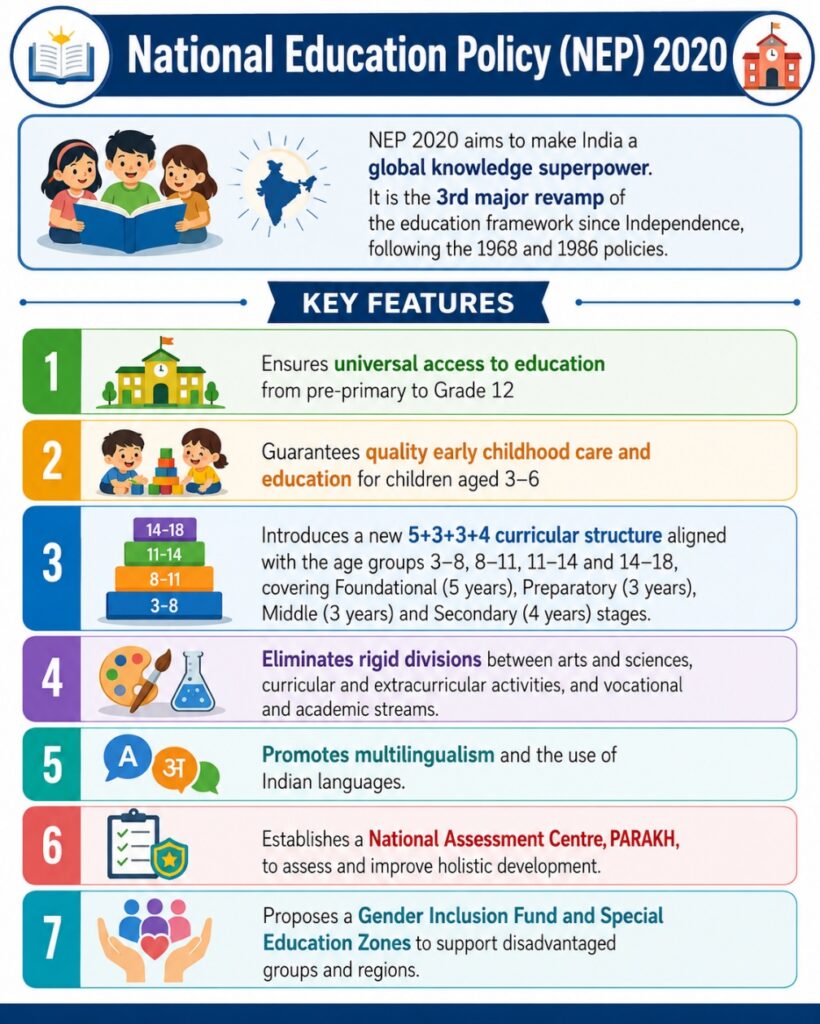
Other Education Initiatives National Education Policy 2020
Samagra Shiksha
Mid-Day MealScheme
Beti Bachao Beti Padhao
PM e-VIDYA
SWAYAM
|
Significance
- PM-SHRI can improve the quality of public school education.
- It can create model schools for wider education reform.
- It supports implementation of NEP 2020 at the school level.
- It promotes digital learning, vocational education and competency-based learning.
- It supports green practices and modern infrastructure in schools.
- It can improve learning outcomes through continuous assessment.
- It highlights the need for Centre-State cooperation in education.
Challenges
- Political differences may delay implementation.
- NEP-linked conditions may create resistance in some States.
- Branding and cost-sharing issues may create federal tensions.
- Delays in signing MoUs reduce the effective implementation period.
- Students may lose intended benefits due to administrative delays.
- Linking Samagra Shiksha funding with PM-SHRI may create governance disputes.
- Different States may have different language, curriculum and education-policy priorities.
Way Forward
- Centre and States should resolve concerns through dialogue.
- Student welfare and learning outcomes must remain the main priority.
- States’ concerns on language, curriculum and branding should be addressed.
- The scheme should allow space for State Curriculum Frameworks within broad NEP goals.
- Fund release should be transparent and predictable.
- PM-SHRI schools should become genuine model schools, not merely renamed institutions.
- Monitoring should focus on learning outcomes, inclusion, infrastructure and school quality.
Conclusion
PM-SHRI is an important school transformation scheme aimed at creating exemplar institutions for NEP 2020 implementation. It can improve public school quality through smart infrastructure, competency-based learning, digital tools and green initiatives.
However, the delay in West Bengal, Kerala and Tamil Nadu shows that education reform needs cooperative federalism. The scheme can succeed only if Centre-State differences are resolved through flexibility, dialogue and a student-centred approach
UPSC PYQ
Q.Consider the following statements concerning the National Education Policy, 2020: (CDS-I/2023)
- At least 50 percent of the learners through the school and higher education system should get exposure to vocational education by 2025.
- Secondary schools should collaborate with ITIs, Polytechnics and local industries.
- Vocational education should be exclusively provided by NGOs.
Which of the statements given above is/are correct?
A. 1 only
B. 1 and 2 only
C. 2 and 3 only
D. 1, 2 and 3
Answer: B. 1 and 2 only
Explanation:
Statement 1 is correct.
The National Education Policy, 2020 aims to expose at least 50% of learners in school and higher education to vocational education by 2025. This is intended to reduce the social status hierarchy attached to vocational learning.
Statement 2 is correct.
NEP 2020 encourages secondary schools to collaborate with Industrial Training Institutes, Polytechnics and local industries. This helps students gain practical skills and real-life work exposure.
Statement 3 is incorrect.
Vocational education is not exclusively provided by NGOs. NEP 2020 seeks to integrate vocational education into the mainstream curriculum through schools, colleges, ITIs, polytechnics, industries and other stakeholders.
CARE MCQ
Q.With reference to the PM-SHRI scheme, consider the following statements:
- It was launched in 2022.
- It aims to upgrade more than 14,500 existing schools.
- It is linked with implementation of NEP 2020.
Which of the above statements are correct?
A. 1 and 2 only
B. 2 and 3 only
C. 1 and 3 only
D. 1, 2 and 3
Answer: D
Explanation:
- Statement 1 is correct: PM-SHRI was launched in 2022.
- Statement 2 is correct: It aims to upgrade more than 14,500 schools.
- Statement 3 is correct: These schools are expected to showcase NEP 2020 implementation
FAQs
1.What is PM-SHRI?
PM-SHRI stands for Pradhan Mantri Schools for Rising India. It is a Centrally Sponsored Scheme launched to upgrade existing schools into model institutions that showcase the implementation of NEP 2020.
2.When was PM-SHRI launched?
PM-SHRI was launched in 2022.
3.What is the main objective of PM-SHRI?
The main objective is to transform more than 14,500 existing schools into exemplar institutions with better infrastructure, learning methods and student outcomes.
4.What is the duration of the scheme?
The scheme runs from 2022–23 to 2026–27. After this period, maintenance responsibility will lie with the respective States and Union Territories.
5.What is the funding pattern of PM-SHRI?
The funding pattern is 60:40 for general States and UTs with legislature, 90:10 for North-Eastern and Himalayan States and Jammu & Kashmir, and 100% Central funding for UTs without legislature.