Table of Contents
Relevance: UPSC GS Paper III: Science and Technology, Agriculture, Disaster Management, Climate Change
For Prelims:
- IMD, Ministry of Earth Sciences, Bharat Forecast System, Indian Institute of Tropical Meteorology, National Centre for Medium Range Weather Forecasting, Block-Level Forecast, Hyper-Local Forecast, 1-km Resolution Forecast, 6-km Resolution Forecast, Artificial Intelligence, Arka, Arunika, Monsoon Core Zone, Automatic Weather Stations, Southwest Monsoon, Weather Forecasting Model,
For Mains:
Climate-Resilient Agriculture, Impact-Based Forecasting, Decision-Support System, Monsoon Variability, Disaster Risk Reduction, Rainfed Agriculture, Agricultural Advisory Services, Digital Public Infrastructure for Agriculture, Localised Climate Adaptation, Farmer-Centric Forecasting, Precision Weather Services, Sowing Decision Support, Extreme Weather Preparedness, Climate-Smart Governance, Rural Livelihood Security
Why in News?
- The India Meteorological Department has unveiled a new weather forecast system to provide block-level forecasts of the monsoon’s journey.
- This is a major step towards hyper-local weather forecasting in India. The system will help farmers know the likely arrival and progress of the monsoon at a smaller administrative level.
- The main objective is to help farmers decide the correct time for sowing, especially in rainfed regions.
- IMD also launched a 1-km resolution forecast pilot for Uttar Pradesh, which can provide highly localised weather forecasts up to 10 days in advance.
Background
- The southwest monsoon is very important for India’s agriculture, water resources and rural economy. A large part of Indian agriculture still depends on rainfall.
- Earlier, monsoon arrival estimates were mostly available at the level of States or districts. For example, the monsoon usually reaches Mumbai around June 10 and Delhi around June 29.
- However, rainfall is not uniform everywhere. Even within the same district, some blocks or villages may receive rainfall, while others may remain dry.
- This creates difficulty for farmers. If farmers sow seeds just because the monsoon has officially reached the district, but their local area does not receive enough rainfall, they may suffer seed loss and crop damage.
- Therefore, IMD has been working to provide more localised and farmer-friendly forecasts.
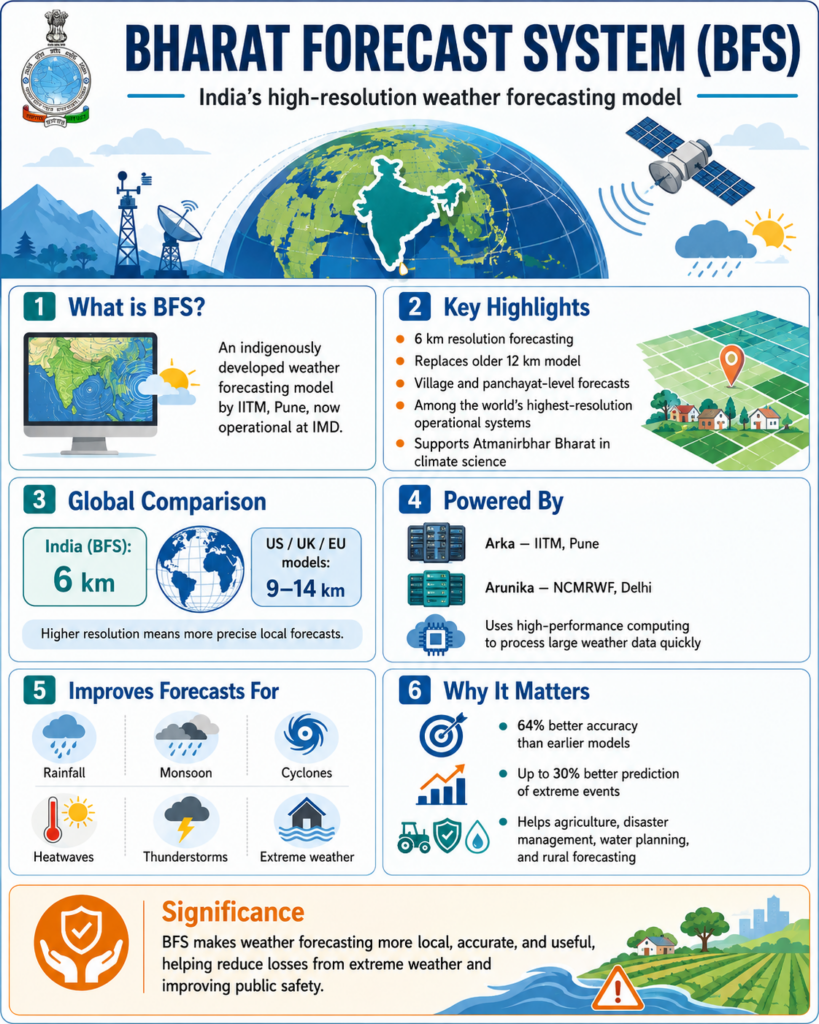
Bharat Forecast System (BFS) What is BFS?· Bharat Forecast System (BFS) is India’s new high-resolution weather forecasting model developed indigenously by the Indian Institute of Tropical Meteorology (IITM), Pune. · It is now operational at the India Meteorological Department (IMD). Key Features
Global Comparison
How BFS Works
What Can BFS Forecast?BFS can improve forecasts related to:
Accuracy of BFS
Importance of BFS for IndiaBFS is useful for many sectors:
SignificanceThe Bharat Forecast System is an important step in making weather forecasting more local, accurate and useful. It can help reduce losses from extreme weather and support better planning in agriculture, disaster management and public safety.Top of FormBottom of Form |
Key Highlights of the New Forecast System
- Block-Level Monsoon Forecast
- The new forecast system will generate forecasts at the block level. A block is an administrative unit below the district level.
- This is important because weather conditions can vary even within the same district.
- Coverage Across Several States
- The system can currently provide forecasts for 3,196 blocks across 15 States and one Union Territory.
- These regions are mainly part of the monsoon core zone, where agriculture is largely rainfed and highly dependent on the southwest monsoon.
- Four-Week Forecast Window
- The system can issue probabilistic forecasts for the next four weeks.
- This can help farmers and agriculture departments plan sowing, irrigation and other farm operations in advance.
- Blended Forecasting Models
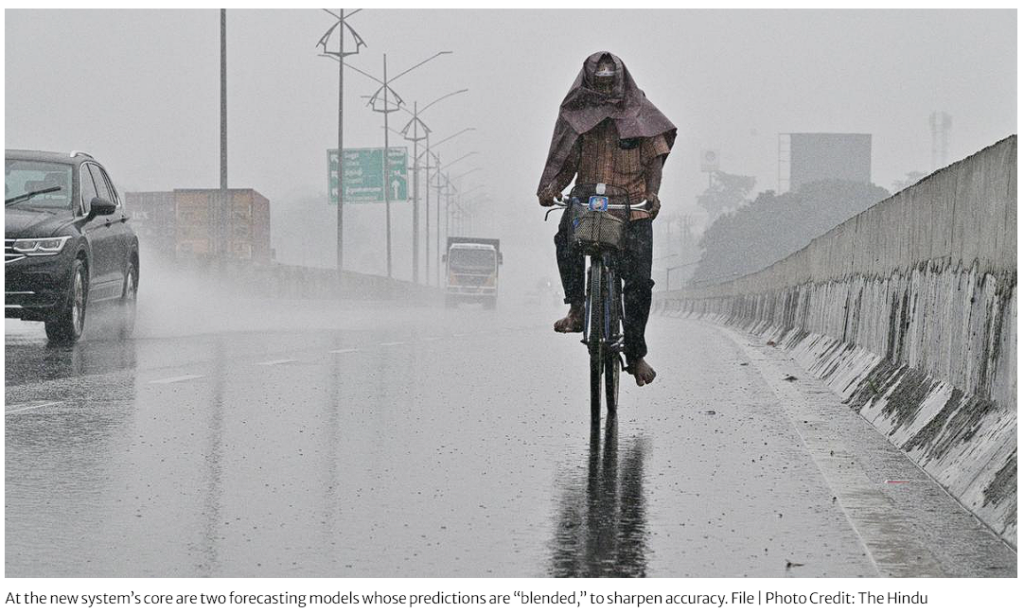
- At the core of the system are two forecasting models. Their predictions are blended to improve accuracy.
- This blending framework has been developed by the Indian Institute of Tropical Meteorology.
- Use of AI and Historical Data
- The system uses artificial intelligence, IMD’s long-term meteorological data and global weather models.
- This helps in understanding the likely movement of the monsoon in a more detailed manner.
- Support to Agriculture Advisory System
- The system was developed at the request of the Ministry of Agriculture and Farmers’ Welfare.
- It is designed to directly support the existing weekly agriculture advisory system.
- 1-km Forecast Pilot in Uttar Pradesh
- IMD has launched a special monsoon forecast model for Uttar Pradesh with 1-km resolution.
- This pilot is valid for 10 days and provides highly localised forecasts.
- It became possible due to the strong network of automatic weather stations in Uttar Pradesh.
Significance
- Helps Farmers Time Sowing
- The biggest benefit of the system is for farmers. It can help them decide the right time to sow crops.
- This is especially important in rainfed regions, where farmers depend mainly on monsoon rainfall.
- Reduces Crop Losses
- If farmers sow before sufficient rainfall, seeds may fail to germinate. This causes financial loss.
- Block-level forecasts can reduce such risks by giving more precise rainfall information.
- Supports Climate-Resilient Agriculture
- Climate change has made rainfall patterns more uncertain. Localised forecasting can help farmers adapt to changing monsoon behaviour.
- Improves Disaster Preparedness
- Accurate local forecasts can help authorities prepare for heavy rainfall, floods, heatwaves and other extreme weather events.
- This can reduce loss of life, crops, livestock and property.
- Strengthens Impact-Based Forecasting
- The new system marks a shift from general weather prediction to impact-based and decision-support forecasting.
- It provides information that can be used by farmers, administrators, disaster managers and citizens.
- Improves Water Management
- Local rainfall forecasts can help in better planning of irrigation, reservoirs, groundwater use and watershed management.
- Promotes Indigenous Technology
- The Bharat Forecast System reflects India’s progress in indigenous weather modelling and high-performance computing.
- It also supports the idea of self-reliance in climate science and disaster management.
- Useful for Local Governance
- Panchayats, district officials and agriculture extension officers can use local forecasts for planning and public advisories.
Challenges
- Need for More Observational Data
- Hyper-local forecasting requires dense and reliable local weather data.
- Many areas still need more automatic weather stations, Doppler weather radars and rainfall monitoring systems.
- Forecasting Sudden Weather Events
- Sudden thunderstorms, cloudbursts and highly localised extreme rainfall are difficult to predict accurately.
- Communication Gap
- Forecasts must reach farmers in a simple and timely manner. Technical forecasts may not be useful unless they are converted into practical advisories.
- Digital Divide
- Many farmers may not have smartphones, internet access or digital literacy. This can limit the benefits of advanced forecasting systems.
- State-Level Data Sharing
- High-resolution forecasting needs good data from States. Other States must improve and share local weather station data.
- Regional Diversity
- India has mountains, deserts, coasts, plains and plateau regions. A single model may need continuous improvement to suit different climatic regions.
Way Forward
- Expand Weather Observation Network
- India should increase the number of automatic weather stations, rainfall gauges and Doppler weather radars.
- This will improve the accuracy of local forecasts.
- Link Forecasts with Farm Advisories
- Weather forecasts should be converted into crop-specific advisories.
- Farmers should receive guidance on sowing, irrigation, fertiliser application, pest control and harvesting.
- Use Local Languages
- Forecasts should be shared in simple local languages through SMS, mobile apps, radio, television and Panchayat-level systems.
- Strengthen Krishi Vigyan Kendras
- Krishi Vigyan Kendras and agriculture extension officers should help farmers understand and use weather advisories.
- Improve Digital Access
- Rural internet connectivity and digital literacy should be improved so that farmers can access timely weather information.
- Expand 1-km Forecasting to Other States
- The Uttar Pradesh pilot should be extended to other States after strengthening local weather data networks.
- Continuous Model Improvement
- AI-based models should be regularly updated with fresh data to improve accuracy and reliability.
Conclusion
IMD’s new block-level monsoon forecast system is an important step towards precision weather forecasting in India.
The Bharat Forecast System, block-level monsoon forecasting and 1-km pilot in Uttar Pradesh can help farmers, administrators and disaster managers take better decisions.
For a monsoon-dependent country like India, accurate and localised forecasts are essential for agriculture, water management and disaster preparedness.
However, the success of the system will depend on strong data networks, simple communication, digital access and effective use of forecasts at the local level.
UPSC PYQ
Q.With reference to ‘Indian Ocean Dipole (IOD)’ sometimes mentioned in the news while forecasting Indian monsoon, which of the following statements is/are correct? (2017)
- IOD phenomenon is characterised by a difference in sea surface temperature between tropical Western Indian Ocean and tropical Eastern Pacific Ocean.
- An IOD phenomenon can influence an El Nino’s impact on the monsoon.
Select the correct answer using the code given below:
A. 1 only
B. 2 only
C. Both 1 and 2
D. Neither 1 nor 2
Answer: B
Explanation
Statement 1 is Incorrect
- The Indian Ocean Dipole (IOD) is characterised by the difference in sea surface temperature between the western tropical Indian Ocean and the eastern tropical Indian Ocean.
- It is not between the Western Indian Ocean and the Eastern Pacific Ocean.
- The Eastern Pacific Ocean is mainly linked with the El Niño–Southern Oscillation (ENSO)
Statement 2 is Correct
- The IOD can influence the impact of El Niño on the Indian monsoon.
- Normally, El Niño weakens the Indian summer monsoon and may cause deficient rainfall. However, a positive IOD can sometimes reduce or balance the negative impact of El Niño by supporting better rainfall over India.
CARE MCQ
Q.With reference to the Bharat Forecast System, consider the following statements:
- It is an indigenously developed high-resolution weather prediction model.
- It was developed by the Indian Institute of Tropical Meteorology.
- It works at a 6-km resolution.
How many of the above statements are correct?
A.Only one
B. Only two
C. All the three
D. None
Answer: C
Explanation:
- Statement 1 is correct: The Bharat Forecast System is an indigenously developed high-resolution weather prediction model.
- Statement 2 is correct: It was developed by the Indian Institute of Tropical Meteorology, Pune.
- Statement 3 is correct: It works at a 6-km resolution, which helps provide more localised forecasts.
Additional Information:
The Bharat Forecast System supports short- and medium-range forecasts and improves local-level weather prediction.
FAQs
Q.What is the Bharat Forecast System?
The Bharat Forecast System is India’s indigenously developed high-resolution weather prediction model. It works at a 6-km resolution.
Q.Why is block-level monsoon forecasting important?
It is important because rainfall may vary within the same district. Block-level forecasts help farmers make better sowing and irrigation decisions.
Q.What is the 1-km forecast pilot?
It is a highly localised rainfall forecast pilot launched for Uttar Pradesh. It can provide weather forecasts for very small areas.
Q.How does AI help in weather forecasting?
AI helps analyse large weather datasets, identify patterns and improve prediction accuracy.
Q.How can farmers benefit from this system?
Farmers can use local rainfall forecasts to plan sowing, irrigation, fertiliser application and crop protection.