Why in News?
The Mission for Elimination of Poverty in Municipal Areas (MEPMA) of Andhra Pradesh signed a Memorandum of Understanding with Mobile Crèches to establish childcare centres in four major cities.
The crèche centres will be set up in:
- Vijayawada
- Visakhapatnam
- Tirupati
- Guntur
The initiative aims to provide quality childcare for the children of urban women self-help group members and enable women to pursue employment and entrepreneurial activities.

What is the Urban Crèche Initiative?
The programme proposes the establishment of 15 crèche centres for children between six months and six years of age.
The centres are expected to benefit around 375 children.
They will provide:
- Daycare and supervision
- Nutrition support
- Basic health services
- Early childhood education
- Safe learning and play spaces
- Age-appropriate care
The programme is aligned with the State’s long-term development vision, Swarna Andhra@2047.
Institutional Arrangement
The initiative is based on a partnership between MEPMA and Mobile Crèches.
- MEPMA: It will function as the implementing agency and coordinate the programme at the urban local level.
- Mobile Crèches: It will provide technical support, training, caregiving models and institutional guidance.
This model combines government implementation capacity with the technical experience of a specialised childcare organisation.
What is MEPMA?
The Mission for Elimination of Poverty in Municipal Areas functions under the Andhra Pradesh Municipal Administration Department.
It works towards:
- Urban poverty reduction
- Organisation of urban poor women into self-help groups
- Livelihood promotion
- Skill development
- Financial inclusion
- Access to welfare schemes
- Community-level institution building
The crèche initiative expands MEPMA’s role from livelihood promotion to supporting the care needs of working women.
Why are Urban Crèche Centres Necessary?
Women’s employment:
- Lack of affordable childcare often prevents women from entering or continuing in paid work. Crèches allow mothers to pursue jobs, self-employment and entrepreneurship without compromising child safety.
Early childhood development:
- The period from birth to six years is crucial for physical growth, cognitive development, emotional well-being and school readiness.
Nutrition and health:
- Crèche centres can support regular nutrition, health monitoring and timely referral to public health institutions.
Urban vulnerability:
- Women in informal employment may lack maternity benefits, flexible work arrangements and access to organised childcare.
Reduction in sibling care:
- In many low-income households, adolescent girls are asked to care for younger siblings. Community crèches can reduce this burden and help girls continue their education.
Capacity-Building Measures
During the 2026–27 financial year, the programme proposes to:
- Train 45 women from self-help groups as crèche workers.
- Certify 15 master trainers.
- Develop Telugu-language caregiving materials.
- Establish a dedicated Management Information System.
- Improve monitoring and accountability.
Training SHG women as crèche workers can generate local employment while creating a community-owned childcare system.
Role of the Management Information System
The proposed Management Information System will assist in:
- Child enrolment and attendance tracking
- Nutrition and health monitoring
- Staff and training records
- Service-quality assessment
- Reporting and programme evaluation
- Identification of gaps in implementation
A digital monitoring system can improve transparency and support evidence-based programme expansion.
Convergence with Existing Health and Childcare Services
The programme will promote coordination with existing public schemes and institutions.
Integrated Child Development Services:
ICDS provides supplementary nutrition, health check-ups, preschool education and referral services through Anganwadi Centres.
Primary Health Centres:
PHCs can support immunisation, medical examination, treatment and referral of children requiring specialised care.
Rashtriya Bal Swasthya Karyakram:
RBSK focuses on early identification and intervention for children affected by the four Ds:
- Defects at birth
- Diseases
- Deficiencies
- Developmental delays, including disabilities
Institutional convergence can prevent duplication and improve the overall quality of childcare.
Significance of the Initiative
Promotes women’s workforce participation:
Reliable childcare can help urban women take up employment and entrepreneurial activities.
Strengthens the care economy:
The programme formally recognises childcare as essential social infrastructure supporting economic participation.
Improves child nutrition:
Regular meals and nutrition monitoring can reduce the risk of undernutrition among young children.
Supports early learning:
Age-appropriate education and play can improve school readiness and cognitive development.
Creates local employment:
Training SHG members as childcare workers provides livelihood opportunities within local communities.
Advances gender equality:
The programme reduces the disproportionate unpaid care burden carried by women and adolescent girls.
Develops a replicable model:
The four-city initiative can serve as a model for expansion across other urban areas of Andhra Pradesh.
Conclusion
The MEPMA–Mobile Crèches initiative recognises childcare as an essential component of women’s economic empowerment and urban social development. By integrating childcare, nutrition, health and early education, the programme can improve the well-being of children while enabling women to participate more fully in employment and entrepreneurship. Strong quality standards, institutional convergence and community ownership will be necessary to transform the pilot into a sustainable urban childcare model across Andhra Pradesh.
Why in News?
The developmental transformation of India’s North-Eastern Region between 2014 and 2026 has gained attention due to major improvements in connectivity, infrastructure, clean energy, agriculture and social services.
The eight States, collectively described as Ashtalakshmi, are increasingly positioned as a key pillar of India’s Act East Policy and the vision of Viksit Bharat.
Why is the North-East Called Ashtalakshmi?
In Indian tradition, Goddess Lakshmi has eight forms representing different sources of prosperity. Similarly, each of the eight Northeastern States possesses distinctive strengths.
The region’s importance arises from its:
- Strategic location
- Cultural diversity
- Rich biodiversity
- Agricultural potential
- Forest-based resources
- Hydropower potential
- Tourism assets
- Connectivity with Southeast Asia
Together, these qualities make the North-East an important source of India’s prosperity, security and regional integration.
How is the Act East Policy Integrating the Region?
The Act East Policy places the North-East at the centre of India’s economic and strategic engagement with ASEAN countries.
Cross-Border Corridors
- India–Myanmar–Thailand Trilateral Highway: Connects Moreh in Manipur with Mae Sot in Thailand through Myanmar.
- Kaladan Multi-Modal Transit Transport Project: Links Sittwe Port with Paletwa through inland waterways and strengthens access between the North-East and Myanmar.
These corridors seek to reduce travel time and logistics costs while improving the movement of people and goods.
Border Trade Infrastructure
- Integrated Check Posts: Facilities such as Moreh improve customs, immigration and cargo handling.
- Border Haats: Markets such as Kamalasagar and Bholaganj promote local trade, livelihoods and people-to-people relations.
Thus, the policy seeks to transform the region from a frontier into a bridge connecting India with Southeast Asia.
What Policy Architecture Supports Development?
PM-DevINE
The Prime Minister’s Development Initiative for North East Region is a fully centrally funded scheme supporting high-impact projects in infrastructure, livelihoods and social development.
NESIDS
The North East Special Infrastructure Development Scheme supports:
- Roads and bridges
- Remote-area connectivity
- Healthcare
- Education
- Power
- Water supply
- Strategic infrastructure
North Eastern Council
The North Eastern Council is the nodal body for the region’s economic and social development. Its focus areas include:
- Bamboo and piggery-based livelihoods
- Tourism
- Healthcare
- Higher education
- Irrigation
- Flood control
- Science and technology
Special Development Packages
Packages for Assam and Tripura focus on employment, skills, entrepreneurship, tourism, social inclusion and peace-building.
This policy framework reflects a shift from general assistance to mission-oriented and region-specific development.
How Has Connectivity Reduced Regional Isolation?
Roads and Highways
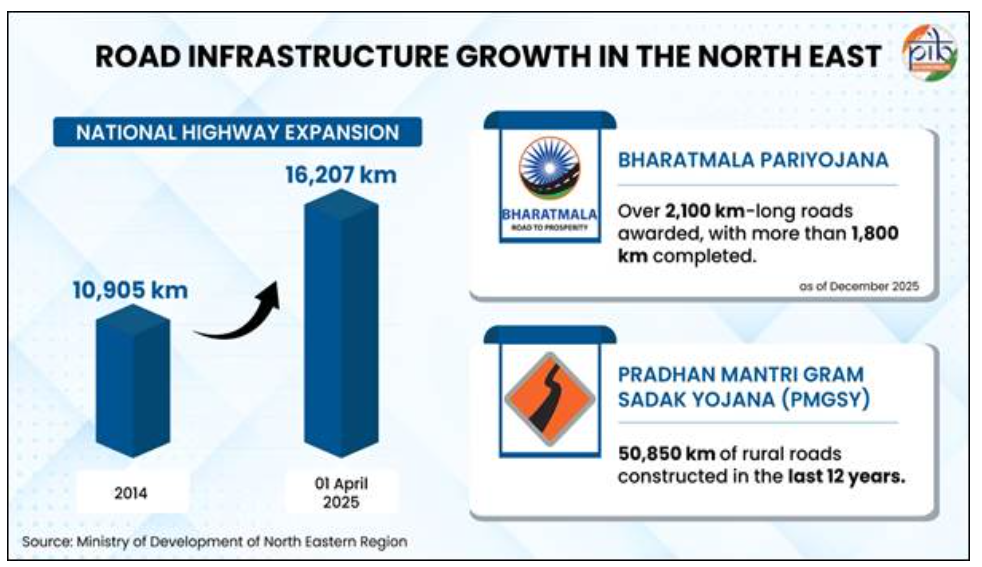
Expansion of National Highways, Bharatmala corridors and rural roads under PMGSY has improved interstate mobility and last-mile access.
Railways
Broad-gauge expansion, electrification and modern train services are integrating hill States with the national railway network.
Major Engineering Projects
- Bogibeel Bridge: Road–rail connectivity across the Brahmaputra.
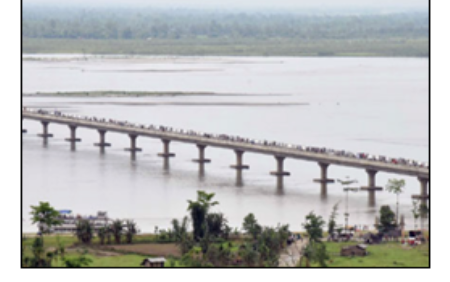
- Bhupen Hazarika Setu: Permanent road connection between northern Assam and eastern Arunachal Pradesh.
- Noney Bridge: A major railway bridge in Manipur.
- Sela Tunnel: All-weather strategic connectivity on the Tezpur–Tawang route.
Air Connectivity
The UDAN scheme has expanded airports and regional routes, reducing travel time for remote communities.
Inland Waterways
The Brahmaputra and Barak rivers are being developed for cargo movement and river tourism through National Waterways.
Digital Connectivity
BharatNet, mobile towers and high-speed internet services are improving access to digital governance, education and economic opportunities.
How is Green Energy Supporting Growth?
Hydropower
Projects such as the Dibang Multipurpose Project and Subansiri Lower Project seek to harness the region’s river systems for renewable electricity and flood management.
North-East Gas Grid
The integrated gas-pipeline network aims to connect all eight States with the national gas grid.
A major engineering milestone is the natural-gas pipeline crossing beneath the Brahmaputra through Horizontal Directional Drilling.
Solar and Decentralised Energy
The region is witnessing expansion of:
- Solar parks
- Rooftop solar
- PM-KUSUM solar pumps
- Mini-grids
- Standalone energy systems
- Green-hydrogen initiatives
These measures can improve energy reliability while reducing dependence on diesel-based power.
How Have Basic Services and Human Development Improved?
Water and Sanitation
The Jal Jeevan Mission has expanded rural tap-water coverage, while all eight States have been declared Open Defecation Free.
Swachh Bharat Mission Phase II now focuses on:
- Solid and liquid waste management
- Plastic-waste management
- Faecal-sludge treatment
- ODF Plus villages
Women’s self-help groups are also participating in village-level waste management.
Healthcare
Major improvements include:
- AIIMS Guwahati
- New medical colleges
- Ayushman Bharat coverage
- Health and Wellness Centres
- eSanjeevani telemedicine
- Jan Aushadhi Kendras
These initiatives have improved access to specialised, primary and affordable healthcare.
Education and Skills
The expansion of universities, colleges, technical institutes, Eklavya Model Residential Schools and Atal Tinkering Labs is strengthening education and innovation.
Apprenticeship and skill-development programmes are also improving employability.
Housing and Electricity
PMAY has expanded pucca housing in rural and urban areas. Beneficiaries are linked with toilets, tap water, LPG and electricity.
All eight States have achieved household electrification under Saubhagya.
How are Agriculture and Rural Livelihoods Diversifying?
Fisheries
Inland fisheries have recorded strong growth, led by Assam. Support includes Kisan Credit Cards, Fish Farmer Producer Organisations and ornamental fisheries.
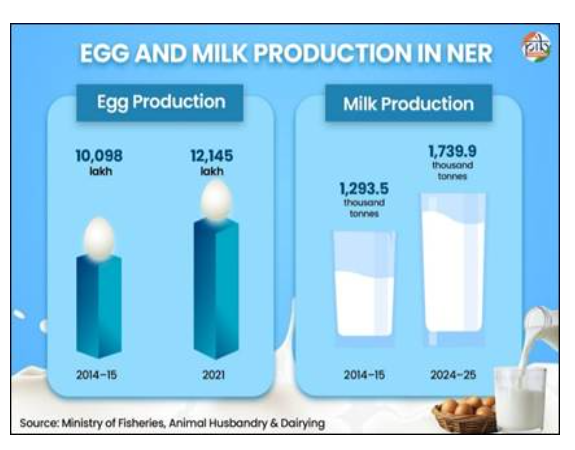
Dairy and Livestock
The establishment of the region’s first cattle IVF laboratory in Guwahati supports improved livestock genetics and dairy productivity.
Agarwood Economy
The North-East contains most of India’s agarwood trees. Tripura has significant potential for agarwood cultivation, processing and exports.
Organic Farming
The Mission Organic Value Chain Development for North Eastern Region promotes:
- Organic cultivation
- Farmer Producer Organisations
- Processing
- Collective marketing
- Market linkages
Forest-Based Livelihoods
The Van Dhan Vikas Yojana supports tribal gatherers and self-help groups engaged in forest produce.
GI Tags and Value Addition
Products such as:
- Queen Pineapple
- Lakadong Turmeric
- King Chilli
- Large Cardamom
reflect the region’s unique agro-biodiversity and export potential.
NERAMAC supports FPOs, product marketing, skill development and cold-storage infrastructure.
What Challenges Remain?
- Difficult terrain and high logistics costs
- Delays in cross-border projects
- Uneven development among States
- Ecological fragility and disaster vulnerability
- Limited processing and market access
- Need for maintenance of new infrastructure
- Shortage of skilled employment
- Border-security concerns
- Need to protect local communities and biodiversity
- Balancing large energy projects with environmental sustainability
Way Forward
Complete Multimodal Connectivity
Road, rail, air, waterway and digital networks should be integrated to reduce logistics costs.
Accelerate Cross-Border Projects
The Trilateral Highway, Kaladan project, Integrated Check Posts and Border Haats require timely completion.
Promote State-Specific Value Chains
Agricultural and cultural strengths should be developed through processing, branding and export-oriented marketing.
Strengthen Human Capital
Healthcare, higher education, technical training and apprenticeships must support future growth.
Ensure Ecological Balance
Infrastructure and energy projects should respect forests, river systems, biodiversity and local communities.
Empower Local Institutions
Women’s SHGs, tribal communities, FPOs and local bodies should participate in planning and implementation.
Improve Last-Mile Delivery
Infrastructure creation must be supported by reliable services, maintenance and institutional accountability.
Conclusion
The transformation of the North-East reflects a shift from geographical isolation and a security-centred approach towards connectivity, strategic integration and inclusive development.
Targeted schemes, multimodal infrastructure, clean energy and livelihood diversification have positioned Ashtalakshmi as an important growth region and India’s gateway to Southeast Asia. Sustaining this progress will require ecological sensitivity, stronger local enterprise and effective last-mile implementation.
Why in News?
India is increasingly moving from being a large consumer of digital technologies to becoming a global centre for technology creation, innovation and deployment.
Mission-mode programmes in Artificial Intelligence, semiconductors, quantum technologies, supercomputing, cloud computing, blockchain and biotechnology are strengthening India’s technological capability. These initiatives are also supporting the broader vision of Viksit Bharat 2047.
What is Driving India’s Technology Transformation?
India’s emerging technology ecosystem rests on three interconnected pillars:
- National capacity: Expansion of digital infrastructure, data centres, cloud systems, research institutions and high-performance computing.
- Technological capability: Development of indigenous solutions in AI, chip design, quantum communication, blockchain and biotechnology.
- Global credibility: Promotion of trusted Digital Public Infrastructure, responsible technology governance and international partnerships.
The transformation has been enabled by sustained public investment, startup growth, industry-academia collaboration and large-scale skilling programmes.
Digital India: Foundation of the Technology Ecosystem
The Digital India Programme, launched in 2015, created the basic infrastructure required for emerging technologies.
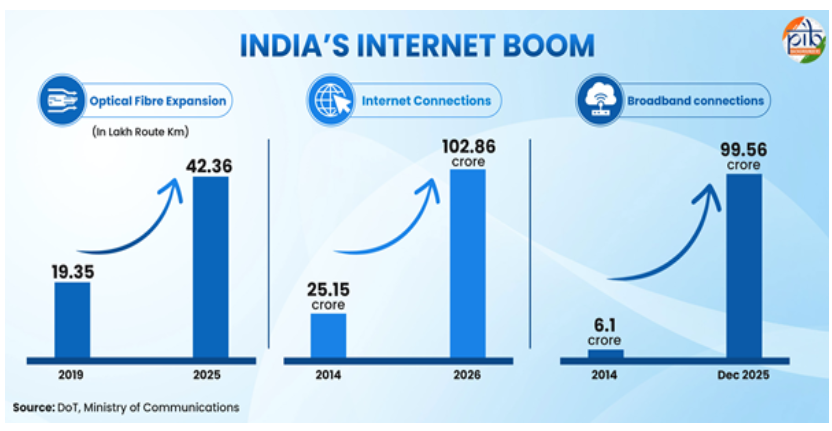
- Connectivity expansion: Optical fibre coverage increased from 19.35 lakh route km in 2019 to 42.36 lakh route km in 2025.
- Internet access: Connections increased from 25.15 crore in 2014 to 102.86 crore in 2026.
- Broadband growth: Broadband connections rose from 6.1 crore to 99.56 crore.
- 5G rollout: Services reached 99.9% of districts.
- Affordability: Average data cost fell from around ₹269 per GB to ₹8–10 per GB.
- Usage: Monthly data consumption increased from 61.66 MB to 24.01 GB per user.
Affordable connectivity enabled the growth of digital payments, cloud services, telemedicine, online education, e-governance and startups.
Major Emerging Technology Initiatives
1. Artificial Intelligence
The IndiaAI Mission, approved in 2024 with an outlay of over ₹10,300 crore, aims to create a nationally accessible AI ecosystem.
Its major components include:
- Indigenous AI computing infrastructure
- Access to advanced GPUs
- AI datasets and models
- Startup support
- Research and innovation
- AI skilling
- Safe and responsible AI
A common computing facility with more than 38,000 GPUs is being developed. The AI Kosh platform hosts 12,115 datasets and 306 AI models across 20 sectors.
Four AI Centres of Excellence focus on:
- Education
- Healthcare
- Sustainable cities
- Agriculture
These centres are developing practical solutions such as disease detection, traffic forecasting, flood prediction and climate-smart farming.
2. Semiconductor Ecosystem
Semiconductors are essential for electronics, defence, telecommunications, AI, cloud systems and advanced manufacturing.
The Semicon India Programme, launched in 2021 with an outlay of ₹76,000 crore, supports:
- Semiconductor fabrication
- Display manufacturing
- Chip design
- Packaging and testing
- Research
- Talent development
As of June 2026, 12 projects worth around ₹1.64 lakh crore had been approved, including one semiconductor fabrication unit, two compound semiconductor fabs and nine packaging units.
The Design Linked Incentive Scheme supports domestic chip design companies, startups, MSMEs and academic institutions.
The India Semiconductor Mission 2.0 focuses on semiconductor equipment, materials, indigenous intellectual property and resilient supply chains.
3. Quantum Technologies
The National Quantum Mission, approved in 2023 with an outlay of ₹6,003.65 crore, focuses on:
- Quantum computing
- Quantum communication
- Quantum sensing and metrology
- Quantum materials and devices
- The mission has established four thematic hubs, supported 17 startups and engaged more than 152 researchers across 43 organisations.
- India also demonstrated a 1,000-km secure quantum communication network.
- The foundation stone for India’s first Quantum Valley was laid in Amaravati in February 2026.
- Quantum technologies have applications in national security, finance, healthcare, logistics and climate modelling.
4. Supercomputing
The National Supercomputing Mission, launched in 2015 with an outlay of ₹4,500 crore, aims to strengthen India’s high-performance computing capacity.
India has deployed:
- 38 supercomputers
- Combined computing power of 47 petaflops
- Indigenous PARAM Rudra systems
Supercomputers support weather forecasting, climate research, AI, drug discovery and advanced scientific modelling.
5. Cloud Computing
- The government cloud platform MeghRaj, launched in 2014, provides secure and scalable computing infrastructure for public institutions.
MeghRaj 2.0 strengthened:
- Hybrid cloud architecture
- Cybersecurity
- Data control
- Service scalability
- Its adoption increased from 342 government departments in 2015–16 to 2,323 departments by June 2026.
- It supports major platforms such as DigiLocker, MyGov and the National Scholarship Portal.
6. Blockchain
The National Blockchain Framework, initiated in 2021, seeks to create a secure and interoperable blockchain ecosystem for governance.
Important platforms include:
- Vishvasya Blockchain Stack
- NBFLite Sandbox
- Praamaanik
- National Blockchain Portal
Blockchain is being used for:
- Property records
- Document verification
- Medicine supply chains
- Judicial records
- Audit trails
- Spam control
More than 3 crore property documents had been verified through blockchain platforms by October 2025.
7. Data Centres
- Data centres are the physical backbone of AI, cloud computing, blockchain and digital governance.
- India’s data centre capacity increased from around:
- 375 MW in 2020
- Nearly 1,500 MW in 2025
- Major hubs include Mumbai, Navi Mumbai, Hyderabad, Bengaluru, Noida and Jamnagar.
- Large hyperscale and AI-focused projects are also being developed in Andhra Pradesh, Gujarat, Maharashtra and Uttar Pradesh.
Data centres support:
- Data sovereignty
- High-performance computing
- Digital public services
- Cloud adoption
- Skilled employment
- Investment
8. Biotechnology
- Biotechnology is emerging as a major driver of healthcare, food security and industrial innovation.
Important initiatives include:
- National Biopharma Mission
- BioE3 Policy
- BioNEST incubators
- i4 innovation programme
- PACE programme
- India’s biotechnology sector grew from over USD 150 billion in 2023 to around USD 190 billion by June 2026.
- DBT-BIRAC established 94 bio-incubators across 25 States and Union Territories.
Building Research and Innovation Capacity
The Anusandhan National Research Foundation became operational in 2024.
It promotes collaboration among:
- Universities
- Research institutions
- Industry
- Startups
- Government
Its programmes focus on high-impact research, translational innovation and industry-academia partnerships.
- The Research Development and Innovation Scheme, approved in 2025 with a corpus of ₹1 lakh crore, supports long-term private-sector research in AI, advanced manufacturing, deep technology and strategic sectors.
- These initiatives aim to bridge the gap between laboratory research and commercial applications.
Skilling for Emerging Technologies
India’s technology ambitions require a future-ready workforce.
FutureSkills PRIME
Launched in 2018 by MeitY and NASSCOM, it provides training in:
- AI, Big Data, IoT, Cybersecurity, Blockchain and VR
More than 27.53 lakh candidates registered, while around 80% of learners came from Tier-II and Tier-III cities.
NIELIT
NIELIT provides training through:
- 56 centres
- 750 affiliated institutes
- More than 9,000 facilitation centres
It offers courses in AI, cybersecurity, cloud computing, electronics and blockchain.
SOAR Programme
The Skilling for AI Readiness programme, launched in 2025, introduces AI literacy for school students from Classes 6 to 12.
Chips to Start-up Programme
Launched in 2022, it aims to create 85,000 industry-ready professionals in:
- VLSI
- ASICs
- System-on-Chip design
- Embedded systems
- Semiconductor research
India’s Growing Global Technology Credibility
Digital Public Infrastructure
India’s DPI ecosystem includes:
- Aadhaar
- UPI
- DigiLocker
- CoWIN
- UMANG
- Government e-Marketplace
India has signed agreements with 23 countries for cooperation on DPI.
UPI is operational in countries such as Singapore, UAE, France, Nepal and Sri Lanka.
Global Innovation Index
India’s rank improved from 81st in 2015 to 38th in 2025.
Global Capability Centres
India hosts over:
- 2,100 GCCs
- 3,728 units
- 2.36 million professionals
GCCs have evolved from back-office centres into hubs for AI, research, cybersecurity and digital innovation.
Bharat 6G Alliance
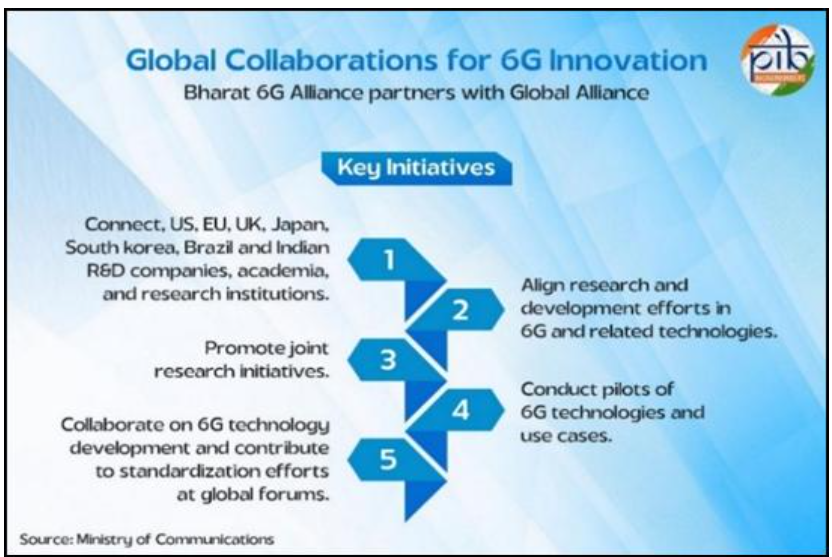
The Bharat 6G Alliance, formed in 2023, supports indigenous 6G research, standards and advanced communications.
Technology Diplomacy
The NEST Division under the Ministry of External Affairs handles the international dimensions of AI, 5G, 6G, semiconductors, biotechnology and clean technologies.
This reflects the growing role of technology in India’s foreign policy.
Significance of India’s Emerging Technology Ecosystem
- Technological sovereignty: Domestic capability in AI, semiconductors, quantum systems and cloud infrastructure reduces external dependence.
- Economic growth: Emerging technologies improve productivity, manufacturing, innovation and employment.
- Better governance: DPI and digital platforms make public service delivery faster, transparent and inclusive.
- National security: Quantum communication, cybersecurity, semiconductors and supercomputing have strategic applications.
- Inclusive development: Affordable internet expands access to finance, education, healthcare and government services.
- Global influence: India is increasingly shaping international debates on trusted, inclusive and human-centric technology.
Key Challenges
- Import dependence: Advanced semiconductor equipment, critical minerals and specialised hardware are still largely imported.
- R&D gap: India needs higher public and private investment in frontier research.
- Skill shortage: Deep-tech sectors require advanced and interdisciplinary expertise.
- Digital divide: Unequal access to devices, connectivity and digital literacy persists.
- Cybersecurity: Greater digitalisation increases risks of cyberattacks and data breaches.
- Ethical concerns: AI and biotechnology require transparent and responsible regulation.
- Commercialisation gap: Research often fails to move effectively from laboratories to industry.
Way Forward
- Increase investment in frontier research and deep technology.
- Strengthen industry-academia partnerships.
- Expand advanced skilling in AI, quantum technology, semiconductors and biotechnology.
- Promote indigenous manufacturing of critical components.
- Develop strong frameworks for data protection, ethical AI and cybersecurity.
- Improve access to technology in rural and underserved areas.
- Encourage startup-led innovation and research commercialisation.
- Build international partnerships without compromising technological sovereignty.
Conclusion
India’s emerging technology ecosystem marks a shift from technology consumption to technology creation.Mission-mode programmes, Digital Public Infrastructure, research institutions, startups and skilling initiatives are creating a strong foundation for technological leadership.To sustain this momentum, India must combine innovation with inclusion, self-reliance with global cooperation, and technological growth with ethical governance. This will be central to achieving Viksit Bharat 2047.