Why in News?
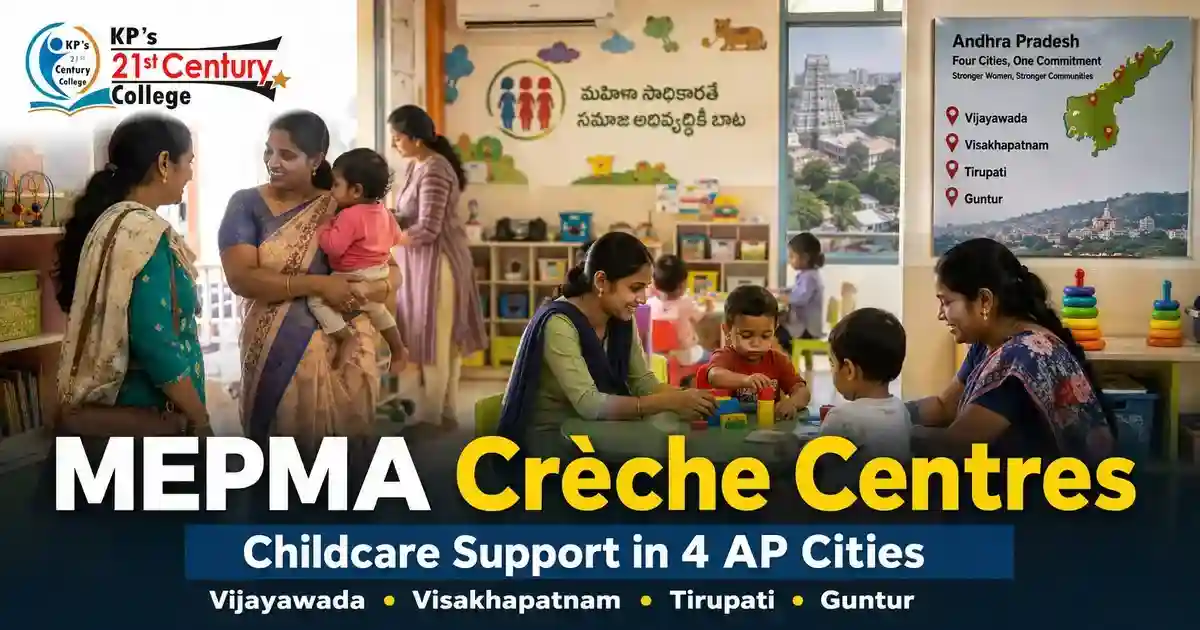
The Mission for Elimination of Poverty in Municipal Areas (MEPMA) of Andhra Pradesh signed a Memorandum of Understanding with Mobile Crèches to establish childcare centres in four major cities.
The crèche centres will be set up in:
- Vijayawada
- Visakhapatnam
- Tirupati
- Guntur
The initiative aims to provide quality childcare for the children of urban women self-help group members and enable women to pursue employment and entrepreneurial activities.

What is the Urban Crèche Initiative?
The programme proposes the establishment of 15 crèche centres for children between six months and six years of age.
The centres are expected to benefit around 375 children.
They will provide:
- Daycare and supervision
- Nutrition support
- Basic health services
- Early childhood education
- Safe learning and play spaces
- Age-appropriate care
The programme is aligned with the State’s long-term development vision, Swarna Andhra@2047.
Institutional Arrangement
The initiative is based on a partnership between MEPMA and Mobile Crèches.
- MEPMA: It will function as the implementing agency and coordinate the programme at the urban local level.
- Mobile Crèches: It will provide technical support, training, caregiving models and institutional guidance.
This model combines government implementation capacity with the technical experience of a specialised childcare organisation.
What is MEPMA?
The Mission for Elimination of Poverty in Municipal Areas functions under the Andhra Pradesh Municipal Administration Department.
It works towards:
- Urban poverty reduction
- Organisation of urban poor women into self-help groups
- Livelihood promotion
- Skill development
- Financial inclusion
- Access to welfare schemes
- Community-level institution building
The crèche initiative expands MEPMA’s role from livelihood promotion to supporting the care needs of working women.
Why are Urban Crèche Centres Necessary?
Women’s employment:
- Lack of affordable childcare often prevents women from entering or continuing in paid work. Crèches allow mothers to pursue jobs, self-employment and entrepreneurship without compromising child safety.
Early childhood development:
- The period from birth to six years is crucial for physical growth, cognitive development, emotional well-being and school readiness.
Nutrition and health:
- Crèche centres can support regular nutrition, health monitoring and timely referral to public health institutions.
Urban vulnerability:
- Women in informal employment may lack maternity benefits, flexible work arrangements and access to organised childcare.
Reduction in sibling care:
- In many low-income households, adolescent girls are asked to care for younger siblings. Community crèches can reduce this burden and help girls continue their education.
Capacity-Building Measures
During the 2026–27 financial year, the programme proposes to:
- Train 45 women from self-help groups as crèche workers.
- Certify 15 master trainers.
- Develop Telugu-language caregiving materials.
- Establish a dedicated Management Information System.
- Improve monitoring and accountability.
Training SHG women as crèche workers can generate local employment while creating a community-owned childcare system.
Role of the Management Information System
The proposed Management Information System will assist in:
- Child enrolment and attendance tracking
- Nutrition and health monitoring
- Staff and training records
- Service-quality assessment
- Reporting and programme evaluation
- Identification of gaps in implementation
A digital monitoring system can improve transparency and support evidence-based programme expansion.
Convergence with Existing Health and Childcare Services
The programme will promote coordination with existing public schemes and institutions.
Integrated Child Development Services:
ICDS provides supplementary nutrition, health check-ups, preschool education and referral services through Anganwadi Centres.
Primary Health Centres:
PHCs can support immunisation, medical examination, treatment and referral of children requiring specialised care.
Rashtriya Bal Swasthya Karyakram:
RBSK focuses on early identification and intervention for children affected by the four Ds:
- Defects at birth
- Diseases
- Deficiencies
- Developmental delays, including disabilities
Institutional convergence can prevent duplication and improve the overall quality of childcare.
Significance of the Initiative
Promotes women’s workforce participation:
Reliable childcare can help urban women take up employment and entrepreneurial activities.
Strengthens the care economy:
The programme formally recognises childcare as essential social infrastructure supporting economic participation.
Improves child nutrition:
Regular meals and nutrition monitoring can reduce the risk of undernutrition among young children.
Supports early learning:
Age-appropriate education and play can improve school readiness and cognitive development.
Creates local employment:
Training SHG members as childcare workers provides livelihood opportunities within local communities.
Advances gender equality:
The programme reduces the disproportionate unpaid care burden carried by women and adolescent girls.
Develops a replicable model:
The four-city initiative can serve as a model for expansion across other urban areas of Andhra Pradesh.
Conclusion
The MEPMA–Mobile Crèches initiative recognises childcare as an essential component of women’s economic empowerment and urban social development. By integrating childcare, nutrition, health and early education, the programme can improve the well-being of children while enabling women to participate more fully in employment and entrepreneurship. Strong quality standards, institutional convergence and community ownership will be necessary to transform the pilot into a sustainable urban childcare model across Andhra Pradesh.