Why in News?
India is increasingly moving from being a large consumer of digital technologies to becoming a global centre for technology creation, innovation and deployment.
Mission-mode programmes in Artificial Intelligence, semiconductors, quantum technologies, supercomputing, cloud computing, blockchain and biotechnology are strengthening India’s technological capability. These initiatives are also supporting the broader vision of Viksit Bharat 2047.
What is Driving India’s Technology Transformation?
India’s emerging technology ecosystem rests on three interconnected pillars:
- National capacity: Expansion of digital infrastructure, data centres, cloud systems, research institutions and high-performance computing.
- Technological capability: Development of indigenous solutions in AI, chip design, quantum communication, blockchain and biotechnology.
- Global credibility: Promotion of trusted Digital Public Infrastructure, responsible technology governance and international partnerships.
The transformation has been enabled by sustained public investment, startup growth, industry-academia collaboration and large-scale skilling programmes.
Digital India: Foundation of the Technology Ecosystem
The Digital India Programme, launched in 2015, created the basic infrastructure required for emerging technologies.
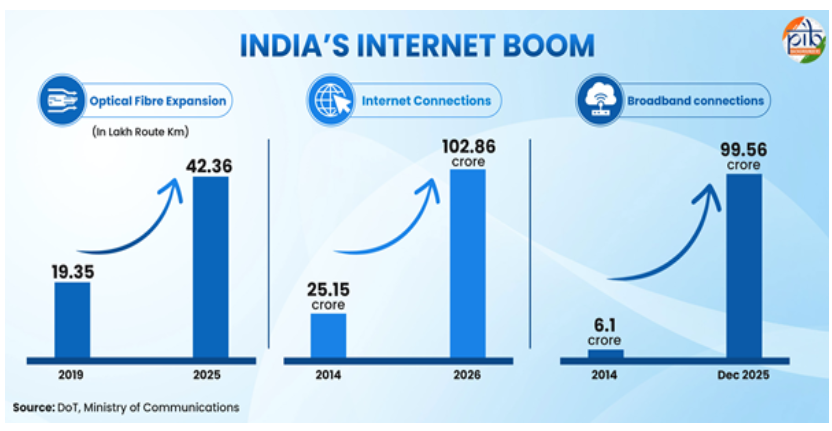
- Connectivity expansion: Optical fibre coverage increased from 19.35 lakh route km in 2019 to 42.36 lakh route km in 2025.
- Internet access: Connections increased from 25.15 crore in 2014 to 102.86 crore in 2026.
- Broadband growth: Broadband connections rose from 6.1 crore to 99.56 crore.
- 5G rollout: Services reached 99.9% of districts.
- Affordability: Average data cost fell from around ₹269 per GB to ₹8–10 per GB.
- Usage: Monthly data consumption increased from 61.66 MB to 24.01 GB per user.
Affordable connectivity enabled the growth of digital payments, cloud services, telemedicine, online education, e-governance and startups.
Major Emerging Technology Initiatives
1. Artificial Intelligence
The IndiaAI Mission, approved in 2024 with an outlay of over ₹10,300 crore, aims to create a nationally accessible AI ecosystem.
Its major components include:
- Indigenous AI computing infrastructure
- Access to advanced GPUs
- AI datasets and models
- Startup support
- Research and innovation
- AI skilling
- Safe and responsible AI
A common computing facility with more than 38,000 GPUs is being developed. The AI Kosh platform hosts 12,115 datasets and 306 AI models across 20 sectors.
Four AI Centres of Excellence focus on:
- Education
- Healthcare
- Sustainable cities
- Agriculture
These centres are developing practical solutions such as disease detection, traffic forecasting, flood prediction and climate-smart farming.
2. Semiconductor Ecosystem
Semiconductors are essential for electronics, defence, telecommunications, AI, cloud systems and advanced manufacturing.
The Semicon India Programme, launched in 2021 with an outlay of ₹76,000 crore, supports:
- Semiconductor fabrication
- Display manufacturing
- Chip design
- Packaging and testing
- Research
- Talent development
As of June 2026, 12 projects worth around ₹1.64 lakh crore had been approved, including one semiconductor fabrication unit, two compound semiconductor fabs and nine packaging units.
The Design Linked Incentive Scheme supports domestic chip design companies, startups, MSMEs and academic institutions.
The India Semiconductor Mission 2.0 focuses on semiconductor equipment, materials, indigenous intellectual property and resilient supply chains.
3. Quantum Technologies
The National Quantum Mission, approved in 2023 with an outlay of ₹6,003.65 crore, focuses on:
- Quantum computing
- Quantum communication
- Quantum sensing and metrology
- Quantum materials and devices
- The mission has established four thematic hubs, supported 17 startups and engaged more than 152 researchers across 43 organisations.
- India also demonstrated a 1,000-km secure quantum communication network.
- The foundation stone for India’s first Quantum Valley was laid in Amaravati in February 2026.
- Quantum technologies have applications in national security, finance, healthcare, logistics and climate modelling.
4. Supercomputing
The National Supercomputing Mission, launched in 2015 with an outlay of ₹4,500 crore, aims to strengthen India’s high-performance computing capacity.
India has deployed:
- 38 supercomputers
- Combined computing power of 47 petaflops
- Indigenous PARAM Rudra systems
Supercomputers support weather forecasting, climate research, AI, drug discovery and advanced scientific modelling.
5. Cloud Computing
- The government cloud platform MeghRaj, launched in 2014, provides secure and scalable computing infrastructure for public institutions.
MeghRaj 2.0 strengthened:
- Hybrid cloud architecture
- Cybersecurity
- Data control
- Service scalability
- Its adoption increased from 342 government departments in 2015–16 to 2,323 departments by June 2026.
- It supports major platforms such as DigiLocker, MyGov and the National Scholarship Portal.
6. Blockchain
The National Blockchain Framework, initiated in 2021, seeks to create a secure and interoperable blockchain ecosystem for governance.
Important platforms include:
- Vishvasya Blockchain Stack
- NBFLite Sandbox
- Praamaanik
- National Blockchain Portal
Blockchain is being used for:
- Property records
- Document verification
- Medicine supply chains
- Judicial records
- Audit trails
- Spam control
More than 3 crore property documents had been verified through blockchain platforms by October 2025.
7. Data Centres
- Data centres are the physical backbone of AI, cloud computing, blockchain and digital governance.
- India’s data centre capacity increased from around:
- 375 MW in 2020
- Nearly 1,500 MW in 2025
- Major hubs include Mumbai, Navi Mumbai, Hyderabad, Bengaluru, Noida and Jamnagar.
- Large hyperscale and AI-focused projects are also being developed in Andhra Pradesh, Gujarat, Maharashtra and Uttar Pradesh.
Data centres support:
- Data sovereignty
- High-performance computing
- Digital public services
- Cloud adoption
- Skilled employment
- Investment
8. Biotechnology
- Biotechnology is emerging as a major driver of healthcare, food security and industrial innovation.
Important initiatives include:
- National Biopharma Mission
- BioE3 Policy
- BioNEST incubators
- i4 innovation programme
- PACE programme
- India’s biotechnology sector grew from over USD 150 billion in 2023 to around USD 190 billion by June 2026.
- DBT-BIRAC established 94 bio-incubators across 25 States and Union Territories.
Building Research and Innovation Capacity
The Anusandhan National Research Foundation became operational in 2024.
It promotes collaboration among:
- Universities
- Research institutions
- Industry
- Startups
- Government
Its programmes focus on high-impact research, translational innovation and industry-academia partnerships.
- The Research Development and Innovation Scheme, approved in 2025 with a corpus of ₹1 lakh crore, supports long-term private-sector research in AI, advanced manufacturing, deep technology and strategic sectors.
- These initiatives aim to bridge the gap between laboratory research and commercial applications.
Skilling for Emerging Technologies
India’s technology ambitions require a future-ready workforce.
FutureSkills PRIME
Launched in 2018 by MeitY and NASSCOM, it provides training in:
- AI, Big Data, IoT, Cybersecurity, Blockchain and VR
More than 27.53 lakh candidates registered, while around 80% of learners came from Tier-II and Tier-III cities.
NIELIT
NIELIT provides training through:
- 56 centres
- 750 affiliated institutes
- More than 9,000 facilitation centres
It offers courses in AI, cybersecurity, cloud computing, electronics and blockchain.
SOAR Programme
The Skilling for AI Readiness programme, launched in 2025, introduces AI literacy for school students from Classes 6 to 12.
Chips to Start-up Programme
Launched in 2022, it aims to create 85,000 industry-ready professionals in:
- VLSI
- ASICs
- System-on-Chip design
- Embedded systems
- Semiconductor research
India’s Growing Global Technology Credibility
Digital Public Infrastructure
India’s DPI ecosystem includes:
- Aadhaar
- UPI
- DigiLocker
- CoWIN
- UMANG
- Government e-Marketplace
India has signed agreements with 23 countries for cooperation on DPI.
UPI is operational in countries such as Singapore, UAE, France, Nepal and Sri Lanka.
Global Innovation Index
India’s rank improved from 81st in 2015 to 38th in 2025.
Global Capability Centres
India hosts over:
- 2,100 GCCs
- 3,728 units
- 2.36 million professionals
GCCs have evolved from back-office centres into hubs for AI, research, cybersecurity and digital innovation.
Bharat 6G Alliance
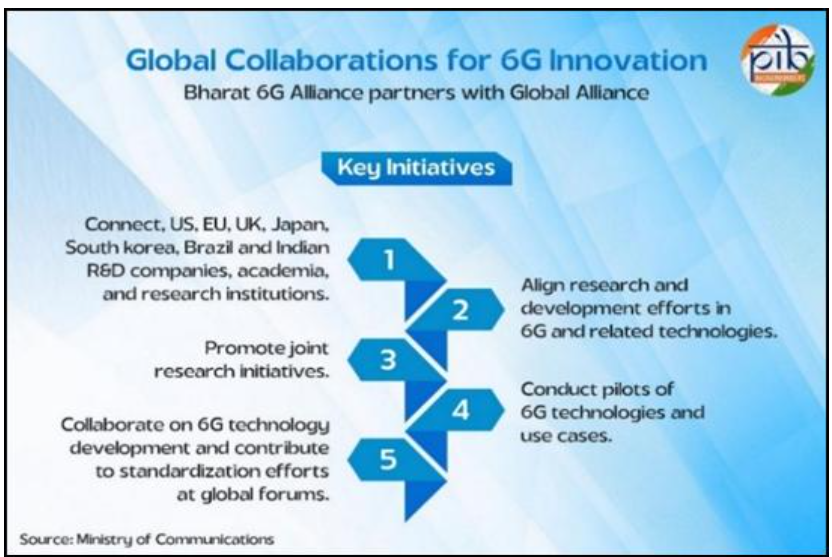
The Bharat 6G Alliance, formed in 2023, supports indigenous 6G research, standards and advanced communications.
Technology Diplomacy
The NEST Division under the Ministry of External Affairs handles the international dimensions of AI, 5G, 6G, semiconductors, biotechnology and clean technologies.
This reflects the growing role of technology in India’s foreign policy.
Significance of India’s Emerging Technology Ecosystem
- Technological sovereignty: Domestic capability in AI, semiconductors, quantum systems and cloud infrastructure reduces external dependence.
- Economic growth: Emerging technologies improve productivity, manufacturing, innovation and employment.
- Better governance: DPI and digital platforms make public service delivery faster, transparent and inclusive.
- National security: Quantum communication, cybersecurity, semiconductors and supercomputing have strategic applications.
- Inclusive development: Affordable internet expands access to finance, education, healthcare and government services.
- Global influence: India is increasingly shaping international debates on trusted, inclusive and human-centric technology.
Key Challenges
- Import dependence: Advanced semiconductor equipment, critical minerals and specialised hardware are still largely imported.
- R&D gap: India needs higher public and private investment in frontier research.
- Skill shortage: Deep-tech sectors require advanced and interdisciplinary expertise.
- Digital divide: Unequal access to devices, connectivity and digital literacy persists.
- Cybersecurity: Greater digitalisation increases risks of cyberattacks and data breaches.
- Ethical concerns: AI and biotechnology require transparent and responsible regulation.
- Commercialisation gap: Research often fails to move effectively from laboratories to industry.
Way Forward
- Increase investment in frontier research and deep technology.
- Strengthen industry-academia partnerships.
- Expand advanced skilling in AI, quantum technology, semiconductors and biotechnology.
- Promote indigenous manufacturing of critical components.
- Develop strong frameworks for data protection, ethical AI and cybersecurity.
- Improve access to technology in rural and underserved areas.
- Encourage startup-led innovation and research commercialisation.
- Build international partnerships without compromising technological sovereignty.
Conclusion
India’s emerging technology ecosystem marks a shift from technology consumption to technology creation.Mission-mode programmes, Digital Public Infrastructure, research institutions, startups and skilling initiatives are creating a strong foundation for technological leadership.To sustain this momentum, India must combine innovation with inclusion, self-reliance with global cooperation, and technological growth with ethical governance. This will be central to achieving Viksit Bharat 2047.