Why in News?
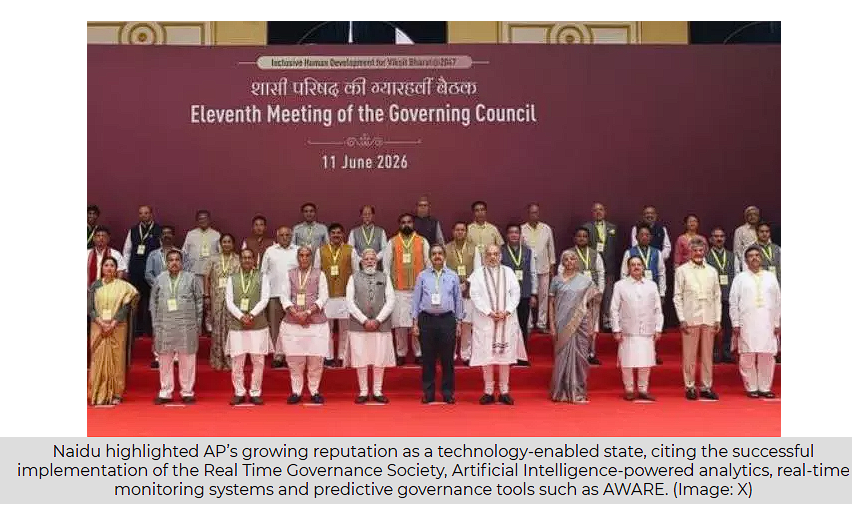
Andhra Pradesh Chief Minister N. Chandrababu Naidu presented the Swarna Andhra @2047 Vision at the NITI Aayog Governing Council meeting in New Delhi.
He said that Andhra Pradesh aims to become a prosperous, inclusive and globally competitive economy through a human capital-driven development model. The vision is linked with India’s broader goal of Viksit Bharat 2047.
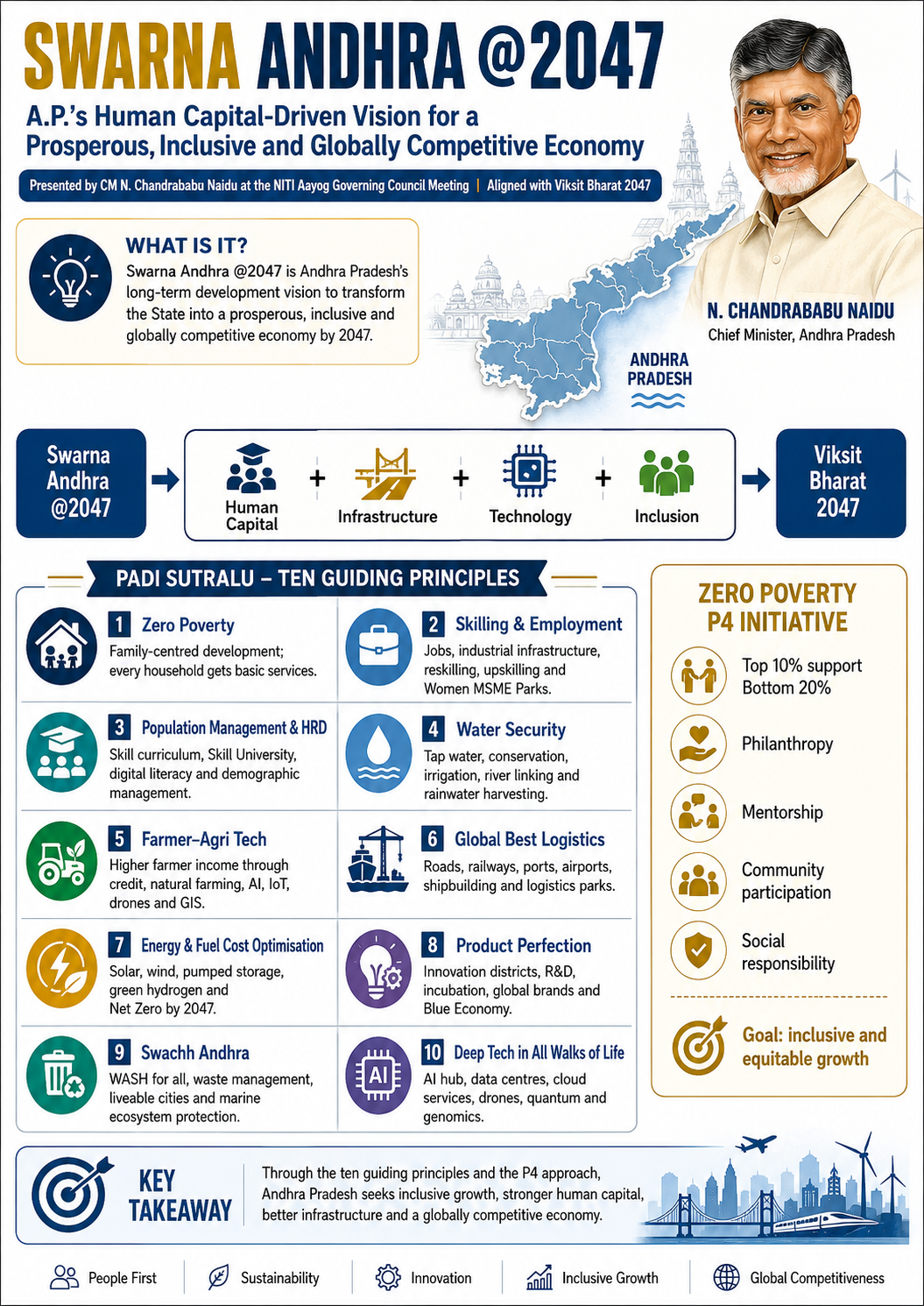
What is Swarna Andhra @2047 Vision?
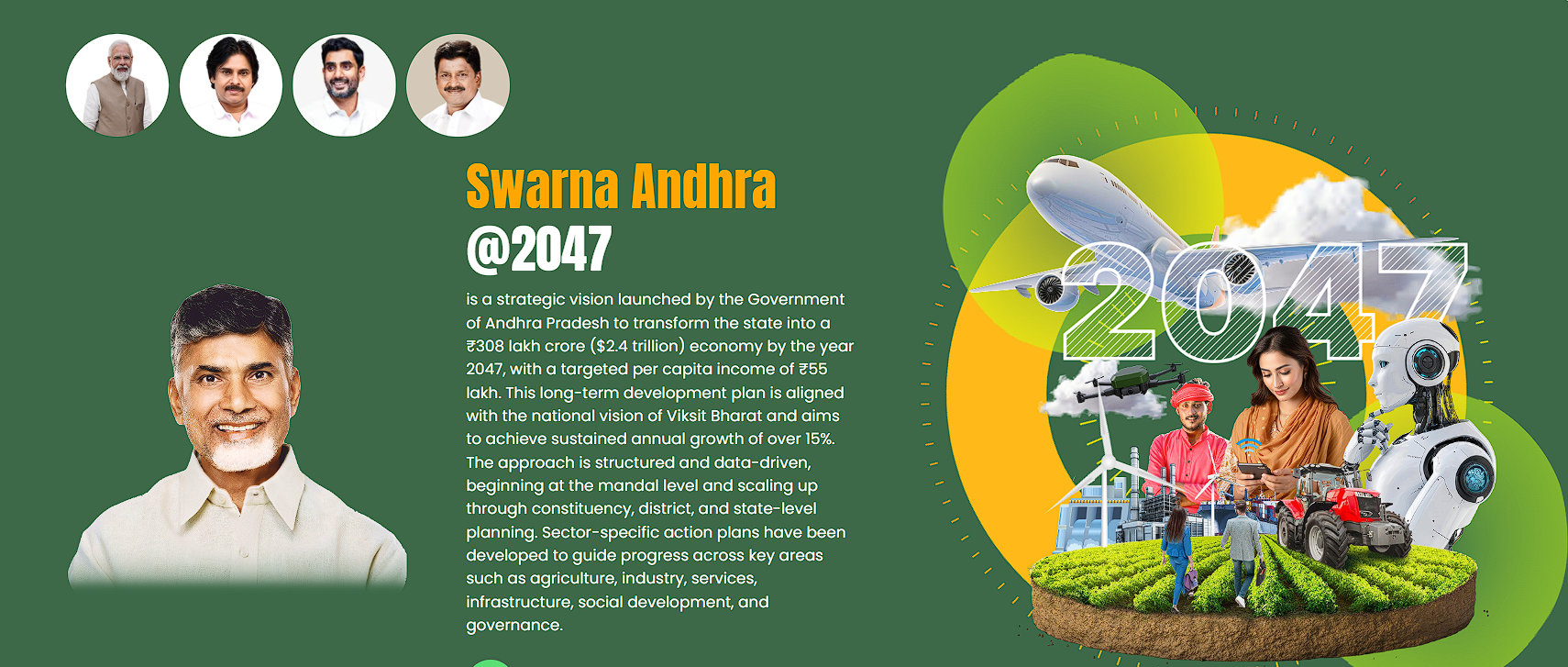
- Swarna Andhra @2047 is Andhra Pradesh’s long-term development vision.
- It aims to transform the State into a prosperous and globally competitive economy by 2047.
Padi Sutralu – Swarna Andhra @2047 (Ten Guiding Principles)
- Zero Poverty
Family as the unit of development; every household to get tap water, electricity, clean energy, sanitation, digital connectivity, social security and affordable healthcare. - Skilling and Employment
Focus on jobs, industrial infrastructure, reskilling, upskilling, simplified procedures, product quality and Women MSME Parks. - Population Management and HRD
Remote learning centres, Skill University, skill curriculum, Unique Skill Passport, skill audit, 100% digital literacy and demographic management. - Water Security
Tap water for every household, water conservation, river interlinking, irrigation for every acre, rainwater harvesting and resilient infrastructure. - Farmer–Agri Tech
Higher farmer income through credit, mentorship, natural farming, horticulture, aquaculture, AI, IoT, drones, robotics and GIS-based water management. - Global Best Logistics
Strong roads, railways, ports, airports, shipbuilding, inland waterways, coastal economic zones and multi-modal logistics parks. - Energy and Fuel Cost Optimisation
Solar, wind, pumped storage, green hydrogen, net zero by 2047, green innovation and early warning systems. - Product Perfection
Innovation districts, global investors, universities, R&D centres, incubation parks, global brands and Blue Economy potential. - Swachh Andhra
WASH for all, waste management, liveable cities, marine ecosystem protection and green financing. - Deep Tech in All Walks of Life
AI hub, data centres, cloud services, Drone Capital of India, quantum computing, genomics and technology commercialisation. - It is designed to align Andhra Pradesh’s growth strategy with Viksit Bharat 2047.
Major Goals of the Vision
- Achieve zero poverty.
- Create large-scale employment opportunities.
- Strengthen skills and human capital.
- Ensure water and energy security.
- Promote growth through:
- Agri-tech
- Logistics
- Deep-tech
- Artificial Intelligence
- Quantum technologies
- Build a globally competitive and investment-friendly economy.
- Ensure inclusive development for all citizens.
Technology-led Governance Model
Andhra Pradesh is using a technology-driven governance framework to improve administration.
Key Tools
- Real Time Governance
- Artificial Intelligence-enabled analytics
- Real-time monitoring systems
- Predictive governance tools such as AWARE
Expected Benefits
- Better administrative efficiency.
- Faster decision-making.
- Evidence-based policy implementation.
- Improved citizen service delivery.
- Early identification of governance problems.
- Better monitoring of welfare schemes and infrastructure projects.
Investment and Economic Growth
- Chief Minister Naidu stated that Andhra Pradesh has attracted investments of more than ₹23 lakh crore over the last two years.
- This has been linked to:
- Transparent policies
- Governance reforms
- Business-friendly ecosystem
- Faster approvals
- Policy stability
- He advised States to focus on:
- Strong infrastructure
- Stable policies
- Quick clearances
- Efficient approvals
- He cautioned against unsustainable incentive-based competition among States to attract investments.
Seven Basic Necessities
The State government aims to ensure that every family has access to seven basic necessities.
| Basic Necessity | Importance |
| Housing | Shelter and dignity |
| Sanitation | Health and hygiene |
| Tap Water | Safe drinking water |
| Clean Cooking Fuel | Better health and reduced indoor pollution |
| Electricity | Basic living and economic activity |
| Digital Connectivity | Access to services and opportunities |
| Direct Benefit Transfers | Transparent welfare delivery |
These seven necessities form the foundation of the State’s inclusive development agenda.
Zero Poverty P4 Initiative
- The Chief Minister highlighted the Zero Poverty P4 initiative.
- P4 encourages the top 10% of society to support the bottom 20%.
- Support may be provided through:
- Philanthropy
- Mentorship
- Community participation
- Social responsibility
- The aim is to promote inclusive and equitable growth.
- It seeks to combine government welfare with citizen participation.
Education and Skilling Reforms
Andhra Pradesh is focusing on preparing its workforce for the future.
Major Reforms
- AI-enabled learning.
- Industry-integrated higher education.
- Flexible lifelong learning pathways.
- Advanced skilling programmes.
- Training in emerging fields such as:
- Artificial Intelligence
- Quantum technologies
- Deep technology
Importance
- Improves employability.
- Helps youth adapt to future job markets.
- Connects education with industry needs.
- Supports innovation-driven economic growth.
Demographic Sustainability
- The Chief Minister pointed out that Andhra Pradesh’s fertility rate is below 1.5.
- A very low fertility rate can create future challenges such as:
- Ageing population
- Workforce shortage
- Rising dependency ratio
- Pressure on healthcare and pensions
- Slower economic growth
- Andhra Pradesh has outlined a Population Management Policy to address these concerns.
- The policy aims to ensure long-term workforce availability and economic sustainability.
Significance
- Provides a long-term roadmap for Andhra Pradesh’s development.
- Aligns State development with Viksit Bharat 2047.
- Promotes inclusive growth through basic necessities and poverty reduction.
- Encourages technology-led governance and data-based decision-making.
- Focuses on human capital, skills and future industries.
- Supports investment-led economic growth.
- Highlights the need for policy stability and infrastructure rather than excessive incentives.
- Recognises demographic sustainability as a long-term development challenge.
Challenges
- Translating vision documents into ground-level implementation.
- Ensuring benefits reach poor and vulnerable groups.
- Attracting investments across all regions, not only major urban centres.
- Creating sufficient quality jobs for youth.
- Preventing skill mismatch between education and industry needs.
- Managing low fertility and ageing-related challenges.
- Ensuring adequate water and energy security.
- Maintaining transparency and accountability in technology-led governance.
Way Forward
- Prepare clear sector-wise action plans with timelines.
- Strengthen district-level implementation and monitoring.
- Link education reforms with local industry needs.
- Expand skilling in AI, logistics, agri-tech and manufacturing.
- Ensure last-mile delivery of the seven basic necessities.
- Promote balanced regional development.
- Encourage public-private partnerships for infrastructure and skills.
- Use technology for transparency, but protect citizen data and privacy.
- Develop a long-term demographic strategy for workforce sustainability.
Conclusion
The Swarna Andhra @2047 Vision represents Andhra Pradesh’s attempt to build a prosperous, inclusive and globally competitive State by 2047. Its focus on zero poverty, human capital, technology-led governance, investment, infrastructure and demographic sustainability makes it a comprehensive development framework.
Its success will depend on effective implementation, policy continuity, inclusive delivery and strong coordination with the Union government and NITI Aayog.
Why in News?
The administration of the Union Territory of Andaman and Nicobar Islands has proposed draft rules to introduce formal elections for Nicobarese Village Councils and Tribal Councils.
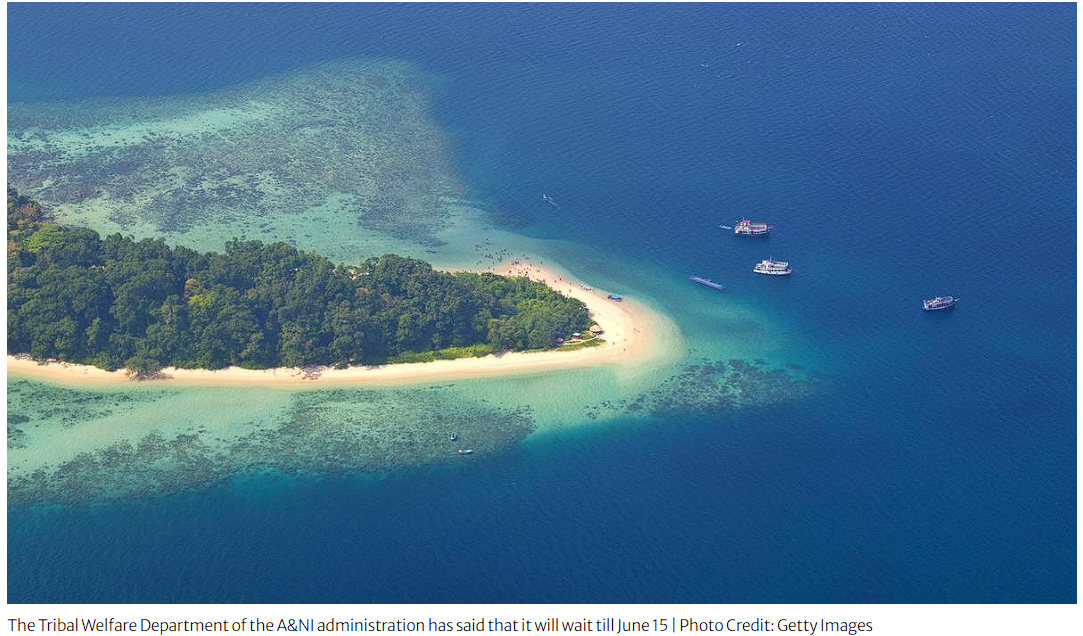
The draft Andaman and Nicobar Islands Tribal Councils (Preparation of Electoral Rolls and Conduct of Elections) Rules, 2026 seek to create electoral rolls, constituencies and reservation provisions for women in tribal councils. This has triggered debate among Nicobarese leaders, who fear that the rules may alter their traditional consensus-based self-governance system.

What do the Draft Rules Propose?
The draft rules propose a formal election system for Nicobarese tribal institutions.
Major Proposals
- Constitution of Village Councils and Tribal Councils through formal elections.
- Delimitation of constituencies.
- Preparation of electoral rolls.
- Reservation of seats and leadership positions for women.
- Election of five to nine Captains for each village.
- Direct voting for the post of Chief Captain of each Island Tribal Council.
- Election of other positions such as:
- Vice-Chief Captain
- First Captain
- All First Captains of the Island
- Formal administrative supervision of the election process.
How do Nicobarese Tribal Councils Function Today?
- The Nicobarese community has a long tradition of customary self-governance.
- Each inhabited island in the Nicobar group has its own Tribal Council.
- Village leadership is usually headed by Captains.
- Captains are assisted by:
- First Captain
- Second Captain
- Third Captain
- Tribal Councils represent Nicobarese communities in islands such as:
- Car Nicobar
- Nancowry
- Kamorta
- Teressa
- Little Nicobar
- Great Nicobar
- The traditional leadership structure evolved from community needs and customary practices.
How are Leaders Chosen Currently?
- Nicobarese leaders are generally chosen through community consensus.
- Villagers meet and discuss who should lead.
- Leadership is based on:
- Community trust
- Local reputation
- Ability to communicate with officials
- Education and exposure
- Practical understanding of village issues
- Some villages use simple local voting methods, but the process remains rooted in community consultation.
- The focus is not on political competition but on collective acceptance.
Why are the Proposed Changes Causing Concern?
1. Fear of Bureaucratisation
- Tribal leaders fear that a formal election system may convert customary leadership into a bureaucratic process.
- They worry that traditional decision-making may be replaced by official procedures.
2. Threat to Customary Governance
- Existing systems are based on consensus, consultation and village-level trust.
- Formal electoral rules may weaken flexible customary practices.
3. Lack of Consultation
- Several leaders argue that the community has not been adequately consulted.
- They say draft rules must be explained properly in local languages before implementation.
4. Possibility of Political Interference
- Formal elections may introduce party-style competition into tribal society.
- This could disturb community harmony and traditional leadership values.
5. Link with Great Nicobar Concerns
- Some leaders suspect that formalisation may make tribal councils more favourable to Union government projects.
- This concern is especially strong in the context of the proposed ₹91,000 crore Great Nicobar transshipment port, airport and tourism project.
Administration’s Argument
The administration argues that formal elections may bring:
- Clear electoral rules.
- Better representation.
- Defined constituencies.
- Reservation for women.
- More structured tribal governance.
- Greater transparency in leadership selection.
- Stronger link between the administration and tribal councils.
However, tribal leaders believe that reforms should not disturb the core of Nicobarese self-governance.
Larger Context: Great Nicobar and Tribal Rights
- Great Nicobar has become important due to proposed large infrastructure projects.
- These include:
- Transshipment port
- Airport
- Tourism-linked development
- Strategic infrastructure
- Nicobarese leaders have already raised concerns about environmental, social and cultural impacts.
- Therefore, changes to tribal council governance are being viewed with caution.
- The issue is not only about elections but also about tribal autonomy, land, culture and decision-making power.
Significance
- Highlights the tension between formal democratic procedures and customary tribal governance.
- Raises questions about how modern governance should interact with indigenous institutions.
- Shows the importance of consultation before changing tribal governance structures.
- Brings attention to the rights of island communities.
- Reflects the importance of decentralisation and local self-governance.
- Links governance reforms with larger development debates in Great Nicobar.
Challenges
- Balancing customary leadership with democratic accountability.
- Ensuring women’s representation without weakening traditional institutions.
- Preventing political competition from disturbing community harmony.
- Explaining draft rules clearly to local communities.
- Protecting tribal autonomy while improving governance transparency.
- Avoiding top-down decision-making.
- Ensuring that development projects do not bypass tribal consent.
Way Forward
- Conduct wide consultations with Nicobarese communities.
- Translate draft rules into local languages.
- Give enough time for tribal councils to understand and respond.
- Respect customary decision-making systems.
- Explore a hybrid model combining traditional consensus with democratic safeguards.
- Ensure women’s participation through culturally sensitive methods.
- Protect tribal autonomy in all development decisions.
- Follow principles of participatory governance and informed consent.
- Avoid imposing uniform governance models on distinct tribal societies.
Conclusion
The debate over elections in Nicobar is not merely about electoral rules. It is about the future of Nicobarese self-governance, customary authority and tribal autonomy.
Formal elections may improve transparency and representation, but they should not weaken community-based governance. A balanced approach must protect indigenous traditions while ensuring accountability, gender inclusion and democratic participation.
Why in News?
Nepal Prime Minister Balendra Shah “Balen” recently made remarks in Nepal’s Parliament on the Kalapani–Lipulekh–Limpiyadhura boundary dispute with India.He indicated that the dispute should not be treated as a one-sided issue. According to him, both India and Nepal should examine the facts objectively and resolve the matter amicably through diplomatic channels.His remarks created protests in Nepal, but they also suggest a possible shift towards a more rational and practical approach in India–Nepal relations.
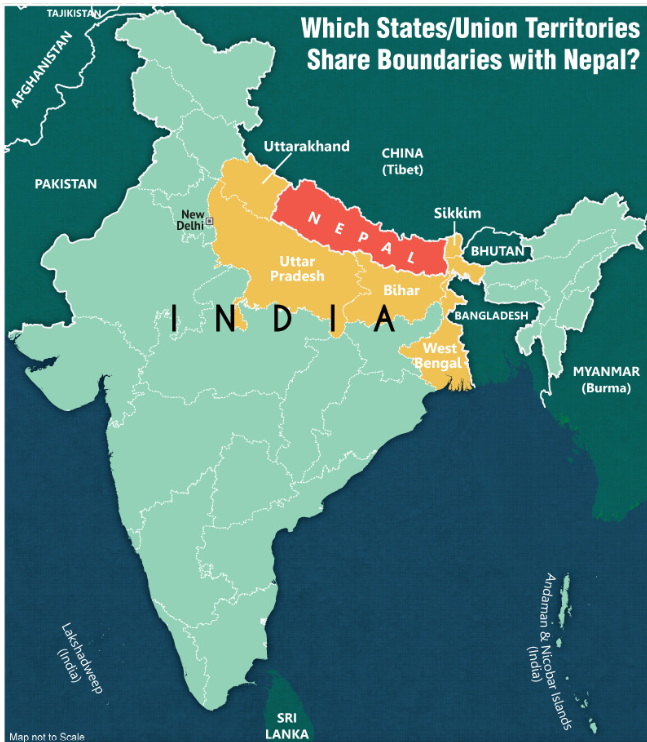
Historical Roots of the India–Nepal Boundary Issue
- The boundary disagreement between India and Nepal mainly relates to Kalapani, Lipulekh and Limpiyadhura.
- Its origin goes back to the Treaty of Sugauli, 1816, signed after the Anglo-Nepalese War between Nepal and the British East India Company.
- The treaty recognised the Kali or Mahakali River as Nepal’s western boundary, but it did not clearly mention the exact source of the river.
- This uncertainty over the river’s origin later created different interpretations of the boundary.
Nepal’s Position
- Nepal argues that the Kali River begins from the westernmost stream near Limpiyadhura.
- Based on this view, Nepal claims Kalapani, Lipulekh and Limpiyadhura as part of its territory.
- In 2020, Nepal amended its Constitution and adopted a new political map showing these areas within Nepal.
- It later strengthened this claim by issuing a new NPR 100 banknote carrying the revised map.
India’s Position
- India maintains that the Kali River originates near Kalapani, east of Limpiyadhura.
- Therefore, India considers the disputed region as part of Pithoragarh district in Uttarakhand.
- India also has administrative and military presence in the area.
Why the Region Matters
- The area is strategically sensitive because it lies close to China.
- Lipulekh Pass is important for:
- India–China trade
- The Kailash Mansarovar Yatra
- India’s Himalayan security interests
Nepal’s Changing Approach Towards India
Shift Towards Practical Cooperation
- Nepal’s foreign policy approach towards India is becoming more practical and development-focused.
- Instead of depending mainly on political slogans or ideological positions, Nepal is giving more importance to economic cooperation.
- The plan to export 10,000 MW of hydropower to India over the next decade reflects this shift towards mutual economic benefit.
Demand for Equal Diplomatic Treatment
- Nepal is moving away from the older idea of a very informal “special relationship” with India.
- It now seeks a more formal and balanced relationship based on sovereign equality.
- This means Nepal wants diplomatic protocol, mutual respect and state-to-state parity to guide its relations with India.
Boundary Issues Through Dialogue
- Nepal appears to be taking a more measured approach to border disputes.
- Instead of turning boundary questions into emotional nationalist issues, Kathmandu is increasingly treating them as technical and diplomatic matters.
- This approach can create space for evidence-based discussion and peaceful resolution.
Search for Strategic Autonomy
- Nepal wants to follow an independent foreign policy.
- It does not want to be seen as merely balancing between India and China.
- Its focus is now on using historical evidence, diplomacy and national interest while dealing with sensitive issues.
Recent Positive Outcomes in India–Nepal Engagement
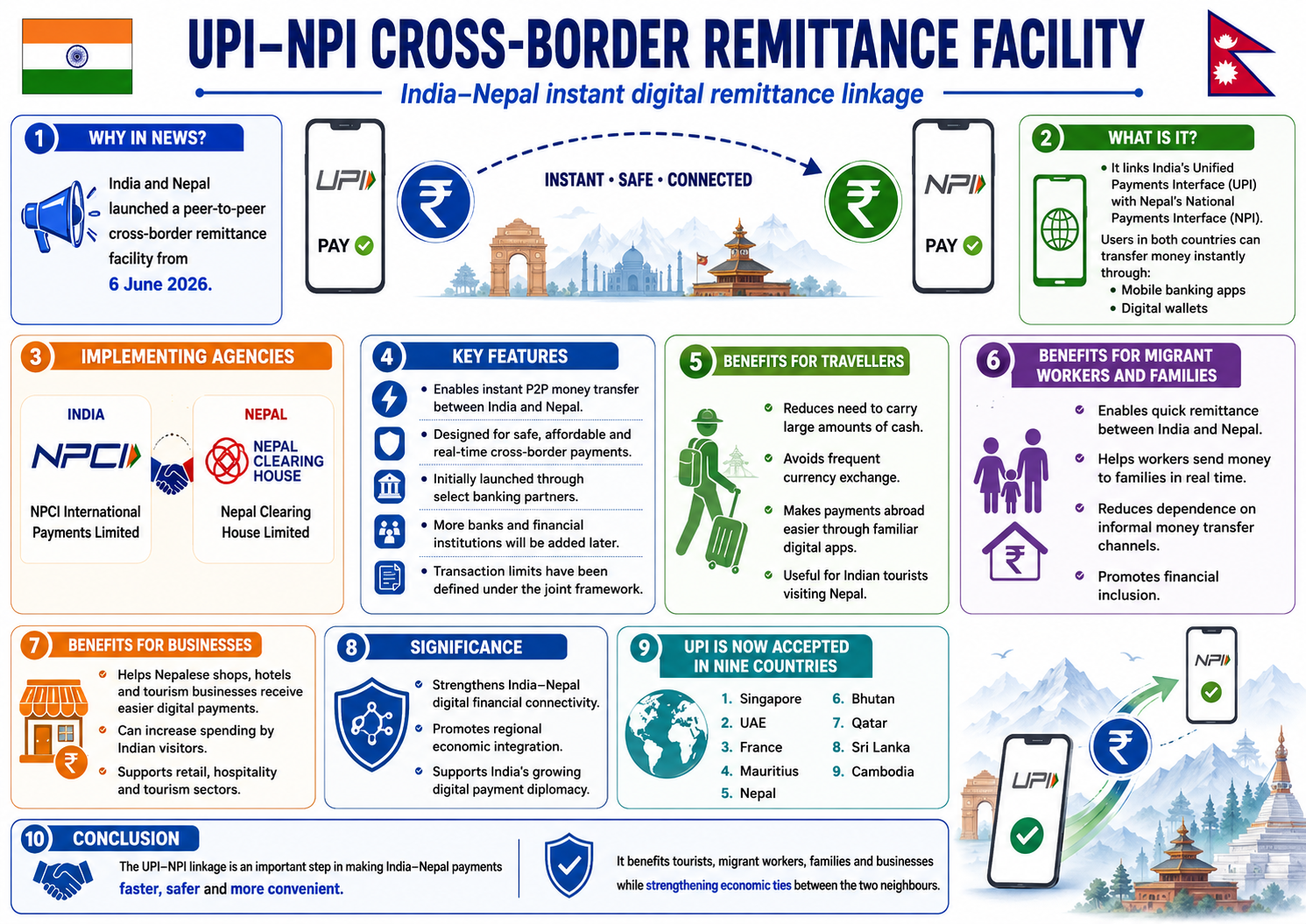
Digital Payment Connectivity
- India and Nepal launched a Peer-to-Peer payment linkage.
- This connects India’s Unified Payments Interface with Nepal’s National Payments Interface.
- It can help people make real-time, low-cost cross-border payments.
- It will also support remittances, financial inclusion and easier transactions between citizens of both countries.
Language Technology Cooperation
- An MoU was signed between Digital India Bhashini and Kathmandu University.
- The aim is to develop a voice-based digital language translation platform in Nepal.
- This can improve digital access and support people who use local languages.
Cooperation in Criminal Matters
- India and Nepal welcomed the implementation of the Mutual Legal Assistance Agreement in Criminal Matters.
- This will help both countries cooperate in dealing with cross-border crime, investigation and legal processes.
Development Partnership
- India handed over 72 health facilities and 12 cultural heritage projects to Nepal.
- These projects were completed under India’s post-2015 earthquake reconstruction assistance.
- This reflects India’s role as a development partner in Nepal’s public health and cultural heritage restoration. Top of Form
Strategic Importance of India–Nepal Relations
- Himalayan Security: Nepal lies between India and China, making it important for India’s northern security and the safety of the Indo-Gangetic plains.
- Siliguri Corridor: Stability in Nepal helps protect the Siliguri Corridor, which connects mainland India with the Northeast.
- Open Border: The 1,751-km open border promotes trade, culture and people-to-people ties, but also needs cooperation to prevent smuggling, illegal migration and cross-border crime.
- China Factor: China’s growing presence through BRI and infrastructure projects makes India–Nepal connectivity and economic cooperation strategically important.
- Water and Energy Security: Nepal’s rivers are vital for flood management in northern India, while its hydropower potential can support India’s clean energy needs.
Key Challenges in India–Nepal Relations
- China Factor: Nepal’s growing engagement with China through BRI, trans-Himalayan railway plans and Chinese-funded projects raises strategic concerns for India.
- 2015–16 Blockade Perception: Nepal accused India of an unofficial blockade during the Madhesi protests, which India denied. This increased anti-India sentiment in Nepal.
- Changing Diplomatic Approach: Nepal’s new leadership seeks sovereign equality and formal diplomatic protocol, moving away from the traditional “special relationship”.
- Open Border Security: The 1,751-km open border supports people-to-people ties but also enables smuggling, illegal migration, fake currency and cross-border crime.
- Water-Sharing Issues: Rivers like Kosi, Gandak and Mahakali remain sources of friction due to disputes over water sharing, flood control and project implementation.
- Project Delays: Delay in the 5,040 MW Pancheshwar Multipurpose Project affects trust and slows down energy and water cooperation.
Measures to Strengthen India–Nepal Relations
- Respect Sovereign Sensitivities: India should engage Nepal with mutual respect, non-interference and sovereign equality.
- Modernise Old Agreements: Both countries should review the 1950 Treaty of Peace and Friendship and address provisions viewed by Nepal as unequal.
- Resolve Boundary Issues Diplomatically: The Kalapani–Lipulekh–Limpiyadhura dispute should be handled through technical talks and Foreign Secretary-level dialogue, not public rhetoric.
- Improve Project Delivery: India should complete key projects such as the Arun-III Hydropower Project, cross-border rail links and pipeline expansion on time.
- Expand Energy Partnership: Nepal’s plan to export 10,000 MW hydropower to India should be supported with strong transmission infrastructure.
- Strengthen Water Cooperation: Both sides should fast-track the Pancheshwar Multipurpose Project and improve flood management on the Kosi and Gandak rivers.
- Promote People-to-People Ties: Open border, cultural links, educational exchanges and military cooperation should be used to build long-term trust.
- Connectivity Over Competition: India should counter external influence through better rail, road, energy, digital and trade connectivity, not through rivalry.
Conclusion
Nepal’s new, pragmatic leadership gives India an opportunity to renew bilateral relations on a modern footing. By respecting Nepal’s concerns over sovereign equality, reducing emotional nationalism, and prioritising connectivity, trade, hydropower and economic cooperation, both countries can build a stable and future-oriented partnership. Such a balanced approach will protect India’s strategic interests in the Himalayas while supporting Nepal’s development aspirations.