Why in News?
Nepal Prime Minister Balendra Shah “Balen” recently made remarks in Nepal’s Parliament on the Kalapani–Lipulekh–Limpiyadhura boundary dispute with India.He indicated that the dispute should not be treated as a one-sided issue. According to him, both India and Nepal should examine the facts objectively and resolve the matter amicably through diplomatic channels.His remarks created protests in Nepal, but they also suggest a possible shift towards a more rational and practical approach in India–Nepal relations.
Historical Roots of the India–Nepal Boundary Issue
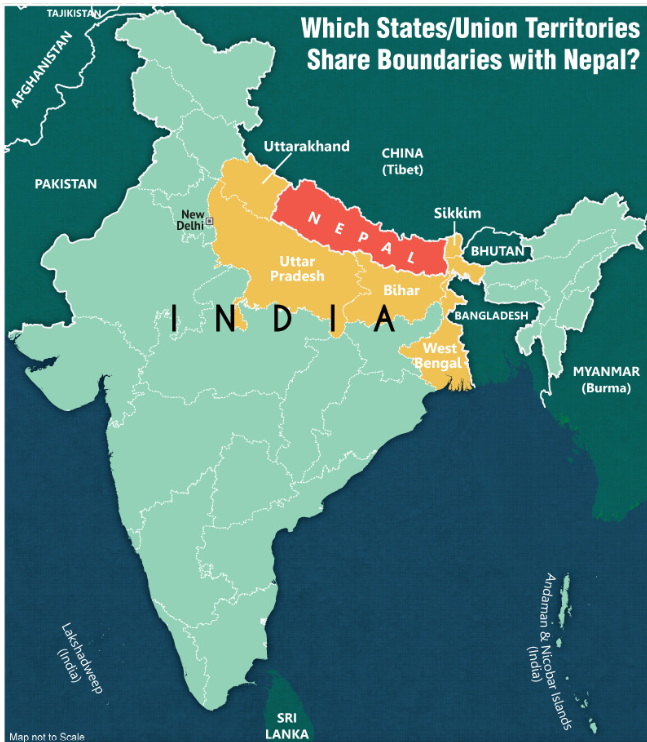
- The boundary disagreement between India and Nepal mainly relates to Kalapani, Lipulekh and Limpiyadhura.
- Its origin goes back to the Treaty of Sugauli, 1816, signed after the Anglo-Nepalese War between Nepal and the British East India Company.
- The treaty recognised the Kali or Mahakali River as Nepal’s western boundary, but it did not clearly mention the exact source of the river.
- This uncertainty over the river’s origin later created different interpretations of the boundary.
Nepal’s Position
- Nepal argues that the Kali River begins from the westernmost stream near Limpiyadhura.
- Based on this view, Nepal claims Kalapani, Lipulekh and Limpiyadhura as part of its territory.
- In 2020, Nepal amended its Constitution and adopted a new political map showing these areas within Nepal.
- It later strengthened this claim by issuing a new NPR 100 banknote carrying the revised map.
India’s Position
- India maintains that the Kali River originates near Kalapani, east of Limpiyadhura.
- Therefore, India considers the disputed region as part of Pithoragarh district in Uttarakhand.
- India also has administrative and military presence in the area.
Why the Region Matters
- The area is strategically sensitive because it lies close to China.
- Lipulekh Pass is important for:
- India–China trade
- The Kailash Mansarovar Yatra
- India’s Himalayan security interests
Nepal’s Changing Approach Towards India
Shift Towards Practical Cooperation
- Nepal’s foreign policy approach towards India is becoming more practical and development-focused.
- Instead of depending mainly on political slogans or ideological positions, Nepal is giving more importance to economic cooperation.
- The plan to export 10,000 MW of hydropower to India over the next decade reflects this shift towards mutual economic benefit.
Demand for Equal Diplomatic Treatment
- Nepal is moving away from the older idea of a very informal “special relationship” with India.
- It now seeks a more formal and balanced relationship based on sovereign equality.
- This means Nepal wants diplomatic protocol, mutual respect and state-to-state parity to guide its relations with India.
Boundary Issues Through Dialogue
- Nepal appears to be taking a more measured approach to border disputes.
- Instead of turning boundary questions into emotional nationalist issues, Kathmandu is increasingly treating them as technical and diplomatic matters.
- This approach can create space for evidence-based discussion and peaceful resolution.
Search for Strategic Autonomy
- Nepal wants to follow an independent foreign policy.
- It does not want to be seen as merely balancing between India and China.
- Its focus is now on using historical evidence, diplomacy and national interest while dealing with sensitive issues.
Recent Positive Outcomes in India–Nepal Engagement
Digital Payment Connectivity
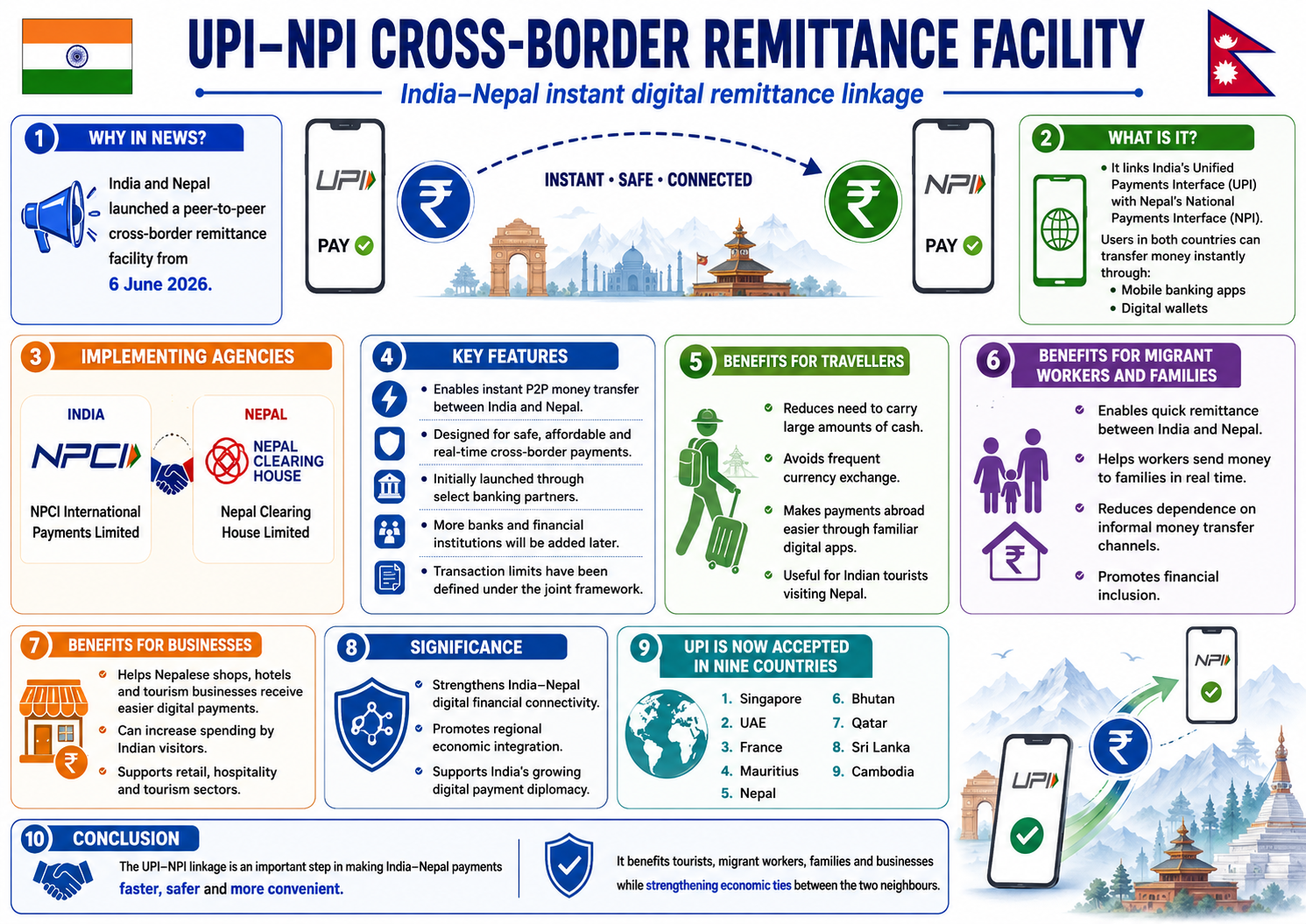
- India and Nepal launched a Peer-to-Peer payment linkage.
- This connects India’s Unified Payments Interface with Nepal’s National Payments Interface.
- It can help people make real-time, low-cost cross-border payments.
- It will also support remittances, financial inclusion and easier transactions between citizens of both countries.
Language Technology Cooperation
- An MoU was signed between Digital India Bhashini and Kathmandu University.
- The aim is to develop a voice-based digital language translation platform in Nepal.
- This can improve digital access and support people who use local languages.
Cooperation in Criminal Matters
- India and Nepal welcomed the implementation of the Mutual Legal Assistance Agreement in Criminal Matters.
- This will help both countries cooperate in dealing with cross-border crime, investigation and legal processes.
Development Partnership
- India handed over 72 health facilities and 12 cultural heritage projects to Nepal.
- These projects were completed under India’s post-2015 earthquake reconstruction assistance.
- This reflects India’s role as a development partner in Nepal’s public health and cultural heritage restoration. Top of Form
Strategic Importance of India–Nepal Relations
- Himalayan Security: Nepal lies between India and China, making it important for India’s northern security and the safety of the Indo-Gangetic plains.
- Siliguri Corridor: Stability in Nepal helps protect the Siliguri Corridor, which connects mainland India with the Northeast.
- Open Border: The 1,751-km open border promotes trade, culture and people-to-people ties, but also needs cooperation to prevent smuggling, illegal migration and cross-border crime.
- China Factor: China’s growing presence through BRI and infrastructure projects makes India–Nepal connectivity and economic cooperation strategically important.
- Water and Energy Security: Nepal’s rivers are vital for flood management in northern India, while its hydropower potential can support India’s clean energy needs.
Key Challenges in India–Nepal Relations
- China Factor: Nepal’s growing engagement with China through BRI, trans-Himalayan railway plans and Chinese-funded projects raises strategic concerns for India.
- 2015–16 Blockade Perception: Nepal accused India of an unofficial blockade during the Madhesi protests, which India denied. This increased anti-India sentiment in Nepal.
- Changing Diplomatic Approach: Nepal’s new leadership seeks sovereign equality and formal diplomatic protocol, moving away from the traditional “special relationship”.
- Open Border Security: The 1,751-km open border supports people-to-people ties but also enables smuggling, illegal migration, fake currency and cross-border crime.
- Water-Sharing Issues: Rivers like Kosi, Gandak and Mahakali remain sources of friction due to disputes over water sharing, flood control and project implementation.
- Project Delays: Delay in the 5,040 MW Pancheshwar Multipurpose Project affects trust and slows down energy and water cooperation.
Measures to Strengthen India–Nepal Relations
- Respect Sovereign Sensitivities: India should engage Nepal with mutual respect, non-interference and sovereign equality.
- Modernise Old Agreements: Both countries should review the 1950 Treaty of Peace and Friendship and address provisions viewed by Nepal as unequal.
- Resolve Boundary Issues Diplomatically: The Kalapani–Lipulekh–Limpiyadhura dispute should be handled through technical talks and Foreign Secretary-level dialogue, not public rhetoric.
- Improve Project Delivery: India should complete key projects such as the Arun-III Hydropower Project, cross-border rail links and pipeline expansion on time.
- Expand Energy Partnership: Nepal’s plan to export 10,000 MW hydropower to India should be supported with strong transmission infrastructure.
- Strengthen Water Cooperation: Both sides should fast-track the Pancheshwar Multipurpose Project and improve flood management on the Kosi and Gandak rivers.
- Promote People-to-People Ties: Open border, cultural links, educational exchanges and military cooperation should be used to build long-term trust.
- Connectivity Over Competition: India should counter external influence through better rail, road, energy, digital and trade connectivity, not through rivalry.
Conclusion
Nepal’s new, pragmatic leadership gives India an opportunity to renew bilateral relations on a modern footing. By respecting Nepal’s concerns over sovereign equality, reducing emotional nationalism, and prioritising connectivity, trade, hydropower and economic cooperation, both countries can build a stable and future-oriented partnership. Such a balanced approach will protect India’s strategic interests in the Himalayas while supporting Nepal’s development aspirations.