Why in News?
The administration of the Union Territory of Andaman and Nicobar Islands has proposed draft rules to introduce formal elections for Nicobarese Village Councils and Tribal Councils.
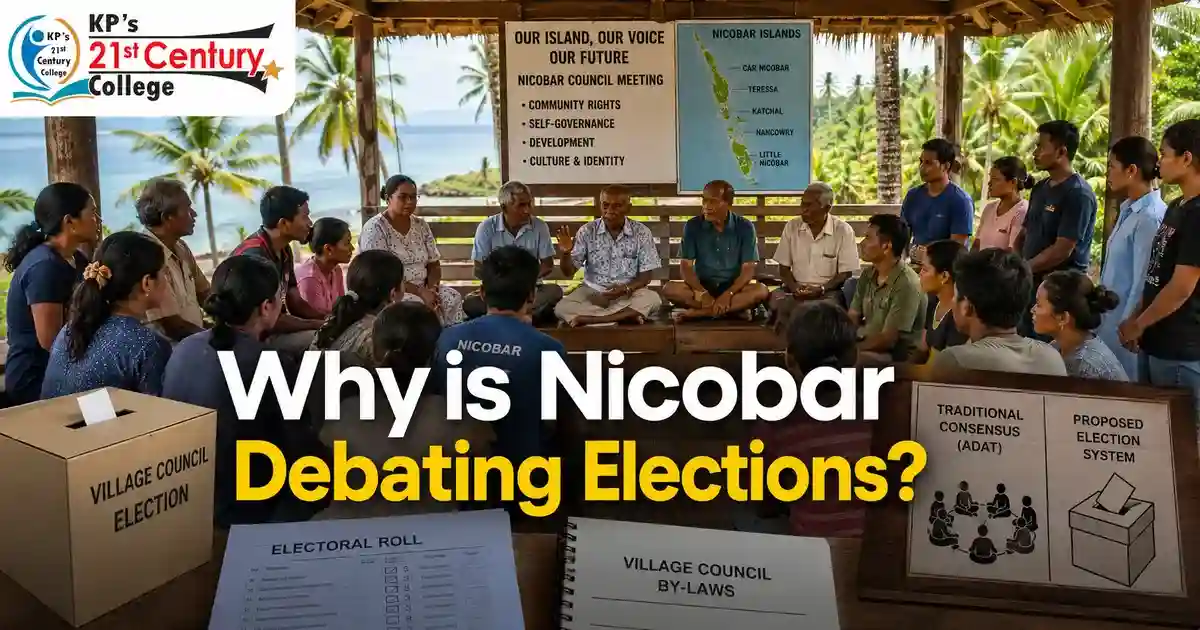
The draft Andaman and Nicobar Islands Tribal Councils (Preparation of Electoral Rolls and Conduct of Elections) Rules, 2026 seek to create electoral rolls, constituencies and reservation provisions for women in tribal councils. This has triggered debate among Nicobarese leaders, who fear that the rules may alter their traditional consensus-based self-governance system.

What do the Draft Rules Propose?
The draft rules propose a formal election system for Nicobarese tribal institutions.
Major Proposals
- Constitution of Village Councils and Tribal Councils through formal elections.
- Delimitation of constituencies.
- Preparation of electoral rolls.
- Reservation of seats and leadership positions for women.
- Election of five to nine Captains for each village.
- Direct voting for the post of Chief Captain of each Island Tribal Council.
- Election of other positions such as:
- Vice-Chief Captain
- First Captain
- All First Captains of the Island
- Formal administrative supervision of the election process.
How do Nicobarese Tribal Councils Function Today?
- The Nicobarese community has a long tradition of customary self-governance.
- Each inhabited island in the Nicobar group has its own Tribal Council.
- Village leadership is usually headed by Captains.
- Captains are assisted by:
- First Captain
- Second Captain
- Third Captain
- Tribal Councils represent Nicobarese communities in islands such as:
- Car Nicobar
- Nancowry
- Kamorta
- Teressa
- Little Nicobar
- Great Nicobar
- The traditional leadership structure evolved from community needs and customary practices.
How are Leaders Chosen Currently?
- Nicobarese leaders are generally chosen through community consensus.
- Villagers meet and discuss who should lead.
- Leadership is based on:
- Community trust
- Local reputation
- Ability to communicate with officials
- Education and exposure
- Practical understanding of village issues
- Some villages use simple local voting methods, but the process remains rooted in community consultation.
- The focus is not on political competition but on collective acceptance.
Why are the Proposed Changes Causing Concern?
1. Fear of Bureaucratisation
- Tribal leaders fear that a formal election system may convert customary leadership into a bureaucratic process.
- They worry that traditional decision-making may be replaced by official procedures.
2. Threat to Customary Governance
- Existing systems are based on consensus, consultation and village-level trust.
- Formal electoral rules may weaken flexible customary practices.
3. Lack of Consultation
- Several leaders argue that the community has not been adequately consulted.
- They say draft rules must be explained properly in local languages before implementation.
4. Possibility of Political Interference
- Formal elections may introduce party-style competition into tribal society.
- This could disturb community harmony and traditional leadership values.
5. Link with Great Nicobar Concerns
- Some leaders suspect that formalisation may make tribal councils more favourable to Union government projects.
- This concern is especially strong in the context of the proposed ₹91,000 crore Great Nicobar transshipment port, airport and tourism project.
Administration’s Argument
The administration argues that formal elections may bring:
- Clear electoral rules.
- Better representation.
- Defined constituencies.
- Reservation for women.
- More structured tribal governance.
- Greater transparency in leadership selection.
- Stronger link between the administration and tribal councils.
However, tribal leaders believe that reforms should not disturb the core of Nicobarese self-governance.
Larger Context: Great Nicobar and Tribal Rights
- Great Nicobar has become important due to proposed large infrastructure projects.
- These include:
- Transshipment port
- Airport
- Tourism-linked development
- Strategic infrastructure
- Nicobarese leaders have already raised concerns about environmental, social and cultural impacts.
- Therefore, changes to tribal council governance are being viewed with caution.
- The issue is not only about elections but also about tribal autonomy, land, culture and decision-making power.
Significance
- Highlights the tension between formal democratic procedures and customary tribal governance.
- Raises questions about how modern governance should interact with indigenous institutions.
- Shows the importance of consultation before changing tribal governance structures.
- Brings attention to the rights of island communities.
- Reflects the importance of decentralisation and local self-governance.
- Links governance reforms with larger development debates in Great Nicobar.
Challenges
- Balancing customary leadership with democratic accountability.
- Ensuring women’s representation without weakening traditional institutions.
- Preventing political competition from disturbing community harmony.
- Explaining draft rules clearly to local communities.
- Protecting tribal autonomy while improving governance transparency.
- Avoiding top-down decision-making.
- Ensuring that development projects do not bypass tribal consent.
Way Forward
- Conduct wide consultations with Nicobarese communities.
- Translate draft rules into local languages.
- Give enough time for tribal councils to understand and respond.
- Respect customary decision-making systems.
- Explore a hybrid model combining traditional consensus with democratic safeguards.
- Ensure women’s participation through culturally sensitive methods.
- Protect tribal autonomy in all development decisions.
- Follow principles of participatory governance and informed consent.
- Avoid imposing uniform governance models on distinct tribal societies.
Conclusion
The debate over elections in Nicobar is not merely about electoral rules. It is about the future of Nicobarese self-governance, customary authority and tribal autonomy.
Formal elections may improve transparency and representation, but they should not weaken community-based governance. A balanced approach must protect indigenous traditions while ensuring accountability, gender inclusion and democratic participation.