Relevance: APPSC Group-I: Science and Technology; Andhra Pradesh Current Affairs
For Prelims:
- Vikram-I, Skyroot Aerospace, Satish Dhawan Space Centre, Sriharikota, IN-SPACe, Low-Earth Orbit, First Launch Pad
For Mains:
- Private space economy, commercial launch services, space-sector reforms, public-private collaboration, small-satellite launch market, technology entrepreneurship
Why in News?
Hyderabad-based Skyroot Aerospace has successfully stacked the first stage of its Vikram-I rocket at the First Launch Pad of the Satish Dhawan Space Centre, Sriharikota.
This is the first time a privately designed, developed and manufactured orbital-class rocket has been stacked at ISRO’s First Launch Pad.

What is Vikram-I?
- Vikram-I is Skyroot Aerospace’s maiden orbital launch vehicle.
- It is designed to carry small satellites into Low-Earth Orbit and is currently undergoing final integration and technical testing.
- The vehicle is part of India’s growing commercial launch ecosystem, which seeks to meet the rising demand for affordable and flexible small-satellite launches.
Why is the Stacking Milestone Important?
First private orbital rocket at the pad:
- The event marks the first stacking of a privately developed orbital-class launch vehicle at ISRO’s First Launch Pad.
Transition from development to launch preparation:
- Stacking indicates that individual stages are being assembled into a flight-ready vehicle.
Use of national launch infrastructure:
- The milestone demonstrates how private companies can access ISRO facilities for commercial space missions.
Proximity to maiden orbital flight:
- With integration and testing underway, Vikram-I has moved closer to its first orbital launch.
Institutional Ecosystem
Skyroot Aerospace
- Skyroot Aerospace is a Hyderabad-based private space start-up engaged in the design and development of launch vehicles.
- Its Vikram series is intended to provide launch services for small satellites.
ISRO
- The Indian Space Research Organisation provides launch infrastructure, technical facilities and range support at Sriharikota.
- The First Launch Pad has previously supported major missions, including Chandrayaan and the Mars Orbiter Mission.
IN-SPACe
The Indian National Space Promotion and Authorisation Centre facilitates and authorises private-sector space activities.
For the Vikram-I mission, final scheduling will depend on:
- Completion of technical integration tests
- Safety and mission clearances
- Range availability
- Coordination with IN-SPACe and launch authorities
Significance for India’s Private Space Sector
Commercial launch capability:
Vikram-I can strengthen India’s capacity to serve the global small-satellite launch market.
Validation of private-sector reforms:
The milestone reflects the outcome of reforms that opened India’s space sector to non-government entities.
Start-up innovation:
It demonstrates the growing role of Indian start-ups in advanced engineering, propulsion and launch-vehicle development.
Public-private collaboration:
The use of ISRO infrastructure by a private company shows a shift from a government-dominated model to a collaborative space ecosystem.
Regional innovation hub:
Skyroot’s progress reinforces Hyderabad’s position as an emerging centre for aerospace and deep-technology enterprises.
Strategic capability:
Domestic private launch capacity can improve India’s technological self-reliance and reduce dependence on foreign launch providers.
Way Forward
- Complete all technical tests with strong safety assurance.
- Build a reliable pipeline of domestic and international satellite customers.
- Expand access to shared testing and launch infrastructure.
- Encourage private investment in propulsion, avionics and satellite manufacturing.
- Strengthen coordination among ISRO, IN-SPACe, NSIL and private companies.
- Support research partnerships between start-ups, universities and public institutions.
- Develop dedicated launch facilities for commercial missions as demand grows.
- Ensure that rapid commercialisation is matched by safety, accountability and regulatory clarity.
Conclusion
The stacking of Vikram-I at Sriharikota marks a significant step in India’s transition towards a broader and more competitive space economy.
The milestone is important not only for Skyroot Aerospace but also for India’s private space ecosystem. Its lasting significance will depend on a successful orbital launch, reliable commercial operations and continued cooperation between public institutions and private innovators.
CARE MCQ
Q. Consider the following statements regarding Vikram-I:
- It is an orbital launch vehicle developed by Skyroot Aerospace.
- It is designed primarily to place small satellites in Low-Earth Orbit.
- It is the first privately developed orbital-class rocket to be stacked at ISRO’s First Launch Pad.
- IN-SPACe has no role in coordinating private space launches in India.
Which of the statements given above are correct?
A. 1 and 2 only
B. 1, 2 and 3 only
C. 2, 3 and 4 only
D. 1, 2, 3 and 4
Answer: B
Explanation
Statement 1 is correct: Vikram-I has been developed by Hyderabad-based Skyroot Aerospace.
Statement 2 is correct: It is intended to carry small satellites into Low-Earth Orbit.
Statement 3 is correct: Its stacking at Sriharikota marks the first such event involving a privately developed orbital-class rocket at ISRO’s First Launch Pad.
Statement 4 is incorrect: IN-SPACe facilitates, authorises and coordinates private-sector space activities in India.
FAQs
1. What is Vikram-I?
Vikram-I is Skyroot Aerospace’s maiden orbital launch vehicle for carrying small satellites into Low-Earth Orbit.
2. Which company developed Vikram-I?
It was developed by Skyroot Aerospace, a Hyderabad-based private space start-up.
3. Where was the first stage stacked?
It was stacked at the First Launch Pad of the Satish Dhawan Space Centre, Sriharikota.
4. Why is this milestone important?
It is the first time a privately developed orbital-class rocket has been stacked at ISRO’s First Launch Pad.
5. What is Low-Earth Orbit?
Low-Earth Orbit is the region of space relatively close to Earth where many communication, imaging and scientific satellites operate.
6. What is IN-SPACe?
IN-SPACe is the government body that promotes, facilitates and authorises private space activities in India.
Relevance: UPSC GS Paper II: Public Health, Nutrition, Women and Child Welfare, Government Policies and Interventions
For Prelims:
- Anaemia Mukt Bharat Abhiyaan, 7×7×7 Framework, T4 Strategy, Iron-Folic Acid, WIFS, PMSMA, JANANI Portal, RBSK, U-WIN
For Mains:
- Lifecycle approach, therapeutic anaemia management, continuum of care, intergenerational malnutrition, digital health tracking, Jan Bhagidari, whole-of-government approach
Why in News?
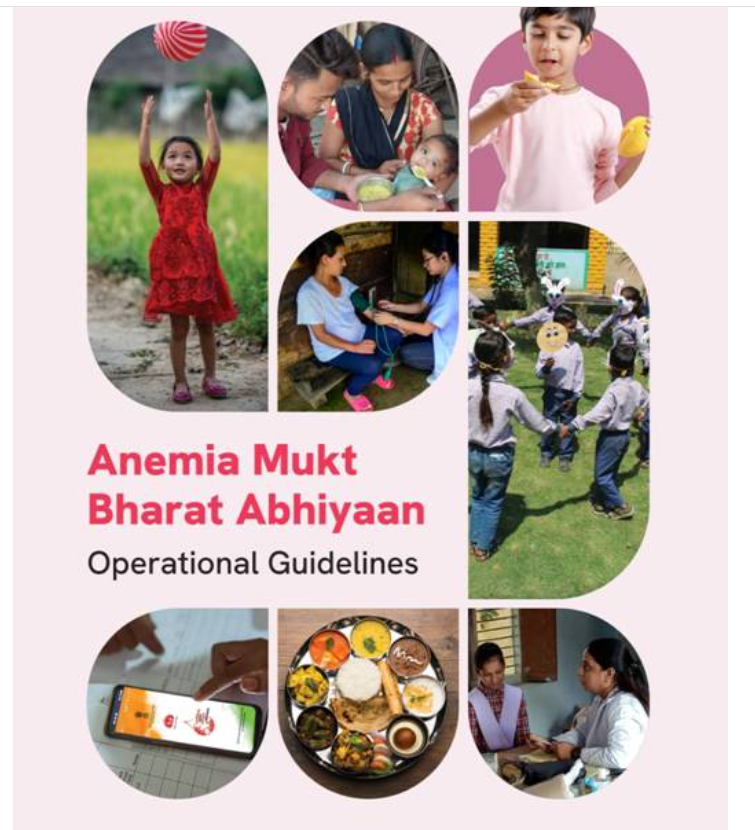
The Union Health Ministry released the revised Anaemia Mukt Bharat Abhiyaan Operational Guidelines during the 16th meeting of the Central Council of Health and Family Welfare.The revised framework marks a shift from preventive supplementation alone to a broader model based on testing, therapeutic treatment, dietary improvement, digital tracking and community participation.
What is Anaemia?
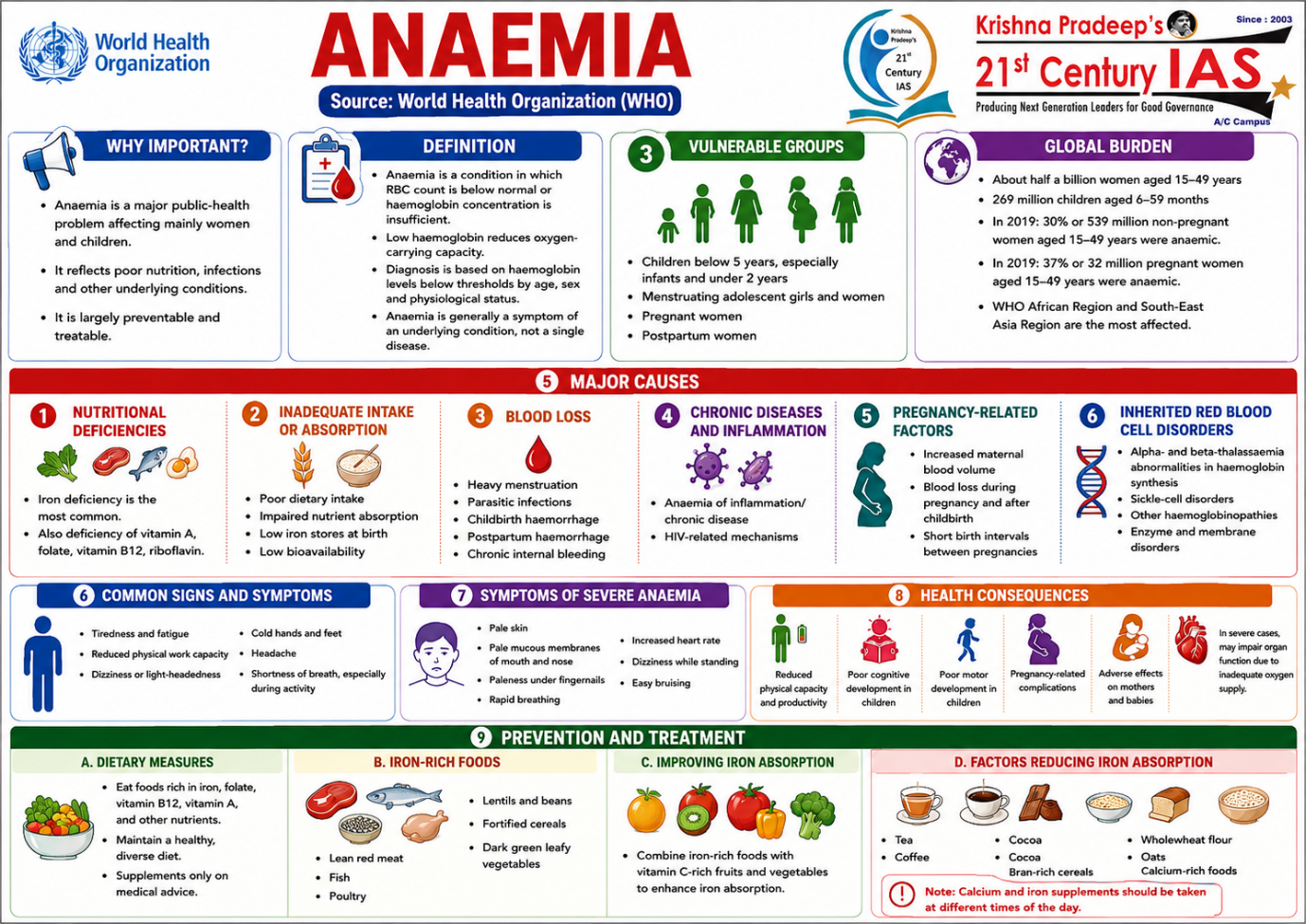
- Anaemia is a condition in which the number of red blood cells or their oxygen-carrying capacity is insufficient to meet the body’s physiological needs.
Its major causes include:
- Iron deficiency
- Folate, vitamin B12 and vitamin A deficiencies
- Parasitic infections
- Malaria
- Chronic inflammation
- Inherited blood disorders
According to the WHO:
- Women of reproductive age with haemoglobin below 12 g/dL are considered anaemic.
- Children below five years with haemoglobin below 11 g/dL are considered anaemic.
Burden of Anaemia
Anaemia affects health, learning ability and productivity.
Health effects
- Fatigue, weakness and dizziness
- Reduced immunity
- Poor concentration
- Impaired cognitive and motor development in children
- Prematurity, perinatal loss and low birth weight during pregnancy
Vulnerable groups
The burden is highest among:
- Children below five years
- Menstruating adolescent girls
- Pregnant women
- Postpartum women
Extent of the problem
Globally, anaemia affects:
- 40% of children aged 6–59 months
- 37% of pregnant women
- 30% of non-pregnant women aged 15–49 years
According to NFHS-5, anaemia in India affects:
- 67.1% of children below five years
- 59.1% of adolescent girls aged 15–19 years
- 57% of women aged 15–49 years
- 52.2% of pregnant women
What is Anaemia Mukt Bharat?
- Anaemia Mukt Bharat was launched in 2018 under the National Health Mission.
- It adopted a lifecycle approach to address nutritional and non-nutritional causes of anaemia among children, adolescents, women of reproductive age and pregnant and lactating women.
- Its objective was to combine prevention, screening, treatment and behaviour change.
Original 6×6×6 Strategy
The earlier framework consisted of:
- Six beneficiary groups
- Six interventions
- Six institutional mechanisms
Its important interventions included:
Iron-Folic Acid supplementation:
Age-specific IFA supplementation was provided to children, adolescents, non-pregnant women and pregnant women.
Biannual deworming:
Albendazole was administered to children and adolescents to control worm infestation.
Testing and treatment:
Haemoglobin screening and treatment were promoted through health facilities and outreach services.
Food fortification:
Iron-fortified foods were included in public nutrition programmes.
Behaviour-change communication:
Families were counselled on dietary habits, supplementation and treatment adherence.
Management of non-nutritional causes:
The programme also addressed malaria, fluorosis and haemoglobinopathies such as sickle-cell disease.
Transition to Anaemia Mukt Bharat Abhiyaan
The revised programme expands the earlier model in four important ways:
- Moves from prophylactic care to therapeutic care
- Adds systematic follow-up and tracking
- Introduces the Eating Right approach
- Strengthens community participation through Jan Chetna and Jan Bhagidari
The change recognises that supplementation alone cannot reduce anaemia without diagnosis, treatment compliance and follow-up.
New 7×7×7 Framework
The earlier 6×6×6 model has been expanded into a 7×7×7 framework.
Seventh Beneficiary Group
- Low Birth Weight babies aged 0–6 months have been added.
- Their inclusion seeks to break the intergenerational cycle of maternal and childhood anaemia at the earliest stage.
Seventh Intervention
The Eating Right approach promotes:
- Iron-rich foods
- Diversified diets
- Conscious daily food choices
- Improved household nutrition practices
Seventh Institutional Mechanism
- A strengthened Monitoring and Evaluation framework has been introduced for digital tracking and programme planning.
T4 Strategy
The earlier **T3 approach—Test, Treat and Talk—**has been expanded into T4: Test, Treat, Talk and Track.
Test:
Identify anaemia through haemoglobin screening.
Treat:
Provide treatment according to severity and clinical protocols.
Talk:
Counsel beneficiaries on food, supplementation and treatment adherence.
Track:
Monitor referral, follow-up and response to treatment.
The addition of tracking is intended to prevent beneficiaries from dropping out after screening.
Therapeutic Management
- For severe anaemia and non-responders among pregnant and lactating women, the revised guidelines include intravenous iron therapy.
The approved interventions include:
- Ferric Carboxymaltose
- Iron Sucrose
This reflects the programme’s shift from routine supplementation to case-based clinical treatment.
Digital Tracking Architecture
The revised framework establishes a unified Anaemia Mukt Bharat Abhiyaan Portal.
It will integrate records from:
- JANANI Portal: Pregnant women
- RBSK Portal: Child health screening
- U-WIN Portal: Immunisation-linked child records
The digital system will track the full continuum of care:
- Screening
- Haemoglobin testing
- Counselling
- Treatment
- Referral
- Follow-up
This can improve accountability and help identify regional or beneficiary-level gaps.
Related Government Initiatives
Weekly Iron and Folic Acid Supplementation
- The WIFS programme provides supervised weekly IFA tablets to adolescent girls and boys,It also includes biannual deworming with Albendazole.
Universal Screening of Pregnant Women
Anaemia screening forms part of antenatal care.
Pregnant women receive IFA tablets through:
- Sub-centres
- Primary Health Centres
- Other public health facilities
- Village Health and Nutrition Days
Pradhan Mantri Surakshit Matritva Abhiyan
Under PMSMA, special antenatal check-ups are conducted on the 9th of every month to detect and manage high-risk pregnancies, including anaemia.
Mother and Child Tracking Systems
Digital systems are used to report and monitor anaemic and severely anaemic pregnant women.
Blood Banks and Storage Units
District hospitals and sub-district facilities are being strengthened to manage complications arising from severe anaemia.
Governance and Community Participation
- Health is a State subject, and implementation rests mainly with States and Union Territories.
- The Union government provides technical and financial support through the National Health Mission.
The revised programme adopts:
Jan Bhagidari:
Community participation in prevention, treatment and awareness.
Jan Chetna:
Public awareness aimed at de-normalising fatigue, weakness and poor nutrition.
Significance
Lifecycle coverage:
The programme addresses anaemia from infancy to adulthood.
Intergenerational impact:
Including low-birth-weight babies can help interrupt the cycle of maternal and childhood anaemia.
Therapeutic orientation:
Severe cases will receive active treatment instead of supplementation alone.
Digital accountability:
Integrated tracking can improve referral and follow-up.
Maternal and child health:
Reduced anaemia can contribute to lower IMR and MMR.
Human-capital gains:
Better nutrition can improve learning, productivity and long-term development.
Key Challenges
- Inadequate haemoglobin testing in remote areas
- Poor compliance with IFA supplementation
- Side effects leading to treatment discontinuation
- Limited access to diversified diets
- Weak follow-up after screening
Way Forward
- Ensure routine haemoglobin testing in schools, Anganwadi Centres and health facilities.
- Strengthen the availability of IFA supplements and therapeutic iron.
- Improve counselling on side effects and treatment adherence.
- Promote affordable, region-specific iron-rich diets.
- Expand screening for malaria, fluorosis and haemoglobin disorders.
- Train ASHAs, Anganwadi workers and health personnel in referral and follow-up.
- Ensure interoperability and accurate data entry across portals.
- Use schools, SHGs and local bodies for sustained Jan Chetna campaigns.
Conclusion
The Anaemia Mukt Bharat Abhiyaan marks a shift from a supplementation-centred programme to a comprehensive system of testing, treatment, counselling and tracking.
Its success will depend on effective State implementation, timely diagnosis, dietary improvement, digital follow-up and community participation. By treating anaemia as a lifecycle and cross-sectoral challenge, India can improve maternal and child health and strengthen human development.
UPSC PYQ
Q. Consider the following statements in the context of interventions being undertaken under the Anaemia Mukt Bharat Strategy:
- It provides prophylactic calcium supplementation for pre-school children, adolescents and pregnant women.
- It runs a campaign for delayed cord clamping at the time of childbirth.
- It provides for periodic deworming of children and adolescents.
- It addresses non-nutritional causes of anaemia in endemic pockets, with special focus on malaria, haemoglobinopathies and fluorosis.
How many of the statements given above are correct?
A. Only one
B. Only two
C. Only three
D. All four
Answer: C
Explanation
Statement 1 is incorrect:
Anaemia Mukt Bharat provides prophylactic Iron and Folic Acid supplementation, not calcium supplementation. Iron and folic acid help in the formation of haemoglobin and prevent nutritional anaemia among children, adolescents and pregnant women.
Statement 2 is correct:
The strategy promotes delayed cord clamping at the time of childbirth. Delaying the clamping of the umbilical cord for a short period allows additional blood to pass from the placenta to the newborn. This improves the infant’s iron stores and reduces the risk of anaemia during early infancy.
Statement 3 is correct:
Anaemia Mukt Bharat provides for periodic deworming of children and adolescents, generally using Albendazole. Intestinal worms can cause blood loss and reduce the absorption of nutrients, thereby contributing to anaemia.
Statement 4 is correct:
The strategy also addresses non-nutritional causes of anaemia in endemic areas. These include:
- Malaria, which destroys red blood cells
- Haemoglobinopathies, such as sickle-cell disease and thalassaemia
- Fluorosis, which may interfere with normal blood formation
Therefore, Statements 2, 3 and 4 are correct, while Statement 1 is incorrect.
CARE MCQ
Q. Consider the following statements regarding Anaemia Mukt Bharat Abhiyaan:
- It expands the earlier 6×6×6 strategy into a 7×7×7 framework.
- Low Birth Weight babies aged 0–6 months have been added as a beneficiary group.
- The T4 strategy stands for Test, Treat, Talk and Track.
- The revised guidelines exclude intravenous iron therapy for severe anaemia.
Which of the statements given above are correct?
A. 1 and 2 only
B. 1, 2 and 3 only
C. 2, 3 and 4 only
D. 1, 2, 3 and 4
Answer: B
Explanation
Statement 1 is correct: The revised programme adopts a 7×7×7 framework.
Statement 2 is correct: Low Birth Weight babies aged 0–6 months are the new beneficiary group.
Statement 3 is correct: T4 means Test, Treat, Talk and Track.
Statement 4 is incorrect: Intravenous iron therapy is included for severe cases and non-responders among pregnant and lactating women.
FAQs
1. What is Anaemia Mukt Bharat Abhiyaan?
It is the revised national programme for preventing, diagnosing, treating and tracking anaemia across the lifecycle.
2. When was Anaemia Mukt Bharat launched?
It was launched in 2018 under the National Health Mission.
3. What causes anaemia?
The major causes are iron deficiency, vitamin deficiencies, infections, chronic inflammation and inherited blood disorders.
4. What was the earlier strategy?
The original programme followed a 6×6×6 strategy.
5. What is the new framework?
The revised programme follows a 7×7×7 framework.
6. Who is the new beneficiary group?
Low Birth Weight babies aged 0–6 months.
7. What is the new intervention?
The Eating Right approach, which promotes diversified and iron-rich diets.
8. What does T4 stand for?
Test, Treat, Talk and Track.
Relevance: UPSC GS Paper III: Indian Economy, Taxation, Formalisation and Ease of Doing Business
For Prelims:
- GST, 101st Constitutional Amendment, Articles 246A, 269A and 279A, GST Council, GSTN, CGST, SGST, UTGST, IGST
For Mains:
- One Nation, One Tax, destination-based taxation, cooperative federalism, Input Tax Credit, tax formalisation, digital tax administration, common national market
Why in News?
The Goods and Services Tax completed nine years on July 1, 2026. Introduced in 2017, GST replaced multiple Central and State indirect taxes with an integrated tax framework. Over the years, rate rationalisation, digital compliance systems and Centre–State coordination has strengthened its role in creating a common national market.
What is GST?
- The Goods and Services Tax is an indirect tax levied on the supply of goods and services for domestic consumption.
- Although consumers ultimately bear the tax, businesses collect it at the point of sale and deposit it with the government.
- GST is imposed on the value added at each stage of the supply chain. Through Input Tax Credit, a business can deduct the tax already paid on inputs from its final tax liability, thereby reducing the cascading effect of taxation.
Evolution of GST in India
2003:
- The Kelkar Task Force on Indirect Taxes recommended the introduction of a comprehensive GST.
2006:
- The Union Budget proposed the implementation of a national GST.
2014:
- The Constitution Amendment Bill was introduced as the 122nd Constitutional Amendment Bill.
2016:
- The Bill was enacted as the Constitution (101st Amendment) Act, 2016.
2017:
- GST came into force across India on July 1, 2017.
- It subsumed 17 taxes and 13 cesses, replacing a fragmented indirect-tax system with a more uniform framework.
Constitutional Framework
Article 246A
- It grants Parliament and State Legislatures concurrent powers to make GST laws.
- However, Parliament has exclusive authority to legislate on GST relating to inter-State trade or commerce.
Article 269A
- It deals with GST on inter-State supplies.
- The Union government levies and collects the tax, which is then apportioned between the Centre and States.
Article 279A
- It provides for the establishment of the GST Council by the President.
- The Council recommends tax rates, exemptions, threshold limits, procedural rules and special provisions.
Salient Features of GST
Tax on supply:
- GST is levied on the supply of goods and services rather than separately on manufacture, sale or service.
Destination-based tax:
- Tax revenue generally accrues to the State where the final consumption takes place.
Value-added taxation:
- Input Tax Credit prevents repeated taxation of the same value.
Dual structure:
- Both the Union and State governments levy GST on intra-State supplies.
Common national market:
- Uniform principles reduce internal tax barriers and support inter-State trade.
Digital administration:
- Registration, return filing, tax payment, invoice reporting and refund processing are largely electronic.
Components of GST
Central Goods and Services Tax
- CGST is levied by the Union government on intra-State supplies.
State Goods and Services Tax
- SGST is levied by the concerned State government on the same intra-State transaction.
Union Territory Goods and Services Tax
- UTGST applies to intra-Union Territory supplies in applicable Union Territories, together with CGST.
Integrated Goods and Services Tax
- IGST is levied by the Union government on inter-State supplies and imports. Its proceeds are shared with the destination State.
Taxes Subsumed under GST
Major Central levies
GST replaced taxes such as:
- Service Tax
- Central Excise Duty on covered goods
- Additional Duties of Customs
- Special Additional Duty of Customs
- Relevant Central cesses and surcharges
Major State levies
It subsumed:
- State VAT or Sales Tax on covered goods
- Purchase Tax
- Luxury Tax
- Entry Tax and Octroi
- Entertainment Tax, except local-body levies
- Taxes on lotteries, betting and gambling
- Relevant State cesses and surcharges
Items and Levies Outside GST
Alcoholic liquor for human consumption
It remains outside the scope of GST and is taxed by States.
Petroleum products
GST may be imposed on the following products from a date recommended by the GST Council:
- Petroleum crude
- Petrol
- High-Speed Diesel
- Natural gas
- Aviation Turbine Fuel
Until then, excise duty and State VAT continue to apply.
Other independent levies
These include:
- Basic Customs Duty
- Stamp Duty
- Motor Vehicle Tax
- Electricity Duty
- Toll Tax
- Anti-dumping and safeguard duties
- Certain local-body taxes
GST Council and Cooperative Federalism
The GST Council is a constitutional body under Article 279A.
It brings the Union and States together to decide:
- Tax rates
- Exemptions
- Threshold limits
- Model laws
- Procedural rules
- Special provisions for States
Because both levels of government share the GST base, the Council has become an important institution of cooperative fiscal federalism.
Goods and Services Tax Network
The GSTN provides the digital infrastructure for the GST system.
It supports:
- Registration
- Return filing
- Electronic payments
- Refunds
- E-invoicing
- Input Tax Credit matching
- Data exchange among tax authorities
GSTN connects the Centre, States, taxpayers and other stakeholders through a common technological platform.
Next-Generation GST Reforms
The 56th meeting of the GST Council approved a new phase of reforms that came into effect in September 2025.
Simplified rate structure:
The tax system was primarily reorganised around the 5% and 18% slabs.
Luxury and sin goods:
A higher 40% rate was introduced for specified luxury and demerit goods.
Consumer relief:
Rate reductions and exemptions were aimed at improving affordability of selected essential goods and services.
Correction of inverted duty structures:
Changes sought to reduce situations where tax on inputs exceeded tax on finished products.
Easier compliance:
Registration, refunds and return filing were simplified, especially for MSMEs and start-ups.
Relief for MSMEs and Small Taxpayers
Higher registration threshold
- The GST registration threshold for suppliers of goods was increased from ₹20 lakh to ₹40 lakh, subject to applicable conditions.
Composition Scheme
- Eligible small taxpayers can pay tax at a prescribed rate on turnover with simpler return and record requirements.
The turnover limit was raised to ₹1.5 crore for eligible taxpayers.
QRMP Scheme
- The Quarterly Return Monthly Payment Scheme allows taxpayers with annual turnover up to ₹5 crore to file returns quarterly while paying tax monthly.
NIL returns through SMS
- Taxpayers with no transactions can file specified NIL returns using SMS.
E-commerce relief
- Eligible small suppliers making intra-State supplies through e-commerce operators were exempted from compulsory registration under prescribed conditions.
Dispute relief
- Measures were introduced to reduce appeal pre-deposits and provide conditional waiver of interest and penalties for certain past demands.
Technology-Driven Tax Administration
E-invoicing:
Real-time invoice reporting improves accuracy and reduces fake invoicing.
Automated reconciliation:
Supplier tax liability is matched with the recipient’s Input Tax Credit claims.
Pre-filled returns:
System-generated information reduces repetitive reporting and manual errors.
Artificial Intelligence and analytics:
AI and machine learning identify suspicious registrations, invoice patterns and tax-evasion risks.
Risk-based scrutiny:
Authorities can focus on high-risk taxpayers while reducing unnecessary intervention for compliant businesses.
This shift has made tax administration more transparent, data-driven and predictable.
Major Achievements
Unified national market:
GST reduced internal tax barriers and improved the movement of goods and services across States.
Reduction of cascading:
Input Tax Credit lowered the burden of tax on tax.
Wider tax base:
The number of registered GST taxpayers increased from about 66.5 lakh in 2017 to 1.65 crore by May 2026.
Higher collections:
Gross GST collections increased from approximately ₹7.4 lakh crore in 2017–18 to ₹22.27 lakh crore in 2025–26.
Economic formalisation:
Digital invoices and return filing brought more firms and transactions into the formal economy.
Ease of doing business:
A common framework replaced multiple State-level tax procedures.
Transparency:
Electronic records created an auditable trail for transactions and tax payments.
Revenue buoyancy:
Improved compliance and reporting strengthened fiscal transparency and predictability.
Way Forward
- Continue rate rationalisation while safeguarding revenue stability.
- Reduce classification disputes and inverted duty structures.
- Make refunds faster and largely automated.
- Protect genuine Input Tax Credit claimants through proportionate enforcement.
- Strengthen GSTN capacity, cybersecurity and grievance redressal.
- Use AI-based scrutiny transparently and fairly.
- Consider phased inclusion of petroleum products through GST Council consensus.
Conclusion
GST is one of India’s most important structural tax reforms. It replaced a fragmented indirect-tax system with a destination-based, digitally administered and nationally integrated framework. Its achievements include a wider tax base, higher collections, reduced cascading and greater formalisation. However, GST remains an evolving reform. The next phase should focus on simpler rates, easier compliance, faster refunds, stable State finances and taxpayer trust.
UPSC PYQ
Q. GST is a/an (CAPF/2022)
A. Destination-based consumption tax
B. Origin-based production tax
C. Destination-based sales tax on transaction
D. Origin-based tax on sales transaction
Answer: A
Explanation
The Goods and Services Tax (GST) is a comprehensive indirect tax imposed on the supply of goods and services.
GST is described as a destination-based consumption tax because the tax revenue goes to the State or jurisdiction where the goods or services are finally consumed, rather than where they are produced.
For example, if a product is manufactured in Gujarat but consumed in Telangana, the tax revenue belongs primarily to Telangana, which is the destination State.
In the case of inter-State supply, Integrated GST (IGST) is collected by the Central Government and later apportioned between the Centre and the destination State.
Thus, GST follows the principle of taxation at the place of consumption.
CARE MCQ
Q. Consider the following statements regarding the Goods and Services Tax in India:
- GST is levied on the supply of goods and services.
- Article 246A gives concurrent GST law-making powers to Parliament and State Legislatures.
- GST is an origin-based tax under which revenue accrues to the producing State.
- IGST is imposed on inter-State supplies.
Which of the statements given above are correct?
A. 1 and 2 only
B. 1, 2 and 4 only
C. 2, 3 and 4 only
D. 1, 2, 3 and 4
Answer: B
Explanation
Statement 1 is correct: GST is imposed on the supply of goods and services.
Statement 2 is correct: Article 246A grants concurrent powers to Parliament and State Legislatures, subject to Parliament’s exclusive power over inter-State supplies.
Statement 3 is incorrect: GST is a destination-based tax, so revenue generally accrues to the place of consumption.
Statement 4 is correct: IGST applies to inter-State supplies and imports.
FAQs
1. What is GST?
GST is an indirect tax levied on the supply of goods and services.
2. When was GST implemented?
GST came into force on July 1, 2017.
3. Which amendment introduced GST?
The Constitution (101st Amendment) Act, 2016.
4. Which constitutional Articles deal with GST?
The key Articles are 246A, 269A and 279A.
5. Why is GST called a destination-based tax?
Its revenue generally goes to the State where the goods or services are consumed.
6. What is Input Tax Credit?
It allows a registered business to deduct tax paid on eligible inputs from its output-tax liability.
7. What is CGST?
CGST is the Central tax levied on intra-State supplies.
8. What is SGST?
SGST is the State tax levied on intra-State supplies.
9. What is IGST?
IGST is levied on inter-State supplies and imports.
10. What is UTGST?
UTGST is imposed on intra-Union Territory supplies in applicable Union Territories.