Why in News?
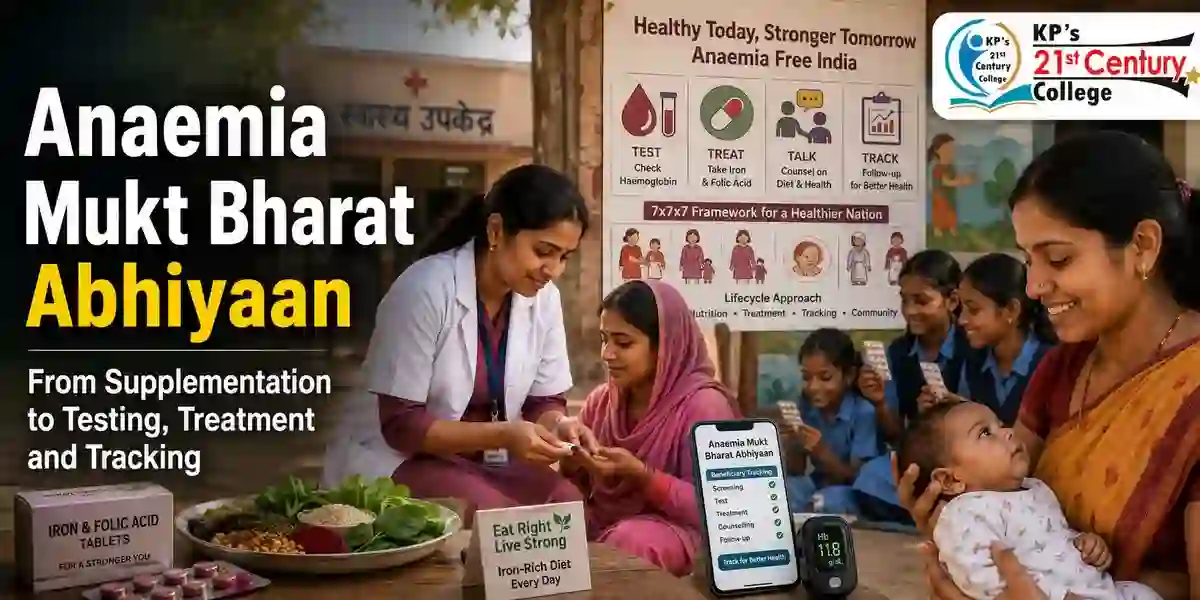
The Union Health Ministry released the revised Anaemia Mukt Bharat Abhiyaan Operational Guidelines during the 16th meeting of the Central Council of Health and Family Welfare.The revised framework marks a shift from preventive supplementation alone to a broader model based on testing, therapeutic treatment, dietary improvement, digital tracking and community participation.
What is Anaemia?
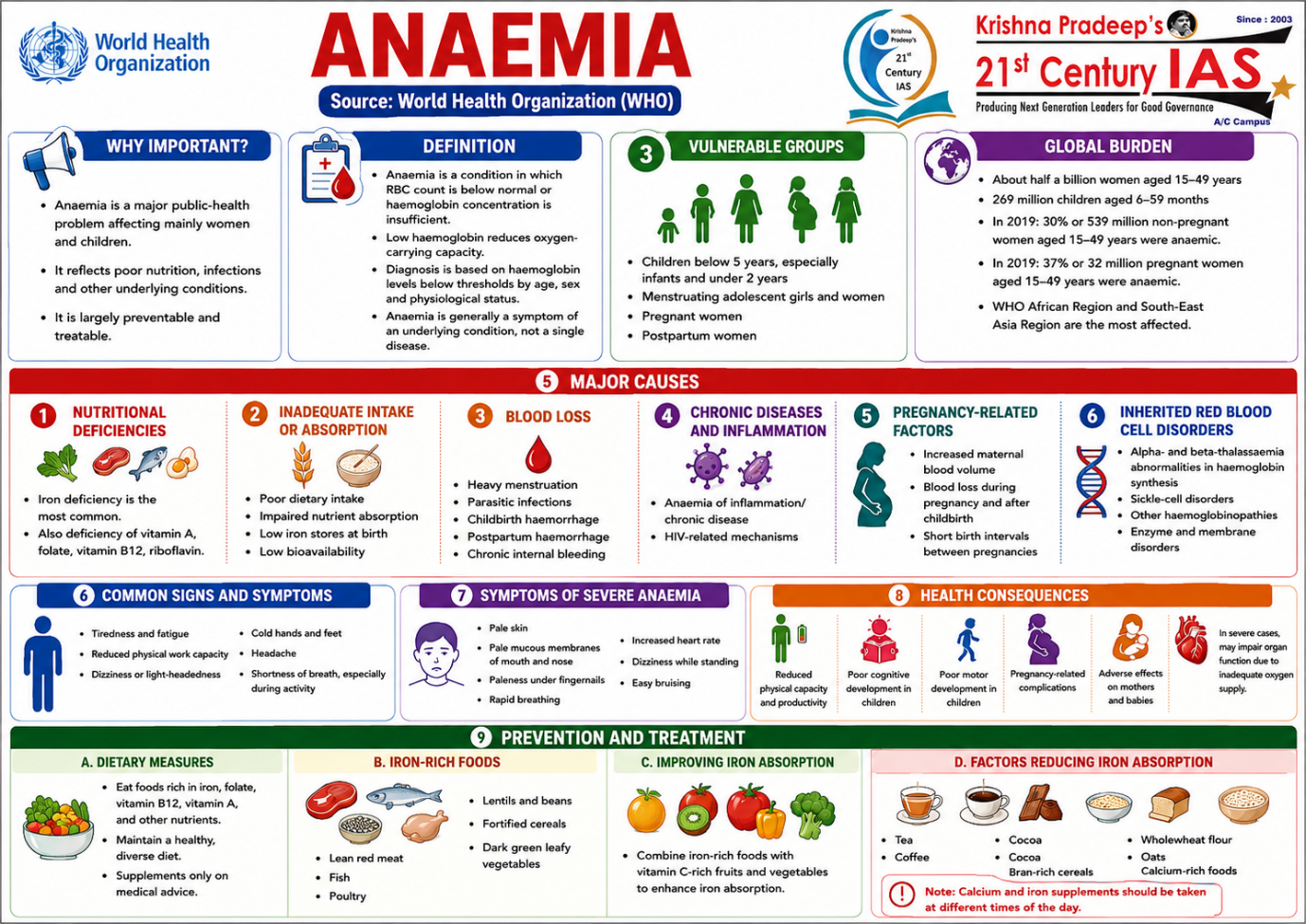
- Anaemia is a condition in which the number of red blood cells or their oxygen-carrying capacity is insufficient to meet the body’s physiological needs.
Its major causes include:
- Iron deficiency
- Folate, vitamin B12 and vitamin A deficiencies
- Parasitic infections
- Malaria
- Chronic inflammation
- Inherited blood disorders
According to the WHO:
- Women of reproductive age with haemoglobin below 12 g/dL are considered anaemic.
- Children below five years with haemoglobin below 11 g/dL are considered anaemic.
Burden of Anaemia
Anaemia affects health, learning ability and productivity.
Health effects
- Fatigue, weakness and dizziness
- Reduced immunity
- Poor concentration
- Impaired cognitive and motor development in children
- Prematurity, perinatal loss and low birth weight during pregnancy
Vulnerable groups
The burden is highest among:
- Children below five years
- Menstruating adolescent girls
- Pregnant women
- Postpartum women
Extent of the problem
Globally, anaemia affects:
- 40% of children aged 6–59 months
- 37% of pregnant women
- 30% of non-pregnant women aged 15–49 years
According to NFHS-5, anaemia in India affects:
- 67.1% of children below five years
- 59.1% of adolescent girls aged 15–19 years
- 57% of women aged 15–49 years
- 52.2% of pregnant women
What is Anaemia Mukt Bharat?
- Anaemia Mukt Bharat was launched in 2018 under the National Health Mission.
- It adopted a lifecycle approach to address nutritional and non-nutritional causes of anaemia among children, adolescents, women of reproductive age and pregnant and lactating women.
- Its objective was to combine prevention, screening, treatment and behaviour change.
Original 6×6×6 Strategy
The earlier framework consisted of:
- Six beneficiary groups
- Six interventions
- Six institutional mechanisms
Its important interventions included:
Iron-Folic Acid supplementation:
Age-specific IFA supplementation was provided to children, adolescents, non-pregnant women and pregnant women.
Biannual deworming:
Albendazole was administered to children and adolescents to control worm infestation.
Testing and treatment:
Haemoglobin screening and treatment were promoted through health facilities and outreach services.
Food fortification:
Iron-fortified foods were included in public nutrition programmes.
Behaviour-change communication:
Families were counselled on dietary habits, supplementation and treatment adherence.
Management of non-nutritional causes:
The programme also addressed malaria, fluorosis and haemoglobinopathies such as sickle-cell disease.
Transition to Anaemia Mukt Bharat Abhiyaan
The revised programme expands the earlier model in four important ways:
- Moves from prophylactic care to therapeutic care
- Adds systematic follow-up and tracking
- Introduces the Eating Right approach
- Strengthens community participation through Jan Chetna and Jan Bhagidari
The change recognises that supplementation alone cannot reduce anaemia without diagnosis, treatment compliance and follow-up.
New 7×7×7 Framework
The earlier 6×6×6 model has been expanded into a 7×7×7 framework.
Seventh Beneficiary Group
- Low Birth Weight babies aged 0–6 months have been added.
- Their inclusion seeks to break the intergenerational cycle of maternal and childhood anaemia at the earliest stage.
Seventh Intervention
The Eating Right approach promotes:
- Iron-rich foods
- Diversified diets
- Conscious daily food choices
- Improved household nutrition practices
Seventh Institutional Mechanism
- A strengthened Monitoring and Evaluation framework has been introduced for digital tracking and programme planning.
T4 Strategy
The earlier **T3 approach—Test, Treat and Talk—**has been expanded into T4: Test, Treat, Talk and Track.
Test:
Identify anaemia through haemoglobin screening.
Treat:
Provide treatment according to severity and clinical protocols.
Talk:
Counsel beneficiaries on food, supplementation and treatment adherence.
Track:
Monitor referral, follow-up and response to treatment.
The addition of tracking is intended to prevent beneficiaries from dropping out after screening.
Therapeutic Management
- For severe anaemia and non-responders among pregnant and lactating women, the revised guidelines include intravenous iron therapy.
The approved interventions include:
- Ferric Carboxymaltose
- Iron Sucrose
This reflects the programme’s shift from routine supplementation to case-based clinical treatment.
Digital Tracking Architecture
The revised framework establishes a unified Anaemia Mukt Bharat Abhiyaan Portal.
It will integrate records from:
- JANANI Portal: Pregnant women
- RBSK Portal: Child health screening
- U-WIN Portal: Immunisation-linked child records
The digital system will track the full continuum of care:
- Screening
- Haemoglobin testing
- Counselling
- Treatment
- Referral
- Follow-up
This can improve accountability and help identify regional or beneficiary-level gaps.
Related Government Initiatives
Weekly Iron and Folic Acid Supplementation
- The WIFS programme provides supervised weekly IFA tablets to adolescent girls and boys,It also includes biannual deworming with Albendazole.
Universal Screening of Pregnant Women
Anaemia screening forms part of antenatal care.
Pregnant women receive IFA tablets through:
- Sub-centres
- Primary Health Centres
- Other public health facilities
- Village Health and Nutrition Days
Pradhan Mantri Surakshit Matritva Abhiyan
Under PMSMA, special antenatal check-ups are conducted on the 9th of every month to detect and manage high-risk pregnancies, including anaemia.
Mother and Child Tracking Systems
Digital systems are used to report and monitor anaemic and severely anaemic pregnant women.
Blood Banks and Storage Units
District hospitals and sub-district facilities are being strengthened to manage complications arising from severe anaemia.
Governance and Community Participation
- Health is a State subject, and implementation rests mainly with States and Union Territories.
- The Union government provides technical and financial support through the National Health Mission.
The revised programme adopts:
Jan Bhagidari:
Community participation in prevention, treatment and awareness.
Jan Chetna:
Public awareness aimed at de-normalising fatigue, weakness and poor nutrition.
Significance
Lifecycle coverage:
The programme addresses anaemia from infancy to adulthood.
Intergenerational impact:
Including low-birth-weight babies can help interrupt the cycle of maternal and childhood anaemia.
Therapeutic orientation:
Severe cases will receive active treatment instead of supplementation alone.
Digital accountability:
Integrated tracking can improve referral and follow-up.
Maternal and child health:
Reduced anaemia can contribute to lower IMR and MMR.
Human-capital gains:
Better nutrition can improve learning, productivity and long-term development.
Key Challenges
- Inadequate haemoglobin testing in remote areas
- Poor compliance with IFA supplementation
- Side effects leading to treatment discontinuation
- Limited access to diversified diets
- Weak follow-up after screening
Way Forward
- Ensure routine haemoglobin testing in schools, Anganwadi Centres and health facilities.
- Strengthen the availability of IFA supplements and therapeutic iron.
- Improve counselling on side effects and treatment adherence.
- Promote affordable, region-specific iron-rich diets.
- Expand screening for malaria, fluorosis and haemoglobin disorders.
- Train ASHAs, Anganwadi workers and health personnel in referral and follow-up.
- Ensure interoperability and accurate data entry across portals.
- Use schools, SHGs and local bodies for sustained Jan Chetna campaigns.
Conclusion
The Anaemia Mukt Bharat Abhiyaan marks a shift from a supplementation-centred programme to a comprehensive system of testing, treatment, counselling and tracking.
Its success will depend on effective State implementation, timely diagnosis, dietary improvement, digital follow-up and community participation. By treating anaemia as a lifecycle and cross-sectoral challenge, India can improve maternal and child health and strengthen human development.