Relevance: APPSC Andhra Pradesh Economy, IIT Tirupati, Clean Energy, Industrial Innovation
For Prelims:
- IIT Tirupati | UNSW Sydney | CoEET Visakhapatnam | Solar PV Manufacturing | Circular Economy
For Mains:
- Clean energy innovation | Solar manufacturing ecosystem | Industry-academia collaboration | Skill development | Energy transition
Why in News?
IIT Tirupati has signed an MoU with the University of New South Wales, Sydney and the Centre of Excellence for Energy Transition, Visakhapatnam to explore the establishment of a Centre of Excellence in Solar Manufacturing at IIT Tirupati. The initiative aims to promote research, education, skill development and industry collaboration in solar manufacturing.
What is the MoU About?
- The MoU proposes the creation of a Centre of Excellence in Solar Manufacturing at IIT Tirupati.
- The centre will focus on strengthening Andhra Pradesh’s capacity in solar photovoltaic manufacturing, recycling, research and clean energy skill development.
- This partnership is part of Andhra Pradesh’s broader push to build a clean energy ecosystem that combines technology, research, industry linkages and skilled manpower.
Role of Key Institutions
1. IIT Tirupati
- IIT Tirupati will provide academic infrastructure, faculty support and research collaboration for the proposed centre.
2. UNSW Sydney
- The University of New South Wales will support the development of academic and professional training programmes and provide expertise in solar cell manufacturing and reliability engineering.
3. CoEET, Visakhapatnam
- The Centre of Excellence for Energy Transition will facilitate funding, industry partnerships, government coordination and administrative support.
- CoEET has been established through collaboration among Andhra Pradesh power utilities, including APDISCOMs, APGENCO and APTRANSCO.
Focus Areas of the Proposed Centre
The proposed centre will work on:
- Solar photovoltaic manufacturing
- Solar panel recycling
- Circular economy practices
- Solar cell technology
- Reliability engineering
- Industry-oriented research
- Skill development and training
- Technology commercialisation
This makes the centre important not only for research but also for creating a practical solar manufacturing ecosystem.
Significance for Andhra Pradesh
1. Clean Energy Manufacturing Hub
- The initiative can help Andhra Pradesh move from renewable energy generation to renewable energy manufacturing and innovation.
2. Industry-Academia Collaboration
- The partnership brings together an IIT, an international university and State energy institutions, creating a strong platform for applied research.
3. Skill Development
- Training programmes can prepare engineers, technicians and researchers for the solar manufacturing sector.
4. Circular Economy Push
- Solar panel recycling and circular economy practices can reduce waste and improve sustainability in the renewable energy sector.
5. Support to Energy Transition
- The centre can contribute to India’s larger goals of clean energy expansion, domestic solar manufacturing and net-zero transition.
Conclusion
The IIT Tirupati–UNSW–CoEET partnership marks an important step in Andhra Pradesh’s clean energy journey. By focusing on solar manufacturing, recycling, circular economy, research and skill development, the proposed centre can help the State become a hub for clean energy innovation. Its success will depend on strong implementation, industry linkage and conversion of research into practical manufacturing solutions.
CARE MCQ
Q. Consider the following statements regarding the IIT Tirupati–UNSW MoU:
- The MoU proposes a Centre of Excellence in Solar Manufacturing at IIT Tirupati.
- UNSW Sydney will support training and expertise in solar cell manufacturing and reliability engineering.
- CoEET will facilitate funding, industry and government partnerships.
- The MoU is related only to conventional thermal power generation.
Which of the statements given above are correct?
(a) 1, 2 and 3 only
(b) 1 and 4 only
(c) 2, 3 and 4 only
(d) 1, 2, 3 and 4
Answer: (a) 1, 2 and 3 only
Explanation
Statements 1, 2 and 3 are correct. The MoU focuses on solar manufacturing, research, training and institutional collaboration.
Statement 4 is incorrect because the MoU is related to solar energy, not thermal power.
FAQs
1. Which institutions signed the MoU?
IIT Tirupati, UNSW Sydney and CoEET Visakhapatnam.
2. What is proposed under the MoU?
A Centre of Excellence in Solar Manufacturing at IIT Tirupati.
3. What will the centre focus on?
Solar PV manufacturing, recycling, circular economy, research and skill development.
4. What is the role of UNSW?
Training support and expertise in solar cell manufacturing and reliability engineering.
5. What is the role of CoEET?
Funding, industry partnerships, government coordination and administrative support.
Relevance: UPSC GS Paper III: Internal Security, Left-Wing Extremism, Security Challenges, Development and Extremism
For Prelims:
- Left-Wing Extremism | National Policy and Action Plan 2015 | CoBRA | Special Central Assistance | Eklavya Model Residential Schools
For Mains:
- Internal security strategy | Security-development approach | Tribal welfare | Rehabilitation of surrendered cadres | Governance in remote areas
Why in News?
India has achieved the milestone of becoming effectively free from Left-Wing Extremism, with no district remaining officially LWE-affected. According to the government, this was achieved through an integrated strategy combining security operations, infrastructure expansion, rehabilitation of surrendered cadres, tribal welfare and improved governance.
What is Left-Wing Extremism?
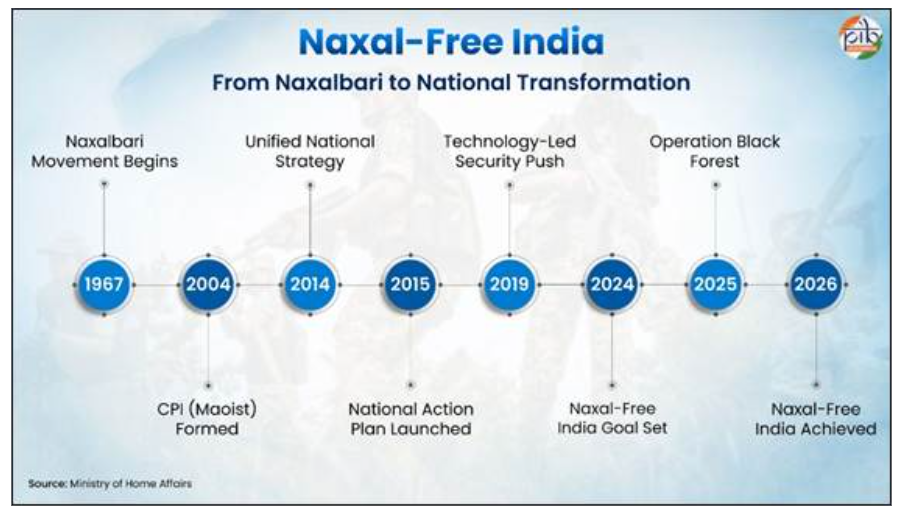
- Left-Wing Extremism (LWE) refers to armed extremist movements inspired by Maoist ideology. In India, it traces its origin to the Naxalbari uprising of 1967 in West Bengal.
- The movement followed the idea of armed revolution and challenged the authority of the democratic state. Over time, several extremist groups merged into the CPI (Maoist) in 2004, making LWE one of India’s major internal security challenges.
- LWE was not only a law-and-order problem. It also reflected gaps in governance, tribal welfare, land rights, connectivity, education, livelihoods and state presence in remote areas.
Peak of LWE Violence Before 2014
The decade from 2004 to 2014 was among the most violent phases of LWE.
Key facts include:
- Violence peaked in 2010 with 1,936 incidents.
- The decade recorded 17,542 violent incidents.
- 1,913 security personnel and 5,019 civilians lost their lives.
- Naxalism was officially described as India’s biggest internal security challenge.
This period showed that scattered and state-wise responses were not enough. A national and coordinated policy became necessary.
Policy Shift: From Fragmented Response to Integrated Strategy
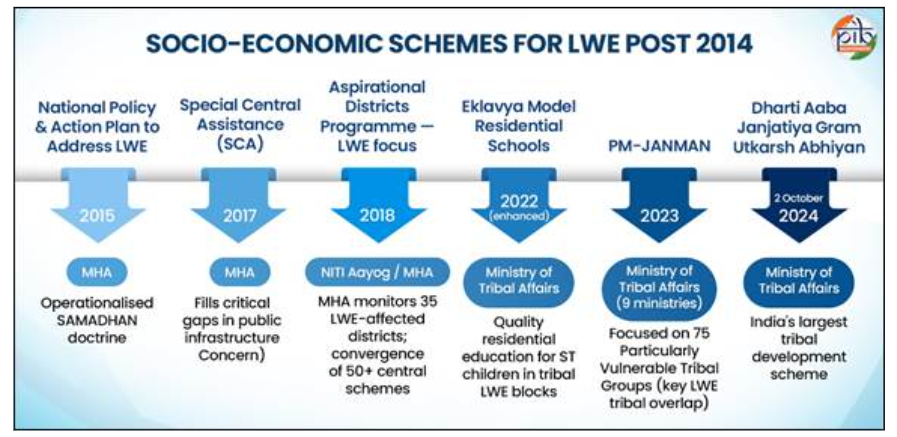
A major shift came with the National Policy and Action Plan to address LWE, 2015.
It replaced an ad hoc approach with a whole-of-government strategy. The policy combined:
- security operations
- development programmes
- infrastructure expansion
- rehabilitation
- tribal welfare
- better Centre-State coordination
The government adopted a three-pronged approach based on Dialogue, Security and Coordination.
Three Pillars of India’s Anti-LWE Strategy
1. Restoring Trust in the State
The first aim was to rebuild the faith of remote communities in the state. This was done through stronger security presence, better coordination, surrender policies and community outreach.
2. Expanding Infrastructure and Connectivity
Roads, mobile towers, banks, schools and healthcare facilities were expanded in earlier LWE-affected regions. This helped connect isolated tribal villages with mainstream governance.
3. Delivering Welfare with Dignity
The strategy focused on tribal welfare, education, skill development, livelihood support and rehabilitation of surrendered cadres.
The approach followed a simple chain: security created space for development, development-built trust, and trust enabled welfare delivery.
Security Measures and Technology Use
The government strengthened the security grid in LWE-affected areas.
Key Measures
- 663 fortified police stations were constructed.
- 408 new CAPF security camps were established in the past seven years.
- 68 night-landing helipads were built for rapid deployment and evacuation.
- Security forces received 400 bullet-proof and blast-proof vehicles.
- Special forces such as CoBRA, CRPF, District Reserve Guard, Jharkhand Jaguar and Greyhounds were integrated.
Technology as a Game Changer
Modern technology was used for surveillance and intelligence. This included:
- drones and UAVs
- satellite imagery
- AI-based data analysis
- location tracking
- call-log analysis
- mobile data analytics
- social media monitoring
This helped security forces improve precision and reduce the operational space of extremist groups.
Landmark Operations
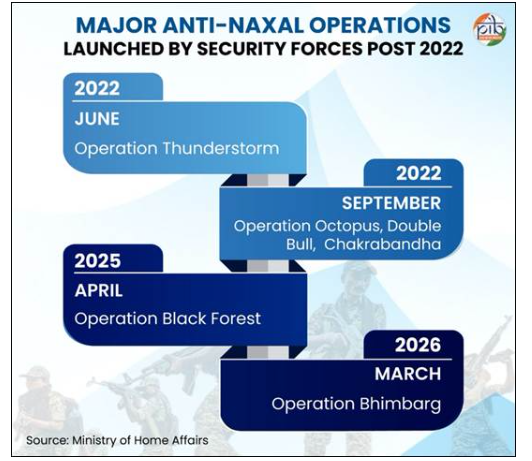
The government followed a “Trace, Target, Neutralise” approach. Major operations included:
- Operation Black Forest
- Operation Octopus
- Operation Double Bull
- Operation Thunderstorm
- Operation Bhimbarg
- Operation Chakrabandha
These operations weakened Maoist networks, restored state presence and enabled development programmes in long-affected regions.
Choking the Support System
The strategy targeted not only armed cadres but also the financial and logistical ecosystem of LWE.
A dedicated vertical was created in the National Investigation Agency to disrupt Naxal financing networks.
Key actions included:
- seizure of assets by NIA
- attachment of assets by the Enforcement Directorate
- investigation and filing of charge sheets in LWE-related cases
- action against support networks and financing channels
This reduced the ability of extremist groups to sustain violence.
Surrender, Rehabilitation and Mainstreaming
The government combined security action with rehabilitation.
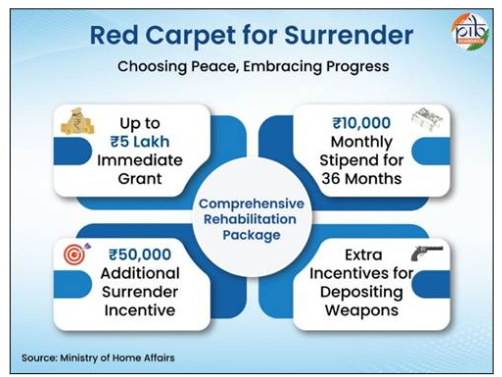
Surrendering cadres receive:
- ₹5 lakh immediate grant for higher-ranked cadres
- ₹2.5 lakh for other cadres
- ₹10,000 monthly stipend for 36 months
- additional incentives for surrender and depositing weapons
In 2025, 2,337 Naxalites surrendered. Between 2024 and March 2026, 3,927 cadres surrendered.
This “red carpet for surrender” approach helped bring cadres back into mainstream society and wakened extremist recruitment.
Infrastructure and Welfare Push in LWE-Affected Areas
The anti-LWE strategy was not limited to policing. It also focused on development.
Road Connectivity
A total of 15,189 km of roads were constructed under LWE-specific road schemes such as the Road Requirement Plan and the Road Connectivity Project for LWE Affected Areas.
Digital Connectivity
9,497 mobile towers were commissioned. Around 96% of villages in the most affected areas now have mobile connectivity.
Financial Inclusion
Between 2015 and 2026:
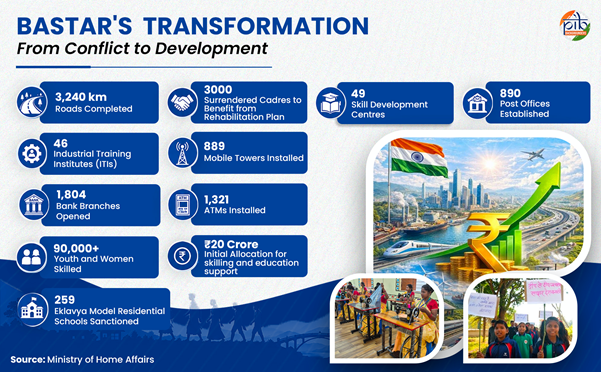
- 1,804 bank branches were opened
- 1,321 ATMs were installed
- 74,720 banking correspondents were appointed
- 6,025 post offices were established
Education and Skill Development
The government sanctioned 259 Eklavya Model Residential Schools, of which 179 became functional. It also developed 47 ITIs and 49 Skill Development Centres. Skill training was provided to more than 90,000 youth and women.
Tribal Youth Exchange Programme
Since 2014, 37,655 tribal youth participated in exposure visits under the Tribal Youth Exchange Programme, promoting national integration and awareness.
Chhattisgarh and Bastar Region Bastar in Chhattisgarh was one of India’s most Naxal-affected regions. Difficult terrain, weak connectivity and limited state presence allowed extremist groups to grow. A major turning point was the formation of the Bastariya Battalion in 2017. It recruited local youth, including many from Bijapur, Sukma and Dantewada. Local participation improved intelligence, trust and coordination. Development also expanded:
Cultural programmes such as Bastar Pandum and Bastar Olympics strengthened tribal identity and community participation.
|
Challenges Ahead
Even after major success, some challenges remain.
1. Consolidation of Gains
Former LWE areas need continuous governance presence to prevent relapse.
2. Legacy Districts
Some districts remain under legacy and thrust categories for continued monitoring and support.
3. Tribal Livelihoods
Peace will last only if tribal communities get secure livelihoods, education and land-linked development.
4. Preventing Alienation
Development must be participatory and respectful of local culture, forests and community rights.
5. Rehabilitation Follow-up
Surrendered cadres need long-term skill, livelihood and social support.
Way Forward
1. Continue Security Vigilance
Even if LWE violence has reduced, intelligence and area domination must continue in sensitive zones.
2. Deepen Governance Outreach
Schools, health centres, banks, roads and digital services should reach all remote habitations.
3. Strengthen Tribal Welfare
Schemes such as EMRS, PM-JANMAN and Dharti Aaba Janjatiya Gram Utkarsh Abhiyan must be effectively implemented.
4. Focus on Livelihoods
Skill training, forest-based livelihoods, agriculture support and local enterprises should be expanded.
5. Ensure Community Participation
Tribal communities should be partners in development, not passive beneficiaries.
6. Monitor Rehabilitation Outcomes
The success of surrender policies must be measured through employment, education and social reintegration.
Conclusion
India’s progress against Left-Wing Extremism shows that internal security challenges cannot be solved by force alone. The success came from a combined approach of security, development, rehabilitation, connectivity and tribal welfare. The major lesson is that peace becomes durable when the state is visible not only through police stations and security camps, but also through schools, roads, banks, healthcare, livelihoods and dignity. The next challenge is to consolidate these gains and ensure that former conflict zones become centres of inclusive development.
UPSC PYQ
Q. It is difficult to recover firearms from Naxals. If you are going to do so, some points should be remembered. Which one of the following is not correct?
- Assess the distance between the Naxals and yourself
- Observe the firearms they are carrying
- Assess the strength of the Naxals
- Open fire as soon as you see them
Answer: D
Explanation
While dealing with Naxals, personnel must act carefully and follow proper procedure. They should assess the distance, observe the firearms, and assess the strength of the Naxals before taking any action.
However, opening fire as soon as they are seen is not correct. Use of force must depend on law, SOPs, threat perception and self-defence requirements. Therefore, option (d) is the incorrect statement.
CARE MCQ
Q. Consider the following statements regarding India’s strategy against Left-Wing Extremism:
- The National Policy and Action Plan to address LWE was approved in 2015.
- The strategy combined security operations with infrastructure development and welfare delivery.
- CoBRA, DRG and Greyhounds have been part of the specialised security architecture against LWE.
- The rehabilitation policy discourages surrendered cadres from joining the mainstream.
Which of the statements given above are correct?
(a) 1, 2 and 3 only
(b) 1 and 4 only
(c) 2, 3 and 4 only
(d) 1, 2, 3 and 4
Answer: (a) 1, 2 and 3 only
Explanation
Statements 1, 2 and 3 are correct. India’s anti-LWE policy was based on a coordinated strategy involving security, development, welfare and specialised forces.
Statement 4 is incorrect because the rehabilitation policy encourages surrendered cadres to return to mainstream society.
FAQs
1. What is Left-Wing Extremism?
It is an armed extremist movement inspired by Maoist ideology and the idea of revolutionary violence.
2. Where did Naxalism begin in India?
It began with the Naxalbari uprising in West Bengal in 1967.
3. What was the major policy shift against LWE?
The National Policy and Action Plan to address LWE, 2015.
4. What are the three broad pillars of the anti-LWE strategy?
Security, development and rehabilitation/welfare.
5. What is CoBRA?
Commando Battalion for Resolute Action, a specialised CRPF unit for anti-Naxal operations.
6. What is the role of EMRS in former LWE areas?
Eklavya Model Residential Schools provide quality residential education for tribal children.
Relevance: UPSC GS Paper II: Judiciary, Constitutional Bodies, Justice Delivery, Separation of Powers, Governance
For Prelims:
- Article 124(1) | Article 123 | Puisne Judge | Constitution Bench | Supreme Court (Number of Judges) Act, 1956
For Mains:
- Judicial pendency | Speedy justice | Judicial capacity building | Access to justice | Case management reforms
Why in News?
The Lok Sabha passed the Supreme Court (Number of Judges) Amendment Bill, 2026, which seeks to increase the sanctioned strength of the Supreme Court from 34 to 38 judges, including the Chief Justice of India. The Bill replaces an ordinance issued earlier in 2026 and now awaits consideration in the Rajya Sabha.
What is the Supreme Court (Number of Judges) Amendment Bill, 2026?
The Bill amends the Supreme Court (Number of Judges) Act, 1956.
Key Provisions
- It increases the number of puisne judges from 33 to 37.
- Including the Chief Justice of India, the total sanctioned strength becomes 38 judges.
- This is the first increase in Supreme Court strength since 2019, when the strength was raised from 31 to 34 judges.
Meaning of Puisne Judge
A puisne judge means an ordinary judge of the Supreme Court other than the Chief Justice of India.
Constitutional Basis for Increasing Supreme Court Strength
Article 124(1): Establishment of Supreme Court
- Article 124(1) establishes the Supreme Court of India.
- It states that the Supreme Court shall consist of:
- the Chief Justice of India, and
- such number of other judges as Parliament may prescribe by law.
- The Constitution does not permanently fix the number of Supreme Court judges.
- Parliament has the power to regulate the strength of Supreme Court judges by ordinary law.
- Therefore, increasing the number of Supreme Court judges does not require a constitutional amendment.
Supreme Court (Number of Judges) Act, 1956
About the Act
- The Supreme Court (Number of Judges) Act, 1956 regulates the sanctioned strength of Supreme Court judges.
- It was enacted under Article 124(1) of the Constitution.
- It has been amended several times to meet rising litigation and judicial workload.
2026 Amendment
The 2026 Bill amends this Act to raise the strength of the Supreme Court to 38 judges including the CJI.
Why Was the Increase Needed?
1. Rising Pendency in Supreme Court
As on 1 January 2026, around 92,101 cases were pending before the Supreme Court.
2. Gap Between Institution and Disposal
In 2025, the Supreme Court received 75,410 fresh cases, but disposed of 65,615 cases. This shows that cases were being filed faster than they were being decided.
3. Need for Speedy Justice
The government stated that increasing judicial strength is necessary to ensure speedy and effective justice.
4. Constitution Bench Requirement
The Supreme Court also has to decide cases involving substantial constitutional questions. These require Constitution Benches of at least five judges, which are difficult to form regularly when the daily case burden is high.
How Will Additional Judges Help?
1. More Benches
Additional judges will allow the Supreme Court to constitute more benches and hear more cases simultaneously.
2. Faster Disposal
An increase in judicial strength can help reduce the gap between case institution and disposal.
3. Regular Constitution Benches
The Chief Justice of India can form Constitution Benches more frequently without disturbing regular hearings.
4. Reduced Workload
More judges can reduce pressure on existing judges and improve the quality of adjudication.
Evolution of Supreme Court Strength
| Year | Sanctioned Strength Including CJI |
| 1950 | 8 judges |
| 1956 | 11 judges |
| 1960 | 14 judges |
| 1978 | 18 judges |
| 1986 | 26 judges |
| 2009 | 31 judges |
| 2019 | 34 judges |
| 2026 | 38 judges |
Is Increasing Judges Enough?
Increasing the number of judges is a necessary but incomplete reform.
Why It Is Necessary
- It improves the Court’s institutional capacity.
- It enables more benches and faster disposal.
- It helps in regular hearing of constitutional matters.
Why It Is Not Sufficient
Judicial pendency is also caused by:
- delays in judicial appointments
- vacancies in High Courts and subordinate courts
- frequent adjournments
- rising number of appeals
- weak case management
- large volume of government litigation
The backlog across all courts in India has crossed 5.5 crore cases, with most pending in lower courts. Hence, reforms must cover the entire judicial system.
Challenges in Reducing Judicial Pendency
1. Low Judge-Population Ratio
The India Justice Report 2025 noted that India has around 15.9 judges per million population, while the Law Commission had recommended 50 judges per million.
2. High Pendency in Lower Courts
In many States, a large number of cases in subordinate courts are pending for more than three years.
3. High Court Backlog
Across High Courts, many cases remain pending for more than five years, delaying final justice.
4. Government as a Major Litigant
A large number of cases involve government departments, increasing the burden on courts.
5. Procedural Delays
Frequent adjournments, poor listing and weak case-flow management slow down justice delivery.
Way Forward
1. Fill Judicial Vacancies
Appointments in the Supreme Court, High Courts and subordinate courts must be completed in time.
2. Strengthen Lower Judiciary
Since most cases are pending in district and subordinate courts, their infrastructure, staff and technology support must improve.
3. Better Case Management
Scientific listing, strict adjournment control and prioritisation of old cases are needed.
4. Reduce Government Litigation
Government departments should avoid unnecessary appeals and strengthen administrative dispute resolution.
5. Use Technology
E-courts, digital filing, virtual hearings and AI-based case categorisation can improve efficiency.
6. Promote Alternative Dispute Resolution
Mediation, arbitration and Lok Adalats can reduce the burden on regular courts.
Conclusion
The increase in Supreme Court strength from 34 to 38 judges is an important step towards strengthening judicial capacity and improving disposal of cases. It can help the Court form more benches and hear Constitution Bench matters more regularly. However, pendency is a systemic challenge and cannot be solved only by increasing judges at the apex court. India needs timely judicial appointments, stronger lower courts, better case management, technology-enabled courts and reduction of unnecessary government litigation. Speedy justice requires not only more judges, but also a more efficient, accessible and accountable justice delivery system.
UPSC PYQ
Q. With reference to the Indian judiciary, consider the following statements:
- Any retired judge of the Supreme Court of India can be called back to sit and act as a Supreme Court judge by the Chief Justice of India with the prior permission of the President of India.
- A High Court in India has the power to review its own judgement as the Supreme Court does.
Which of the statements given above is/are correct?
(a) 1 only
(b) 2 only
(c) Both 1 and 2
(d) Neither 1 nor 2
Answer: (c) Both 1 and 2
Explanation
Statement 1: Correct
- Under Article 128 of the Constitution, the Chief Justice of India, with the previous consent of the President, may request a retired judge of the Supreme Court or a qualified retired High Court judge to sit and act as a judge of the Supreme Court.
- Such a judge enjoys all jurisdiction, powers and privileges of a Supreme Court judge while sitting and acting.
Statement 2: Correct
- The Supreme Court has the power to review its own judgments under Article 137.
- High Courts also have the power to review their own judgments, though this power is not expressly mentioned in the same way in the Constitution.
- High Courts exercise review power through their status as Courts of Record under Article 215 and under procedural laws such as the Civil Procedure Code.
CARE MCQ
Q. Consider the following statements regarding the Supreme Court (Number of Judges) Amendment Bill, 2026:
- It increases the number of puisne judges from 33 to 37.
- Including the Chief Justice of India, the sanctioned strength becomes 38.
- The Bill amends the Supreme Court (Number of Judges) Act, 1956.
- The number of Supreme Court judges is permanently fixed by the Constitution.
Which of the statements given above are correct?
(a) 1, 2 and 3 only
(b) 1 and 4 only
(c) 2, 3 and 4 only
(d) 1, 2, 3 and 4
Answer: (a) 1, 2 and 3 only
Explanation
Statements 1, 2 and 3 are correct. The Bill increases puisne judges from 33 to 37, making the total strength 38 including the CJI, and amends the 1956 Act.
Statement 4 is incorrect because Article 124(1) allows Parliament to prescribe the number of Supreme Court judges by law.
FAQs
1. What is the Supreme Court (Number of Judges) Amendment Bill, 2026?
It is a Bill to increase Supreme Court judges excluding the CJI from 33 to 37.
2. What will be the total Supreme Court strength?
38 judges, including the Chief Justice of India.
3. Which Act is being amended?
The Supreme Court (Number of Judges) Act, 1956.
4. Which Article gives Parliament this power?
Article 124(1).
5. What is a puisne judge?
A Supreme Court judge other than the Chief Justice of India.
6. What is a Constitution Bench?
A bench of at least five judges hearing substantial constitutional questions.
7. Why was the increase proposed?
To address rising pendency and improve the Supreme Court’s disposal capacity.