APPSC Current Affairs 31 July 2026 covering key national and Andhra Pradesh updates

Relevance: APPSC Clean Energy, Manufacturing, Skill Development, Innovation

Important Keywords for Prelims and Mains

For Prelims:

  • Andhra Pradesh–Australia MoUs | Centre of Excellence for Solar Manufacturing | IIT Tirupati | UNSW Sydney | APSSDC

For Mains:

  • Clean energy cooperation | Solar manufacturing ecosystem | Inclusive education | Student mental health support | Global skill pathways

Why in News?

The Andhra Pradesh government and Australian institutions signed four MoUs covering clean energy, advanced manufacturing, inclusive education, student mental health and skill development. The agreements aim to strengthen Andhra Pradesh’s cooperation with Australia in research, innovation, education and workforce development.

Key MoUs Signed

1. Centre of Excellence for Solar Manufacturing

The first MoU was signed among the Centre of Excellence for Energy TransitionIIT Tirupati and the University of New South Wales, Sydney.

It aims to establish a Centre of Excellence for Solar Manufacturing at IIT Tirupati.

Focus Areas

  • Advanced solar photovoltaic manufacturing
  • Solar panel recycling
  • Circular economy practices
  • Industry-driven research
  • Faculty development
  • Technology commercialisation
  • Specialised training programmes

This will help Andhra Pradesh position itself as a hub for solar manufacturing and clean energy innovation.

Significance for Clean Energy

The proposed centre is important because solar energy is central to India’s energy transition. Support from the Australian institution will help in curriculum design, training and research in areas such as:

  • solar cell manufacturing
  • device physics
  • reliability engineering
  • recycling
  • safety and maintenance
  • ingot manufacturing
  • wafering technologies

This can support both renewable energy manufacturing and green jobs in Andhra Pradesh.

Inclusive Education MoU

The second MoU was signed among UNSWSri Padmavati Mahila Visvavidyalayam and Samagra Shiksha, Andhra Pradesh.

It aims to strengthen inclusive education by improving the capacity of teachers to educate children with:

  • autism
  • neurodiverse learning needs
  • special learning requirements

The partnership will focus on specialised training, professional development and teaching resources.

This is significant for building a more inclusive school education system in Andhra Pradesh.

Student Mental Health MoU

The third MoU was signed between the Andhra Pradesh State Council of Higher Education and Australia’s Rebound.

It will implement a technology-enabled pilot project in selected higher educational institutions.

Features

  • Confidential mental health resources
  • Wellness assessment tools
  • Virtual counselling services
  • Free-of-cost pilot programme

This is important because student well-being is becoming a major part of higher education governance.

Skill Development MoU

The fourth MoU was signed between the Andhra Pradesh State Skill Development Corporation and Australia’s Dynamic Learning Services.

It aims to strengthen:

  • vocational education
  • workforce development
  • industry-aligned training
  • globally recognised professional certifications
  • international employment pathways

This can help Andhra Pradesh youth access better domestic and global employment opportunities.

Importance for Andhra Pradesh

1. Clean Energy Manufacturing Push

The solar manufacturing centre can help Andhra Pradesh move from renewable energy generation to renewable energy manufacturing.

2. Higher Education Internationalisation

Partnerships with Australian institutions can improve curriculum, research and faculty development.

3. Inclusive Human Capital Development

Teacher training for neurodiverse children supports equitable education and social inclusion.

4. Student Well-being

Mental health support in colleges can reduce stress, improve learning outcomes and strengthen student support systems.

5. Global Skill Pathways

Industry-aligned training and international certification can improve employability of Andhra Pradesh youth.

6. Investment-Friendly Image

These MoUs strengthen Andhra Pradesh’s image as a State open to global collaboration in education, research and innovation.

Conclusion

The Andhra Pradesh–Australia MoUs show a shift towards knowledge-based cooperation in clean energy, education and skills. By combining solar manufacturing, inclusive education, student mental health and workforce development, Andhra Pradesh can strengthen its human capital and industrial base. The success of these partnerships will depend on implementation, industry linkage and measurable outcomes for students and youth.

CARE MCQ

Q. Consider the following statements regarding the Andhra Pradesh–Australia MoUs:

  1. A Centre of Excellence for Solar Manufacturing is proposed at IIT Tirupati.
  2. One MoU focuses on inclusive education for children with autism and neurodiverse learning needs.
  3. A pilot project on student mental health will be implemented in selected higher educational institutions.
  4. The MoUs are limited only to defence manufacturing.

Which of the statements given above are correct?

(a) 1, 2 and 3 only
(b) 1 and 4 only
(c) 2, 3 and 4 only
(d) 1, 2, 3 and 4

Answer: (a) 1, 2 and 3 only

Explanation

Statements 1, 2 and 3 are correct. The MoUs cover solar manufacturing, inclusive education, student mental health and skill development.
Statement 4 is incorrect because the MoUs are not limited to defence manufacturing.

FAQs

1. How many MoUs were signed?

Four MoUs.

2. What is the clean energy MoU about?

Centre of Excellence for Solar Manufacturing at IIT Tirupati.

3. Which area does the inclusive education MoU cover?

Teacher training for children with autism and neurodiverse learning needs.

4. What is the student mental health project?

A pilot providing wellness tools and virtual counselling in selected colleges.

5. Which body is linked to skill development?

Andhra Pradesh State Skill Development Corporation.

Relevance: UPSC GS Paper III: Renewable Energy, Energy Security, Climate Change, Infrastructure, Manufacturing

Important Keywords for Prelims and Mains

For Prelims:

  • PM Surya Ghar | PM-KUSUM | PM Surya Sarovar Yojana | Green Energy Corridor | International Solar Alliance

For Mains:

  • Clean energy transition | Energy security | Net-zero by 2070 | Domestic solar manufacturing | Grid integration and storage

Why in News?

India’s solar sector has entered a new phase with the approval of the Pradhan Mantri Surya Sarovar Yojana on 31 July 2026. The scheme aims to develop 5,000 MW of floating solar photovoltaic projects with co-located energy storage systems, strengthening India’s clean energy transition.

India’s Solar Rise: Capacity Expansion

  • India’s solar capacity has expanded from around 3 GW in 2014 to 162.15 GW by 30 June 2026. This rapid rise has made solar energy one of the strongest pillars of India’s renewable energy sector.
  • Solar expansion has been driven by policy support, infrastructure creation, competitive bidding, rooftop solar adoption, agricultural solarisation and domestic manufacturing.

Solar Capacity Composition

SegmentInstalled Capacity
Large solar projects118.79 GW
Grid-connected rooftop solar27.88 GW
Hybrid and off-grid solarRemaining capacity

Major solar States include Rajasthan, Gujarat, Karnataka, Tamil Nadu, Andhra Pradesh and Maharashtra.

India’s Solar Journey: Chronology

YearKey Development
2010National Solar Mission launched
2014Solar capacity around 3 GW; Solar Parks Scheme launched
2015Solar target revised to 100 GW
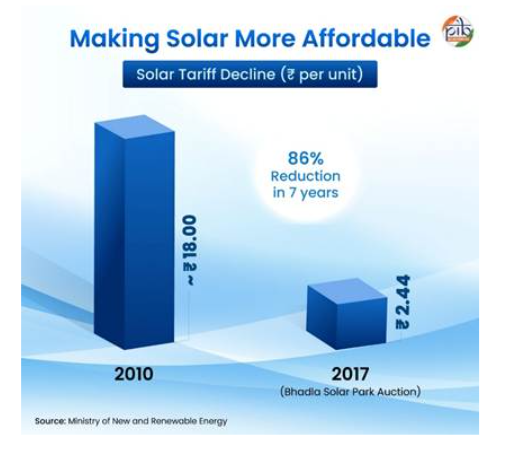
2017Solar tariff fell to ₹2.44/unit at Bhadla
2021Panchamrit goals announced at COP26
2024PM Surya Ghar launched
2025India became the second-largest solar growth market
2026Solar capacity reached 162.15 GW

Pradhan Mantri Surya Sarovar Yojana

The Pradhan Mantri Surya Sarovar Yojana is the latest major step in India’s solar journey.

Key Features

  • Approved on 31 July 2026
  • Supports 5,000 MW of Floating Solar Photovoltaic projects
  • Includes co-located Energy Storage Systems
  • Minimum storage capacity: 2 hours / 10,000 MWh
  • Outlay: ₹5,070 crore
  • Implementation period: FY 2026–27 to FY 2030–31
  • Uses reservoirs and industrial ponds
  • All States and Union Territories are eligible

Significance

The scheme reduces pressure on scarce land, improves grid reliability and helps States manage peak power demand. It is based on the National Institute of Solar Energy assessment, which estimates India’s floating solar potential at about 102.18 GWp.

It is expected to reduce nearly 10 million tonnes of CO₂ emissions annually, generate 16,000–17,000 full-time equivalent jobs, and promote domestic manufacturing of floatation systems, PV cells, modules and energy storage systems.

Major Solar Schemes and Policy Architecture

India’s solar expansion is supported by five major policy pillars.

1. Vision: Panchamrit and Mission LiFE

At COP26, India announced the Panchamrit goals, including 500 GW non-fossil fuel capacity by 2030 and net-zero emissions by 2070Mission LiFE promotes sustainable consumption and citizen participation in climate action.

2. Demand Creation: National Solar Mission and RPOs

The National Solar Mission created long-term policy direction for solar deployment. Renewable Purchase Obligations require obligated entities to procure a fixed share of electricity from renewable sources. The RPO target for 2026–27 is 35.95%.

3. Cost Reduction: Competitive Bidding

Transparent competitive bidding and e-reverse auctions reduced solar tariffs from around ₹18/unit in 2010 to ₹2.44/unit at Bhadla in 2017, making India one of the world’s lowest-cost solar markets.
4. Infrastructure Support

Solar parks and the Green Energy Corridor provide land, transmission and evacuation infrastructure for large-scale solar deployment.

5. Manufacturing Support

The PLI Scheme for High-Efficiency Solar PV Modules and ALMM strengthen domestic manufacturing and quality assurance.

Solar Parks, Green Energy Corridor and Infrastructure Support

  • The Solar Parks Scheme was launched in December 2014 with an initial target of 20 GW, later enhanced to 40 GW.
  • As of February 2026, 54 solar parks with sanctioned capacity of 39,188 MW have been approved.

Examples

  • Bhadla Solar Park, Rajasthan — 2,245 MW, one of the world’s largest solar complexes
  • Pavagada Solar Park, Karnataka
  • Rewa Ultra Mega Solar Park, Madhya Pradesh

Andhra Pradesh

Andhra Pradesh has 5 solar parks with sanctioned capacity of 4,200 MW, making it an important solar State.

Green Energy Corridor

The Green Energy Corridor Programme supports transmission of renewable energy from generation centres to demand centres. It has enabled evacuation of 24,567.8 MW of renewable energy and is planned to support evacuation of around 44 GW across ten States.

PLI, ALMM and Domestic Solar Manufacturing

Production Linked Incentive Scheme for Solar PV

The PLI Scheme for High-Efficiency Solar PV Modules aims to promote domestic manufacturing and reduce import dependence.

Key Facts

  • Total outlay: ₹24,000 crore
  • Tranche I: ₹4,500 crore, approved in 2021
  • Tranche II: ₹19,500 crore, approved in 2022
  • Letters of Award issued for 48,337 MW manufacturing capacity
  • Incentives linked to sales, efficiency and local content

As of September 2025, the scheme had attracted around ₹52,900 crore investment and generated about 44,400 jobs.

Approved List of Models and Manufacturers

  • ALMM, introduced in 2019, is a quality assurance framework for solar PV modules and cells. It ensures that only approved models and manufacturers are used in eligible solar projects.
  • Together, PLI and ALMM strengthen India’s domestic solar ecosystem, reduce import dependence and improve quality confidence for developers and consumers.

Solar for Households and Farmers

PM Surya Ghar: Muft Bijli Yojana

Launched on 13 February 2024PM Surya Ghar is the world’s largest domestic rooftop solar programme.

Key Features

  • Outlay: ₹75,021 crore
  • Target: one crore households
  • Up to 300 units of free electricity per month
  • Subsidy support for rooftop solar
  • Collateral-free loans
  • Dedicated national portal for registration, installation and subsidy disbursement

PM-KUSUM Scheme

The Pradhan Mantri Kisan Urja Suraksha evam Utthaan Mahabhiyan, launched in 2019, promotes solar energy use in agriculture.

Components

  • Component A: Decentralised solar power plants on barren or fallow land
  • Component B: Standalone solar agriculture pumps
  • Component C: Solarisation of grid-connected agricultural pumps

Key Achievements

  • Nearly 11.49 lakh off-grid solar pumps installed
  • More than 15.89 lakh agricultural pumps covered through feeder-level solarisation
  • Around 1,726 MW decentralised solar capacity commissioned on farmers’ land
  • Over 21.77 lakh farmers benefited

PM-KUSUM provides reliable daytime power, reduces diesel dependence and allows farmers to earn by selling surplus power where eligible.

Distributed Solar Growth

India’s solar transition is not limited to large solar parks. Rooftop solar and agricultural solarisation are becoming important.

In FY 2025–26, distributed solar solutions contributed 16.3 GW, or 36% of the 44.61 GW solar capacity added during the year.

Of this:

  • 7.6 GW came from PM-KUSUM
  • 8.7 GW came from rooftop solar

This shows that households and farmers are becoming active energy producers.

India’s Global Solar Leadership

International Solar Alliance

The International Solar Alliance was co-founded by India and France at COP21 in Paris in 2015. It promotes solar deployment, finance, technology sharing and capacity-building among member countries.

8th ISA Assembly

The 8th Assembly of ISA was held in New Delhi in October 2025. It brought together ministers and delegates from more than 125 countries and focused on solar finance, resilient supply chains, inclusive access and technology cooperation.

One Sun One World One Grid

The One Sun One World One Grid initiative was proposed by India in 2018. It aims to create an interconnected global renewable energy grid. At COP26, India and the United Kingdom launched the Green Grids Initiative–OSOWOG to promote cross-border renewable energy trade.

India also helped build consensus during its G20 Presidency on tripling global renewable energy capacity by 2030.

Significance of India’s Solar Push

1. Energy Security

Solar power reduces dependence on imported fossil fuels and strengthens domestic energy availability.

2. Climate Action

Solar expansion supports India’s NDCs, Panchamrit commitments and net-zero target.

3. Manufacturing and Jobs

PLI, ALMM and PM Surya Sarovar promote domestic manufacturing, value addition and clean energy employment.

4. Rural Transformation

PM-KUSUM supports farmers through reliable power, reduced diesel use and additional income opportunities.

5. Household Savings

PM Surya Ghar reduces electricity bills and encourages rooftop solar adoption.

6. Global Leadership

ISA and OSOWOG strengthen India’s role in global clean energy diplomacy.

Challenges

1. Grid Integration

Large solar capacity requires stronger transmission, storage and balancing systems.

2. Storage Cost

Solar is intermittent, so affordable batteries and energy storage systems are essential.

3. Land Pressure

Ground-mounted solar projects need large land parcels. Floating solar can help reduce this pressure.

4. Import Dependence

India must strengthen domestic production of wafers, cells, modules and storage technologies.

5. DISCOM Readiness

Rooftop solar and RPO implementation require strong cooperation from distribution companies.

Way Forward

1. Scale Floating Solar with Storage

PM Surya Sarovar should be implemented effectively to reduce land pressure and improve grid reliability.

2. Strengthen Green Energy Corridors

Transmission networks must grow in line with renewable energy capacity.

3. Deepen Domestic Manufacturing

PLI and ALMM should be used to build a complete solar value chain.

4. Expand Rooftop Solar Access

Subsidies, loans and digital portals must remain simple and citizen-friendly.

5. Solarise Agriculture Sustainably

PM-KUSUM should be linked with efficient irrigation, feeder management and farmer income.

6. Promote Global Solar Cooperation

India should use ISA and OSOWOG to expand solar finance, technology transfer and Global South cooperation.

Conclusion

India’s solar growth shows how coordinated policy can transform an emerging technology into a mainstream energy source. From solar parks and rooftop systems to floating solar, agricultural pumps, domestic manufacturing and global alliances, India is building a complete solar ecosystem. The next phase must focus on storage, grid reliability, local manufacturing and inclusive access, making solar power central to India’s clean energy transition.

UPSC PYQ

Q. Consider the following statements: (2016)

  1. The International Solar Alliance was launched at the United Nations Climate Change Conference in 2015.
  2. The Alliance includes all the member countries of the United Nations.

Which of the statements given above is/are correct?

(a) 1 only

(b) 2 only

(c) Both 1 and 2

(d) Neither 1 nor 2

Answer: (a) 1 only

Explanation

Statement 1: Correct

The International Solar Alliance (ISA) was launched by India and France at the COP21 United Nations Climate Change Conference in Paris in 2015.

Statement 2: Incorrect

At the time of this UPSC question, ISA was primarily meant for solar-resource-rich countries located fully or partly between the Tropic of Cancer and Tropic of Capricorn.

CARE MCQ

Q. Consider the following statements regarding India’s solar energy initiatives:

  1. PM Surya Sarovar Yojana aims to support floating solar projects with energy storage.
  2. PM Surya Ghar promotes rooftop solar adoption among households.
  3. PM-KUSUM promotes solar energy use in agriculture.
  4. ALMM is related to quality assurance for solar PV modules and cells.

Which of the statements given above are correct?

(a) 1, 2 and 3 only

(b) 2 and 4 only

(c) 1, 3 and 4 only

(d) 1, 2, 3 and 4

Answer: (d) 1, 2, 3 and 4

Explanation

All four statements are correct. PM Surya Sarovar focuses on floating solar with storage, PM Surya Ghar promotes rooftop solar, PM-KUSUM supports solar energy in agriculture, and ALMM ensures quality assurance for approved solar PV models and manufacturers.

FAQs

1. What is PM Surya Sarovar Yojana?

A scheme for floating solar projects with energy storage.

2. What is PM Surya Ghar?

A rooftop solar scheme for households.

3. What is PM-KUSUM?

A scheme promoting solar energy in agriculture.

4. What is ALMM?

A quality assurance list for approved solar PV models and manufacturers.

5. What is the Green Energy Corridor?

A transmission programme to evacuate renewable energy.

6. What is ISA?

The International Solar Alliance, co-founded by India and France.

7. What is OSOWOG?

A vision for an interconnected global renewable energy grid

Relevance: UPSC GS Paper II: Education, Governance, Social Justice, Welfare of Vulnerable Sections

Important Keywords for Prelims and Mains

For Prelims:

  •  RTE Act | Neighbourhood School | UDISE+ | NITI Aayog | School Management Committee

For Mains:

  • School rationalisation | Equity in education | Public education access | Gendered dropout risk | Centre-State accountability

Why in News?

A recent NITI Aayog report stated that around 94,000 government schools were closed over the past decade, averaging nearly 25 schools a day. This has contributed to a decline of 2.26 crore students in government school enrolment. The share of government schools in total enrolment has fallen from 71% in 2005 to 49.24% in 2024-25.

Why are Government Schools Shutting Down?

  • Government schools are being closed or merged across States mainly in the name of school rationalisation.
  • School rationalisation generally means merging schools with low enrolment and shifting students to another nearby school. The National Education Policy 2020 supports rationalisation, but it also cautions that the idea of neighbourhood schools should not be endangered.
  • The problem is that these closures cannot be explained only through demographic change, migration or urbanisation. In several States, closures appear as coordinated administrative decisions affecting children who have the least capacity to travel longer distances or shift to private schools.

National Trend in Government School Closures

Government data tabled in the Lok Sabha shows a clear decline in public schooling infrastructure.

IndicatorEarlier PositionLater Position
Government schools nationally11.07 lakh in 2014-1510.17 lakh in 2023-24
Approximate decline Nearly 89,000 schools
Private schools nationally2.88 lakh3.31 lakh
Government school enrolment share71% in 200549.24% in 2024-25

This indicates that while government schools declined, private schools expanded during the same period.

Worst-Affected States

1. Uttar Pradesh

Uttar Pradesh witnessed one of the sharpest declines. Government schools fell from around 1.63 lakh to 1.38 lakh in a single year, a drop of more than 25,000 schools.

2. Madhya Pradesh

Madhya Pradesh’s government schools fell from around 1.22 lakh in 2018-19 to 99,411 the next year, a decline of nearly 22,600 schools in twelve months.

The State’s own School Education Department found serious exclusion indicators:

  • 7.37 lakh children had no school records.
  • 11.38 lakh children were in the “Drop Box” category, meaning at imminent risk of dropping out.
  • 1.23 lakh children were already recorded as dropouts.
  • 1.55 lakh children had left school due to family displacement or migration.
  • More than 3,500 government schools recorded zero new admissions.
  • Another 6,500 schools recorded fewer than 10 admissions.
  • In Jhabua and Shivpuri, around 29,000 children were in the Drop Box category.

This shows that school closure is closely linked with invisibilisation of children from the education system.

3. Jammu and Kashmir

In Jammu and Kashmir, more than 4,300 schools were closed or merged under rationalisation. UDISE+ figures show the State’s school count falling from 23,167 in 2020-21 to 18,785 by 2022-23.

Reports also noted nearly 13,000 vacant teaching posts. In several areas, children now travel 4–6 km daily to reach a functioning school, weakening the neighbourhood school mandate under the Right to Education Act.

Impact on Children’s Access to Education

Government schools are not used equally by all social classes. They are disproportionately used by children from poor households, Scheduled Castes, Scheduled Tribes, minorities, backward communities and rural families.

When a nearby school shuts down, children face:

  • longer travel distance
  • higher transport cost
  • reduced safety
  • greater dropout risk
  • loss of learning continuity
  • dependence on unaffordable private schools
  • weaker community monitoring of schools

Thus, rationalisation may appear efficient on paper, but on the ground it can reduce real access to education.

Who Bears the Biggest Burden?

1. Poor Rural Children

Poor families often cannot afford transport or private schooling. For them, the nearest government school is not just one option; it is often the only accessible option.

2. Girls

Girls are usually the first to be withdrawn when the school is no longer nearby. Distance increases concerns around safety, mobility and household responsibilities.

3. SC, ST and Minority Children

A 2019 National Sample Survey-based analysis found that access to free education declined unevenly, with Muslim, Scheduled Caste and Scheduled Tribe households disproportionately marginalised from nearby schools.

4. Migrant and Displaced Families

Children from families migrating for work are at higher risk of being excluded from school records and becoming dropouts.

5. Children in Multi-Grade Classrooms

In several merged or under-resourced schools, a single teacher may have to handle multiple classes together. This affects learning quality and violates the spirit of RTE staffing and quality norms.

Centre-State Responsibility

  • The Union government has argued that education is on the Concurrent List, and therefore States are responsible for school closures.However, this does not fully absolve the Centre.
  • The Right to Education Act is a Central law, and its mandate on free, compulsory and neighbourhood schooling is a national responsibility. The Centre also influences State school education through Central funding, NEP-linked conditions and national policy frameworks.
  • both Centre and States are responsible for ensuring that rationalisation does not weaken children’s access to public education.

Why the RTE Act Has Fallen Short

The Right to Education Act, 2009, in force since 2010, guarantees free and compulsory education for children aged 6–14 years.

However, several limitations remain.

1. Weak Protection of Neighbourhood Schools

The Act recognises neighbourhood schooling, but large-scale school mergers have weakened this principle.

2. Limited Focus on Quality

The RTE creates access-based entitlements, but it does not sufficiently guarantee the quality of education inside classrooms.

3. Weak Enforcement Capacity

Children cannot assert their own legal rights. Poor and rural parents often lack the legal and institutional capacity to challenge school closures.

4. School Management Committees Remain Weak

SMCs were meant to give parents and communities a formal voice, but they are often inactive or not regularly convened.

5. Power Imbalance

The Act assumes that families can hold the State accountable, but poor households often lack the power to do so.

6. Staffing and Learning Gaps

Teacher vacancies and multi-grade teaching weaken the quality of education, even where schools formally remain open.

Constitutional Provisions on Education in India

ArticleProvision
Fundamental Rights
21ARight to compulsory education
28Freedom as to attendance at religious instruction or religious worship in certain educational institutions
30Right of minorities to establish and administer educational institutions
 Directive Principles of State Policy
41Right to work, to education and public assistance in certain cases
45

Provision for free and compulsory education for children

Provision for early childhood care and education to children below the age of six years

Fundamental Duties
51ADuty of a parent or guardian to provide opportunities for education to his child or ward between the age of six and fourteen years
Part XVII – Official Language
350A

Facilities for instruction in the mother tongue at the primary stage

• It shall be the endeavour of every State to provide adequate facilities for instruction in the mother tongue at the primary stage of education to children belonging to linguistic minority groups.

• The President may issue such directions to any State as he considers necessary or proper for securing the provision of such facilities.

Way Forward

1. Protect the Neighbourhood School Principal

Rationalisation should not be allowed if it forces young children to travel long distances.

2. Social Impact Assessment Before Closure

Before closing or merging a school, States should assess impact on girls, SC/ST children, minorities, children with disabilities and migrant families.

3. Strengthen School Mapping

Children outside school records must be identified through UDISE+, local surveys and door-to-door campaigns.

4. Ensure Safe Transport Where Mergers are Unavoidable

If a school is merged, free and safe transport must be guaranteed, especially for girls and younger children.

5. Fill Teacher Vacancies

School access without teachers cannot fulfil the RTE promise.

6. Revive School Management Committees

SMCs should be regularly convened and consulted before any school closure or merger.

7. Centre-State Monitoring Mechanism

The Centre should monitor whether State-level rationalisation violates RTE norms.

8. Treat Public Schools as Social Infrastructure

Government schools should not be judged only by enrolment numbers. Their role in social justice, gender equality and rural access must be recognised.

Conclusion

Government school closures show that administrative rationalisation can become educational exclusion if not carefully planned. A school that appears “unviable” in official records may be the only accessible institution for a poor child, a girl, or a tribal household. India must ensure that rationalisation does not weaken the constitutional promise of education. The future of public education depends on protecting neighbourhood schools, teacher availability, social equity and accountable governance.

UPSC PYQ

Q. Which of the following provisions of the Constitution of India have a bearing on Education?

  1. Directive Principles of State Policy
  2. Rural and Urban Local Bodies
  3. Fifth Schedule
  4. Sixth Schedule
  5. Seventh Schedule

Select the correct answer:

(a) 1 and 2 only

(b) 3, 4 and 5 only

(c) 1, 2 and 5 only

(d) 1, 2, 3, 4 and 5

Answer

(d) 1, 2, 3, 4 and 5

Explanation

1. Directive Principles of State Policy — Correct

DPSPs contain provisions related to education, especially Article 41Article 45 and Article 46.

2. Rural and Urban Local Bodies — Correct

The 73rd and 74th Constitutional Amendments gave local bodies roles in areas including education, especially through the 11th and 12th Schedules.

3. Fifth Schedule — Correct

The Fifth Schedule deals with administration of Scheduled Areas and Scheduled Tribes. Education of tribal communities is an important governance concern in these areas.

4. Sixth Schedule — Correct

The Sixth Schedule gives autonomous councils in tribal areas of the Northeast powers over subjects including education.

5. Seventh Schedule — Correct

Education is placed in the Concurrent List under the Seventh Schedule, allowing both the Centre and States to legislate on education.

CARE MCQ

Q. Consider the following statements regarding government school closures in India:

  1. School closures are often justified on the ground of rationalisation.
  2. The Right to Education Act recognises the importance of neighbourhood schools.
  3. Closure of nearby schools can disproportionately affect girls and children from poor households.
  4. Education is exclusively a State List subject.

Which of the statements given above are correct?

(a) 1, 2 and 3 only

(b) 1 and 4 only

(c) 2, 3 and 4 only

(d) 1, 2, 3 and 4

Answer: (a) 1, 2 and 3 only

Explanation

Statements 1, 2 and 3 are correct. School closures are often done in the name of rationalisation, but they can weaken access to neighbourhood schools and disproportionately hurt poor children and girls.

Statement 4 is incorrect because education is in the Concurrent List, not exclusively in the State List.

FAQs

1. Why are government schools shutting down?

They are mainly being closed or merged under school rationalisation.

2. What is school rationalisation?

It means merging or closing schools with low enrolment and shifting students to another school.

3. Why is rationalisation controversial?

Because it can increase distance to school and reduce access for poor and rural children.

4. How many government schools were closed over the past decade?

Around 94,000, according to the NITI Aayog report mentioned in the article.

5. What happened to government school enrolment?

It declined by around 2.26 crore students.

6. Which States are among the worst affected?

Uttar Pradesh, Madhya Pradesh and Jammu and Kashmir.

7. Why are girls more affected?

Families may withdraw girls when the school becomes distant due to safety and mobility concerns.

8. Which communities are most affected?

Poor rural children, SCs, STs, minorities, backward communities and migrant families.

9. What is the RTE Act?

The Right to Education Act, 2009 guarantees free and compulsory education for children aged 6–14 years.

APPSC Current Affairs August 4th 2026

Enroll Now for Unlimited UPSC Utsav

Start Date

22/03/2026

Timings

08 AM – 4 PM

    Courses

    Scroll to Top