Table of Contents
Relevance: APPSC Andhra Pradesh Economy, IIT Tirupati, Clean Energy, Industrial Innovation
For Prelims:
- IIT Tirupati | UNSW Sydney | CoEET Visakhapatnam | Solar PV Manufacturing | Circular Economy
For Mains:
- Clean energy innovation | Solar manufacturing ecosystem | Industry-academia collaboration | Skill development | Energy transition
Why in News?
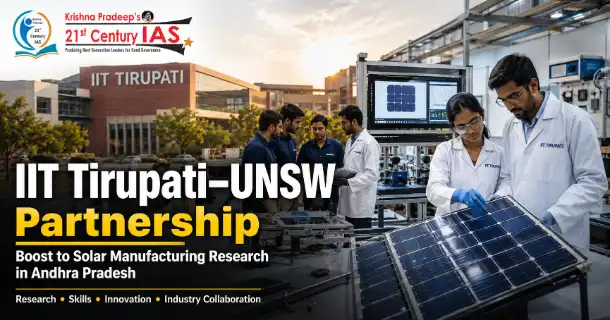
IIT Tirupati has signed an MoU with the University of New South Wales, Sydney and the Centre of Excellence for Energy Transition, Visakhapatnam to explore the establishment of a Centre of Excellence in Solar Manufacturing at IIT Tirupati. The initiative aims to promote research, education, skill development and industry collaboration in solar manufacturing.
What is the MoU About?
- The MoU proposes the creation of a Centre of Excellence in Solar Manufacturing at IIT Tirupati.
- The centre will focus on strengthening Andhra Pradesh’s capacity in solar photovoltaic manufacturing, recycling, research and clean energy skill development.
- This partnership is part of Andhra Pradesh’s broader push to build a clean energy ecosystem that combines technology, research, industry linkages and skilled manpower.
Role of Key Institutions
1. IIT Tirupati
- IIT Tirupati will provide academic infrastructure, faculty support and research collaboration for the proposed centre.
2. UNSW Sydney
- The University of New South Wales will support the development of academic and professional training programmes and provide expertise in solar cell manufacturing and reliability engineering.
3. CoEET, Visakhapatnam
- The Centre of Excellence for Energy Transition will facilitate funding, industry partnerships, government coordination and administrative support.
- CoEET has been established through collaboration among Andhra Pradesh power utilities, including APDISCOMs, APGENCO and APTRANSCO.
Focus Areas of the Proposed Centre
The proposed centre will work on:
- Solar photovoltaic manufacturing
- Solar panel recycling
- Circular economy practices
- Solar cell technology
- Reliability engineering
- Industry-oriented research
- Skill development and training
- Technology commercialisation
This makes the centre important not only for research but also for creating a practical solar manufacturing ecosystem.
Significance for Andhra Pradesh
1. Clean Energy Manufacturing Hub
- The initiative can help Andhra Pradesh move from renewable energy generation to renewable energy manufacturing and innovation.
2. Industry-Academia Collaboration
- The partnership brings together an IIT, an international university and State energy institutions, creating a strong platform for applied research.
3. Skill Development
- Training programmes can prepare engineers, technicians and researchers for the solar manufacturing sector.
4. Circular Economy Push
- Solar panel recycling and circular economy practices can reduce waste and improve sustainability in the renewable energy sector.
5. Support to Energy Transition
- The centre can contribute to India’s larger goals of clean energy expansion, domestic solar manufacturing and net-zero transition.
Conclusion
The IIT Tirupati–UNSW–CoEET partnership marks an important step in Andhra Pradesh’s clean energy journey. By focusing on solar manufacturing, recycling, circular economy, research and skill development, the proposed centre can help the State become a hub for clean energy innovation. Its success will depend on strong implementation, industry linkage and conversion of research into practical manufacturing solutions.
CARE MCQ
Q. Consider the following statements regarding the IIT Tirupati–UNSW MoU:
- The MoU proposes a Centre of Excellence in Solar Manufacturing at IIT Tirupati.
- UNSW Sydney will support training and expertise in solar cell manufacturing and reliability engineering.
- CoEET will facilitate funding, industry and government partnerships.
- The MoU is related only to conventional thermal power generation.
Which of the statements given above are correct?
(a) 1, 2 and 3 only
(b) 1 and 4 only
(c) 2, 3 and 4 only
(d) 1, 2, 3 and 4
Answer: (a) 1, 2 and 3 only
Explanation
Statements 1, 2 and 3 are correct. The MoU focuses on solar manufacturing, research, training and institutional collaboration.
Statement 4 is incorrect because the MoU is related to solar energy, not thermal power.
FAQs
1. Which institutions signed the MoU?
IIT Tirupati, UNSW Sydney and CoEET Visakhapatnam.
2. What is proposed under the MoU?
A Centre of Excellence in Solar Manufacturing at IIT Tirupati.
3. What will the centre focus on?
Solar PV manufacturing, recycling, circular economy, research and skill development.
4. What is the role of UNSW?
Training support and expertise in solar cell manufacturing and reliability engineering.
5. What is the role of CoEET?
Funding, industry partnerships, government coordination and administrative support.