Why in News?
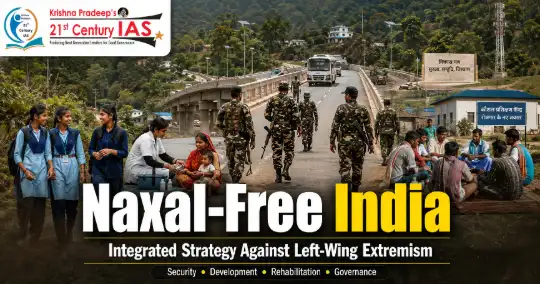
India has achieved the milestone of becoming effectively free from Left-Wing Extremism, with no district remaining officially LWE-affected. According to the government, this was achieved through an integrated strategy combining security operations, infrastructure expansion, rehabilitation of surrendered cadres, tribal welfare and improved governance.
What is Left-Wing Extremism?
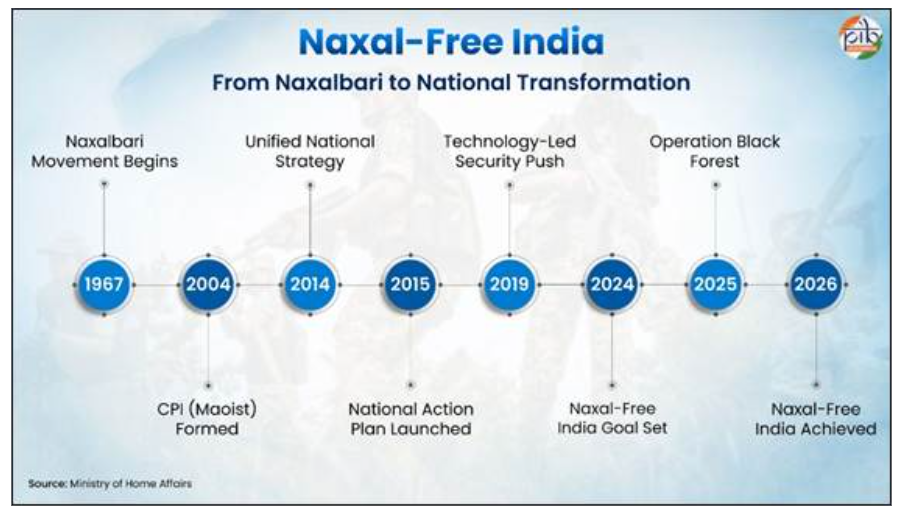
- Left-Wing Extremism (LWE) refers to armed extremist movements inspired by Maoist ideology. In India, it traces its origin to the Naxalbari uprising of 1967 in West Bengal.
- The movement followed the idea of armed revolution and challenged the authority of the democratic state. Over time, several extremist groups merged into the CPI (Maoist) in 2004, making LWE one of India’s major internal security challenges.
- LWE was not only a law-and-order problem. It also reflected gaps in governance, tribal welfare, land rights, connectivity, education, livelihoods and state presence in remote areas.
Peak of LWE Violence Before 2014
The decade from 2004 to 2014 was among the most violent phases of LWE.
Key facts include:
- Violence peaked in 2010 with 1,936 incidents.
- The decade recorded 17,542 violent incidents.
- 1,913 security personnel and 5,019 civilians lost their lives.
- Naxalism was officially described as India’s biggest internal security challenge.
This period showed that scattered and state-wise responses were not enough. A national and coordinated policy became necessary.
Policy Shift: From Fragmented Response to Integrated Strategy
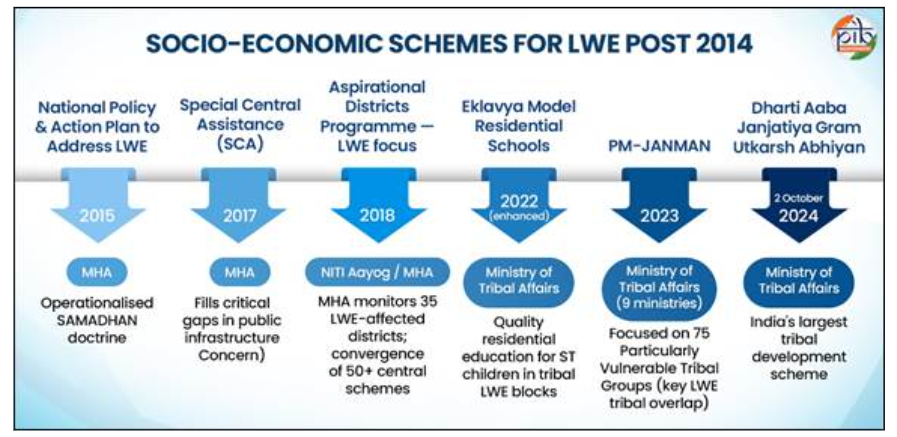
A major shift came with the National Policy and Action Plan to address LWE, 2015.
It replaced an ad hoc approach with a whole-of-government strategy. The policy combined:
- security operations
- development programmes
- infrastructure expansion
- rehabilitation
- tribal welfare
- better Centre-State coordination
The government adopted a three-pronged approach based on Dialogue, Security and Coordination.
Three Pillars of India’s Anti-LWE Strategy
1. Restoring Trust in the State
The first aim was to rebuild the faith of remote communities in the state. This was done through stronger security presence, better coordination, surrender policies and community outreach.
2. Expanding Infrastructure and Connectivity
Roads, mobile towers, banks, schools and healthcare facilities were expanded in earlier LWE-affected regions. This helped connect isolated tribal villages with mainstream governance.
3. Delivering Welfare with Dignity
The strategy focused on tribal welfare, education, skill development, livelihood support and rehabilitation of surrendered cadres.
The approach followed a simple chain: security created space for development, development-built trust, and trust enabled welfare delivery.
Security Measures and Technology Use
The government strengthened the security grid in LWE-affected areas.
Key Measures
- 663 fortified police stations were constructed.
- 408 new CAPF security camps were established in the past seven years.
- 68 night-landing helipads were built for rapid deployment and evacuation.
- Security forces received 400 bullet-proof and blast-proof vehicles.
- Special forces such as CoBRA, CRPF, District Reserve Guard, Jharkhand Jaguar and Greyhounds were integrated.
Technology as a Game Changer
Modern technology was used for surveillance and intelligence. This included:
- drones and UAVs
- satellite imagery
- AI-based data analysis
- location tracking
- call-log analysis
- mobile data analytics
- social media monitoring
This helped security forces improve precision and reduce the operational space of extremist groups.
Landmark Operations
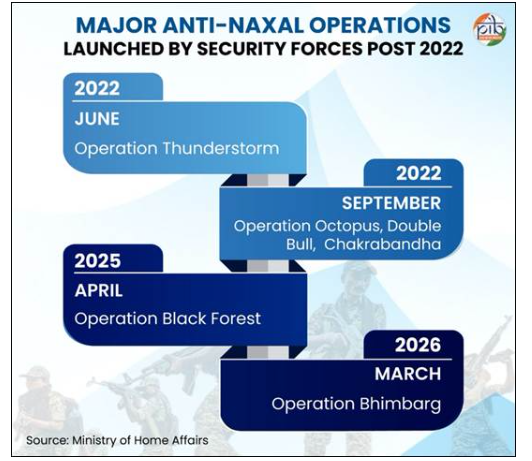
The government followed a “Trace, Target, Neutralise” approach. Major operations included:
- Operation Black Forest
- Operation Octopus
- Operation Double Bull
- Operation Thunderstorm
- Operation Bhimbarg
- Operation Chakrabandha
These operations weakened Maoist networks, restored state presence and enabled development programmes in long-affected regions.
Choking the Support System
The strategy targeted not only armed cadres but also the financial and logistical ecosystem of LWE.
A dedicated vertical was created in the National Investigation Agency to disrupt Naxal financing networks.
Key actions included:
- seizure of assets by NIA
- attachment of assets by the Enforcement Directorate
- investigation and filing of charge sheets in LWE-related cases
- action against support networks and financing channels
This reduced the ability of extremist groups to sustain violence.
Surrender, Rehabilitation and Mainstreaming
The government combined security action with rehabilitation.
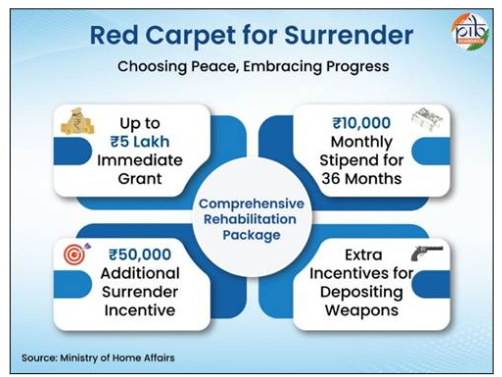
Surrendering cadres receive:
- ₹5 lakh immediate grant for higher-ranked cadres
- ₹2.5 lakh for other cadres
- ₹10,000 monthly stipend for 36 months
- additional incentives for surrender and depositing weapons
In 2025, 2,337 Naxalites surrendered. Between 2024 and March 2026, 3,927 cadres surrendered.
This “red carpet for surrender” approach helped bring cadres back into mainstream society and wakened extremist recruitment.
Infrastructure and Welfare Push in LWE-Affected Areas
The anti-LWE strategy was not limited to policing. It also focused on development.
Road Connectivity
A total of 15,189 km of roads were constructed under LWE-specific road schemes such as the Road Requirement Plan and the Road Connectivity Project for LWE Affected Areas.
Digital Connectivity
9,497 mobile towers were commissioned. Around 96% of villages in the most affected areas now have mobile connectivity.
Financial Inclusion
Between 2015 and 2026:
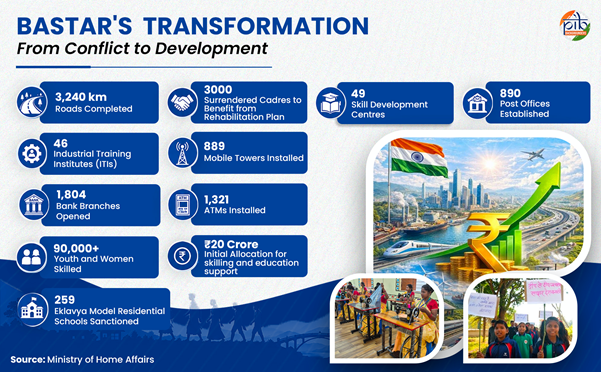
- 1,804 bank branches were opened
- 1,321 ATMs were installed
- 74,720 banking correspondents were appointed
- 6,025 post offices were established
Education and Skill Development
The government sanctioned 259 Eklavya Model Residential Schools, of which 179 became functional. It also developed 47 ITIs and 49 Skill Development Centres. Skill training was provided to more than 90,000 youth and women.
Tribal Youth Exchange Programme
Since 2014, 37,655 tribal youth participated in exposure visits under the Tribal Youth Exchange Programme, promoting national integration and awareness.
Chhattisgarh and Bastar Region Bastar in Chhattisgarh was one of India’s most Naxal-affected regions. Difficult terrain, weak connectivity and limited state presence allowed extremist groups to grow. A major turning point was the formation of the Bastariya Battalion in 2017. It recruited local youth, including many from Bijapur, Sukma and Dantewada. Local participation improved intelligence, trust and coordination. Development also expanded:
Cultural programmes such as Bastar Pandum and Bastar Olympics strengthened tribal identity and community participation.
|
Challenges Ahead
Even after major success, some challenges remain.
1. Consolidation of Gains
Former LWE areas need continuous governance presence to prevent relapse.
2. Legacy Districts
Some districts remain under legacy and thrust categories for continued monitoring and support.
3. Tribal Livelihoods
Peace will last only if tribal communities get secure livelihoods, education and land-linked development.
4. Preventing Alienation
Development must be participatory and respectful of local culture, forests and community rights.
5. Rehabilitation Follow-up
Surrendered cadres need long-term skill, livelihood and social support.
Way Forward
1. Continue Security Vigilance
Even if LWE violence has reduced, intelligence and area domination must continue in sensitive zones.
2. Deepen Governance Outreach
Schools, health centres, banks, roads and digital services should reach all remote habitations.
3. Strengthen Tribal Welfare
Schemes such as EMRS, PM-JANMAN and Dharti Aaba Janjatiya Gram Utkarsh Abhiyan must be effectively implemented.
4. Focus on Livelihoods
Skill training, forest-based livelihoods, agriculture support and local enterprises should be expanded.
5. Ensure Community Participation
Tribal communities should be partners in development, not passive beneficiaries.
6. Monitor Rehabilitation Outcomes
The success of surrender policies must be measured through employment, education and social reintegration.
Conclusion
India’s progress against Left-Wing Extremism shows that internal security challenges cannot be solved by force alone. The success came from a combined approach of security, development, rehabilitation, connectivity and tribal welfare. The major lesson is that peace becomes durable when the state is visible not only through police stations and security camps, but also through schools, roads, banks, healthcare, livelihoods and dignity. The next challenge is to consolidate these gains and ensure that former conflict zones become centres of inclusive development.