Table of Contents
Relevance: UPSC GS Paper II: Judiciary, Constitutional Bodies, Justice Delivery, Separation of Powers, Governance
For Prelims:
- Article 124(1) | Article 123 | Puisne Judge | Constitution Bench | Supreme Court (Number of Judges) Act, 1956
For Mains:
- Judicial pendency | Speedy justice | Judicial capacity building | Access to justice | Case management reforms
Why in News?
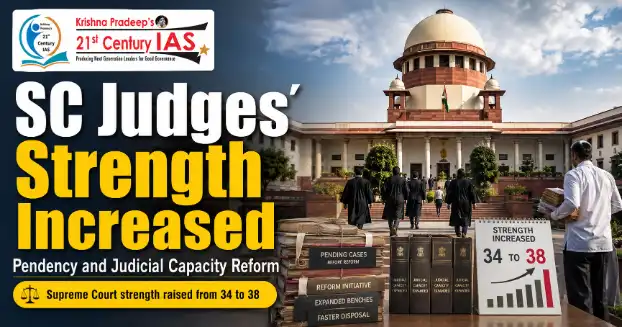
The Lok Sabha passed the Supreme Court (Number of Judges) Amendment Bill, 2026, which seeks to increase the sanctioned strength of the Supreme Court from 34 to 38 judges, including the Chief Justice of India. The Bill replaces an ordinance issued earlier in 2026 and now awaits consideration in the Rajya Sabha.
What is the Supreme Court (Number of Judges) Amendment Bill, 2026?
The Bill amends the Supreme Court (Number of Judges) Act, 1956.
Key Provisions
- It increases the number of puisne judges from 33 to 37.
- Including the Chief Justice of India, the total sanctioned strength becomes 38 judges.
- This is the first increase in Supreme Court strength since 2019, when the strength was raised from 31 to 34 judges.
Meaning of Puisne Judge
A puisne judge means an ordinary judge of the Supreme Court other than the Chief Justice of India.
Constitutional Basis for Increasing Supreme Court Strength
Article 124(1): Establishment of Supreme Court
- Article 124(1) establishes the Supreme Court of India.
- It states that the Supreme Court shall consist of:
- the Chief Justice of India, and
- such number of other judges as Parliament may prescribe by law.
- The Constitution does not permanently fix the number of Supreme Court judges.
- Parliament has the power to regulate the strength of Supreme Court judges by ordinary law.
- Therefore, increasing the number of Supreme Court judges does not require a constitutional amendment.
Supreme Court (Number of Judges) Act, 1956
About the Act
- The Supreme Court (Number of Judges) Act, 1956 regulates the sanctioned strength of Supreme Court judges.
- It was enacted under Article 124(1) of the Constitution.
- It has been amended several times to meet rising litigation and judicial workload.
2026 Amendment
The 2026 Bill amends this Act to raise the strength of the Supreme Court to 38 judges including the CJI.
Why Was the Increase Needed?
1. Rising Pendency in Supreme Court
As on 1 January 2026, around 92,101 cases were pending before the Supreme Court.
2. Gap Between Institution and Disposal
In 2025, the Supreme Court received 75,410 fresh cases, but disposed of 65,615 cases. This shows that cases were being filed faster than they were being decided.
3. Need for Speedy Justice
The government stated that increasing judicial strength is necessary to ensure speedy and effective justice.
4. Constitution Bench Requirement
The Supreme Court also has to decide cases involving substantial constitutional questions. These require Constitution Benches of at least five judges, which are difficult to form regularly when the daily case burden is high.
How Will Additional Judges Help?
1. More Benches
Additional judges will allow the Supreme Court to constitute more benches and hear more cases simultaneously.
2. Faster Disposal
An increase in judicial strength can help reduce the gap between case institution and disposal.
3. Regular Constitution Benches
The Chief Justice of India can form Constitution Benches more frequently without disturbing regular hearings.
4. Reduced Workload
More judges can reduce pressure on existing judges and improve the quality of adjudication.
Evolution of Supreme Court Strength
| Year | Sanctioned Strength Including CJI |
| 1950 | 8 judges |
| 1956 | 11 judges |
| 1960 | 14 judges |
| 1978 | 18 judges |
| 1986 | 26 judges |
| 2009 | 31 judges |
| 2019 | 34 judges |
| 2026 | 38 judges |
Is Increasing Judges Enough?
Increasing the number of judges is a necessary but incomplete reform.
Why It Is Necessary
- It improves the Court’s institutional capacity.
- It enables more benches and faster disposal.
- It helps in regular hearing of constitutional matters.
Why It Is Not Sufficient
Judicial pendency is also caused by:
- delays in judicial appointments
- vacancies in High Courts and subordinate courts
- frequent adjournments
- rising number of appeals
- weak case management
- large volume of government litigation
The backlog across all courts in India has crossed 5.5 crore cases, with most pending in lower courts. Hence, reforms must cover the entire judicial system.
Challenges in Reducing Judicial Pendency
1. Low Judge-Population Ratio
The India Justice Report 2025 noted that India has around 15.9 judges per million population, while the Law Commission had recommended 50 judges per million.
2. High Pendency in Lower Courts
In many States, a large number of cases in subordinate courts are pending for more than three years.
3. High Court Backlog
Across High Courts, many cases remain pending for more than five years, delaying final justice.
4. Government as a Major Litigant
A large number of cases involve government departments, increasing the burden on courts.
5. Procedural Delays
Frequent adjournments, poor listing and weak case-flow management slow down justice delivery.
Way Forward
1. Fill Judicial Vacancies
Appointments in the Supreme Court, High Courts and subordinate courts must be completed in time.
2. Strengthen Lower Judiciary
Since most cases are pending in district and subordinate courts, their infrastructure, staff and technology support must improve.
3. Better Case Management
Scientific listing, strict adjournment control and prioritisation of old cases are needed.
4. Reduce Government Litigation
Government departments should avoid unnecessary appeals and strengthen administrative dispute resolution.
5. Use Technology
E-courts, digital filing, virtual hearings and AI-based case categorisation can improve efficiency.
6. Promote Alternative Dispute Resolution
Mediation, arbitration and Lok Adalats can reduce the burden on regular courts.
Conclusion
The increase in Supreme Court strength from 34 to 38 judges is an important step towards strengthening judicial capacity and improving disposal of cases. It can help the Court form more benches and hear Constitution Bench matters more regularly. However, pendency is a systemic challenge and cannot be solved only by increasing judges at the apex court. India needs timely judicial appointments, stronger lower courts, better case management, technology-enabled courts and reduction of unnecessary government litigation. Speedy justice requires not only more judges, but also a more efficient, accessible and accountable justice delivery system.
UPSC PYQ
Q. With reference to the Indian judiciary, consider the following statements:
- Any retired judge of the Supreme Court of India can be called back to sit and act as a Supreme Court judge by the Chief Justice of India with the prior permission of the President of India.
- A High Court in India has the power to review its own judgement as the Supreme Court does.
Which of the statements given above is/are correct?
(a) 1 only
(b) 2 only
(c) Both 1 and 2
(d) Neither 1 nor 2
Answer: (c) Both 1 and 2
Explanation
Statement 1: Correct
- Under Article 128 of the Constitution, the Chief Justice of India, with the previous consent of the President, may request a retired judge of the Supreme Court or a qualified retired High Court judge to sit and act as a judge of the Supreme Court.
- Such a judge enjoys all jurisdiction, powers and privileges of a Supreme Court judge while sitting and acting.
Statement 2: Correct
- The Supreme Court has the power to review its own judgments under Article 137.
- High Courts also have the power to review their own judgments, though this power is not expressly mentioned in the same way in the Constitution.
- High Courts exercise review power through their status as Courts of Record under Article 215 and under procedural laws such as the Civil Procedure Code.
CARE MCQ
Q. Consider the following statements regarding the Supreme Court (Number of Judges) Amendment Bill, 2026:
- It increases the number of puisne judges from 33 to 37.
- Including the Chief Justice of India, the sanctioned strength becomes 38.
- The Bill amends the Supreme Court (Number of Judges) Act, 1956.
- The number of Supreme Court judges is permanently fixed by the Constitution.
Which of the statements given above are correct?
(a) 1, 2 and 3 only
(b) 1 and 4 only
(c) 2, 3 and 4 only
(d) 1, 2, 3 and 4
Answer: (a) 1, 2 and 3 only
Explanation
Statements 1, 2 and 3 are correct. The Bill increases puisne judges from 33 to 37, making the total strength 38 including the CJI, and amends the 1956 Act.
Statement 4 is incorrect because Article 124(1) allows Parliament to prescribe the number of Supreme Court judges by law.
FAQs
1. What is the Supreme Court (Number of Judges) Amendment Bill, 2026?
It is a Bill to increase Supreme Court judges excluding the CJI from 33 to 37.
2. What will be the total Supreme Court strength?
38 judges, including the Chief Justice of India.
3. Which Act is being amended?
The Supreme Court (Number of Judges) Act, 1956.
4. Which Article gives Parliament this power?
Article 124(1).
5. What is a puisne judge?
A Supreme Court judge other than the Chief Justice of India.
6. What is a Constitution Bench?
A bench of at least five judges hearing substantial constitutional questions.
7. Why was the increase proposed?
To address rising pendency and improve the Supreme Court’s disposal capacity.