Relevance: GS Paper III – Agriculture | Economy | Rural Development | Agri-value Chains
For Prelims:
Milky Mushroom, Paddy Straw Mushroom, Button Mushroom, Self Help Groups (SHGs), Agri Diversification, High-Value Crops
For Mains:
Agricultural Diversification, Rural Livelihoods, Value Chain Development, Export-Oriented Agriculture, Women Empowerment
Why in News?
- The Government of Andhra Pradesh, led by N. Chandrababu Naidu, is preparing to launch a “Mushroom Mission” with an estimated investment of ₹13,000 crore.
- The initiative aims to transform the State into India’s largest mushroom producer and create a new agri-based economic ecosystem focused on high-value crops.
What is the Mushroom Mission?
- The Mushroom Mission is a large-scale agricultural diversification programme designed to promote mushroom cultivation as a commercial activity across Andhra Pradesh.
- The mission proposes the establishment of around 62 lakh mushroom production units, primarily small and medium-scale units spread across approximately 5,000 sq ft each.
- The initiative is structured to promote decentralised production, linking cultivation with processing, storage, and marketing.
- The government also proposes to classify mushrooms as agricultural produce, which will enable farmers to access subsidies, institutional credit, and market support systems.
Production Targets and National Context
- The mission aims to increase annual mushroom production in Andhra Pradesh to 67,500 tonnes, surpassing the current leading producer state.
- At present, Bihar is the largest mushroom producer in India with approximately 45,000 tonnes of annual output.
- This shift indicates a strategic move by Andhra Pradesh to enter high-value agricultural markets and compete at the national level.
Institutional and Financial Framework
The total investment proposed under the mission is ₹13,000 crore.
Out of this, approximately ₹5,184 crore will be provided as subsidy support, accounting for nearly 40% of the total cost.
This subsidy will be jointly funded by the Central and State governments.
The mission will involve:
- development of production infrastructure
- support for small and medium enterprises
- establishment of processing units
- strengthening supply chains
This reflects a model similar to earlier successful sectoral missions like aquaculture and millets.
Role of SHGs and Rural Economy
The mission plans to leverage Andhra Pradesh’s strong network of Self Help Groups (SHGs).
SHGs will play a central role in:
- promoting mushroom cultivation at the grassroots level
- enabling women participation in agriculture
- facilitating micro-enterprises
- improving rural household incomes
This aligns the mission with broader goals of women empowerment and inclusive rural development.
Mushroom Varieties and Agro-Climatic Suitability
The mission focuses on commercially viable mushroom varieties suitable for Indian climatic conditions:
Mushroom Type | Key Feature | Suitability |
Milky Mushroom | Heat-resistant | Ideal for tropical climates like Andhra Pradesh |
Paddy Straw Mushroom | Fast-growing | Suitable for paddy-growing regions |
Button Mushroom | High market demand | Requires controlled environment |
These varieties ensure both climatic adaptability and market viability.
Agricultural Significance of Mushroom
Aspect | Key Fact (Prelims-Oriented) |
Nutrient Recycling | Mushrooms decompose lignin and cellulose → convert agro-waste into humus |
Waste Utilization | Grown on paddy straw, wheat straw, bagasse, sawdust (low-cost substrates) |
Soil Health | Spent mushroom substrate (SMS) improves soil organic carbon and microbial activity |
Biofertilizer Role | Certain fungi enhance nutrient availability (especially phosphorus solubilization) |
Climate Resilience | Requires less land, water, and time compared to traditional crops |
Crop Diversification | Ideal for small and marginal farmers; indoor cultivation possible |
Income Source | High value crop with short production cycle (30–60 days) |
Nutritional Security | Rich in protein (20–30% dry weight), vitamins (B-complex), and minerals |
Integrated Farming | Can be linked with poultry, dairy, and vermicomposting systems |
Export Potential | Button mushroom dominates global trade; In |
CARE MCQ
Q. Consider the following statements regarding mushroom cultivation:
- Mushrooms are autotrophic organisms.
- Milky mushrooms are suitable for tropical climates.
- Mushroom cultivation requires large land areas compared to traditional crops.
Which of the statements given above are correct?
(a) 1 only
(b) 2 only
(c) 2 and 3 only
(d) 1, 2 and 3
Ans: (b)
Explanation
Statement 1 is incorrect : mushrooms are heterotrophic fungi and do not perform photosynthesis.
Statement 2 is correct :milky mushrooms are adapted to warm tropical climates.
Statement 3 is incorrect : mushroom cultivation requires relatively small land area.
Q. In mushroom cultivation, the term “spawn” refers to:
(a) Sterilized organic substrate used as a growth medium
(b) Pure culture of fungal mycelium used for inoculation
(c) Fruiting body of the fungus harvested for consumption
(d) Chemical nutrient solution added to enhance growth
Ans: (b)
Explanation: Spawn is the vegetative mycelium of fungi grown on a carrier (like grains) used as inoculum to initiate mushroom cultivation; it is analogous to “seed” in plant cultivation.
Q. In controlled mushroom cultivation, which of the following environmental changes most directly triggers the transition from vegetative mycelial growth to fruiting body formation?
(a) Reduction in carbon dioxide concentration along with increased oxygen availability
(b) Increase in carbon dioxide concentration to enhance metabolic activity
(c) Complete exclusion of light to prevent photo-inhibition of mycelium
(d) Sudden increase in substrate nutrient concentration
Ans: (a)
Explanation:
Fruiting (pinning) in mushrooms is triggered by a shift in environmental conditions, especially:
- Lower CO₂ levels (fresh air exchange)
- Higher oxygen availability
- Along with humidity and temperature adjustments
APPSC Mains Question
Q. Discuss the role of agricultural diversification in enhancing rural incomes. Examine the potential of mushroom cultivation as a sustainable agri-based livelihood option.
(250 words)
FAQs
Q1. Why is the Mushroom Mission important?
Ans: It promotes high-value agriculture and creates new livelihood opportunities.
Q2. Why are mushrooms considered a good crop?
Ans: They require less land, grow quickly, and have high market demand.
Q3. Which state currently leads mushroom production in India?
Ans: Bihar.
Q4. What role do SHGs play in this mission?
Ans: They help in grassroots implementation and promote women’s participation.
Q5. What is the export potential of mushrooms?
Ans: There is high demand in Gulf countries and international markets.
Relevance: GS Paper II – Governance | Local Self-Government | Decentralisation
For Prelims:
Panchayat Advancement Index (PAI) 2.0, SDGs localization, Gram Panchayat ranking, Ministry of Panchayati Raj, SDG indicators, Local Governance Index
For Mains:
grassroots governance, decentralisation, SDG localisation, rural development, performance-based governance, cooperative federalism, data-driven policy, local accountability, inclusive development
Why in News?
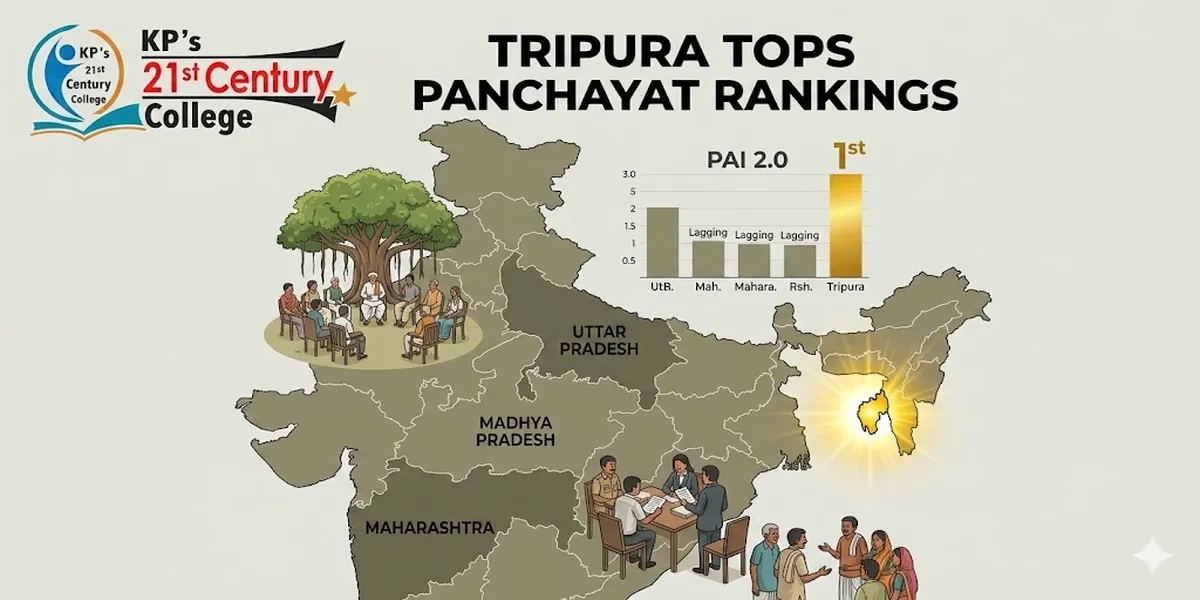
- The Panchayat Advancement Index (PAI) 2.0 report has ranked over 2.5 lakh Gram Panchayats across India based on their performance in achieving Sustainable Development Goals (SDGs).
- The report highlights strong performance by smaller states like Tripura, Kerala, and Odisha, while large states such as Uttar Pradesh, Bihar, Rajasthan, and Punjab lag behind.
What is PAI 2.0?
- PAI 2.0 is a comprehensive performance assessment tool developed by the Ministry of Panchayati Raj to evaluate rural local bodies.
- It measures the performance of Gram Panchayats across 150 indicators aligned with 9 Sustainable Development Goals (SDGs).
- The index acts as a report card for grassroots governance, promoting data-driven planning and accountability.
Key Findings of the Report
Top Performing States
- Tripura – Around 80% of its Gram Panchayats ranked as “Front Runner”
- Kerala – About 10% of Panchayats in top category
- Odisha – Around 9% achieved high performance
These states show strong institutional capacity and better local governance outcomes.
Lagging Large States
- Uttar Pradesh
- Bihar
- Rajasthan
- Punjab
These states have large populations and administrative complexities, which affect performance.
Overall Observation
- No Panchayat reached the “Achiever” (90–100) category
- Majority fall in Performer / Aspirant categories
This indicates scope for significant improvement in grassroots governance.
Ranking Framework (Categories)
Gram Panchayats are classified into five categories based on scores:
- Achiever: 90–100
- Front Runner: 75–90
- Performer: 60–75
- Aspirant: 40–60
- Beginner: Below 40
This framework mirrors national SDG ranking methodology.
Indicators and SDG Linkage
PAI 2.0 evaluates Panchayats across 9 SDGs, including:
- Poverty reduction
- Health and nutrition
- Water and sanitation
- Quality education
- Gender equality
- Infrastructure development
- Environmental sustainability
This reflects localisation of SDGs—bringing global goals to village-level governance.
Why Some States Perform Better
- Strong Decentralisation: States like Kerala have a long tradition of decentralised planning and local empowerment.
- Capacity Building: Better training of Panchayat representatives and administrative staff.
- Social Development Model: Higher literacy, awareness, and citizen participation improve outcomes.
- Effective Fund Utilisation: Better use of central and state grants for development schemes.
Why Large States Lag?
- Administrative Scale: Large population and geographical size create governance challenges.
- Capacity Deficit: Limited training and institutional capacity at the Panchayat level.
- Financial Dependence: Over-reliance on higher-level governments reduces autonomy.
- Weak Data Systems: Lack of reliable real-time data affects planning and monitoring.
- Social Inequalities:Deep-rooted socio-economic disparities slow progress.
Significance of PAI 2.0
- Strengthens Grassroots Governance: Encourages performance-based evaluation of Panchayats.
- SDG Localization: Aligns local governance with global development goals.
- Policy Feedback Tool: Helps governments identify gaps and target interventions.
- Promotes Competitive Federalism: States compete to improve local governance outcomes.
- Enhances Accountability: Creates transparency in rural development performance.
Panchayati Raj
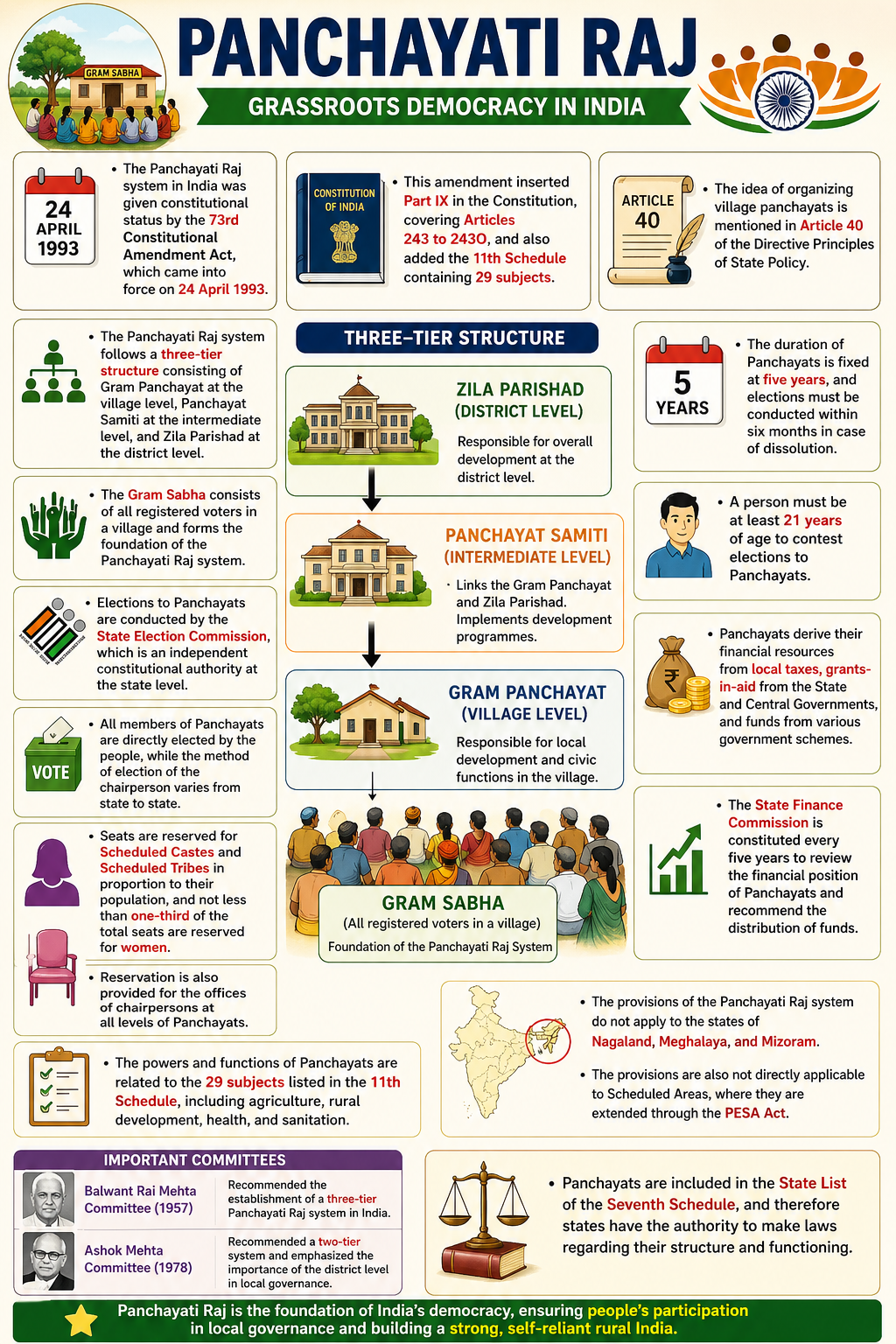
· The Panchayati Raj system in India was given constitutional status by the 73rd Constitutional Amendment Act, which came into force on 24 April 1993. · This amendment inserted Part IX in the Constitution, covering Articles 243 to 243O, and also added the 11th Schedule containing 29 subjects. · The idea of organizing village panchayats is mentioned in Article 40 of the Directive Principles of State Policy. · The Panchayati Raj system follows a three-tier structure consisting of Gram Panchayat at the village level, Panchayat Samiti at the intermediate level, and Zila Parishad at the district level. · The Gram Sabha consists of all registered voters in a village and forms the foundation of the Panchayati Raj system. · Elections to Panchayats are conducted by the State Election Commission, which is an independent constitutional authority at the state level. · All members of Panchayats are directly elected by the people, while the method of election of the chairperson varies from state to state. · Seats are reserved for Scheduled Castes and Scheduled Tribes in proportion to their population, and not less than one-third of the total seats are reserved for women. · Reservation is also provided for the offices of chairpersons at all levels of Panchayats. · The duration of Panchayats is fixed at five years, and elections must be conducted within six months in case of dissolution. · A person must be at least 21 years of age to contest elections to Panchayats. · Panchayats derive their financial resources from local taxes, grants-in-aid from the State and Central Governments, and funds from various government schemes. · The State Finance Commission is constituted every five years to review the financial position of Panchayats and recommend the distribution of funds. · The powers and functions of Panchayats are related to the 29 subjects listed in the 11th Schedule, including agriculture, rural development, health, and sanitation. · The provisions of the Panchayati Raj system do not apply to the states of Nagaland, Meghalaya, and Mizoram. · The provisions are also not directly applicable to Scheduled Areas, where they are extended through the PESA Act. · The Balwant Rai Mehta Committee of 1957 recommended the establishment of a three-tier Panchayati Raj system in India. · The Ashok Mehta Committee of 1978 recommended a two-tier system and emphasized the importance of the district level in local governance. · Panchayats are included in the State List of the Seventh Schedule, and therefore states have the authority to make laws regarding their structure and functioning. |
Challenges in PRI Performance
- Financial Constraints: Limited own revenue generation; heavy dependence on grants.
- Functional Overlap: Unclear division of powers between states and Panchayats.
- Human Resource Issues: Lack of trained personnel and administrative support.
- Political Interference: State governments often dominate local bodies.
Way Forward
- Capacity building of Panchayat representatives must be strengthened.
- Fiscal decentralisation should be enhanced through greater revenue powers.
- Digital governance tools and real-time data systems should be expanded.
- Best practices from top-performing states should be replicated.
- Greater community participation must be encouraged for inclusive governance.
Conclusion
The Panchayat Advancement Index 2.0 highlights the uneven progress of grassroots governance in India. While states like Tripura and Kerala demonstrate the potential of decentralisation, the lag in larger states shows systemic challenges.
Strengthening Panchayati Raj Institutions is essential for achieving inclusive development, effective SDG implementation, and realizing the vision of “Viksit Bharat” from the village level upward.
CARE MCQ
Q. With reference to the Panchayat Advancement Index (PAI) 2.0, consider the following statements:
- It is prepared by the Ministry of Panchayati Raj.
- It evaluates Gram Panchayats based on Sustainable Development Goals.
- All Panchayats in India have been ranked as ‘Front Runner’ or above.
Which of the statements given above is/are correct?
a. 1 and 2 only
b. 2 and 3 only
c. 1 and 3 only
d. 1, 2 and 3
Ans: (a)
Explanation
Statement 1 is correct : PAI is prepared by the Ministry of Panchayati Raj.
Statement 2 is correct : it uses SDG-based indicators.
Statement 3 is incorrect : No Panchayat reached even the “Achiever” category.
Q. Consider the following statements about the role of Panchayati Raj Institutions (PRIs) in rural development:
- Panchayati Raj Institutions are constitutionally empowered to prepare plans for economic development and social justice.
- The 73rd Constitutional Amendment Act, 1992 does not provide for the direct election of all members of Panchayati Raj Institutions.
- PRIs play an important role in the implementation of centrally sponsored schemes such as MGNREGA.
- The financial powers of PRIs are limited only to local taxation and do not include grants from the Union or State governments.
Which of the statements given above are correct?
(a) 1 and 3 only
(b) 2 and 4 only
(c) 1, 2 and 4 only
(d) All of the above
Ans: (a)
Explanation:
Statement 1 is correct: The 73rd Constitutional Amendment Act, 1992 inserted Part IX (Articles 243–243O) into the Constitution, which mandates Panchayats to prepare plans for economic development and social justice. This is further supported by the Eleventh Schedule, which lists 29 subjects that may be devolved to Panchayats.
Statement 2 is incorrect: The 73rd Amendment provides for the direct election of all members of Panchayats at the village, intermediate, and district levels. Only the Chairpersons at higher levels may be elected indirectly. Therefore, this statement is incorrect.
Statement 3 is correct: PRIs play a crucial role in implementing various centrally sponsored schemes, including the Mahatma Gandhi National Rural Employment Guarantee Act (MGNREGA). They are involved in planning, execution, and monitoring at the grassroots level.
Statement 4 is incorrect: PRIs are not limited to collecting local taxes. They also receive grants-in-aid from the Union and State governments, including funds recommended by the Finance Commission. Thus, their financial powers extend beyond traditional local taxation.
Q. Consider the following statements regarding the powers and functions of Panchayats in India:
- Panchayats have the authority to levy, collect, and appropriate taxes, duties, tolls, and fees.
- The preparation of plans for economic development and social justice is the responsibility of the State Government, not the Panchayats.
- Panchayats play a role in implementing schemes for economic development and social justice as entrusted by the State Legislature.
- Panchayats function independently of State legislation in matters of local governance.
How many of the statements given above are correct?
(a) Only one
(b) Only two
(c) Only three
(d) All four
Ans: (b)
Explanation:
Statement 1 is correct: Under Article 243H, Panchayats are empowered to levy, collect, and appropriate taxes, duties, tolls, and fees, subject to State legislation. This provides them with a source of local revenue.
Statement 2 is incorrect: The 73rd Amendment explicitly assigns Panchayats the responsibility of preparing plans for economic development and social justice. Hence, this function is not exclusively with the State Government.
Statement 3 is correct: Panchayats are entrusted with the implementation of development schemes as determined by the State Legislature. They act as grassroots institutions for executing welfare and development programmes.
Statement 4 is incorrect: Panchayats do not function independently of State legislation. Their powers, authority, and functions are largely defined and regulated by State laws under the constitutional framework.
Q. Consider the following statements about the 73rd and 74th Constitutional Amendments:
- The 73rd Amendment deals with the constitutional status and organization of Panchayats.
- The 74th Amendment provides for the constitution of Municipalities only at the district level.
- The 74th Amendment provides for the establishment of a District Planning Committee for district-level planning.
- The 74th Amendment provides for reservation of seats in Municipalities for Scheduled Castes and Scheduled Tribes.
How many of the statements given above are correct?
(a) Only one
(b) Only two
(c) Only three
(d) All four
Ans: (c)
Explanation:
Statement 1 is correct: The 73rd Amendment (1992) gave constitutional status to Panchayati Raj Institutions and established a three-tier system of rural local governance.
Statement 2 is incorrect: The 74th Amendment provides for Municipalities at three levels—Nagar Panchayat, Municipal Council, and Municipal Corporation—depending on the size and nature of the urban area. It is not limited to the district level.
Statement 3 is correct: The 74th Amendment provides for the creation of a District Planning Committee (Article 243ZD) to consolidate plans prepared by Panchayats and Municipalities into a district development plan.
Statement 4 is correct: The 74th Amendment mandates reservation of seats for Scheduled Castes and Scheduled Tribes in Municipalities, ensuring inclusive representation in urban local governance.
FAQs
Q1. What is PAI 2.0?
It is a performance index measuring the development and governance quality of Gram Panchayats.
Q2. Which state topped the PAI 2.0 rankings?
Tripura emerged as the top-performing state.
Q3. Why are large states lagging?
Due to administrative complexity, weak capacity, and socio-economic challenges.
Q4. How is PAI linked to SDGs?
It evaluates Panchayats based on SDG-aligned indicators like poverty, health, and infrastructure.
Q5. Why is PAI important for UPSC?
It connects governance, decentralisation, and SDG implementation—important for GS Paper II and III.
Relevance: :GS Paper III – Environment | Geography | Resource Security
For Prelims:
Rare Earth Elements (REEs), Mekong River, Heavy Metal Pollution, Transboundary Rivers, Mekong River Commission, Bioaccumulation
For Mains:
environmental degradation, resource geopolitics, transboundary water governance, sustainable mining, food security, ecological crisis, regional cooperation, environmental externalities
Why in News?
- Unregulated rare earth mining in Myanmar and Laos is causing toxic pollution in tributaries of the Mekong River.
• This pollution threatens agriculture, fisheries, and livelihoods across Southeast Asia.
• The contamination is raising concerns about food security in a region often referred to as the “world’s kitchen.”
What is the Issue?
- The issue arises from poorly regulated rare earth mining activities that release toxic chemicals into nearby water bodies.
- These pollutants travel across borders through river systems, creating a transboundary environmental crisis.
- The problem affects not only the countries where mining occurs but also downstream nations dependent on the Mekong River.
About Mekong River Basin
· The Mekong River is one of the longest rivers in the world and is the longest river in Southeast Asia. · The river originates from the Tibetan Plateau in China, where it is known as the Lancang River. · The Mekong River flows through six countries, namely China, Myanmar, Laos, Thailand, Cambodia, and Vietnam. · The river finally drains into the South China Sea through a large and fertile delta in Vietnam. · The Mekong River Basin is one of the most biodiverse river basins in the world, supporting a large variety of fish species and aquatic ecosystems. · The basin is crucial for agriculture, especially rice cultivation, and supports millions of people dependent on fisheries and farming. · The Mekong Delta in Vietnam is often referred to as the “rice bowl” of Southeast Asia due to its high agricultural productivity. · Seasonal flooding in the Mekong River is important for maintaining soil fertility and sustaining ecosystems in the basin. · The Mekong River Commission was established in 1995 to promote sustainable development and cooperative management of the river. · The Mekong River Commission includes four member countries: Laos, Thailand, Cambodia, and Vietnam, while China and Myanmar are dialogue partners. · The river is heavily used for hydropower generation, especially in upstream regions, leading to concerns over ecological imbalance and downstream water flow. · Construction of dams in the upper reaches of the river, particularly in China, has raised concerns about reduced sediment flow and altered water regimes. · The Mekong River Basin is considered geopolitically significant due to shared water resources and competing national interests. · The Tonle Sap Lake in Cambodia is closely connected to the Mekong River and exhibits a unique seasonal flow reversal phenomenon. |
Nature of Rare Earth Mining Pollution
- Rare earth mining uses chemical leaching techniques to extract minerals from ores.
- This process generates toxic waste containing heavy metals such as arsenic, mercury, lead, and cadmium.
- These toxic substances are discharged into nearby streams and tributaries.
- Rivers such as the Sai and Ruak carry these pollutants into the Mekong River system.
- The contamination spreads downstream, affecting multiple countries and ecosystems.
Impact of Mining
Category | Key Impacts |
Environmental Impact | Mining activities lead to water pollution, making river water unsafe for drinking and irrigation. Soil contamination reduces land fertility and agricultural productivity. Aquatic ecosystems are disrupted, causing loss of fish and biodiversity. Heavy metals persist in the environment due to their non-biodegradable nature and tendency to accumulate over time. |
Human Health Impact | Consumption of contaminated water and food exposes populations to toxic heavy metals. This results in serious health issues such as cancer, neurological disorders, and organ damage. Children are more vulnerable and may suffer developmental problems. Communities living near river systems face the highest health risks. |
Agricultural and Food Security Impact | Countries dependent on the Mekong River for irrigation experience crop contamination, especially in rice cultivation. Soil and water degradation leads to declining agricultural productivity. Food quality is affected, and export potential is reduced, impacting regional and global food supply chains. |
Importance of Rare Earth Minerals
- Rare earth elements are a group of 17 elements, including the lanthanides, scandium, and yttrium.
- They are essential for modern technologies such as electric vehicles, wind turbines, smartphones, and defense systems.
- They play a critical role in clean energy transition and digital technologies.
- Despite their importance, their extraction is environmentally damaging if not properly regulated.
Existing Institutional Mechanism
Role of Mekong River Commission
- Established in 1995 to promote sustainable management of the Mekong River basin.
- Member countries include Cambodia, Laos, Thailand, and Vietnam.
- It facilitates cooperation, data sharing, and environmental monitoring among member states.
Limitations
- Myanmar and China are not full members of the Commission.
- The Commission lacks enforcement powers to regulate harmful mining practices.
- Weak coordination limits its ability to address transboundary pollution effectively.
Key Challenges
- Transboundary nature of pollution makes regulation and accountability difficult.
- Downstream countries have limited control over upstream mining activities.
- High global demand for rare earth minerals discourages strict environmental regulation.
- Lack of binding international frameworks to regulate mining practices.
- Weak governance and monitoring systems in mining regions.
Way Forward
- Strengthen regional cooperation and include all basin countries in governance mechanisms.
- Enforce strict environmental regulations and monitoring of mining activities.
- Promote sustainable mining technologies and proper waste management systems.
- Develop global standards for responsible and ethical sourcing of rare earth minerals.
- Support affected communities through alternative livelihoods and water safety initiatives.
Conclusion
The Mekong River crisis highlights the conflict between economic development and environmental sustainability. While rare earth minerals are essential for modern technologies and clean energy, their unregulated extraction is threatening a critical ecosystem that supports millions of people. Effective governance, sustainable practices, and international cooperation are essential to protect both environmental and food security.
CARE MCQ
Q. With reference to rare earth mining and the Mekong River, consider the following statements:
- Rare earth mining can lead to heavy metal contamination in river systems.
- All countries through which the Mekong River flows are members of the Mekong River Commission.
- Rare earth minerals are essential for renewable energy technologies.
Which of the statements given above is/are correct?
(a) 1 and 3 only
(b) 2 and 3 only
(c) 1 and 2 only
(d) 1, 2 and 3
Ans: (a)
Explanation
Statement 1 is correct: Rare earth mining releases heavy metals into water systems.
Statement 2 is incorrect: Myanmar and China are not full members of the Mekong River Commission.
Statement 3 is correct: Rare earth minerals are critical for renewable energy technologies.
Q .Consider the following statements regarding the applications of rare earth minerals in technology:
Statement-I: Lanthanum, a light rare earth element, is widely used in high-performance optical glass such as apochromatic lenses and night vision devices due to its high refractive index and low dispersion properties.
Statement-II: Dysprosium, a heavy rare earth element, is used as an alloying agent in Neodymium-Iron-Boron (NdFeB) magnets to enhance coercivity and thermal stability, especially in high-temperature applications like electric vehicle motors.
Which one of the following is correct in respect of the above statements?
(a) Both Statement-I and Statement-II are correct and Statement-II is the correct explanation for Statement-I
(b) Both Statement-I and Statement-II are correct but Statement-II is not the correct explanation for Statement-I
(c) Statement-I is correct but Statement-II is incorrect
(d) Statement-I is incorrect but Statement-II is correct
Ans: (b)
Explanation:
Statement-I is correct: Lanthanum (La) is an important light rare earth element used in the production of high-quality optical glass. Its addition increases the refractive index while reducing chromatic aberration, making it suitable for apochromatic lenses, camera optics, and night vision systems. Hence, this statement is correct.
Statement-II is correct: Dysprosium (Dy) is a heavy rare earth element used in NdFeB (Neodymium-Iron-Boron) magnets. It enhances coercivity (resistance to demagnetization) and improves thermal stability, which is critical for applications like electric vehicle motors, wind turbines, and high-performance electronics. Therefore, this statement is correct
Why Statement-II does NOT explain Statement-I:
The two statements describe different applications of different rare earth elements. Lanthanum’s role is based on optical properties, whereas Dysprosium’s role is based on magnetic properties. There is no causal relationship between them.
Q. Consider the following statements regarding the environmental impact of rare earth element (REE) mining and processing:
Statement-I: The extraction and processing of rare earth elements are often associated with the release of naturally occurring radioactive materials such as thorium and uranium.
Statement-II: The major environmental challenge in rare earth processing arises mainly from atmospheric emissions, while liquid waste streams are generally treated effectively and do not pose significant risks.
Which one of the following is correct in respect of the above statements?
(a) Both Statement-I and Statement-II are correct and Statement-II is the correct explanation for Statement-I
(b) Both Statement-I and Statement-II are correct but Statement-II is not the correct explanation for Statement-I
(c) Statement-I is correct but Statement-II is incorrect
(d) Statement-I is incorrect but Statement-II is correct
Ans: (c)
Explanation:
Statement-I is correct: Rare earth ores, particularly monazite, often contain thorium and uranium, which are naturally occurring radioactive materials (NORM). During mining and processing, these materials can be released into the environment through tailings, wastewater, and dust, posing radiological and environmental hazards. Hence, this statement is correct.
Statement-II is incorrect: While atmospheric emissions such as sulfur dioxide are a concern, the major environmental challenge lies in the generation of toxic liquid waste streams containing acids, heavy metals, and radioactive residues. These wastes can lead to severe soil and water contamination if not properly managed. Therefore, the statement understates the severity of liquid waste pollution and is incorrect.
Q. Consider the following statements regarding the extraction methods of Rare Earth Elements (REEs):
Statement-I: Rare earth elements from ionic adsorption clay deposits are often extracted using in-situ leaching, where a solution is passed directly through the ore body.
Statement-II: Froth flotation can directly separate individual light rare earth elements from heavy rare earth elements based on their surface properties.
Which one of the following is correct in respect of the above statements?
(a) Both Statement-I and Statement-II are correct and Statement-II is the correct explanation for Statement-I
(b) Both Statement-I and Statement-II are correct but Statement-II is not the correct explanation for Statement-I
(c) Statement-I is correct but Statement-II is incorrect
(d) Statement-I is incorrect but Statement-II is correct
Ans: (c)
Explanation:
Statement-I is correct: In ionic adsorption clay deposits, especially in southern China, REEs are loosely bound to clay particles. These are extracted using in-situ leaching, where a chemical solution (like ammonium sulfate) is circulated through the deposit to dissolve and recover the rare earth elements. This method avoids large-scale excavation.
Statement-II is incorrect: Froth flotation is used to separate REE-bearing minerals from gangue, not to separate individual rare earth elements. Due to the chemical similarity among rare earth elements, their separation requires advanced processes such as solvent extraction or ion exchange, not flotation.
Q.Consider the following countries:
- Cambodia
- China
- Laos
- Myanmar
- Thailand
- Vietnam
How many of the above are full member countries of the Mekong River Commission (MRC)?
a). Two
b). Three
c). Four
d). Five
Ans: (c)
Explanation:
The Mekong River Commission (MRC) is an inter-governmental organization that works directly with the governments of Cambodia, Lao PDR, Thailand, and Viet Nam to jointly manage the shared water resources and the sustainable development of the Mekong River. China and Myanmar are upstream countries in the Mekong basin but are designated as ‘dialogue partners’, not full members, of the MRC. Therefore, there are four full member countries.
FAQs
Q1. What are rare earth elements?
Ans: Rare earth elements are a group of 17 metallic elements used in advanced technologies like electronics and renewable energy systems.
Q2. Why is the Mekong River important?
Ans: It supports agriculture, fisheries, and livelihoods for millions and is a major contributor to global food supply.
Q3. Why is rare earth mining harmful?
Ans: It releases toxic chemicals and heavy metals that pollute water, soil, and ecosystems.
Q4. What is the Mekong River Commission?
Ans: It is an intergovernmental body that promotes sustainable management of the Mekong River basin.
Q5. Why is this topic important for UPSC?
Ans: It connects environment, geography, resource security, and international cooperation, making it relevant for GS Paper III.