Table of Contents
Relevance: :GS Paper III – Environment | Biodiversity | Conservation
GS Paper III – Science and Technology | Artificial Intelligence | Internal Security in Forest Governance
For Prelims:
Amrabad Tiger Reserve, Project Tiger, Nallamala Hills, Eastern Ghats, Krishna River, Chenchu Tribe, Thermal Imaging Camera, PTZ Camera, AI Surveillance, Wildlife Crime Monitoring, GIS Mapping, Forest Fire Detection
For Mains:
Technology in Conservation, AI in Wildlife Protection, Human-Wildlife Interface, Forest Governance, Smart Surveillance Systems
Why in News?
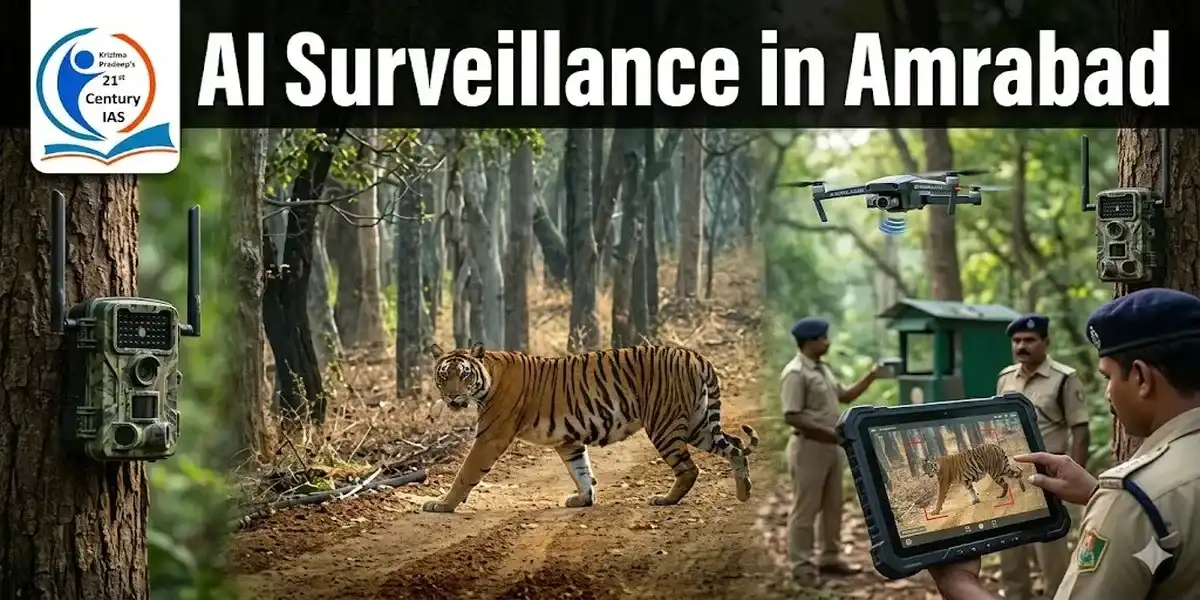
The Telangana Government has decided to deploy an Artificial Intelligence (AI)-based forest and wildlife surveillance system on a pilot basis in the Amrabad Tiger Reserve for strengthening forest monitoring and wildlife protection.
- The system will function as an integrated standalone surveillance network using normal cameras, thermal imaging cameras, wireless communication systems, control room monitoring, and AI-enabled alerts.
- The project is aimed at improving tiger conservation, preventing poaching, detecting illegal mining, checking forest infiltration, identifying wildlife crime-prone zones, and providing data-based decision support for the Forest Department.
- This development is important because it combines biodiversity conservation with modern AI-based governance tools.
About Amrabad Tiger Reserve
- Amrabad Tiger Reserve is located in the districts of Nagarkurnool and Nalgonda in Telangana.
- It lies in the Nallamala Hills, which form part of the Eastern Ghats.
- The southern boundary of the reserve is formed by the Krishna River, making riverine ecology an important feature of the landscape.
- It was officially established in 2014 after the bifurcation of Andhra Pradesh and was earlier part of the larger Nagarjunasagar–Srisailam Tiger Reserve.
- It is one of the largest tiger reserves in India and forms a major forest block in southern India.
- Its rugged plateau terrain, deep valleys, dense forests, and water systems make it an ideal habitat for large carnivores.
Geographical Location and Ecological Importance
- The reserve lies in the Deccan Plateau region and acts as a major ecological corridor connecting tiger habitats between central India and southern India.
- It supports gene flow between tiger populations and helps maintain landscape-level biodiversity.
- The Nallamala forest system is one of the largest stretches of dry deciduous forests in peninsular India.
- Because of the Krishna River boundary, the reserve also supports important riparian ecosystems and aquatic biodiversity.
- The presence of valleys, rocky escarpments, and seasonal streams creates ideal shelter and prey habitats for predators.
Flora and Fauna of the Reserve
The dominant forest type is Southern Tropical Dry Deciduous Forest.
Major vegetation includes:
- Teak (Tectona grandis)
- Hardwickia / Axlewood
- Terminalia species
- Bamboo
- Mixed dry deciduous species
Important animal species include:
- Tiger (Panthera tigris tigris) – flagship species under Project Tiger
- Leopard (Panthera pardus)
- Dhole (Cuon alpinus) – endangered wild dog
- Sloth Bear (Melursus ursinus)
- Indian Pangolin (Manis crassicaudata)
- Chital (Axis axis)
- Sambar (Rusa unicolor)
- Nilgai (Boselaphus tragocamelus)
Riverine and reptilian fauna include:
- Mugger Crocodile (Crocodylus palustris)
- Monitor lizards
- Various snake species
Chenchu Tribe and Conservation Interface
- Amrabad Tiger Reserve is unique because of the presence of the Chenchu tribe, a Particularly Vulnerable Tribal Group (PVTG).
- The Chenchus are traditional forest-dwelling hunter-gatherer communities who have lived inside these forests for generations.
- This makes Amrabad one of the rare tiger reserves where indigenous communities continue to live within core forest areas.
- Their livelihood depends on forest produce, traditional ecological knowledge, and forest access.
- This creates an important governance challenge between wildlife conservation and tribal rights, especially under:
- Wildlife Protection Act, 1972
- Forest Rights Act, 2006
AI-Based Wildlife Surveillance System
The new AI-integrated surveillance system will function through a hybrid model using:
- normal image and video cameras
- thermal sensing cameras
- wireless network communication
- central control room monitoring
- graphical alerts on geomaps
- remote camera operations on a 24×7 basis
- The system will generate alarms and alerts whenever unusual movement, poaching risk, illegal entry, fire incidents, or wildlife movement is detected.
- The control room will be connected to all cameras and will store feed for monitoring and reporting.
- The system will also provide movement pattern analysis of wildlife for better management.
Technical Component | Main Function | Key Benefit |
AI-Based Object Detection | Identifies animal, human, and livestock movement | Improves anti-poaching operations |
Thermal Imaging Cameras | Detect animals through heat signatures, even in darkness | Helps in night surveillance and tiger tracking |
PTZ Cameras | Rotates, zooms, and tracks movement dynamically | Reduces surveillance gaps |
Geo-Coordinate Mapping | Links alerts with exact location coordinates | Improves quick response and hotspot mapping |
Forest Fire Detection | Detects heat anomalies, smoke, and temperature spikes | Enables early fire warning |
GIS and Predictive Analytics | Maps wildlife, terrain, and human activity patterns | Helps identify poaching zones and conflict areas |
Challenges in Implementation
Several operational challenges remain:
- maintaining equipment in remote forest terrain
- uninterrupted wireless connectivity in deep forests
- high cost of installation and maintenance
- technical training of field staff
- balancing surveillance with tribal rights and local sensitivities
CARE MCQ
Q. Consider the following statements regarding Amrabad Tiger Reserve:
- It is located in the Nallamala Hills of Telangana.
- The Krishna River forms part of its southern boundary.
- The Chenchu tribe is a Particularly Vulnerable Tribal Group associated with this reserve.
Which of the statements given above are correct?
(a) 1 and 2 only
(b) 2 and 3 only
(c) 1, 2 and 3
(d) 1 and 3 only
Answer: (c)
Explanation
Statement 1 is correct : the reserve lies in the Nallamala Hills of the Eastern Ghats.
Statement 2 is correct : the Krishna River forms the southern boundary.
Statement 3 is correct : the Chenchu tribe is a PVTG traditionally living in this forest region.
Therefore, the correct answer is (c)
Q.With reference to Kawal Tiger Reserve, consider the following statements:
- Kawal Tiger Reserve is located in the northern part of Telangana.
- It lies in the districts of Adilabad, Nirmal, and Mancherial.
- It forms part of the Godavari River basin.
- It is part of the Eastern Ghats mountain range.
Which of the statements given above are correct?
(a) 1, 2 and 3 only
(b) 1 and 4 only
(c) 2, 3 and 4 only
(d) 1, 2, 3 and 4
Answer: (a) 1, 2 and 3 only
Statement 1 is correct: Kawal Tiger Reserve is situated in the northern part of Telangana and is one of the major tiger habitats of the state.
Statement 2 is correct: The reserve extends across Adilabad, Nirmal, and Mancherial districts and forms an important protected forest landscape.
Statement 3 is correct: Kawal Tiger Reserve lies within the Godavari River basin, which supports rich biodiversity and dry deciduous forest ecosystems.
Statement 4 is incorrect: Kawal Tiger Reserve is not part of the Eastern Ghats mountain range. It mainly consists of tropical dry deciduous forests and plateau region forests of the Deccan landscape.
Q.With reference to the Eastern Ghats, consider the following statements:
- The Eastern Ghats run parallel to the eastern coast of India in a discontinuous manner.
- They are older and more eroded than the Western Ghats.
- The Godavari, Mahanadi, and Krishna rivers cut through the Eastern Ghats.
- The Eastern Ghats are continuous mountain ranges like the Western Ghats.
Which of the statements given above are correct?
(a) 1, 2 and 3 only
(b) 1, 3 and 4 only
(c) 2 and 4 only
(d) 1, 2, 3 and 4
Answer: (a) 1, 2 and 3 only
Statement 1 is correct: The Eastern Ghats extend parallel to the eastern coast of India from Odisha to Tamil Nadu, but unlike the Western Ghats, they are discontinuous and broken by rivers.
Statement 2 is correct: The Eastern Ghats are older and more eroded than the Western Ghats due to long geological processes and river erosion.
Statement 3 is correct: Major rivers such as the Mahanadi, Godavari, Krishna, and Kaveri cut across the Eastern Ghats and flow into the Bay of Bengal.
Statement 4 is incorrect: The Eastern Ghats are not continuous mountain ranges. They are discontinuous because several major rivers cut across them before draining into the Bay of Bengal.
APPSC Mains Question
Q. Discuss how Artificial Intelligence can improve wildlife conservation and forest governance in India, with special reference to tiger reserves.
(250 words)
FAQs
1.Where is Amrabad Tiger Reserve located?
Ans: It is located in Nagarkurnool and Nalgonda districts of Telangana.
2.Why is Amrabad Tiger Reserve important?
Ans: It is one of India’s major tiger reserves and an important ecological corridor in southern India.
3.Which tribe lives inside the reserve?
Ans: The Chenchu tribe, classified as a Particularly Vulnerable Tribal Group (PVTG), lives within the forest region.
4.What is the role of thermal cameras?
Ans: They detect animals and intrusions using heat signatures, especially during night surveillance.
5.Why is AI surveillance important?
Ans: It improves real-time monitoring, anti-poaching operations, fire detection, and scientific wildlife management.