Why in News?
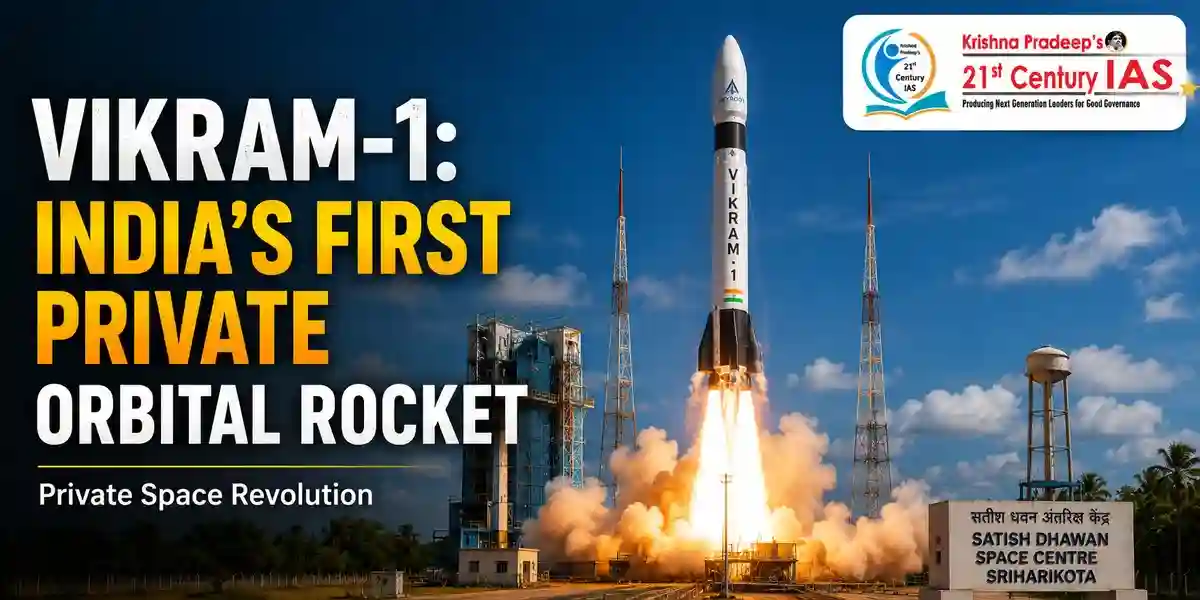
On 18 July 2026, Skyroot Aerospace’s Vikram-1 lifted off from the Satish Dhawan Space Centre, Sriharikota, marking India’s first private orbital rocket launch from Indian soil. The rocket lifted off at 12:05:30 PM and successfully injected its payload into an orbit of around 450 km about 15 minutes after launch. The mission also made India the third country after the United States and China to achieve orbital launch capability through private enterprise.
What is Vikram-1?
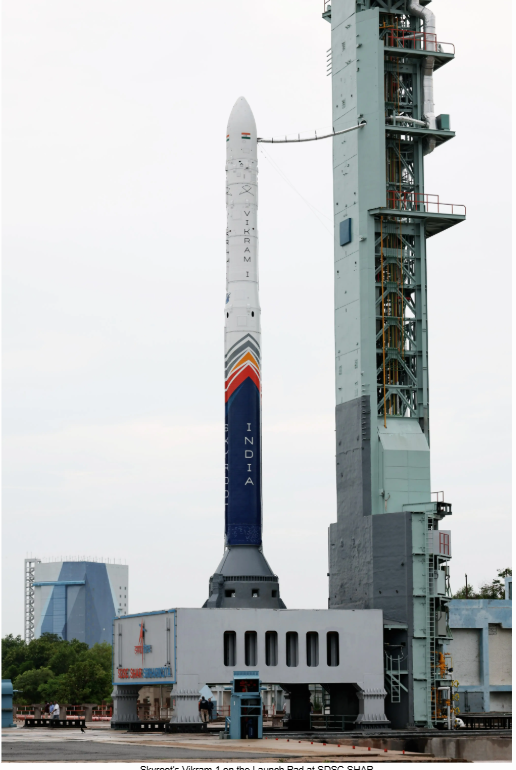
- Vikram-1, also referred to as Vikram-I, is a privately developed Indian orbital rocket built by Skyroot Aerospace, a Hyderabad-based space start-up.
- Its main purpose is to launch small satellites into Low Earth Orbit. It is different from a test rocket because it does not merely reach space and come down; it places payloads into a stable orbit around Earth.
- The mission was launched from Sriharikota, located in Andhra Pradesh, near Pulicat Lake and the Bay of Bengal. Sriharikota remains India’s primary rocket launch centre. ISRO is also developing another major launch facility at Kulasekarapattinam in Tamil Nadu.
Orbital Rocket and Low Earth Orbit
An orbital rocket is a rocket that can place a satellite into a stable orbit around Earth.
| Type | Meaning |
| Sub-orbital rocket | Goes to space but does not place a satellite into orbit |
| Orbital rocket | Places a satellite into orbit around Earth |
- Low Earth Orbit, or LEO, is the region close to Earth, usually between 160 km and 2,000 km above Earth’s surface. Satellites in LEO generally complete one orbit around Earth in about 90–120 minutes.
LEO is important for:
- Earth observation: Monitoring forests, rivers, land use and urban growth
- Communication satellites: Supporting TV, phone and internet services
- Internet satellite constellations: Providing connectivity in remote areas
- Imaging satellites: Capturing satellite images of cities, cyclones and terrain
- Disaster monitoring: Supporting flood and cyclone warnings
- Climate monitoring: Tracking glaciers, sea temperature and weather changes
- Defence and surveillance: Monitoring borders, ships and security zones
LEO is commercially valuable because its closeness to Earth reduces communication delay and improves imaging and observation quality.
About Vikram-1
| Point | Details |
| Rocket Name | Vikram-1 / Vikram-I |
| Developer | Skyroot Aerospace |
| Launch Date | 18 July 2026 |
| Launch Site | Satish Dhawan Space Centre, Sriharikota |
| Mission Name | Mission Aagaman |
| Orbit Targeted | Low Earth Orbit |
| Orbit Achieved | Around 450 km |
| Payload Capacity | Up to 350 kg to LEO |
| Nature | First privately developed Indian orbital launch vehicle |
| Regulatory Support | IN-SPACe |
| Institutional Support | ISRO facilities and technical support |
Vikram-1 uses an all-carbon composite structure, solid-fuel boosters and a 3D-printed liquid engine. It is designed for the fast-growing global market for small satellite launches.
Mission Aagaman
The maiden orbital mission of Vikram-1 was called Mission Aagaman.
The mission aimed to test and validate:
- Propulsion system
- Avionics
- Telemetry
- Guidance
- Navigation
- Control systems
- In-flight performance
Mission Aagaman also collected data for future commercial launches. This makes it important not only as a symbolic milestone but also as a technology-validation mission for India’s private space sector.
Payloads Carried by Vikram-1
Vikram-1 carried multiple customer payloads and in-orbit experiments.
| Payload | Simple Meaning | Purpose |
| SCOPE | Skyroot’s own small satellite | To collect flight data and assess Vikram-1’s space performance |
| Grahaa / SOLARAS S3 | Earth-observation / technology satellite | To test space technology and collect Earth-related information |
| DCUBED payload | German technology demonstration payload | To test new space technology in orbit |
| Cosmoserve Embrace | Robotic arm experiment | To test technology useful for future orbital debris capture |
| Cosmic Bloom | Art payload sent to space | To symbolise the link between science, creativity and space exploration |
| 18-karat gold micro-rocket | Small gold model of a rocket | Tribute to Indian scientists and India’s space journey |
These payloads show that the mission combined technology testing, commercial payload deployment, Earth observation, debris-related experimentation and symbolic space outreach.
Technical Features of Vikram-1
| Feature | Details |
| Height | Around 22 metres / seven storeys |
| Stages | 4-stage rocket |
| Main Propulsion | 3 solid stages |
| Upper Stage | Liquid-fuel orbital adjustment module |
| Payload Capacity | Up to 350 kg to LEO |
| Target Orbit | Around 450 km |
| Special Feature | 3D-printed liquid engine |
- Vikram-1 uses three solid-fuel stages to lift the rocket from Earth and push it towards space. Its upper stage uses liquid fuel to make final corrections and place the satellite in the required orbit.
- The liquid engine used in the upper stage is called RAMAN-I.
Role of ISRO and IN-SPACe
- Although Vikram-1 was developed by a private company, ISRO and IN-SPACe played important enabling roles.
ISRO’s Support
ISRO provided:
- Access to solid motor casting facilities
- Static test facilities at SDSC, Sriharikota
- Liquid engine testing support at LPSC
- Stage preparation support
- Material handling support
- Trajectory analysis
- Vehicle integration support
- Safety support during launch operations
The first-stage and second-stage solid motors were tested at SDSC facilities, while the liquid engine RAMAN-I was tested at the Liquid Propulsion Systems Centre.
IN-SPACe’s Role
IN-SPACe stands for Indian National Space Promotion and Authorisation Centre. It acted as the regulator and promoter for private space activities by providing access mechanisms, technical consultancy, mission readiness reviews and launch clearances.
Significance of Vikram-1
1. First Private Orbital Rocket from India
Vikram-1 marks the first successful orbital launch by a private Indian company from Indian soil. It signals India’s transition from an ISRO-dominated launch ecosystem to a broader public-private space ecosystem.
2. Entry into Private Orbital Launch Club
With this mission, India joined the United States and China as countries with private orbital launch capability.
3. Boost to Commercial Space Sector
The launch strengthens India’s role in the global small satellite launch market, where demand is rising due to Earth observation, communications, internet constellations and defence applications.
4. Success of Space Sector Reforms
The mission reflects the impact of space-sector reforms after 2020 and the Indian Space Policy 2023, which opened the space value chain to private participation.
5. Support for LEO Economy
Small rockets like Vikram-1 can provide flexible, dedicated and on-demand launch services for small satellites in Low Earth Orbit.
6. Technology Indigenisation
Features such as the all-carbon composite structure, solid-fuel stages, and 3D-printed liquid engine show India’s growing capability in advanced launch vehicle technologies.
India’s Space Sector Reforms
The Vikram-1 launch is part of a wider transformation in India’s space economy.
Indian Space Policy 2023
The policy allowed Non-Government Entities to participate across the space value chain, including satellite manufacturing, launch vehicles, applications, downstream services and commercial space activities.
IN-SPACe
As of June 2026, IN-SPACe had registered over 4,500 organisations, issued 133 authorisations and signed 106 MoUs.
NSIL
NewSpace India Limited is ISRO’s commercial arm. As of July 2026, NSIL had launched 141 satellites, including 138 international/customer satellites and 3 Indian satellites.
Funding Support
Support measures for private space enterprises include:
- IN-SPACe Seed Fund Scheme
- ₹1,000 crore Venture Capital Fund
- ₹500 crore Technology Adoption Fund
- Liberalised FDI policy for the space sector
The Technology Adoption Fund supports indigenous space technologies by Non-Government Entities and can fund up to 60% of project cost for start-ups and MSMEs, subject to a cap.
Important Timeline
| Year | Development |
| 2020 | India opened the space sector to private participation |
| 2022 | Skyroot launched Vikram-S, India’s first privately developed rocket to reach space on a sub-orbital flight |
| 2023 | Indian Space Policy 2023 formalised private participation framework |
| 2024 | Agnikul Cosmos launched from India’s first private launch pad, Dhanush |
| February 2026 | SSLV technology transfer to HAL facilitated |
| 18 July 2026 | Vikram-1 became India’s first private orbital launch vehicle from Indian soil |
Difference between Vikram-S and Vikram-1
| Point | Vikram-S | Vikram-1 |
| Type | Sub-orbital rocket | Orbital rocket |
| Meaning | Goes to space and comes back/down | Places satellite into Earth orbit |
| Purpose | Technology demonstration/test rocket | Small satellite launch vehicle |
| Launch Year | 2022 | 2026 |
| Mission Nature | Test flight | Actual orbital mission |
| Payload Role | Carried payloads for experiments | Can place satellites in Low Earth Orbit |
| Importance | India’s first private rocket to reach space | India’s first private orbital rocket launch |
Challenges
- Private launch providers must ensure reliability across repeated missions.
- The small satellite market is competitive globally.
- Space debris risk will increase as LEO becomes more crowded.
- Regulatory coordination between ISRO, IN-SPACe, NSIL and private firms must remain clear.
- Private firms need sustained funding, testing infrastructure and skilled manpower.
- India must strengthen domestic supply chains for advanced propulsion, composites, avionics and launch systems.
Way Forward
India should build on Vikram-1’s success by expanding testing infrastructure access, strengthening IN-SPACe’s single-window role, supporting start-ups through targeted funding, promoting indigenous component manufacturing, developing responsible space-debris mitigation norms and encouraging dedicated launch services for small satellites. Greater collaboration among ISRO, IN-SPACe, NSIL, start-ups, academia and industry can convert India’s private space momentum into a globally competitive commercial space ecosystem.
Conclusion
The successful launch of Vikram-1 marks a turning point in India’s space journey. It demonstrates that Indian private companies can design, develop and execute orbital launch missions with institutional support from ISRO and regulatory facilitation from IN-SPACe. By placing payloads into a 450 km Low Earth Orbit, Vikram-1 has strengthened India’s position in the small satellite launch market and advanced the country’s transition towards a vibrant NewSpace economy.