Relevance: Telangana Current Affairs, Sports,

Important Keywords for Prelims and Mains

For Prelims:

  • ILCA Open International Sailing Championship, Hyderabad Sailing Week 2026, Yachting Association of India, EME Sailing Association, MCEME, Hussain Sagar, ILCA 7, ILCA 6, ILCA 4

For Mains:

  • Sports infrastructure, competitive sailing, women’s participation in sports, military institutions and sports promotion, youth development, international sporting events

Why in News?

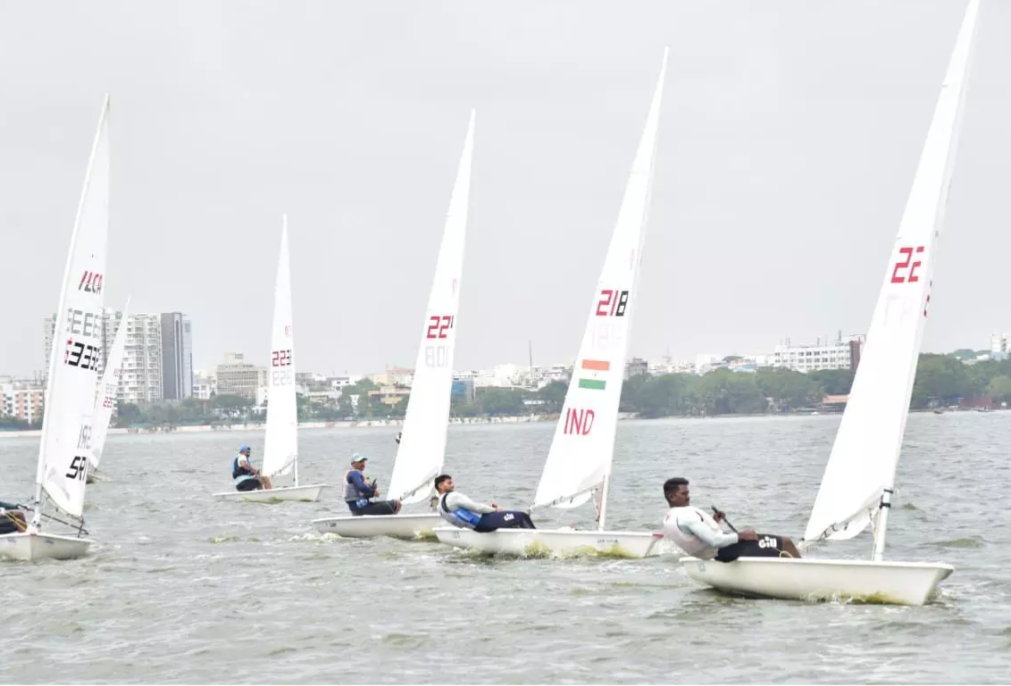
India’s first ILCA Open International Sailing Championship concluded in Hyderabad after a week-long competition at Hussain Sagar. The event brought together 124 sailors, including international participants, and was held alongside the Yachting Association of India’s 40th Hyderabad Sailing Week 2026.
About the Championship

  • The ILCA Open International Sailing Championship was organised in Hyderabad as India’s first international championship under this format.
  • The competition was held at Hussain Sagar, a well-known water body associated with sailing activity in Hyderabad. The event strengthened the city’s position as a venue for competitive sailing.
  • It was conducted alongside the 40th Hyderabad Sailing Week 2026, organised under the framework of the Yachting Association of India.

Organising Institutions

  • The championship was hosted by the EME Sailing Association.
  • It was conducted under the aegis of the Military College of Electronics and Mechanical Engineering, Hyderabad.

The event was organised in association with:

  • International Laser Class Association
  • Yachting Association of India
  • EME Sailing Association
  • Military College of Electronics and Mechanical Engineering

This shows the role of defence-linked institutions in promoting organised and competitive sports in India.

Participation and Categories

  • The event brought together 124 sailors, including overseas participants.
  • Sailors came from 19 sailing clubs and institutions, including:
  • Army sailing establishments
  • Navy sailing establishments
  • Civilian sailing institutions
  • Overseas participants
  • A total of 19 women and girls participated in the championship.
  • The races were conducted across the following categories:
  • ILCA 7
  • ILCA 6 — Men and Women
  • ILCA 4 — Boys and Girls

This made the event inclusive across age and gender categories within competitive sailing.

Importance for Hyderabad and Indian Sailing

  • The successful conduct of India’s first ILCA Open International Sailing Championship at Hussain Sagar is an important milestone for Indian sailing.
  • The event adds to Hyderabad’s sporting profile and reinforces the city’s association with water sports. Hosting an international sailing event also gives Indian sailors exposure to competitive racing standards and interaction with overseas participants.
  • The championship also strengthens the legacy of Hyderabad Sailing Week, which has completed its 40th edition in 2026.

Role of EMESA and MCEME

  • The EME Sailing Association has contributed to sailing for nearly four decades.
  • Its association with MCEME has helped develop sailing talent and build institutional support for the sport.
  • Over the years, EMESA has produced:
  • Olympians
  • Arjuna Awardees
  • Accomplished sailors

The championship therefore reflects both continuity and expansion in India’s sailing ecosystem.

Conclusion

The conclusion of India’s first ILCA Open International Sailing Championship in Hyderabad marks an important moment for Indian sailing. With 124 sailors, participation from 19 clubs and institutions, international representation, and races across ILCA 7, ILCA 6 and ILCA 4 categories, the event strengthened Hyderabad’s place in competitive sailing. It also highlighted the continuing contribution of EMESA and MCEME in nurturing sailing talent and promoting discipline-oriented sports.

CARE MCQ

Q. Consider the following statements regarding the ILCA Open International Sailing Championship 2026:

  1. It was held at Hussain Sagar in Hyderabad.
  2. It was conducted alongside the 40th Hyderabad Sailing Week 2026.
  3. The championship was hosted by the EME Sailing Association.
  4. It was limited only to civilian sailing clubs.

Which of the statements given above are correct?

a) 1, 2 and 3 only

b) 1 and 4 only

c) 2, 3 and 4 only

d) 1, 2, 3 and 4

Answer: A

Explanation:

Statement 1 is correct: The championship was held at Hussain Sagar in Hyderabad.

Statement 2 is correct: It was held alongside the YAI 40th Hyderabad Sailing Week 2026.

Statement 3 is correct: The event was hosted by the EME Sailing Association.

Statement 4 is incorrect: Participants came from Army, Navy and civilian sailing establishments, along with overseas participants.

FAQs

Q.  Where was the ILCA Open International Sailing Championship held?
It was held at Hussain Sagar, Hyderabad.

Q.  How many sailors participated?
124 sailors participated, including international participants.

Q. Which event was held alongside it?
It was held alongside the YAI 40th Hyderabad Sailing Week 2026.

Q. Who hosted the championship?
The championship was hosted by the EME Sailing Association.

Q. Which categories were included?
The event included ILCA 7, ILCA 6 and ILCA 4 categories.


Relevance: UPSC GS Paper II: Cooperative Federalism, Governance, Policy Reforms, Centre-State Relations

Important Keywords for Prelims and Mains

For Prelims:

  • Investment Friendliness Index, NITI Aayog, Viksit Bharat @2047, Viksit Rajya @2047, Competitive Federalism, Cooperative Federalism, Investor Perception Survey, Infrastructure, Business Climate, Regulatory Ease, Financial Health, Environmental Resilience, National Single Window System

For Mains:

  • State-led investment reforms, investment competitiveness, private investment, industrialisation, policy predictability, regulatory efficiency, infrastructure-led growth, regional investment disparities, investor confidence, evidence-based governance

Why in News?

NITI Aayog has released the report titled “Investment Friendliness Index”, a structured and data-driven framework to assess how effectively States and Union Territories create, enable and sustain an environment conducive to investments. The Index aims to benchmark State-level investment ecosystems, promote reforms, strengthen competitive and cooperative federalism, and support the vision of Viksit Bharat @2047 through stronger Viksit Rajya @2047 pathways.

Background of the Investment Friendliness Index

  • During the 9th Governing Council Meeting of NITI Aayog held in July 2024, the Prime Minister tasked NITI Aayog with preparing an Investment-Friendly Charter comprising key policies, programmes and processes required to attract investments.
  • Subsequently, the Union Budget 2025–26 announced the development of an Investment Friendliness Index to promote reforms and build a conducive investment ecosystem across States.
  • The Index has been designed as a homegrown, evidence-based reform instrument that moves beyond one-time ease-of-doing-business rankings and focuses on continuous improvement in State-level investment conditions.

What is the Investment Friendliness Index?

  • The Investment Friendliness Index is a composite assessment tool developed by NITI Aayog to evaluate the investment readiness of all 28 States and 8 Union Territories.
  • It examines the quality of the investment ecosystem across policy, institutional, regulatory, infrastructure and sustainability-related parameters.
  • The Index seeks to answer a core governance question: How prepared is a State or Union Territory to attract, facilitate and sustain domestic and foreign investment?

It is not merely a ranking exercise. It is designed to:

  • Identify strengths of each State and UT
  • Highlight reform gaps
  • Promote adoption of best practices
  • Encourage peer learning
  • Support investor confidence
  • Strengthen India’s global investment competitiveness

Framework and Methodology

The Investment Friendliness Index has been developed through a rigorous and consultative process involving a review of global and domestic investment benchmarking methodologies.

It uses 84 indicators, combining:

  • Secondary data
  • Primary investor perception surveys

The Index evaluates investment attractiveness across eight pillars.

PillarCore Focus
InfrastructurePhysical logistics, power reliability, digital connectivity
Business ClimateSingle-window systems, operational continuity, ease of business functioning
ResourcesIndustrial land, skilled labour, raw material availability
Government PolicyPolicy predictability, stability and investor support
Regulatory EaseLower compliance burden and reduced bureaucratic friction
Institutional EnvironmentCapacity, transparency and responsiveness of State institutions
Financial HealthFiscal prudence and macroeconomic stability of States
Environmental ResilienceSustainability, ecological compliance and climate-sensitive planning

This makes the IFI a more comprehensive tool than narrow regulatory rankings because it combines hard infrastructure, governance quality, fiscal strength, investor perception and environmental sustainability.

Key Results and State Categorisation

Based on overall scores, States and Union Territories have been classified into four categories:

CategoryScore Range
Top PerformersAbove 50
Frontrunners45–50
Emerging Performers40–45
Aspiring StatesBelow 40

Overall Top Performers

The top-performing States in the Investment Friendliness Index are:

  1. Gujarat – 56.6
  2. Maharashtra – 53.7
  3. Tamil Nadu – 53.3
  4. Goa – 53.1
  5. Odisha – 52.4

In addition, 15 States have been classified as Frontrunners, while eight States/UTs each have been placed in the Emerging Performers and Aspiring States categories.

Peer Group Assessment

Recognising India’s diverse federal structure, the Index also compares States and UTs within peer groups.

Large States

  • Gujarat secured the first rank, followed by Maharashtra and Tamil Nadu. These are also the top three performers in the overall Index.

Hilly and North-Eastern States

  • Uttarakhand emerged as the highest-ranked State, followed by Assam and Himachal Pradesh.

Union Territories and City States

  • Goa secured the top position, followed by Delhi and Chandigarh.
  • This peer-group approach allows more meaningful comparison by considering differences in geography, economic scale and administrative capacity.

Why the Investment Friendliness Index Matters

1. Advancing Viksit Bharat @2047

  • India aims to become a developed economy by 2047. Achieving this goal will require higher investment rates, deeper industrialisation, innovation, employment generation and stronger private sector participation.
  • India’s real GDP grew at an average annual rate of around 6.1% between FY1992 and FY2025, but long-term development ambitions require faster and sustained growth. The investment rate stood at around 29.9% of GDP in FY25, lower than the 40% plus investment rates achieved by economies such as Japan, South Korea and China during their rapid industrialisation phases.
  • Thus, investment acceleration is central to the vision of Viksit Bharat @2047.

2. States are Central to Investment Decisions

While the Union Government provides the national policy and macroeconomic framework, actual investment decisions are strongly shaped by State-level conditions.

Investors consider factors such as:

  • Availability of industrial land
  • Quality of roads, power and digital connectivity
  • Regulatory efficiency
  • Single-window clearance systems
  • Skilled labour availability
  • Policy predictability
  • Law and order
  • Fiscal stability
  • Environmental clearance processes

Therefore, stronger State investment ecosystems are essential for India’s competitiveness.

3. Addressing Regional Investment Imbalances

  • Investment in India remains regionally concentrated. Nearly 85% of FDI inflows are concentrated in Maharashtra, Karnataka, Gujarat, Delhi and Tamil Nadu, while the North-Eastern States receive less than 1%.
  • The difference between the highest score, Gujarat at 56.6, and the lowest score, Lakshadweep at 24.5, reflects deep structural disparities in infrastructure, institutions and economic base.
  • The IFI can help weaker States identify gaps and adopt targeted reforms.

4. Moving Beyond Incentive-Based Competition

  • Many States compete through fiscal incentives, subsidies and tax concessions. However, the report underlines that investors value transparent, predictable and stable regulatory environments more than incentives alone.
  • This makes policy certainty, faster approvals and institutional responsiveness central to investment competitiveness.

Insights from State Profiles

The report provides detailed State Profiles for each State and Union Territory.

These profiles:

  • Benchmark States against comparable peers
  • Identify key enabling factors
  • Highlight weak indicators
  • Include investor perception survey insights
  • Capture on-ground business experience
  • Help policymakers frame targeted reforms
  • Enable investors to understand jurisdiction-wise strengths and opportunities

Some important insights include:

Gujarat

  • Gujarat leads due to efficient port turnaround times, reliable power supply, strong manufacturing exports and better fiscal indicators. It accounts for around 31% of India’s merchandise exports and had a low fiscal deficit-to-GSDP ratio of 2.81% in FY2024.

Maharashtra

  • Maharashtra performs strongly in business climate. It has the highest share of private equity and venture capital investment, around 35% of the national total, and a large number of Atal Tinkering Labs.

Tamil Nadu

  • Tamil Nadu performs well in infrastructure and business climate. It is supported by strong export performance and near-100% MoU conversion.

Goa

  • Goa performs strongly in resources and regulatory ease among city States and UTs, aided by high spending on skilling and healthcare and a high renewable share in its power mix.

Challenges in Attracting Investments Across States

1. Regional Investment Disparities

  • Investment remains concentrated in a few advanced States. States with weaker infrastructure, smaller markets or difficult geography struggle to attract large-scale private investment.

2. Long Approval Timelines

  • Investors continue to face delays in approvals, clearances and project permissions. In many cases, the approval process may take several months, affecting investment decisions.

3. Land Access Issues

  • Availability of clear, litigation-free and well-connected industrial land remains a key investor concern.

4. Skill Shortages

  • Shortage of skilled labour and talent migration affect several States, including Jammu and Kashmir, Chhattisgarh, Rajasthan, Tripura, Nagaland and Uttar Pradesh.

5. Weak Single-Window Systems

  • Some States still face weak implementation of digital single-window clearance systems. In Jammu and Kashmir, for example, the digital system is reportedly bypassed, with manual complaint registration continuing despite online provisions.

6. Law and Order Concerns

  • Investor confidence can be affected by perceived security issues. In Bihar, safety concerns and limited air connectivity to Tier-II and Tier-III cities have been identified as constraints.

7. Fiscal Stress

  • High debt and interest burden reduce the capacity of States to invest in infrastructure and incentives. Bihar’s outstanding liabilities-to-GSDP ratio is nearly 500 basis points above the national average, while Jammu and Kashmir’s gross fiscal deficit is around 9% of GSDP.

8. Digital Infrastructure Gaps

  • Weak last-mile digital connectivity affects business operations. Jammu and Kashmir’s 4G/5G penetration remains low, with a Base Transceiver Station density of 0.82 per sq. km.

9. Environmental and Climate Risks

  • Industrial clusters in parts of Uttar Pradesh such as Noida, Ghaziabad and Muzaffarnagar face high AQI levels of 200–600 for much of the year. Several States also face flood risks requiring better drainage and water-management systems.

10. Logistics Bottlenecks

  • Poor road quality, weak last-mile connectivity, inadequate warehousing and cold-storage infrastructure continue to affect investment. Airport-related constraints are visible in Bihar, Sikkim, Odisha, Chandigarh and Chennai.

11. Slow Incentive Disbursement

  • Delays in incentive payments and weak inter-departmental coordination have been highlighted in States such as Andhra Pradesh and Telangana.

Region-Specific Structural Challenges

Hilly and North-Eastern States

Difficult terrain increases the cost of infrastructure development and restricts access to resources. Ladakh recorded one of the lowest overall scores at 27.0.

Large States

Large States face complex administrative structures and intra-State regional disparities, affecting policy implementation efficiency.

Union Territories and City States

Compact geography limits land and natural resource availability, although better urban infrastructure partly offsets this disadvantage.

Measures Needed to Improve Investment Competitiveness

1. Land and Labour Reforms

States should simplify land allotment, improve land banks and strengthen labour flexibility while protecting worker welfare.

2. Genuine Single-Window Clearance

Digital clearance systems under the National Single Window System should be fully integrated. Manual approvals should be reduced, and project approval timelines should move from 6–18 months to around 30–60 days.

3. Targeted Industrial Policies

States should adopt sector-specific policies supported by national initiatives such as the Production Linked Incentive Scheme. Examples include Gujarat’s Semiconductor Policy and Tamil Nadu’s EV Policy.

4. Infrastructure-First Strategy

Industrial growth must be supported through PM Gati Shakti National Master PlanNational Industrial Corridor Development ProgrammeGIFT CitySamruddhi Corridor and Chennai–Bengaluru Industrial Corridor.

5. Strengthening Business Climate

States should reduce regulatory compliance, simplify approvals, provide grievance redressal and improve investor facilitation.

6. Fiscal Sustainability

States need to reduce debt burdens, diversify revenue sources and create fiscal space for infrastructure and industrial incentives.

7. Bridging Infrastructure Gaps

Power supply should be strengthened through the Revamped Distribution Sector Scheme, digital connectivity through BharatNet, and logistics infrastructure through the PM Gati Shakti framework.

8. Institutional Governance

Policy stability, transparent land allotment, faster environmental clearances and accountable institutions are essential to build investor confidence.

9. Human Capital Development

States must strengthen Skill India MissionPM Kaushal Vikas Yojana and National Apprenticeship Promotion Scheme to address skilled labour shortages.

10. Climate-Resilient Infrastructure

Investment ecosystems should integrate environmental resilience through National Action Plan on Climate Change and climate-resilient industrial planning.

11. Recurring Benchmarking

The IFI should be institutionalised as a recurring benchmarking tool so that States can track progress over successive editions.

Significance of the Index

Competitive and Cooperative Federalism

The Index encourages States to compete on reform quality while learning from each other’s best practices.

Evidence-Based Policymaking

It provides data-backed insights instead of anecdotal claims about investment climate.

Private Investment Mobilisation

It helps identify reforms needed to attract domestic and foreign private investment.

Regional Balance

It can guide lagging States in improving infrastructure, regulation and institutions.

Investor Confidence

Transparent rankings and State profiles can help investors compare opportunities across jurisdictions.

Viksit Rajya to Viksit Bharat

The Index connects State-level reform performance with the national goal of Viksit Bharat @2047.

Conclusion

The Investment Friendliness Index 2026 marks an important shift from narrow ease-of-doing-business rankings to a broader, continuous and evidence-based reform framework. By assessing States and Union Territories across infrastructure, business climate, resources, policy, regulatory ease, institutional environment, financial health and environmental resilience, it provides a practical roadmap for improving India’s investment ecosystem. Its success will depend on whether States use the Index not merely as a ranking, but as a reform guide to improve investor confidence, reduce regional disparities and accelerate India’s journey towards Viksit Bharat @2047.

CARE MCQ

Q. Consider the following statements regarding the Investment Friendliness Index 2026:

  1. It was released by NITI Aayog to assess investment readiness of States and Union Territories.
  2. It evaluates all 28 States and 8 Union Territories across eight pillars.
  3. It uses both secondary data and investor perception-based inputs.
  4. It classifies Top Performers as those scoring below 40.

Which of the statements given above are correct?

(a) 1, 2 and 3 only
(b) 1 and 4 only
(c) 2, 3 and 4 only
(d) 1, 2, 3 and 4

Correct Answer: (a) 1, 2 and 3 only

Explanation

Statement 1 is correct: The Index was released by NITI Aayog to benchmark investment friendliness across States and UTs.

Statement 2 is correct: It covers all 28 States and 8 Union Territories.

Statement 3 is correct: The framework uses 84 indicators, including secondary data and investor perception survey inputs.

Statement 4 is incorrect: Top Performers are those scoring above 50. States scoring below 40 are classified as Aspiring States.

FAQs

Q. What is the Investment Friendliness Index?
It is a NITI Aayog framework to assess the investment ecosystem of States and Union Territories.

Q. How many pillars does the Index have?
It has eight pillars.

Q. How many indicators are used?
The framework uses 84 indicators.

Q. Which States are Top Performers?
Gujarat, Maharashtra, Tamil Nadu, Goa and Odisha are Top Performers.

Q. Which State ranked first among Large States?
Gujarat ranked first among Large States.

Q. Why is the Index important for Viksit Bharat?
It helps States improve investment ecosystems, attract private investment and support long-term economic growth.

Relevance: UPSC GS Paper III: Space Technology, Science & Technology, Private Sector Participation, Innovation, Indigenisation

Important Keywords for Prelims and Mains

For Prelims:

  • Vikram-1, Skyroot Aerospace, Mission Aagaman, Satish Dhawan Space Centre, Sriharikota, Low Earth Orbit, IN-SPACe, ISRO, NSIL, Indian Space Policy 2023, Vikram-S, Agnikul Cosmos, SSLV, PSLV, 3D-printed liquid engine, RAMAN-I, SCOPE, SOLARAS S3

For Mains:

  • Private space ecosystem, space sector reforms, commercial space economy, small satellite launch market, public-private partnership, NewSpace economy, technology indigenisation, space start-ups

Why in News?

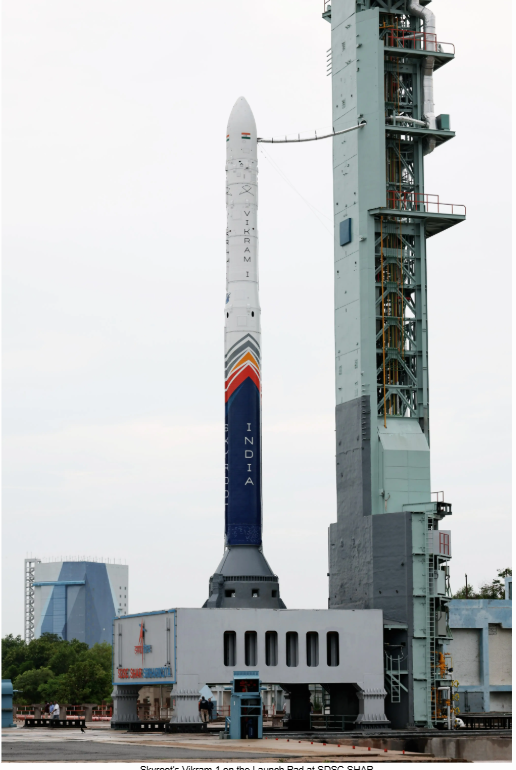
On 18 July 2026Skyroot Aerospace’s Vikram-1 lifted off from the Satish Dhawan Space Centre, Sriharikota, marking India’s first private orbital rocket launch from Indian soil. The rocket lifted off at 12:05:30 PM and successfully injected its payload into an orbit of around 450 km about 15 minutes after launch. The mission also made India the third country after the United States and China to achieve orbital launch capability through private enterprise.
What is Vikram-1?

  • Vikram-1, also referred to as Vikram-I, is a privately developed Indian orbital rocket built by Skyroot Aerospace, a Hyderabad-based space start-up.
  • Its main purpose is to launch small satellites into Low Earth Orbit. It is different from a test rocket because it does not merely reach space and come down; it places payloads into a stable orbit around Earth.
  • The mission was launched from Sriharikota, located in Andhra Pradesh, near Pulicat Lake and the Bay of Bengal. Sriharikota remains India’s primary rocket launch centre. ISRO is also developing another major launch facility at Kulasekarapattinam in Tamil Nadu.

Orbital Rocket and Low Earth Orbit

An orbital rocket is a rocket that can place a satellite into a stable orbit around Earth.

TypeMeaning
Sub-orbital rocketGoes to space but does not place a satellite into orbit
Orbital rocketPlaces a satellite into orbit around Earth
  • Low Earth Orbit, or LEO, is the region close to Earth, usually between 160 km and 2,000 km above Earth’s surface. Satellites in LEO generally complete one orbit around Earth in about 90–120 minutes.

LEO is important for:

  • Earth observation: Monitoring forests, rivers, land use and urban growth
  • Communication satellites: Supporting TV, phone and internet services
  • Internet satellite constellations: Providing connectivity in remote areas
  • Imaging satellites: Capturing satellite images of cities, cyclones and terrain
  • Disaster monitoring: Supporting flood and cyclone warnings
  • Climate monitoring: Tracking glaciers, sea temperature and weather changes
  • Defence and surveillance: Monitoring borders, ships and security zones

LEO is commercially valuable because its closeness to Earth reduces communication delay and improves imaging and observation quality.

About Vikram-1

PointDetails
Rocket NameVikram-1 / Vikram-I
DeveloperSkyroot Aerospace
Launch Date18 July 2026
Launch SiteSatish Dhawan Space Centre, Sriharikota
Mission NameMission Aagaman
Orbit TargetedLow Earth Orbit
Orbit AchievedAround 450 km
Payload CapacityUp to 350 kg to LEO
NatureFirst privately developed Indian orbital launch vehicle
Regulatory SupportIN-SPACe
Institutional SupportISRO facilities and technical support

Vikram-1 uses an all-carbon composite structuresolid-fuel boosters and a 3D-printed liquid engine. It is designed for the fast-growing global market for small satellite launches.

Mission Aagaman

The maiden orbital mission of Vikram-1 was called Mission Aagaman.

The mission aimed to test and validate:

  • Propulsion system
  • Avionics
  • Telemetry
  • Guidance
  • Navigation
  • Control systems
  • In-flight performance

Mission Aagaman also collected data for future commercial launches. This makes it important not only as a symbolic milestone but also as a technology-validation mission for India’s private space sector.

Payloads Carried by Vikram-1

Vikram-1 carried multiple customer payloads and in-orbit experiments.

PayloadSimple MeaningPurpose
SCOPESkyroot’s own small satelliteTo collect flight data and assess Vikram-1’s space performance
Grahaa / SOLARAS S3Earth-observation / technology satelliteTo test space technology and collect Earth-related information
DCUBED payloadGerman technology demonstration payloadTo test new space technology in orbit
Cosmoserve EmbraceRobotic arm experimentTo test technology useful for future orbital debris capture
Cosmic BloomArt payload sent to spaceTo symbolise the link between science, creativity and space exploration
18-karat gold micro-rocketSmall gold model of a rocketTribute to Indian scientists and India’s space journey

These payloads show that the mission combined technology testing, commercial payload deployment, Earth observation, debris-related experimentation and symbolic space outreach.

Technical Features of Vikram-1

FeatureDetails
HeightAround 22 metres / seven storeys
Stages4-stage rocket
Main Propulsion3 solid stages
Upper StageLiquid-fuel orbital adjustment module
Payload CapacityUp to 350 kg to LEO
Target OrbitAround 450 km
Special Feature3D-printed liquid engine
  • Vikram-1 uses three solid-fuel stages to lift the rocket from Earth and push it towards space. Its upper stage uses liquid fuel to make final corrections and place the satellite in the required orbit.
  • The liquid engine used in the upper stage is called RAMAN-I.

Role of ISRO and IN-SPACe

  • Although Vikram-1 was developed by a private company, ISRO and IN-SPACe played important enabling roles.

ISRO’s Support

ISRO provided:

  • Access to solid motor casting facilities
  • Static test facilities at SDSC, Sriharikota
  • Liquid engine testing support at LPSC
  • Stage preparation support
  • Material handling support
  • Trajectory analysis
  • Vehicle integration support
  • Safety support during launch operations

The first-stage and second-stage solid motors were tested at SDSC facilities, while the liquid engine RAMAN-I was tested at the Liquid Propulsion Systems Centre.

IN-SPACe’s Role

IN-SPACe stands for Indian National Space Promotion and Authorisation Centre. It acted as the regulator and promoter for private space activities by providing access mechanisms, technical consultancy, mission readiness reviews and launch clearances.

Significance of Vikram-1

1. First Private Orbital Rocket from India

Vikram-1 marks the first successful orbital launch by a private Indian company from Indian soil. It signals India’s transition from an ISRO-dominated launch ecosystem to a broader public-private space ecosystem.

2. Entry into Private Orbital Launch Club

With this mission, India joined the United States and China as countries with private orbital launch capability.

3. Boost to Commercial Space Sector

The launch strengthens India’s role in the global small satellite launch market, where demand is rising due to Earth observation, communications, internet constellations and defence applications.

4. Success of Space Sector Reforms

The mission reflects the impact of space-sector reforms after 2020 and the Indian Space Policy 2023, which opened the space value chain to private participation.

5. Support for LEO Economy

Small rockets like Vikram-1 can provide flexible, dedicated and on-demand launch services for small satellites in Low Earth Orbit.

6. Technology Indigenisation

Features such as the all-carbon composite structuresolid-fuel stages, and 3D-printed liquid engine show India’s growing capability in advanced launch vehicle technologies.

India’s Space Sector Reforms

The Vikram-1 launch is part of a wider transformation in India’s space economy.

Indian Space Policy 2023

The policy allowed Non-Government Entities to participate across the space value chain, including satellite manufacturing, launch vehicles, applications, downstream services and commercial space activities.

IN-SPACe

As of June 2026, IN-SPACe had registered over 4,500 organisations, issued 133 authorisations and signed 106 MoUs.

NSIL

NewSpace India Limited is ISRO’s commercial arm. As of July 2026, NSIL had launched 141 satellites, including 138 international/customer satellites and 3 Indian satellites.

Funding Support

Support measures for private space enterprises include:

  • IN-SPACe Seed Fund Scheme
  • ₹1,000 crore Venture Capital Fund
  • ₹500 crore Technology Adoption Fund
  • Liberalised FDI policy for the space sector

The Technology Adoption Fund supports indigenous space technologies by Non-Government Entities and can fund up to 60% of project cost for start-ups and MSMEs, subject to a cap.

Important Timeline

YearDevelopment
2020India opened the space sector to private participation
2022Skyroot launched Vikram-S, India’s first privately developed rocket to reach space on a sub-orbital flight
2023Indian Space Policy 2023 formalised private participation framework
2024Agnikul Cosmos launched from India’s first private launch pad, Dhanush
February 2026SSLV technology transfer to HAL facilitated
18 July 2026Vikram-1 became India’s first private orbital launch vehicle from Indian soil

Difference between Vikram-S and Vikram-1

PointVikram-SVikram-1
TypeSub-orbital rocketOrbital rocket
MeaningGoes to space and comes back/downPlaces satellite into Earth orbit
PurposeTechnology demonstration/test rocketSmall satellite launch vehicle
Launch Year20222026
Mission NatureTest flightActual orbital mission
Payload RoleCarried payloads for experimentsCan place satellites in Low Earth Orbit
ImportanceIndia’s first private rocket to reach spaceIndia’s first private orbital rocket launch

Challenges

  • Private launch providers must ensure reliability across repeated missions.
  • The small satellite market is competitive globally.
  • Space debris risk will increase as LEO becomes more crowded.
  • Regulatory coordination between ISRO, IN-SPACe, NSIL and private firms must remain clear.
  • Private firms need sustained funding, testing infrastructure and skilled manpower.
  • India must strengthen domestic supply chains for advanced propulsion, composites, avionics and launch systems.

Way Forward

India should build on Vikram-1’s success by expanding testing infrastructure access, strengthening IN-SPACe’s single-window role, supporting start-ups through targeted funding, promoting indigenous component manufacturing, developing responsible space-debris mitigation norms and encouraging dedicated launch services for small satellites. Greater collaboration among ISRO, IN-SPACe, NSIL, start-ups, academia and industry can convert India’s private space momentum into a globally competitive commercial space ecosystem.

Conclusion

The successful launch of Vikram-1 marks a turning point in India’s space journey. It demonstrates that Indian private companies can design, develop and execute orbital launch missions with institutional support from ISRO and regulatory facilitation from IN-SPACe. By placing payloads into a 450 km Low Earth Orbit, Vikram-1 has strengthened India’s position in the small satellite launch market and advanced the country’s transition towards a vibrant NewSpace economy.

CARE MCQ

Q. Consider the following statements regarding Vikram-1:

  1. Vikram-1 was developed by Skyroot Aerospace.
  2. It was launched from the Satish Dhawan Space Centre, Sriharikota.
  3. It is a sub-orbital test rocket like Vikram-S.
  4. It can place payloads into Low Earth Orbit.

Which of the statements given above are correct?

(a) 1, 2 and 4 only
(b) 1 and 3 only
(c) 2, 3 and 4 only
(d) 1, 2, 3 and 4

Correct Answer: (a) 1, 2 and 4 only

Explanation

Statement 1 is correct: Vikram-1 was developed by Skyroot Aerospace.

Statement 2 is correct: It was launched from Satish Dhawan Space Centre, Sriharikota.

Statement 3 is incorrect: Vikram-S was a sub-orbital test rocket. Vikram-1 is an orbital launch vehicle.

Statement 4 is correct: Vikram-1 is designed to place small satellites into Low Earth Orbit.

FAQs

Q. What is Vikram-1?
Vikram-1 is India’s first privately developed orbital launch vehicle by Skyroot Aerospace.

Q. When was Vikram-1 launched?
It was launched on 18 July 2026.

Q. Where was Vikram-1 launched from?
It was launched from Satish Dhawan Space Centre, Sriharikota.

Q. What was the mission name?
The maiden orbital mission was called Mission Aagaman.

Q. What orbit did Vikram-1 achieve?
It achieved an orbit of around 450 km.

Q. What is the payload capacity of Vikram-1?
It can carry up to 350 kg to Low Earth Orbit.

 
TGPSC Current Affairs July 17th 2026

Enroll Now for Unlimited UPSC Utsav

Start Date

22/03/2026

Timings

08 AM – 4 PM

    Courses

    Scroll to Top