Mains Practice Questions for the Day
- Q. The Investment Friendliness Index can strengthen competitive and cooperative federalism in India. Discuss its significance and challenges in improving State-level investment ecosystems.
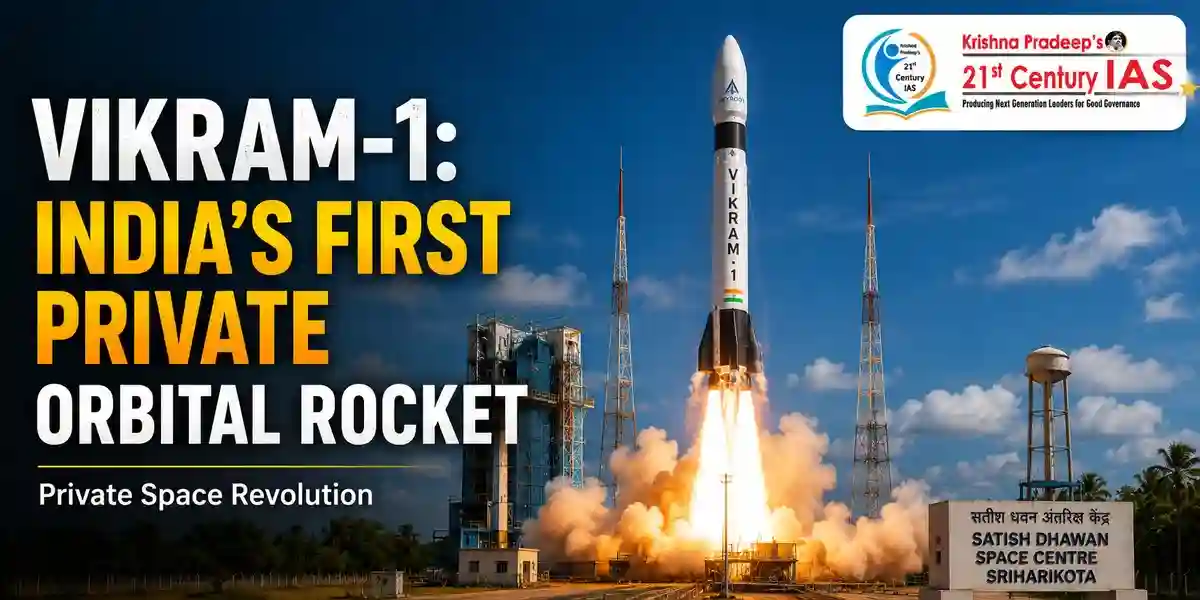
- Q. The successful orbital launch of Vikram-I marks a turning point in India’s space sector reforms. Discuss its significance and the challenges ahead for India’s private space ecosystem.
Q. The Investment Friendliness Index can strengthen competitive and cooperative federalism in India. Discuss its significance and challenges in improving State-level investment ecosystems.
(GS Paper III – Economy / Investment / Industrial Growth)
Introduction:
The Investment Friendliness Index (IFI) 2026, released by NITI Aayog, is a homegrown, data-driven framework to assess the investment readiness of 28 States and 8 Union Territories. It evaluates States across eight pillars such as infrastructure, business climate, resources, regulatory ease, institutional environment, financial health and environmental resilience. The Index supports the vision of Viksit Bharat @2047 by encouraging State-level reforms.
Body
Significance of the Index
- Promotes competitive federalism:
By ranking States and UTs, the Index encourages healthy competition among States to improve their investment climate. - Strengthens cooperative federalism:
It enables peer learning, adoption of best practices and Centre-State collaboration in reforms. - Evidence-based policymaking:
The Index uses 84 indicators and investor perception surveys, helping States identify specific reform gaps. - Supports private investment:
India needs higher investment to achieve developed economy status by 2047. Since investment decisions depend heavily on State-level factors such as land, power, logistics, skilled labour and regulatory efficiency, the Index can guide reforms. - Addresses regional imbalance:
Nearly 85% of FDI inflows are concentrated in Maharashtra, Karnataka, Gujarat, Delhi and Tamil Nadu. IFI can help lagging States improve competitiveness. - Improves investor confidence:
Transparent rankings and State Profiles help investors understand the strengths and weaknesses of different jurisdictions.
Challenges
- Regional disparities:
The gap between Gujarat’s score of 56.6 and Lakshadweep’s 24.5 shows deep structural differences. - Land and approval delays:
Investors continue to face long approval timelines, difficulties in land access and weak single-window systems. - Skill shortages:
Several States face lack of skilled labour and talent migration. - Infrastructure gaps:
Poor Road quality, weak last-mile connectivity, inadequate warehousing and limited airport connectivity affect investment. - Fiscal stress:
High debt and weak fiscal health reduce the ability of States to invest in infrastructure and incentives. - Environmental risks:
Pollution, flood risks and weak climate-resilient infrastructure can reduce industrial productivity.
Way Forward
States must operationalise genuine single-window clearances, simplify land allotment, strengthen skilling through Skill India Mission and PMKVY, expand infrastructure under PM Gati Shakti, improve fiscal sustainability, and build climate-resilient industrial ecosystems.
Conclusion:
The Investment Friendliness Index marks a shift from one-time ease-of-doing-business rankings to a continuous reform framework. If used effectively, it can improve State-level governance, attract investment, reduce regional disparities and accelerate India’s journey towards Viksit Bharat @2047.
Q. The successful orbital launch of Vikram-I marks a turning point in India’s space sector reforms. Discuss its significance and the challenges ahead for India’s private space ecosystem.
(GS Paper III – Science & Technology / Space Technology)
Introduction:
The launch of Vikram-I by Skyroot Aerospace from the Satish Dhawan Space Centre, Sriharikota, on 18 July 2026 marks a major milestone in India’s space programme. It was the first orbital rocket launch by a private Indian company from Indian soil, placing payloads such as SCOPE and Grahaa into Low Earth Orbit (LEO).
Body
Significance of Vikram-I
- Private orbital capability:
Vikram-I makes India one of the few countries where private industry has demonstrated orbital launch capability, alongside the U.S. and China. - Success of space reforms:
The launch reflects the impact of 2020 space-sector reforms, the Indian Space Policy 2023, and the creation of IN-SPACe for authorising and promoting private space activities. - Public-private partnership model:
Though developed by Skyroot, the mission was supported by ISRO through testing, trajectory analysis, stage preparation, launch-pad integration and safety support. IN-SPACe enabled clearances and mission readiness reviews. - Boost to small satellite market:
Vikram-I, a 4-stage rocket with 3 solid stages and a liquid upper stage, can launch small satellites into LEO. This is important for Earth observation, communication, internet constellations, climate monitoring and defence applications. - Technological advancement:
Its use of carbon-fibre composite airframe and 3D-printed liquid engine RAMAN-I shows India’s growing capability in advanced, lightweight and rapid-manufacturing rocket technologies. - Commercial opportunities:
The launch opens possibilities for India to offer dedicated “cab service” style launches for small satellites in the global market.
Challenges Ahead
- Technology reliability: 3D-printed engines and composite bodies require strict quality control, testing and inspection.
- Global competition: The small-satellite launch market is competitive and cost-sensitive.
- Space debris: Rising LEO activity needs strong debris mitigation norms.
- Funding and scale: Start-ups need sustained venture capital, testing facilities and supply-chain support.
- Regulatory clarity: Coordination among ISRO, IN-SPACe and NSIL must remain smooth.
Way Forward
India should expand private access to testing facilities, strengthen IN-SPACe’s single-window role, support indigenous components, promote reusable launch technologies and frame strict space sustainability norms.
Conclusion:
Vikram-I is not merely a rocket launch; it symbolises India’s transition from an ISRO-led space programme to a broader NewSpace economy. With sustained reforms and institutional support, India can emerge as a major player in global commercial space launches.