UPSC Daily Current Affairs 30th March 2026
Relevance: GS Paper III – Environment, Climate Change, Energy, Sustainable Development
For Prelims:
- Climate Action, Energy Transition, Renewable Energy, Fossil Fuel Dependence, Climate Commitments, Emissions Intensity vs Absolute Emissions, Carbon Sink, Equity in Climate Negotiations, Grid Readiness
For Mains:
- Human Space Exploration, Lunar Base, Deep Space Exploration, International Space Cooperation, Role of Private Sector in Space, India’s Lunar Ambitions, Strategic Importance of Moon Missions
Why in News?
The Union Cabinet has approved India’s updated Nationally Determined Contribution (NDC), which will now be communicated to the United Nations Framework Convention on Climate Change (UNFCCC). The revised commitments include increasing the share of installed electric capacity from non-fossil fuel sources to 60% by 2035, reducing the emissions intensity of GDP by 47% from 2005 levels, and raising the country’s carbon sink to 3.5–4 billion tonnes of CO₂ equivalent.
The updated NDC comes at a time when a new emissions analysis indicates that India’s CO₂ emissions growth slowed to 0.7% in 2025, the slowest rate in more than two decades, excluding the pandemic year. This has revived debate on whether India’s climate strategy is beginning to show structural change or whether the apparent progress masks deeper contradictions.
The announcement is also significant because India and Argentina were the only G20 countries that had not announced a 2035 NDC by the end of 2025. Thus, India’s new submission fills an important gap in the global climate pledge framework.
Background and Context
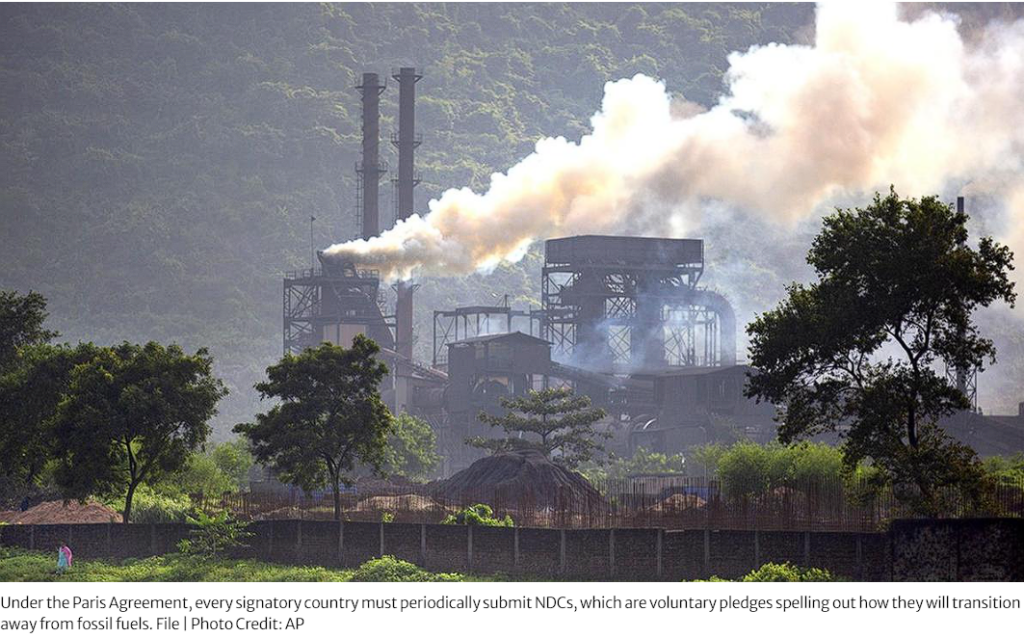
Under the Paris Agreement, all signatory countries are required to periodically submit Nationally Determined Contributions (NDCs). These are voluntary climate pledges that outline how countries intend to reduce emissions, shift away from fossil fuels, and strengthen adaptation and resilience.
India’s previous NDC, submitted in August 2022, had committed to:
- 50% non-fossil installed electric capacity by 2030
- 45% reduction in emissions intensity of GDP from 2005 levels
- Creation of an additional carbon sink of 2.5–3 billion tonnes of CO₂ equivalent
The new NDC raises all three targets. The revised commitments reflect both India’s domestic renewable energy expansion and growing international expectations for stronger climate action in the run-up to 2035.
What are Nationally Determined Contributions (NDCs)?
Key Characteristics
|
Key Developments
1. Enhanced Non-Fossil Capacity Target
India has raised the target for installed non-fossil electric capacity from 50% by 2030 to 60% by 2035.
2. Stronger Emissions Intensity Reduction
The emissions intensity reduction target has been increased from 45% to 47%, relative to 2005 GDP levels.
3. Larger Carbon Sink Commitment
India has raised its carbon sink target from 2.5–3 billion tonnes to 3.5–4 billion tonnes of CO₂ equivalent.
4. Emissions Slowdown in 2025
A new analysis by CREA, published by Carbon Brief, found that India’s CO₂ emissions rose by only 0.7% in 2025, which is the slowest pace since 2001, excluding 2020.
5. Power Sector Emissions Decline
The power sector saw emissions decline by 3.8% in 2025, after coal-fired power generation declined for the first time outside the Covid period since 1973.
6. Strong Renewable Capacity Addition
India added in 2025:
- 47 GW solar
- 6.3 GW wind
- 4 GW hydro
- 0.6 GW nuclear
These additions were enough to meet electricity demand growth of up to 5%.
Comparison with previous commitments
| Parameter | Earlier NDC (2022 update) | New NDC (2026 approval) | Change |
| Non-fossil installed electric capacity | About 50% by 2030 | 60% by 2035 | Higher ambition |
| Emissions intensity of GDP | 45% reduction by 2030 | 47% reduction by 2035 | Tightened target |
| Carbon sink | 2.5–3 billion tonnes CO₂e | 3.5–4 billion tonnes CO₂e | Larger sink target |
India had already achieved the earlier 50% non-fossil installed capacity target ahead of schedule; official data cited by the government showed this milestone had been crossed before 2030. Reuters reported India’s installed clean-energy share at about 52.6% by early 2026.
Core Issues Involved
1. Voluntary Nature of NDCs
NDCs are not legally binding targets for emission reduction. They are self-declared commitments, which makes implementation dependent on domestic political will, financial resources, and institutional capacity.
2. Emissions Intensity vs Absolute Emissions
India continues to use emissions intensity as its primary metric rather than absolute emissions. This means total emissions can still rise if GDP grows faster than emissions decline.
3. Climate Action vs Development Imperatives
India defends its climate approach on grounds of equity, arguing that its per capita emissions are still much lower than those of developed countries. At the same time, it must balance industrial growth, energy demand, and poverty reduction.
4. Renewables Expansion vs Fossil Fuel Continuity
India’s climate strategy contains an internal contradiction: while renewable energy is expanding rapidly, the country is also planning major investments in coal, steel, and petrochemicals.
5. Carbon Sink Reliability
The carbon sink target depends on maintaining or expanding forest cover. However, India remains below the long-standing 33% forest cover goal, with current cover at about 24%, including trees outside forests.
Causes / Reasons
1. Global Pressure for Updated Climate Commitments
As climate negotiations move beyond 2030, countries are expected to update NDCs with stronger targets for 2035.
2. Renewable Energy Momentum
Falling renewable costs and rapid installation of solar and wind have enabled India to go beyond earlier expectations.
3. Need for Strategic Climate Positioning
India’s new NDC strengthens its position in global climate diplomacy by showing that it is not lagging in the submission of enhanced commitments.
4. Domestic Evidence of Decoupling
The slowdown in emissions growth, especially in the power sector, provides an opportunity for India to project itself as being on a cleaner growth pathway.
Implications
Political
- Strengthens India’s image as a responsible climate actor.
- Helps counter criticism that India is delaying stronger climate commitments.
- Improves India’s leverage in demanding climate finance and technology transfer from developed countries.
Economic
- Supports expansion of renewable energy industries.
- May reduce long-term dependence on imported fossil fuels.
- However, achieving the targets will require major investment in grids, storage, and transmission.
Strategic
- Enhances India’s standing in global climate negotiations.
- Positions India more strongly in clean energy geopolitics.
- Helps align India with global low-carbon supply chains and climate-linked trade standards.
Social / Environmental
- Lower coal dependence can reduce air pollution and health burdens.
- Stronger carbon sink targets may support ecological restoration.
- However, weak implementation could make targets largely symbolic.
Institutional Mechanism
- NDCs are submitted under the Paris Agreement through the UNFCCC framework.
- They are voluntary but politically significant commitments.
- India’s climate policy also operates within domestic frameworks related to renewable energy, forest conservation, and power sector planning.
- The implementation of NDCs depends on coordination across ministries dealing with power, coal, environment, forests, industry, and agriculture.
International / Geopolitical Dimension
- Global progress on NDCs remains weak. The UNEP Emissions Gap Report 2025, titled Off Target, stated that countries have repeatedly failed to align their pledges with the 1.5°C goal.
- According to the World Resources Institute, currently submitted NDCs close less than 14% of the emissions gap required to stay within 1.5°C.
- The COP28 UAE Consensus called for:
- Transitioning away from fossil fuels
- Tripling renewable energy
- Doubling energy efficiency by 2030
Yet, according to E3G’s NDC Energy Commitments Tracker, no country has presented a fully comprehensive plan aligned with this package.
India’s updated NDC must therefore be seen in a global setting where countries are enhancing pledges, but actual implementation remains uneven and finance remains inadequate.
Government Response / Policy Measures
- Approval of updated NDC by the Union Cabinet
- Communication of revised targets to the UNFCCC
- Continued promotion of renewable energy expansion
- Long-term grid planning through the Central Electricity Authority
- Emphasis on non-fossil energy capacity, emissions intensity reduction, and carbon sink expansion
Challenges / Criticisms
1. NDCs Often Document Existing Progress
The article points out that the clean energy transition is advancing largely due to falling technology costs and market competition, rather than NDCs themselves.
2. Fossil Fuel Expansion Continues
India still plans:
- 100 GW of new coal-fired capacity over seven years
- $1 trillion in petrochemical investment by 2040
- 50% increase in coal-based steel capacity by 2031
3. Grid Constraints
More than 37 GW of renewable capacity remains stranded due to inadequate grid readiness.
4. Carbon Sink Uncertainty
The carbon sink goal depends on forest and tree cover that may not be stable or ecologically reliable.
5. Limited Structural Change in Industry
In 2025, emissions from steel rose by 8% and cement by 10%, offsetting gains made in the power sector.
6. One Good Year May Not Indicate a Trend
The emissions slowdown in 2025 may partly reflect mild summers, fewer heatwaves, and weak industrial growth, rather than a durable structural shift.
Way Forward
1. Move from Capacity Targets to System Transformation
India must focus not only on adding renewable capacity but on integrating it through stronger transmission networks, storage systems, and grid flexibility.
2. Rationalise Fossil Fuel Expansion
Coal, petrochemical, and steel expansion plans must be aligned with long-term climate goals.
3. Strengthen Carbon Sink Quality
Afforestation and tree-planting strategies must focus on ecological integrity, not just numerical targets.
4. Address Industrial Emissions
Hard-to-abate sectors like steel and cement need targeted decarbonisation pathways.
5. Improve Policy Coherence
Climate commitments should be matched by reforms in energy planning, industrial policy, and land-use strategy.
6. Leverage Climate Diplomacy
India should use its enhanced NDC to seek greater international finance, technology transfer, and climate justice-based support.
Conclusion
India’s updated NDC signals stronger ambition in climate policy by raising targets for non-fossil capacity, emissions intensity reduction, and carbon sinks. It also arrives at a time when renewable energy growth and slowing emissions suggest that parts of the energy transition are gaining momentum. However, major contradictions remain in India’s climate strategy, especially continued investments in coal, petrochemicals, and carbon-intensive industry. Therefore, the true test of the new NDC will lie not in the pledge itself, but in whether India can translate climate ambition into structural transformation.
Prelims PerspectiveWhat is the Paris Agreement?
Main Goals
Key Features
What is the United Nations Framework Convention on Climate Change (UNFCCC)?
Objective
Key Features
What are Intended Nationally Determined Contributions (INDCs)?
Evolution: INDC → NDC
Thus:
Data & Facts for Prelims
|
UPSC PYQ
Q. The term ‘Intended Nationally Determined Contributions’ is sometimes seen in the news in the context of: (UPSC CSE 2016)
(a) Pledges made by European countries to rehabilitate refugees
(b) Plan of action outlined by countries to combat climate change
(c) Capital contributed to Asian Infrastructure Investment Bank
(d) Plan related to Sustainable Development Goals
Answer: (b)
Explanation
What are INDCs?
- Intended Nationally Determined Contributions (INDCs) were:
- Climate action plans submitted by countries before the Paris Agreement (2015).
- These plans outlined:
- How each country intends to reduce greenhouse gas emissions
- Measures for adaptation to climate change
CARE MCQ
Q. With reference to India’s updated Nationally Determined Contribution (NDC), consider the following statements:
- India has committed to achieve 60% of its installed electric capacity from non-fossil sources by 2035.
- India’s updated NDC uses absolute emission reduction as its main indicator.
- India has increased its carbon sink target to 3.5–4 billion tonnes of CO₂ equivalent.
How many of the above statements are correct?
A. Only one
B. Only two
C. All three
D. None
Answer: B
Explanation:
- Statement 1 – Correct: India’s new NDC sets a 60% non-fossil capacity target by 2035.
- Statement 2 – Incorrect: India continues to use emissions intensity of GDP, not absolute emission reduction, as its primary metric.
- Statement 3 – Correct: The new carbon sink target is 3.5–4 billion tonnes of CO₂ equivalent.
Relevance: GS Paper II – International Relations; GS Paper III – Energy Security, Economy
For Prelims:
- Megalithic Burials, Cairns, Stone Circles, Cromlechs, Neolithic Artifacts
For Mains:
- Heritage Conservation, Urbanisation Impact, Cultural Loss, Archaeological Preservation, Historical Site Management
Why in News?
The Strait of Hormuz has emerged as a major geopolitical flashpoint amid the ongoing US–Israel–Iran war (2026). Iran has effectively imposed a selective blockade, severely disrupting global shipping and energy supply chains.
This has triggered one of the largest global energy shocks in recent times.
Importance of the Strait of Hormuz
The Strait of Hormuz is one of the most critical maritime chokepoints in the world:
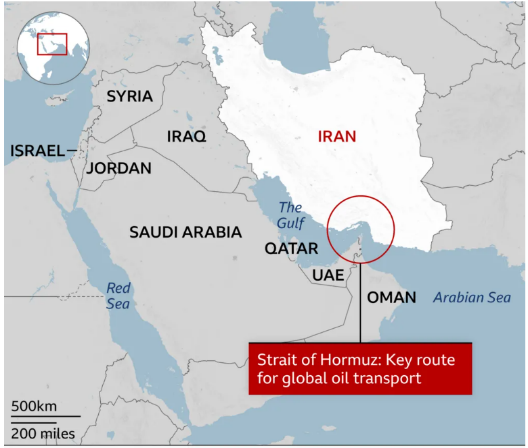
- Connects the Persian Gulf with the Arabian Sea
- Facilitates nearly one-fifth of global oil and gas trade
- Before the conflict:
- Around 130 ships transited daily
However, after the outbreak of war:
- Traffic reduced drastically to 3–4 ships per day
This reflects the scale of disruption and its global economic implications.
STRAIT OF HORMUZ
Location
- Between Iran (North) and Oman & United Arab Emirates (South)
- Connects Persian Gulf → Arabian Sea → Indian Ocean
Key Features
- Width: ~50 km (entry/exit), ~33 km (narrowest)
- Deep enough for large oil tankers
- Major maritime chokepoint
Importance
- ~20 million barrels/day (≈20% global oil trade)
- ~$600 billion annual energy flow
- Vital for global & India’s energy security
Oil Suppliers Using It
- Iran, Iraq, Kuwait, Qatar, Saudi Arabia, UAE
Nature of Iran’s Blockade: A Calibrated Strategy
Iran has not imposed a blanket closure but a selective and strategic blockade:
Selective Access Policy
- Strait declared closed for:
- US
- Israel
- Their allies
- Passage allowed for “friendly nations”:
- India
- China
- Russia
- Iraq
- Pakistan
Security and Military Measures
- Over 20 vessels attacked in and around Hormuz
- Nearly 2,000 vessels stranded near the strait
- Iranian forces warn of “harsh measures” for unauthorised transit
This indicates the use of the strait as a coercive geopolitical instrument.
Iran’s Emerging ‘Toll-Booth System’
A major controversial development is the emergence of a quasi-toll system:
How the System Works:
- Ship operators contact intermediaries linked to Iran
- Submit detailed documentation:
- Ownership chain
- Cargo details
- Crew list
- Undergo “geopolitical vetting”
- If cleared:
- Receive a clearance code
- Get route instructions
- Iranian authorities escort ships through territorial waters
Payment Mechanism
- Charges reportedly up to $2 million per ship
- Some payments made in yuan through intermediaries
- Iran officially denies these claims
Even without formal acknowledgement, this reflects de facto control over transit.
Legal Status: Violation of UNCLOS
The Strait of Hormuz is governed by United Nations Convention on the Law of the Sea (UNCLOS).
Key Legal Provisions:
- Article 38:
- Ensures right of transit passage for all vessels
- Article 39:
- Ships must ensure peaceful passage
- Article 44:
- Coastal states cannot suspend or obstruct passage
Why Iran’s Actions Are Illegal:
- Charging tolls = “hampering passage”
- Blocking ships = violation of transit rights
- Attacks on vessels = clear breach of international law
Gulf Cooperation Council (GCC) has termed this:
- A “clear violation of international law”
Important Distinction
| Feature | Hormuz | Suez/Panama |
| Type | Natural Strait | Artificial Canal |
| Toll | Not allowed | Allowed |
| Legal Status | Free transit | Fee-based |
Impact on Global Energy and Economy
The crisis has triggered significant global consequences:
- Disruption in global oil and gas supply chains
- Increase in shipping risks and insurance costs
- Volatility in energy prices
Since Hormuz carries ~20% of global oil flows, disruption leads to:
- Global inflationary pressures
- Economic uncertainty
Additionally:
- Gulf region produces 22% of global oil output
Hence, Hormuz stability is crucial for global economic stability.
India’s Position and Strategic Response
India, as a major energy importer, is directly affected.
Key Developments:
- At least five ships reached India via Hormuz:
- Pine Gas
- Jag Vasant
- Shivalik
- Nanda Devi
- Jag Laadki
- Iran allowed selective passage for Indian vessels
India’s Official Stand:
- No formal agreement with Iran
- No payments made for transit
- Each ship movement handled individually
- Movement based on safety assessments
Diplomatic Engagement:
- India maintained active communication with Iran:
- Talks with Iranian President
- Multiple engagements with Foreign Minister
India is pursuing a balanced diplomatic approach, avoiding alignment with either bloc.
What Iran Gains from the Crisis
Iran’s control over the strait provides multiple advantages:
Strategic Gains:
- Leverage against US and Israel
- Bargaining power in negotiations
Economic Gains:
- Potential revenue through toll system
- Financial support during wartime
Political Gains:
- Assertion of regional dominance
- Demand for recognition of authority over Hormuz
Control over Hormuz acts as Iran’s strongest geopolitical leverage tool.
Challenges and Risks
1. Escalation of Conflict
- Increased military confrontation in West Asia
2. Threat to Global Trade
- Disruption in maritime routes
3. Legal Uncertainty
- Undermining international maritime norms
4. Energy Security Risks
- Supply shocks
- Price volatility
Conclusion
The Strait of Hormuz crisis illustrates how strategic geography can be weaponised in international politics. Iran’s selective blockade and emerging toll system highlight the intersection of energy security, international law, and geopolitical rivalry.
For India and the global community, the crisis underscores the need for:
- Diversification of energy sources
- Strengthening maritime security
- Upholding international law
UPSC PYQ
Q. The Suez Canal, the Strait of Hormuz and the Strait of Gibraltar are important because they:
A. prevent attacks on bordering nations
B. prohibit the movement of ships carrying nuclear weapons
C. unite Russian access to warm water ports
D. control access to vital trade routes
Answer: D
CARE MCQ
Q. Consider the following statements regarding the Strait of Hormuz:
- The Strait of Hormuz connects the Persian Gulf with the Arabian Sea.
- It is bounded by Iran to the north and Oman and the UAE to the south.
Which of the statements given above is/are correct?
A. 1 only
B. 2 only
C. Both 1 and 2
D. Neither 1 nor 2
Answer: C
Explanation
- Statement 1 is correct: The Strait of Hormuz connects the Persian Gulf to the Arabian Sea, making it a crucial maritime route.
- Statement 2 is correct: It lies between Iran (north) and Oman & UAE (south).
Additional Information
- It is one of the world’s most important oil transit chokepoints.
- Around 20 million barrels of oil per day pass through it.
- Major exporters include Iran, Iraq, Kuwait, Qatar, Saudi Arabia, and UAE.
- The strait is wide and deep enough for large oil tankers.