Strait of Hormuz Crisis: Strategic Leverage, Legal Controversy and Global Energy Implications
Table of Contents
Relevance: GS Paper II – International Relations; GS Paper III – Energy Security, Economy
For Prelims:
- Megalithic Burials, Cairns, Stone Circles, Cromlechs, Neolithic Artifacts
For Mains:
- Heritage Conservation, Urbanisation Impact, Cultural Loss, Archaeological Preservation, Historical Site Management
Why in News?
The Strait of Hormuz has emerged as a major geopolitical flashpoint amid the ongoing US–Israel–Iran war (2026). Iran has effectively imposed a selective blockade, severely disrupting global shipping and energy supply chains.
This has triggered one of the largest global energy shocks in recent times.
Importance of the Strait of Hormuz
The Strait of Hormuz is one of the most critical maritime chokepoints in the world:
- Connects the Persian Gulf with the Arabian Sea
- Facilitates nearly one-fifth of global oil and gas trade
- Before the conflict:
- Around 130 ships transited daily
However, after the outbreak of war:
- Traffic reduced drastically to 3–4 ships per day
This reflects the scale of disruption and its global economic implications.
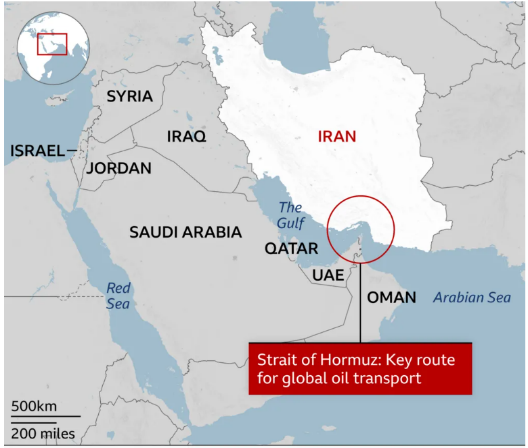
STRAIT OF HORMUZ
Location
- Between Iran (North) and Oman & United Arab Emirates (South)
- Connects Persian Gulf → Arabian Sea → Indian Ocean
Key Features
- Width: ~50 km (entry/exit), ~33 km (narrowest)
- Deep enough for large oil tankers
- Major maritime chokepoint
Importance
- ~20 million barrels/day (≈20% global oil trade)
- ~$600 billion annual energy flow
- Vital for global & India’s energy security
Oil Suppliers Using It
- Iran, Iraq, Kuwait, Qatar, Saudi Arabia, UAE
Nature of Iran’s Blockade: A Calibrated Strategy
Iran has not imposed a blanket closure but a selective and strategic blockade:
Selective Access Policy
- Strait declared closed for:
- US
- Israel
- Their allies
- Passage allowed for “friendly nations”:
- India
- China
- Russia
- Iraq
- Pakistan
Security and Military Measures
- Over 20 vessels attacked in and around Hormuz
- Nearly 2,000 vessels stranded near the strait
- Iranian forces warn of “harsh measures” for unauthorised transit
This indicates the use of the strait as a coercive geopolitical instrument.
Iran’s Emerging ‘Toll-Booth System’
A major controversial development is the emergence of a quasi-toll system:
How the System Works:
- Ship operators contact intermediaries linked to Iran
- Submit detailed documentation:
- Ownership chain
- Cargo details
- Crew list
- Undergo “geopolitical vetting”
- If cleared:
- Receive a clearance code
- Get route instructions
- Iranian authorities escort ships through territorial waters
Payment Mechanism
- Charges reportedly up to $2 million per ship
- Some payments made in yuan through intermediaries
- Iran officially denies these claims
Even without formal acknowledgement, this reflects de facto control over transit.
Legal Status: Violation of UNCLOS
The Strait of Hormuz is governed by United Nations Convention on the Law of the Sea (UNCLOS).
Key Legal Provisions:
- Article 38:
- Ensures right of transit passage for all vessels
- Article 39:
- Ships must ensure peaceful passage
- Article 44:
- Coastal states cannot suspend or obstruct passage
Why Iran’s Actions Are Illegal:
- Charging tolls = “hampering passage”
- Blocking ships = violation of transit rights
- Attacks on vessels = clear breach of international law
Gulf Cooperation Council (GCC) has termed this:
- A “clear violation of international law”
Important Distinction
| Feature | Hormuz | Suez/Panama |
| Type | Natural Strait | Artificial Canal |
| Toll | Not allowed | Allowed |
| Legal Status | Free transit | Fee-based |
Impact on Global Energy and Economy
The crisis has triggered significant global consequences:
- Disruption in global oil and gas supply chains
- Increase in shipping risks and insurance costs
- Volatility in energy prices
Since Hormuz carries ~20% of global oil flows, disruption leads to:
- Global inflationary pressures
- Economic uncertainty
Additionally:
- Gulf region produces 22% of global oil output
Hence, Hormuz stability is crucial for global economic stability.
India’s Position and Strategic Response
India, as a major energy importer, is directly affected.
Key Developments:
- At least five ships reached India via Hormuz:
- Pine Gas
- Jag Vasant
- Shivalik
- Nanda Devi
- Jag Laadki
- Iran allowed selective passage for Indian vessels
India’s Official Stand:
- No formal agreement with Iran
- No payments made for transit
- Each ship movement handled individually
- Movement based on safety assessments
Diplomatic Engagement:
- India maintained active communication with Iran:
- Talks with Iranian President
- Multiple engagements with Foreign Minister
India is pursuing a balanced diplomatic approach, avoiding alignment with either bloc.
What Iran Gains from the Crisis
Iran’s control over the strait provides multiple advantages:
Strategic Gains:
- Leverage against US and Israel
- Bargaining power in negotiations
Economic Gains:
- Potential revenue through toll system
- Financial support during wartime
Political Gains:
- Assertion of regional dominance
- Demand for recognition of authority over Hormuz
Control over Hormuz acts as Iran’s strongest geopolitical leverage tool.
Challenges and Risks
1. Escalation of Conflict
- Increased military confrontation in West Asia
2. Threat to Global Trade
- Disruption in maritime routes
3. Legal Uncertainty
- Undermining international maritime norms
4. Energy Security Risks
- Supply shocks
- Price volatility
Conclusion
The Strait of Hormuz crisis illustrates how strategic geography can be weaponised in international politics. Iran’s selective blockade and emerging toll system highlight the intersection of energy security, international law, and geopolitical rivalry.
For India and the global community, the crisis underscores the need for:
- Diversification of energy sources
- Strengthening maritime security
- Upholding international law
UPSC PYQ
Q. The Suez Canal, the Strait of Hormuz and the Strait of Gibraltar are important because they:
A. prevent attacks on bordering nations
B. prohibit the movement of ships carrying nuclear weapons
C. unite Russian access to warm water ports
D. control access to vital trade routes
Answer: D
CARE MCQ
Q. Consider the following statements regarding the Strait of Hormuz:
- The Strait of Hormuz connects the Persian Gulf with the Arabian Sea.
- It is bounded by Iran to the north and Oman and the UAE to the south.
Which of the statements given above is/are correct?
A. 1 only
B. 2 only
C. Both 1 and 2
D. Neither 1 nor 2
Answer: C
Explanation
- Statement 1 is correct: The Strait of Hormuz connects the Persian Gulf to the Arabian Sea, making it a crucial maritime route.
- Statement 2 is correct: It lies between Iran (north) and Oman & UAE (south).
Additional Information
- It is one of the world’s most important oil transit chokepoints.
- Around 20 million barrels of oil per day pass through it.
- Major exporters include Iran, Iraq, Kuwait, Qatar, Saudi Arabia, and UAE.
- The strait is wide and deep enough for large oil tankers.