Mains Practice Questions for the Day
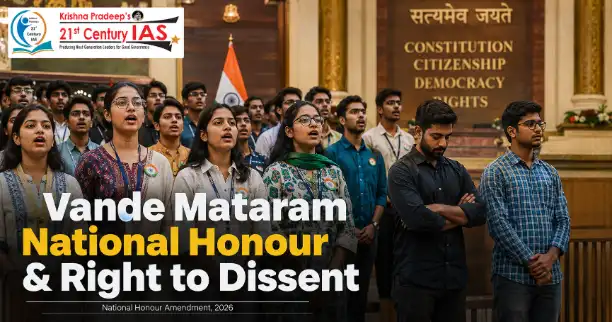
- Q. The constitutional obligation to respect national symbols does not necessarily imply compulsory participation in patriotic rituals. Examine this statement with reference to the status of Vande Mataram, the Prevention of Insults to National Honour (Amendment) Act, 2026 and relevant judicial principles.
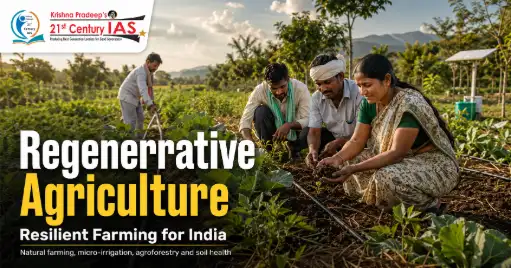
- Q. Regenerative agriculture can simultaneously address soil degradation, climate vulnerability and declining farm profitability in India. Discuss the major practices and policy measures required for its widespread adoption.
Q. The constitutional obligation to respect national symbols does not necessarily imply compulsory participation in patriotic rituals. Examine this statement with reference to the status of Vande Mataram, the Prevention of Insults to National Honour (Amendment) Act, 2026 and relevant judicial principles.
Introduction:
Vande Mataram played an important role in India’s freedom struggle. In 1950, Constituent Assembly President Dr. Rajendra Prasad stated that it should be honoured equally with Jana Gana Mana. However, the Constitution neither designates it as the National Anthem nor expressly mentions a “National Song”.
Body
Scope of Statutory Protection
The 2026 Amendment substitutes Section 3 of the Prevention of Insults to National Honour Act, 1971. It penalises a person who intentionally:
- prevents the singing of the National Anthem or National Song; or
- disturbs an assembly engaged in such singing.
Punishment may extend to three years’ imprisonment, a fine or both. Under Section 3A, repeat convictions attract a minimum one-year imprisonment.
However, the amendment does not:
- compel anyone to sing;
- prescribe a mandatory version;
- require all six stanzas; or
- criminalise respectful silence.
Constitutional Issues Involved
Freedom of Expression—Article 19(1)(a)
- Includes both expression and the freedom to remain silent.
- Non-participation cannot automatically be equated with disrespect.
Freedom of Conscience—Article 25
- Protects genuinely held religious convictions.
- It is relevant because the later stanzas invoke Durga, Lakshmi and Saraswati.
Fundamental Duties—Article 51A
- Require respect for national symbols.
- However, they cannot override Fundamental Rights under Part III.
Judicial Position: Bijoe Emmanuel
In Bijoe Emmanuel v. State of Kerala (1986), Jehovah’s Witness students respectfully stood during the National Anthem but declined to sing. The Supreme Court held that their expulsion violated Articles 19(1)(a) and 25.
The judgment established that:
- respect does not require compulsory singing;
- peaceful silence differs from deliberate disruption; and
- tolerance is an essential constitutional value.
Way Forward
- Interpret “disturbance” narrowly.
- Protect genuine conscientious objection.
- Issue clear enforcement guidelines.
- Penalise obstruction, not peaceful non-participation.
Conclusion:
Constitutional patriotism protects national honour without enforcing uniformity. Respectful silence must therefore remain protected in India’s plural democracy.
Q. Regenerative agriculture can simultaneously address soil degradation, climate vulnerability and declining farm profitability in India. Discuss the major practices and policy measures required for its widespread adoption.
Introduction:
Regenerative agriculture is a holistic approach that actively restores soil health, biodiversity and ecosystem functions while maintaining farm productivity. It differs from conventional sustainability by seeking ecological improvement rather than merely preventing further damage.
Body
Contribution to Agricultural Resilience
Soil and Water Restoration
- Green manuring, cover cropping and mulching increase organic matter and reduce erosion.
- Micro-irrigation improves water-use efficiency.
- Scientific nitrogen management reduces nutrient losses and nitrous oxide emissions.
Biodiversity and Climate Action
- Agroforestry stores carbon, moderates local temperatures and rejuvenates degraded land.
- Natural farming limits chemical inputs and promotes biological formulations.
- Crop rotation and multi-cropping strengthen ecological diversity.
Farm Economy
- Integrated Farming Systems combine crops, livestock, fisheries, horticulture and apiculture.
- Diversification reduces crop-failure risks and creates multiple income sources.
- Lower dependence on purchased inputs can improve net farm income.
Policy Support
The National Mission on Natural Farming supports clusters, Community Resource Persons and bio-input centres. PKVY promotes organic farming and certification, while Per Drop More Crop finances drip and sprinkler systems.
The Rainfed Area Development Programme supports cluster-based Integrated Farming Systems. The agroforestry component of PM-RKVY expands nurseries and quality planting material. Soil Health Cards provide scientific, plot-specific nutrient recommendations.
Measures Required
- Provide transition support to small and marginal farmers.
- Expand locally available biological inputs.
- Strengthen extension services through KVKs and Krishi Sakhis.
- Develop credible certification and remunerative markets.
- Integrate Soil Health Cards with crop planning.
- Measure soil carbon, water use, biodiversity and farmer income.
- Converge natural farming, irrigation, agroforestry and IFS schemes.
Conclusion:
Regenerative agriculture can rebuild the ecological foundations of Indian farming. Its success requires locally adapted practices, scientific monitoring, institutional convergence and assured economic returns for farmers.