Indian Astronaut Shubhanshu Shukla Returns to Earth After Axiom Mission 4 (Ax-4)
 UPSC Relevance: GS 3 Science and Technology
Context: Axiom Mission 4 (Ax-4)
Why in News
A new study demonstrates how manipulating locust pheromones, specifically 4-vinylanisole (4VA).
Introduction
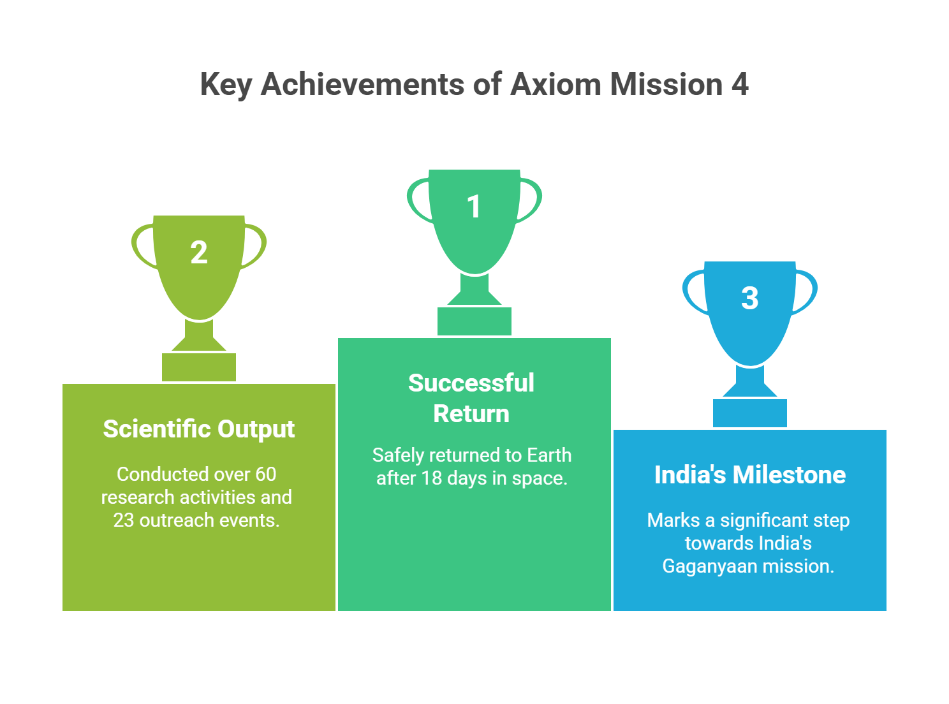
- Indian Air Force Group Captain and astronaut Shubhanshu Shukla, along with his fellow crew members of Axiom Mission 4 (Ax-4), successfully returned to Earth after an 18-day mission aboard the International Space Station (ISS).
- The mission marks a significant milestone in India’s path toward indigenous human spaceflight, particularly the upcoming Gaganyaan mission.
Key Highlights of the Mission:
- Crew Return: The SpaceX Dragon capsule, piloted by Shukla, splashed down in the Pacific Ocean off the coast of San Diego, United States, at 3:02 p.m. IST on July 15, 2025, completing the crew’s safe return. The capsule had undocked from the ISS nearly 22.5 hours earlier, on July 14.
- Crew Members:
- Peggy Whitson (Commander, United States)
- Shubhanshu Shukla (Pilot, India)
- Sławosz Uznański-Wiśniewski (Mission Specialist, Poland)
- Tibor Kapu (Mission Specialist, Hungary)
- Mission Duration and Achievements:
- Total duration: 18 days onboard the ISS
- Launched: June 25, 2025, via Falcon 9 rocket from Kennedy Space Center, Florida
- Completed: 320 orbits of Earth, covering approximately 8.4 million miles
- Scientific output: Over 60 research activities and 23 outreach events conducted
Scientific Experiments by Shubhanshu Shukla:
- Conducted studies on skeletal muscle degradation in microgravity.
 Participated in agricultural experiments, successfully growing methi (fenugreek) and moong (green gram) seeds in space — showcasing India’s interest in long-duration human space missions with sustainable life-support systems.
Re-entry and Splashdown Process:
- Deorbit Burn: Initiated at 2:09 p.m. IST and lasted 18 minutes
- Sequence:
- Trunk separation
- Nose cone closure
- Deployment of two drogue parachutes
- Deployment of four main parachutes
- Splashdown: Successful and on schedule; followed by recovery operations by SpaceX personnel on the recovery vessel Shannon
Post-Mission Recovery:
- After splashdown, astronauts underwent initial medical evaluations onboard the vessel.
- They will be flown to Houston, Texas, for post-mission debriefing and reintegration.
- Group Captain Shukla will undergo a seven-day rehabilitation programme under the supervision of flight surgeons to adapt to Earth’s gravity after nearly 20 days in microgravity.
Significance for India:
- This mission is a precursor to ISRO’s Gaganyaan programme, India’s first human spaceflight initiative.
- Showcases India’s growing participation in international space cooperation, particularly in low Earth orbit missions.
- Demonstrates India’s preparedness in astronaut training, international collaboration, and space science research.
 Conclusion:
- Group Captain Shubhanshu Shukla’s role in Axiom Mission 4 symbolizes a historic leap for India’s human spaceflight aspirations.
- The success of this mission not only adds valuable experience for ISRO’s upcoming Gaganyaan mission but also places India among key global players contributing to low Earth orbit exploration and scientific advancement.
CARE MCQ |
UPSC PYQ |
Q1. With reference to Axiom Mission 4 (Ax-4), recently seen in news, consider the following statements:
Which of the statements given above is/are correct? A. 1 and 2 only |
Q. Consider the following space missions: (2025)
How many of the space missions given above encourage and support microgravity research? (a) Only one (b) Only two (c) All three (d) None Answer: (c) |
| Answer 1- B
Explanation
|
New Gecko Species Cnemaspis brahmaputra Discovered in Assam
Source: The Hindu
UPSC Relevance: GS3 Environment and Ecology
Context: Cnemaspis brahmaputra,
Why in News
A new diurnal gecko species, Cnemaspis brahmaputra, has been discovered in Assam’s Brahmaputra River valley.
Introduction
 A new species of diurnal gecko, Cnemaspis brahmaputra, has been discovered at Dirgheswari Temple on the northern bank of the Brahmaputra River, facing Guwahati in Assam.
- This discovery adds to the growing body of evidence indicating the rich and unique biodiversity of Northeast India.
Key Highlights:
- Scientific Discovery: The new gecko species has been described in the latest issue of Taprobanica: The Journal of Asian Biodiversity.
- Taxonomy:
Cnemaspis brahmaputra belongs to the Cnemaspis podihuna clade — a group of small, diurnal geckos (active during the day), primarily known from Sri Lanka.
Its discovery in Assam suggests a historical biogeographic link between Sri Lanka and Northeast India. - Ecological Significance:
- Most lizards of this kind in Northeast India are nocturnal, but this species is diurnal, making it unique.
- It inhabits the Brahmaputra River valley, a major ecological corridor.
- The river has played a dual role as a geographic barrier and evolutionary corridor, influencing species distribution.
- Morphological Distinctiveness:
Compared to its Sri Lankan relatives, C. brahmaputra is genetically and morphologically distinct:- Larger body size
- Fewer mid-body scale rows
- More ventral scale rows
- Absence of tubercles on lower flanks
- Three enlarged rows of thigh scales aligned with the femoral scale row
- Biodiversity Context:
- This is the second species of the genus Cnemaspis recorded in the Northeast.
- The first, Cnemaspis assamensis, was described in 2000.
- Both species belong to the same clade but are located on opposite banks of the Brahmaputra and show significant genetic divergence.
Collaborating Institutions and Authors:
- Wildlife Protection and Research Society, Maharashtra
- Research Centre for Biosystematics and Evolution, Indonesia
- Assam Don Bosco University, Department of Zoology
- Help Earth, a biodiversity conservation organisation
Naming Rationale:
- Jayaditya Purkayastha of Help Earth stated that the species was named after the Brahmaputra River, recognizing its ecological and cultural significance to the Northeast.
- The river plays a pivotal role in shaping regional biodiversity and evolutionary patterns.
CARE MCQ |
UPSC PYQ |
Q2. With reference to the newly discovered gecko species Cnemaspis brahmaputra, consider the following statements:
Which of the statements given above is/are correct? A. 2 only |
Q. Recently, there was a growing awareness in our country about the importance of Himalayan nettle (Girardinia diversifolia) because it is found to be a sustainable source of (2019)
Ans: (d) |
| Answer 2- A
Explanation
|
Prime Minister Professorships under ANRF
Source: The Hindu
UPSC Syllabus Relevance: GS 2 Polity and Governance
Context: Anusandhan National Research Foundation (ANRF)
Why in News
The Prime Minister Professorships, launched under the Anusandhan National Research Foundation (ANRF).
Introduction
- ANRF harness the expertise of retired and overseas scientists to mentor emerging research institutions in India.
- To leverage the experience of retired and overseas scientists, the Anusandhan National Research Foundation (ANRF) has launched the Prime Minister Professorships, aimed at strengthening research capabilities in State universities with emerging research ecosystems.
Key Features of the Prime Minister Professorships
- Administering Body:
The programme is launched by ANRF, which has subsumed the Science and Engineering Research Board (SERB). - Fellowship & Grant:
- Annual Fellowship: ₹30 lakh
- Research Grant: ₹24 lakh (for consumables, domestic travel, contingencies, equipment, etc.)
- Overhead Provision: ₹1 lakh per annum to the host institution
- Eligibility Criteria:
- Retired scientists with a distinguished record
- Overseas scientists, including:
- Non-Resident Indians (NRIs)
- Persons of Indian Origin (PIOs)
- Overseas Citizens of India (OCIs)
- Industry professionals and Professors of Practice with proven expertise in research and innovation
Distinctive Features Compared to Earlier Fellowships
- Replaces the SERB Distinguished Fellowship, which provided:
- ₹20 lakh research grant per annum
- ₹60,000 monthly fellowship
- Wider scope and eligibility, including international applicants and professionals from outside academia
- Focus on institutional development, not just individual research
Institutional Linkage through PAIR Programme
- Professors must be based at State universities identified as “spoke” institutions under the Promoting Advanced and Inclusive Research (PAIR) programme.
- PAIR Framework:
- Links emerging institutions (“spokes”) with top-ranked institutions (“hubs”)
- Hubs: Institutions ranked 25 or below in the National Institutional Ranking Framework (NIRF)
- Spokes: State universities, some NITs, IIITs, and select Central Universities
Objective of the Programme
- Strengthen research capacity in State universities with nascent ecosystems
- Facilitate relocation of distinguished scientists to host institutions for sustained engagement
- Provide academic and research mentorship to faculty and students
- Promote equitable growth in national R&D capacity
Significance
- Encourages brain circulation by attracting overseas talent
- Fosters inclusive innovation by investing in under-resourced institutions
- Supports India’s goal of becoming a global knowledge superpower by promoting mentorship-driven research growth
Conclusion
- The Prime Minister Professorships mark a paradigm shift in India’s research funding model, focusing not only on excellence but also on inclusivity.
- By tapping into the wisdom of experienced scientists and professionals, the scheme aims to nurture talent and create vibrant research cultures in universities that have historically remained on the fringes of India’s scientific landscape.
CARE MCQ |
UPSC PYQ |
Q3. With reference to the “Prime Minister Professorships” launched by the Anusandhan National Research Foundation (ANRF), consider the following statements:
Which of the statements given above is/are correct? A. 1 and 2 only |
Q. Which of the following statements is/are correct regarding National Innovation Foundation-India (NIF)? (2015)
Select the correct answer using the code given below: (a) 1 only (b) 2 only (c) Both 1 and 2 (d) Neither 1 nor 2 Ans: (a) |
| Answer 3-C
Explanation
|
Headline Inflation Falls, But Household Costs Continue to Rise
Source: The Hindu
https://www.thehindu.com/opinion/editorial/pain-remains-on-inflation/article69815434.ece
UPSC Syllabus Relevance: GS3 Economy
Context: Headline Inflation
Why in News
Despite headline CPI inflation falling to a 77-month low of 2.1% in June 2025, essential non-food items continue to experience high inflation.
Introduction
- The decline of headline retail inflation to a 77-month low of 2.1% in June 2025 may appear to be a major victory for economic policymakers.
- At first glance, it suggests price stability, macroeconomic control, and a supportive environment for economic recovery.
- However, this statistical milestone conceals a more nuanced and sobering reality. For the average Indian consumer, particularly in urban and lower-income households, inflation is far from over.
- A closer look at the sectoral components of inflation reveals disparities in price pressures, raising questions about how well headline inflation metrics represent the real cost of living.
Headline vs. Core Reality: Dissecting the Inflation Figures
- While food prices — traditionally the most volatile component of the Consumer Price Index (CPI) — saw a welcome easing, the trend is seasonal, not structural.
- In June 2025, food and beverage prices contracted by 0.2% on a high base effect of 8.4% from the previous year. Prices of essential food items such as vegetables, pulses, spices, and meat declined year-on-year.
However, other categories crucial to daily life witnessed sharp inflationary pressures:
- Education and stationery: Inflation rose to 4.4%, a 15-month high, driven by rising costs in school and private tuition fees.
- Health care: Prices saw persistent increases, also touching a 15-month high, indicating rising out-of-pocket health expenditures.
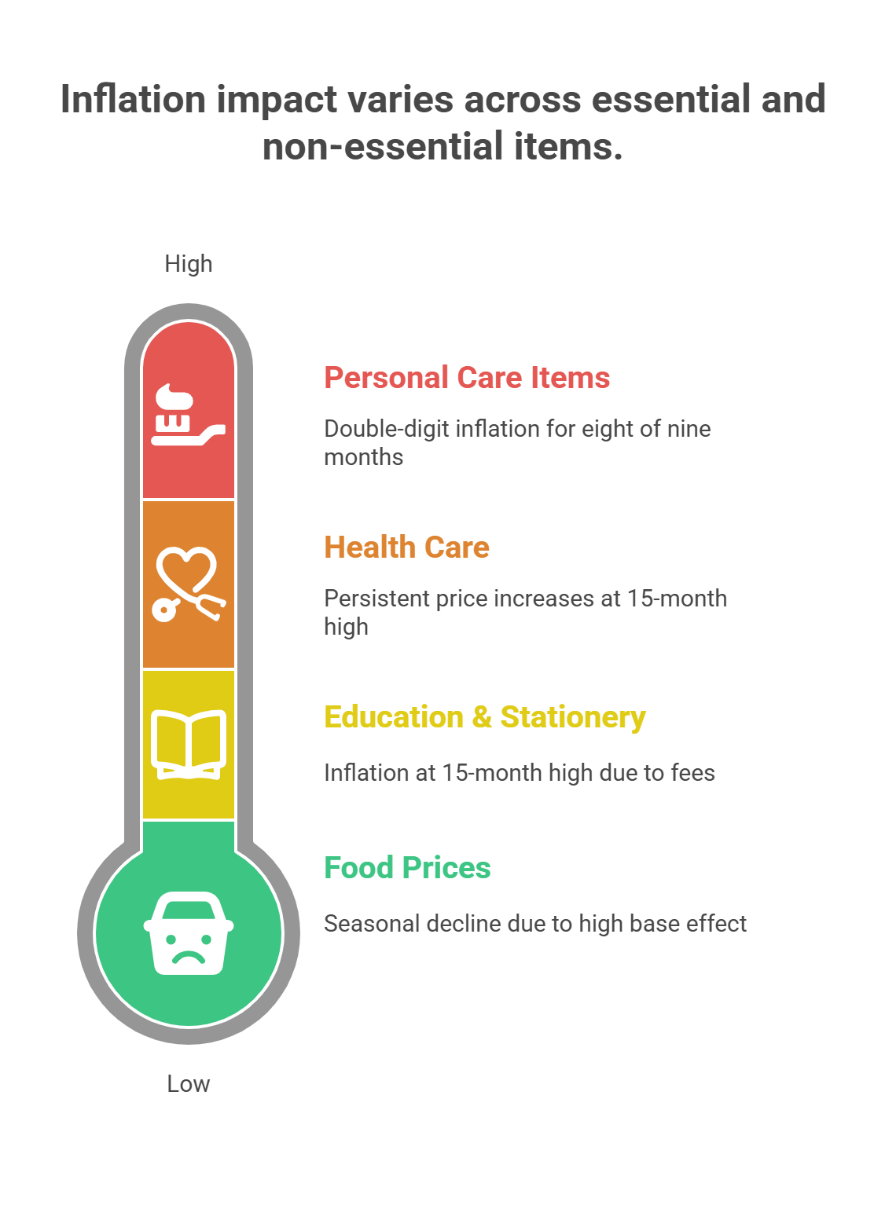 Personal care items: Inflation soared to 14.8%, the eighth month in nine that this category saw double-digit inflation. Everyday products like soap, shampoo, toothpaste, and sanitary napkins have become increasingly expensive.
This uneven inflation landscape means that while overall CPI inflation looks subdued, non-food essentials — which account for a growing share of household expenditure — are burdening consumers, especially those outside the rural poor demographic that traditionally spends more on food.
Structural Problems in CPI Weightage
- A central issue is the disproportionate weight of food in the CPI. Presently, food and beverages account for 46% of the overall CPI basket, making the index highly sensitive to food price movements.
- In contrast, the recent Household Consumption Expenditure Survey (HCES) data suggest that food comprises only around 30% of actual household spending, especially in urban and middle-income households.
- The Ministry of Statistics and Programme Implementation (MoSPI) is currently in the process of updating the base year of the CPI from 2011–12 to a more recent period.
- This revision will also include an update of the category-wise weights to better reflect evolving consumption patterns.
- However, until this revision is completed and implemented, monetary policy, inflation targeting, and welfare measures continue to be guided by an outdated index.
Policy Implications and the Need for Nuanced Inflation Management
The implications of relying on an outdated inflation metric are considerable:
- Monetary Policy Mismatch: The RBI’s inflation targeting framework, which hinges on headline CPI, may misjudge actual demand-side pressures and the inflation pain experienced by households. A low headline figure may discourage rate cuts even as real purchasing power declines for essential non-food goods.
- Misleading Economic Narratives: A headline inflation figure of 2.1% suggests economic relief, but it masks the real burden on the poor and middle class, who are paying more for health care, education, and personal care.
- Fiscal and Social Policy Blind Spots: Welfare schemes, subsidies, and tax relief policies designed to offset inflation must be informed by disaggregated inflation data, not just the headline number.
- Undermining Public Trust: When the public’s lived experience of inflation diverges from official data, it erodes trust in institutions, particularly in the credibility of government statistics and central bank actions.
The Way Forward
To make inflation metrics more relevant, representative, and useful, the following steps are essential:
- Accelerate the CPI revision process: MoSPI must urgently complete the base year update, incorporating new weights based on recent HCES data to reflect current spending habits more accurately.
- Develop a dual-index model: Consider the development of a core inflation index that strips away food and fuel volatility but adds weight to health, education, housing, and personal care, especially in urban CPI.
- Supplement CPI with alternate data: Use tools like the Consumer Confidence Survey, real-time retail price indices, and region-specific price indicators to supplement the CPI and get a finer picture of inflation dynamics.
- Targeted welfare interventions: Government schemes aimed at inflation relief must take into account category-specific inflation (e.g., sanitary products, tuition fees), ensuring that assistance is targeted, not generalised.
Conclusion
- The fall in headline inflation to 2.1% may look impressive in macroeconomic terms, but it does not adequately reflect the pain experienced by Indian households. Policymaking based solely on this headline number risks becoming disconnected from ground realities.
- As India moves toward becoming a more consumption-driven economy, it is imperative that inflation metrics evolve to capture the diversity of household experiences, especially in urban and semi-urban India.
- A more dynamic, updated CPI is not just a statistical necessity — it is an economic and social imperative.
CARE MCQ |
UPSC PYQ |
Q4. With reference to India’s Consumer Price Index (CPI) and recent inflation trends, consider the following statements:
Which of the statements given above are correct? A. 1 and 2 only |
Q. Consider the following statements: (2023)
The ‘Stability and Growth Pact’ of the European Union is a treaty that
How many of the above statements are correct (a) Only one Ans: (a) |
| Answer – 4 – D
Explanation –
|
Concerns with Corporate Investment in India
Source: The Hindu
https://www.thehindu.com/business/Economy/why-is-corporate-investment-falling/article69810527.ece
UPSC Syllabus Relevance: GS3 Economy
Context: Corporate Investment in India
Why in News?
Despite policy measures like tax cuts and capex push, corporate investment in India remains sluggish due to low demand and uncoordinated private sector response.
Introduction
- Despite favourable policy moves such as corporate tax cuts, increased government capital expenditure, and accommodative monetary policy, corporate investment in India continues to lag.
- The Index of Industrial Production (IIP) growth slowed to a nine-month low of 1.2% in June 2025, raising concerns about industrial recovery and job creation in the post-pandemic era.
Understanding Investment in a Capitalist Economy
- Investment is not an autonomous activity; it is fundamentally driven by the demand for goods and services. This classical observation has deep theoretical underpinnings, particularly in Marxist economics.
- To understand the sluggishness in corporate investment, one must revisit the structural dynamics of how investment decisions are made under capitalism.
Theoretical Background: Luxemburg vs. Baranovsky
- Tugan Baranovsky argued that investment could sustain itself if capitalists maintain a balance between production of consumption and capital goods. For him, investment creates its own market; machines can be made to produce more machines in a closed loop of capital accumulation.
- Rosa Luxemburg, on the other hand, emphasized that individual capitalists’ base investment decisions on expected demand. While theoretically investment can drive profit, in real-world capitalism, investment decisions are uncoordinated. No individual firm will invest in the absence of perceived market demand, especially if existing capacity remains underutilized.
Thus, investment requires an exogenous stimulus — it cannot initiate growth cycles on its own in times of economic slowdown.

India’s Current Scenario:
Policy Measures Taken
- Corporate Tax Cuts (2019): Reduction from 30% to 22% intended to boost post-tax profitability and incentivize private investment.
- Public Capital Expenditure: Massive infrastructure push over successive Union Budgets.
- Monetary Easing by RBI: Repo rate cuts and liquidity support through various instruments to lower the cost of borrowing.
Despite these measures, Gross Fixed Capital Formation (GFCF) by the private sector in machinery, equipment, and intellectual property has grown only 35% cumulatively between FY20 and FY23.
Why Investment Remains Low
1. Lack of Aggregate Demand
- Investment decisions are primarily governed by the expected demand for final goods.
- With private consumption demand still recovering, especially post-COVID, businesses see no reason to expand production capacity.
- The economy suffers from underutilization of existing infrastructure, further deterring new investment.
2. Misreading of the Investment-Profit Relationship
- The government assumed that higher profits would lead to higher investment, but the causality runs the other way — investment leads to profits, not vice versa.
- Investment needs the confidence of a revival, not just financial capacity.
3. Limitations of Public Capital Expenditure
While public capex is expected to crowd-in private investment, the following factors reduce its effectiveness:
- Long Gestation Periods: Infrastructure projects like roads and ports take time to generate spillover effects.
- High Import Content: If capital goods are imported, the demand stimulus leaks out of the domestic economy.
- Low Labour Intensity: Use of capital-intensive methods reduces employment generation and hence curtails consumption demand.
4. Ineffectiveness of Monetary Policy Alone
- Low interest rates or surplus liquidity cannot drive investment unless speculative confidence returns.
- As Keynes noted, both credit availability and business confidence must revive to trigger a turnaround.
Way Forward:
Given that private investment is unlikely to pick up on its own in a slowing economy, government spending remains the most potent tool to jumpstart the investment cycle. This includes:
- Boosting direct income support and employment schemes to raise consumption.
- Enhancing labour-intensive infrastructure projects to improve immediate employment and consumption.
- Targeted fiscal spending that generates local demand and avoids high import dependence.
With global demand slowing and export markets weakening due to geopolitical tensions and trade protectionism, domestic demand revival must be the central strategy.
Conclusion
- Corporate investment in India remains subdued not due to lack of profitability or financing options, but due to structural constraints in demand revival. Policymakers must recognize that investment is not a self-sustaining engine in capitalist economies.
- Without exogenous interventions — especially government expenditure that raises effective demand — India’s industrial revival will remain elusive.
- A coordinated fiscal-monetary approach rooted in realistic expectations of capitalist behaviour is essential for sustained growth and employment generation.
CARE MCQ |
UPSC PYQ |
Q5. With reference to corporate investment and economic theory, consider the following statements:
Which of the statements given above is/are correct? |
Q. Increase in absolute and per capita real GNP do not connote a higher level of economic development, if: (2018)
(a) Industrial output fails to keep pace with agricultural output. (b) Agricultural output fails to keep pace with industrial output (c) Poverty and unemployment increase. (d) Imports grow faster than exports. Ans: (c) |
| Answer – 5 – A
Explanation –
|
South Asia Achieves Historic Immunization Milestone; India Reduces Zero-Dose Children by 43%
Source: The Hindu
 UPSC Syllabus Relevance: GS3 Public Health
Context: Global Immunization
Why in News
As per the WHO–UNICEF 2024 data released on July 15, 2025, South Asia recorded its highest-ever childhood immunization rates.
Background and Context
- Immunization as a Public Health Priority: Immunization remains one of the most cost-effective public health interventions, preventing millions of deaths annually worldwide.
- South Asia, with its large and diverse population, has historically faced challenges like rural outreach, vaccine hesitancy, and infrastructural gaps.
- Impact of COVID-19: The pandemic severely disrupted routine immunization programmes globally, creating a surge in ‘zero-dose’ children (those who have not received a single vaccine dose).
Key Highlights of the Report
- Record High Coverage:
- DTP3 Coverage: South Asia achieved its highest-ever DTP3 (Diphtheria, Tetanus, Pertussis) coverage at 92% in 2024.
- First-dose DTP: Improved to 95%, surpassing pre-pandemic levels.
- Reduction in Zero-dose Children:
- Regional drop by 27% (from 2.5 million in 2023 to 1.8 million in 2024).
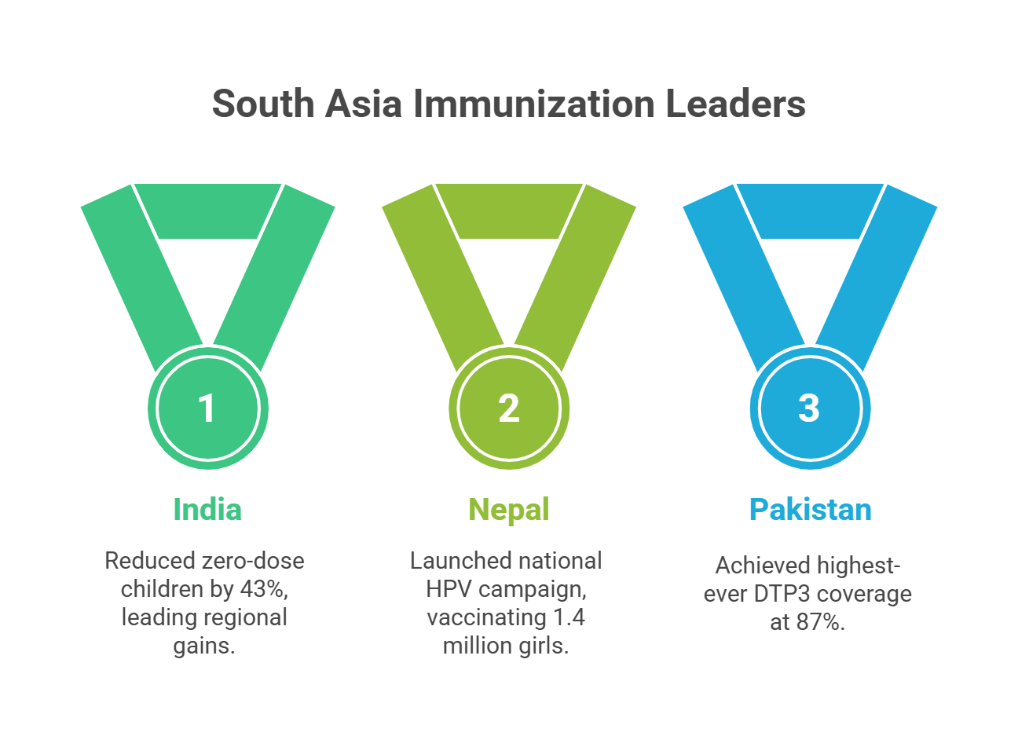
- India alone reduced its zero-dose children by 43% (from 1.6 million to 0.9 million).
- Progress in Measles Control:
- 93% of infants received first dose; 88% received second dose.
- Measles cases fell by 39% regionally, but coverage still below the 95% herd immunity threshold.
- HPV Vaccination Gains:
- Regional HPV coverage rose from 2% to 9%.
- Bangladesh vaccinated over 7.1 million girls; Nepal launched its national HPV campaign vaccinating 1.4 million girls.
- Bhutan, Maldives, Sri Lanka also saw notable increases.
- Country-wise Trends:
- India and Nepal are leading the gains.
- Pakistan achieved its highest-ever DTP3 coverage (87%).
- Afghanistan remains a concern with lowest coverage and slight decline.
Enablers of Progress
- Strong Political Will: Sustained commitment by governments.
- Frontline Workers: Tireless work of community health workers, especially women.
- Digital Tools: Better data systems and targeted outreach campaigns.
- Donor and Partner Support: Consistent financial and technical backing from global agencies.
Challenges Ahead
- Coverage Gaps: Despite gains, 2.9 million children in the region remain un- or under-vaccinated.
- HPV Vaccination: Still low; India and Pakistan yet to fully roll out national HPV programmes.
- Equity Issues: Hard-to-reach rural, conflict-affected, and marginalized communities continue to lag behind.
- Surveillance Needs: Strengthening systems to detect and control vaccine-preventable disease outbreaks remains vital.
Way Forward (Policy Implications)
- Sustain Political Commitment: Immunization must remain a top priority in health budgets.
- Invest in Frontline Workers: Training, incentives, and safety for community health workers need continued attention.
Expand HPV Programmes: Timely rollout in India and Pakistan is critical for cervical cancer prevention.
Bridge Equity Gaps: Focus on rural, tribal, and conflict-prone areas to reach ‘zero-dose’ children.
Strengthen Surveillance: Robust data systems to monitor coverage and disease trends.
Public Awareness: Combat vaccine hesitancy through community trust-building and clear communication.
Conclusion
- The record immunization coverage in South Asia reflects a significant public health milestone post-COVID.
- While India and Nepal’s progress is commendable, the region’s unfinished agenda—especially zero-dose children and adolescent HPV immunization—calls for sustained investments, inclusive strategies, and resilient health systems to secure the health rights of every child.
CARE MCQ |
UPSC PYQ |
Q6. With reference to the WHO–UNICEF report on immunization coverage in South Asia for the year 2024, consider the following statements:
Which of the statements given above are correct? |
Q. ‘Mission Indradhanush’ launched by the Government of India pertains to (2016)
(a) Immunization of children and pregnant women (d) New Educational Policy Ans: (a) |
| Answer – 6 – A
Explanation –
|