Table of Contents
Relevance: GS Paper III – Environment | Biodiversity | Wildlife Conservation | Andhra Pradesh Current Affairs
For Prelims:
Papikonda National Park, Tadoba-Andhari Tiger Reserve, NTCA, Godavari River, Eastern Ghats, Tiger Dispersal, Wildlife Protection Act 1972, Schedule I Species, Project Tiger, Core Area, Buffer Area
For Mains:
Tiger Corridors, Human-Wildlife Conflict, Landscape Conservation, Protected Area Management, Inter-State Wildlife Movement
Why in News?
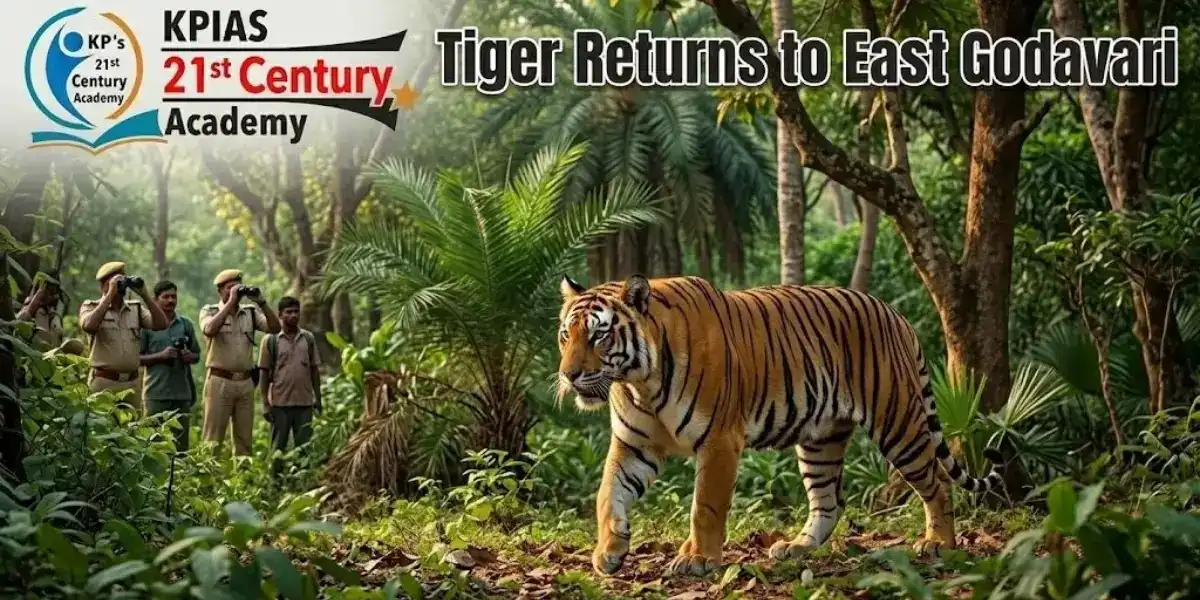
An adult male tiger named “Explorer,” which dispersed from Tadoba-Andhari Tiger Reserve in Maharashtra, has again entered East Godavari district of Andhra Pradesh after crossing the Godavari River.
The tiger travelled across Maharashtra, Chhattisgarh, Telangana and Andhra Pradesh, covering more than 650 km in 53 days. It was tranquilised near Kurmapuram village on February 6, 2026 and released into Papikonda National Park on February 14 following directions of the National Tiger Conservation Authority.
Since release, it has crossed the Godavari River twice and returned to East Godavari. Forest officials confirmed that it has not attacked any human during its entire movement.
Key Facts :
Point | Fact |
Origin of tiger | Tadoba-Andhari Tiger Reserve, Maharashtra |
Release site | Papikonda National Park, Andhra Pradesh |
Tranquilised at | Kurmapuram village, East Godavari |
Repeated movement area | Korukonda mandal near Munagala village |
Distance travelled | More than 650 km |
States covered | Maharashtra, Chhattisgarh, Telangana, Andhra Pradesh |
River crossed | Godavari River |
Preferred habitat in summer | Streams and water bodies |
Human attack reported | No |
Special field fact | Tranquilisation avoided inside water bodies |
Papikonda National Park
- It is located in the East Godavari and West Godavari districts of Andhra Pradesh.
- It spreads over an area of 86 square kilometres.
- It lies in the Papikondalu hill range of the Eastern Ghats.
- It is situated along both the left and right banks of the Godavari River.
- It is known for its distinct river gorge landscape formed by the Godavari flowing through forested hills.
- It was declared a Reserved Forest in 1882.
- It was later notified as a Wildlife Sanctuary in 1978.
- It was upgraded to a National Park in 2008.
- It is dominated by tropical moist deciduous forests.
- It supports important fauna such as tiger, gaur, and mouse deer.
- It forms part of the Godavari riverine ecosystem within the Eastern Ghats.
- It has been in recent news due to tiger movement and release under guidelines of the National Tiger Conservation Authority.
Tadoba-Andhari Tiger Reserve
- Tadoba-Andhari Tiger Reserve is located in Chandrapur district of Maharashtra and is one of India’s oldest tiger reserves.
- It is named after Tadoba Lake and the Andhari River. It is famous for high tiger density, dry deciduous forests, and strong corridor connectivity.
Major Big Cats of India
Species | Scientific Name | IUCN Status | Key Habitat in India |
Bengal Tiger | Panthera tigris tigris | Endangered | Central India, Sundarbans, Western Ghats, Northeast |
Asiatic Lion | Panthera leo persica | Endangered | Gir region, Gujarat |
Indian Leopard | Panthera pardus fusca | Vulnerable | Across India |
Snow Leopard | Panthera uncia | Vulnerable | Himalayas—Ladakh, Himachal, Uttarakhand, Sikkim, Arunachal |
Clouded Leopard | Neofelis nebulosa | Vulnerable | Northeast India |
Godavari River
- It originates from Trimbakeshwar in Maharashtra and flows eastward into the Bay of Bengal, forming a large delta in Andhra Pradesh.
- It flows through Maharashtra, Telangana, Chhattisgarh, and Andhra Pradesh, creating an inter-state river basin.
- In Andhra Pradesh, it passes through the Papikondalu (Eastern Ghats) region and the Papikonda National Park landscape.
- It forms a riverine forest corridor in the Papikondalu region, with continuous forest cover along both banks.
- It has been observed that a tiger has crossed the river multiple times, indicating that wide rivers do not always act as absolute barriers.
- The tiger movement has been recorded along water bodies and forest patches, especially during summer conditions.
- The riverine stretch has facilitated long-distance dispersal of the tiger across Maharashtra–Telangana–Chhattisgarh–Andhra Pradesh.
Key recall: Godavari (Trimbakeshwar origin) flows through 4 states, forms a delta in Andhra Pradesh, and acts as a riverine corridor enabling interstate tiger movement in the Papikondalu region.
Tiger Conservation Framework
- Tiger receives the highest legal protection in India.
- Under the Wildlife Protection Act, 1972, tiger is listed under Schedule I, which provides maximum legal protection.
- Project Tiger was launched in 1973 for ensuring viable tiger populations through habitat protection and scientific management.
- Tiger reserves follow a two-zone model:
- Core Area – strictly protected zone with minimal human interference
- Buffer Area – regulated-use zone around the core for coexistence with local communities
CARE MCQ
Q. Consider the following statements:
- Papikonda is a Tiger Reserve in Andhra Pradesh.
- Tiger is listed under Schedule I of the Wildlife Protection Act, 1972.
- Godavari is the longest river of Peninsular India.
Which of the above are correct?
(a) 2 and 3 only
(b) 1 and 2 only
(c) 1 and 3 only
(d) 1, 2 and 3
Ans: (a)
Explanation:
Statement 1 is incorrect because Papikonda is a National Park, not a Tiger Reserve. Statements 2 and 3 are correct.
Q.Consider the following statements:
- Pulicat Lake is a brackish water lagoon.
- Nagarjunsagar-Srisailam Tiger Reserve is shared by Andhra Pradesh and Telangana.
- Sri Venkateswara National Park is located in the Western Ghats.
Which of the statements given above are correct?
(a) 1 and 2 only
(b) 2 and 3 only
(c) 1 and 3 only
(d) 1, 2 and 3
Ans. (a)
Explanation:
Statement 1 is correct : Pulicat Lake is a coastal lagoon with a mix of seawater and freshwater, hence classified as brackish. It is also an important habitat for migratory birds, especially flamingos.
Statement 2 is correct: Nagarjunsagar-Srisailam Tiger Reserve extends across both Andhra Pradesh and Telangana and is one of the largest tiger reserves in India.
Statement 3 is incorrect : Sri Venkateswara National Park is located in the Eastern Ghats (Tirumala hills), not in the Western Ghats.
Q.Consider the following statements regarding the Godavari River:
- It flows through a gorge-like landscape in the Papikondalu hills of the Eastern Ghats.
- Its lower course in Andhra Pradesh is associated with mangrove ecosystems.
- It is the second longest river in India.
Which of the statements given above are correct?
(a) 1 and 2 only
(b) 2 and 3 only
(c) 1 and 3 only
(d) 1, 2 and 3
Ans. (d)
Explanation:
Statement 1 is correct: the Godavari flows through the Papikondalu hills forming a gorge-like landscape in the Eastern Ghats.
Statement 2 is correct: its delta region in Andhra Pradesh supports mangrove ecosystems such as those in Coringa.
Statement 3 is correct: the Godavari is the second longest river in India after the Ganga.
APPSC Mains Question
Q.Inter-state tiger dispersal highlights the importance of landscape-level conservation beyond protected area boundaries. Discuss with reference to Andhra Pradesh. [250 WORDS]
FAQs
Q.Is Papikonda a Tiger Reserve?
Ans: No, it is a National Park.
Q.From where did the tiger originate?
Ans: From Tadoba-Andhari Tiger Reserve in Maharashtra.
Q.Why do male tigers move long distances?
Ans:For territory, prey and breeding opportunities.
Q.Why is Godavari important here?
Ans:It acts as both a barrier and an ecological corridor.
Q.Why was tranquilisation difficult?
Ans:Because the tiger stayed inside water bodies during daytime.