Table of Contents
Relevance: GS Paper II – Polity | Parliament | Anti-Defection Law | Constitutional Provisions
For Prelims:
Anti-Defection Law, Tenth Schedule, 52nd Constitutional Amendment Act, 1985, 91st Constitutional Amendment Act, 2003, Rajya Sabha Chairman, Merger Provision, Disqualification Petition, Kihoto Hollohan Case, Voluntarily Giving Up Membership, Party Whip
For Mains:
party discipline, legislative stability, judicial review, constitutional morality, political defections, parliamentary ethics, Speaker’s discretion, democratic accountability, federal politics, institutional neutrality
Why in News?
party discipline, legislative stability, judicial review, constitutional morality, political defections, parliamentary ethics, Speaker’s discretion, democratic accountability, federal politics, institutional neutrality
What Happened in the Rajya Sabha
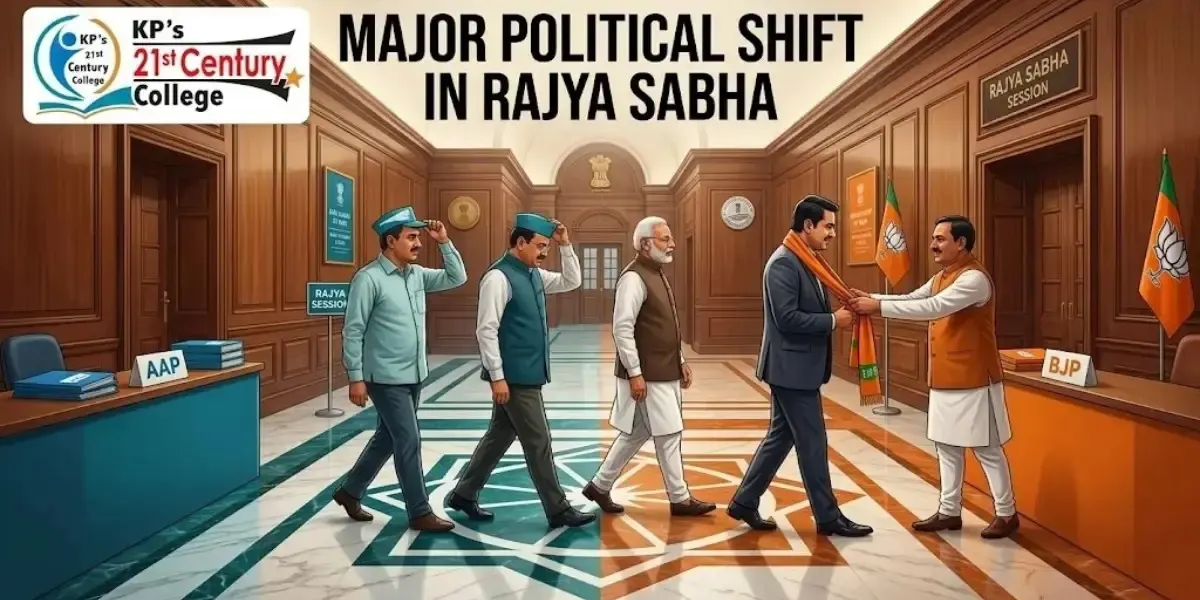
- The seven MPs publicly announced that they were merging with the BJP and claimed protection under the merger provision of the Anti-Defection Law.
- Under the Tenth Schedule, if at least two-thirds of the members of a legislature party agree to merge with another political party, they are protected from disqualification.
- Since seven out of ten MPs satisfy the two-thirds requirement, legal experts suggest that the Rajya Sabha Chairman may accept the merger claim, similar to the precedent seen in the Telugu Desam Party (TDP) Rajya Sabha case.
- However, opposition parties may file a disqualification petition challenging the legitimacy of the merger and questioning whether it reflects a genuine party merger or only individual defections.
- Until the Chairman gives a final decision, the defecting MPs technically remain AAP members.
Anti-Defection Law: Constitutional Basis
- The Anti-Defection Law was introduced through the 52nd Constitutional Amendment Act, 1985, which added the Tenth Schedule to the Constitution.
- Its primary aim is to prevent political defections motivated by personal gain and to ensure stability in governments.
- The law applies to both Parliament and State Legislatures.
It was further strengthened by the 91st Constitutional Amendment Act, 2003, which removed the provision of “split” (1/3rd members) and retained only the “merger” provision.
Grounds for Disqualification
- A Member of Parliament or State Legislature can be disqualified under the Anti-Defection Law on several grounds.
- If an elected member voluntarily gives up membership of the political party on whose ticket they were elected, they can be disqualified. This does not require formal resignation; even conduct indicating disloyalty may be enough.
- If a member votes or abstains from voting against the party whip without prior permission and the action is not condoned by the party within 15 days, disqualification can follow.
- An independent member who joins any political party after election is also disqualified.
- A nominated member can join a political party only within six months of taking their seat. After that, joining a party leads to disqualification.
Merger Exception under the Tenth Schedule
- The most important exception under the Anti-Defection Law is the merger provision.
- If not less than two-thirds of the members of a legislature party agree to merge with another political party, they are protected from disqualification.
- This provision was retained after the 91st Amendment, while the earlier “split” exception for one-third members was removed.
- In this case, seven out of ten AAP Rajya Sabha MPs constitute exactly two-thirds, which gives them a legal basis to claim merger protection.
- However, the controversy lies in determining whether this is a genuine political merger of the party or merely a strategic defection of MPs.
- This interpretation becomes crucial for the Chairman’s decision.
Supreme Court’s Stance
- Kihoto Hollohan v. Zachillhu (1992)
- Speaker’s decision is subject to judicial review on limited grounds.
- Ravi S. Naik v. Union of India (1994)
- Defection can be inferred from conduct; resignation is not necessary.
- Keisham Meghachandra Singh v. Speaker, Manipur Assembly (2020)
- Speaker should decide cases within 3 months.
- Suggested creation of an independent tribunal.
- Padi Kaushik Reddy v. State of Telangana (2025)
- Supreme Court called for reforms to ensure timely and impartial decisions.
- Re-examined the role of the Speaker.
Powers and Functions of Rajya Sabha Chairman
Area | Power / Function | Key Prelims Fact |
Constitutional Position | Ex-officio Chairman | Vice-President acts as Chairman (Art. 64, 89) |
Presiding Function | Conducts proceedings | Maintains order, decides speaking order |
Discipline | Maintains decorum | Can suspend members for disorderly conduct |
Rules Interpretation | Final authority on procedure | Decisions on rules are binding |
Points of Order | Decides points raised by members | Ensures proceedings follow rules |
Voting Power | Casting vote only | No vote in first instance; votes only in tie |
Adjournment Power | Adjourns/suspends House | In case of disorder or lack of quorum |
Committee Role | Nominates members | Important in committee functioning |
Administrative Role | Controls Secretariat | Supervises Rajya Sabha Secretariat |
Anti-Defection | Decides disqualification | Acts under Tenth Schedule |
Judicial Review | Decisions reviewable | Subject to court review |
Money Bill Role | No final authority | Speaker of Lok Sabha decides Money Bill |
Removal | Cannot be removed by RS alone | Removed as Vice-President by Parliament |
Way Forward
The Anti-Defection Law should be reformed to balance party discipline with democratic debate. The law should be limited mainly to votes affecting government stability such as no-confidence motions, money bills, and confidence votes, rather than every legislative issue.
The power to decide disqualification should be shifted from the Speaker or Chairman to an independent tribunal or the Election Commission to improve neutrality. A strict constitutional time limit should be introduced for deciding disqualification petitions.
The merger provision should also be reviewed carefully so that it protects genuine political restructuring rather than encouraging strategic defections
Conclusion
The defection of seven AAP Rajya Sabha MPs to the BJP is not merely a party issue; it is a major constitutional test for the Anti-Defection Law.
The case highlights the continuing tension between political strategy and constitutional ethics. Whether the Chairman treats this as a legitimate merger or an unlawful defection will shape the future interpretation of the Tenth Schedule.
Ultimately, the strength of parliamentary democracy depends not only on legal provisions but also on the political morality of those who operate within them.
CARE MCQ
Q. Consider the following statements regarding disqualification of a Member of Parliament on grounds of defection:
- A member can be disqualified if he or she votes against the party whip in the House without prior permission, even when the party is part of a ruling coalition.
- The Speaker of the House decides questions of disqualification under the Anti-Defection Law, and such decisions are completely immune from judicial review.
- The Anti-Defection Law applies to both elected and nominated members of Parliament.
Which of the statements given above is/are correct?
(a) 1 and 2 only
(b) 2 and 3 only
(c) 1 and 3 only
(d) 1, 2 and 3
Ans: (c) 1 and 3 only
Explanation:
Statement 1 is correct:Under the Tenth Schedule of the Constitution, a member may be disqualified if he votes or abstains from voting contrary to the direction issued by his political party, commonly known as the party whip, without obtaining prior permission. This rule applies irrespective of whether the party is in government, opposition, or part of a coalition. Therefore, even in a coalition government, defying the party whip can lead to disqualification.
Statement 2 is incorrect: The Speaker of the Lok Sabha or the Chairman of the Rajya Sabha has the authority to decide questions of disqualification under the Anti-Defection Law. However, their decision is not beyond challenge. In Kihoto Hollohan v. Zachillhu (1992), the Supreme Court held that the Speaker’s decision is subject to judicial review, especially on grounds of mala fide action, violation of constitutional provisions, or procedural irregularity. Therefore, the statement is incorrect.
Statement 3 is correct: The Anti-Defection Law applies to both elected and nominated members of Parliament. A nominated member can also be disqualified if he joins a political party after six months from the date of taking his seat in the House. Thus, the law covers both categories of members. Hence, this statement is correct.
Q. Consider the following statements regarding the Anti-Defection Law in India:
- A member of a political party is disqualified from being a member of the House if he voluntarily gives up the membership of his political party.
- A political party may merge with another party without attracting disqualification if not less than two-thirds of its legislators agree to the merger.
- The decision on disqualification under the Anti-Defection Law is taken by the President of India on the advice of the Election Commission.
- A legislator is not disqualified if his original political party merges with another party but he and some other members choose not to join the merged party and function as a separate group.
Which of the statements given above are correct?
(a) 1 and 2 only
(b) 2 and 4 only
(c) 1, 2 and 3 only
(d) 1, 2 and 4 only
Ans: (d) 1, 2 and 4 only
Explanation:
Statement 1 is correct: One of the main grounds of disqualification under the Tenth Schedule is when a member voluntarily gives up the membership of his political party. This does not require a formal resignation; even conduct indicating abandonment of party loyalty may be treated as voluntarily giving up membership. Therefore, this statement is correct.
Statement 2 is correct: The law provides an exception in case of a merger of political parties. If at least two-thirds of the legislators of a legislative party agree to merge with another party, such members are protected from disqualification. This provision replaced the earlier split exception, which was removed by the 91st Constitutional Amendment. Hence, this statement is correct.
Statement 3 is incorrect: The decision on disqualification is not taken by the President. It is decided by the Speaker of the Lok Sabha or the Chairman of the Rajya Sabha in the case of Parliament, and by the Speaker/Chairman in State Legislatures. The President and Election Commission are involved in disqualification under other provisions like office of profit, but not under the Anti-Defection Law. Therefore, this statement is incorrect.
Statement 4 is correct: When a merger takes place, legislators who choose not to join the merged party and prefer to continue as a separate group are also protected from disqualification. The law recognizes both those who accept the merger and those who refuse it, provided the merger satisfies the two-thirds requirement. Hence, this statement is correct.
Q. Which of the following Supreme Court cases is related to the judicial review of the Speaker’s decision on disqualification under the Tenth Schedule?
(a) Kihoto Hollohan vs Zachillhu And Others
(b) Golaknath vs State of Punjab
(c) Kesavananda Bharati vs State of Kerala
(d) Indira Nehru Gandhi vs Raj Narain
Answer: (a) Kihoto Hollohan vs Zachillhu And Others
Explanation:
The Supreme Court in Kihoto Hollohan vs Zachillhu And Others upheld the constitutional validity of the Tenth Schedule (Anti-Defection Law) while ruling that the Speaker’s decision is subject to judicial review. This ensured that the Speaker’s powers are not absolute and can be challenged in courts on grounds such as mala fides or violation of constitutional mandates.
Q. Regarding the Anti-Defection Law in India, which of the following statements is correct?
(a) It applies only to the members of the Lok Sabha.
(b) It is mentioned under Article 102 of the Constitution.
(c) It was introduced by the 52nd Amendment Act, 1985.
(d) It allows a member to change parties if there’s a merger of two-thirds of the members.
Answer: (c) It was introduced by the 52nd Amendment Act, 1985.
Explanation:
The Anti-Defection Law was introduced through the 52nd Constitutional Amendment Act, which added the Tenth Schedule to the Constitution.
FAQs
Q1. What is the Anti-Defection Law?
It is a constitutional law under the Tenth Schedule that prevents legislators from changing political parties for personal or political gain.
Q2. Which amendment introduced the Anti-Defection Law?
The 52nd Constitutional Amendment Act, 1985 introduced it.
Q3. What is the merger exception?
If at least two-thirds of members of a legislature party join another party, they are protected from disqualification.
Q4. Who decides disqualification in Rajya Sabha cases?
The Chairman of the Rajya Sabha decides such cases.
Q5. Why is the Anti-Defection Law criticized?
It suppresses dissent, allows misuse of the merger clause, and gives excessive discretion to presiding officers.