Table of Contents
Relevance:GS Paper III – Environment | Biodiversity | Wetlands | Ecology
For Prelims:
Chilika Lake, Mangalajodi, Ramsar Site, Brackish Water Lagoon, Central Asian Flyway, Nalabana Bird Sanctuary, Irrawaddy Dolphin, Bar-headed Goose, Migratory Birds
For Mains:
Chilika Lake, Mangalajodi, Ramsar Site, Brackish Water Lagoon, Central Asian Flyway, Nalabana Bird Sanctuary, Irrawaddy Dolphin, Bar-headed Goose, Migratory Birds
Why in News?
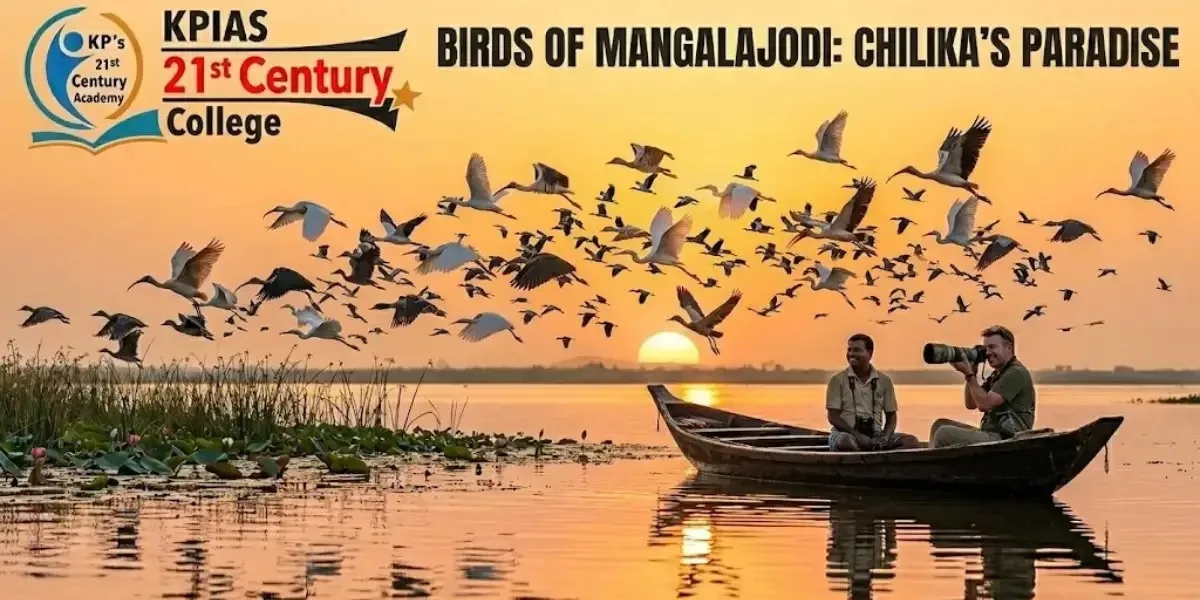
A coffee table book titled Birds of Mangalajodi – A Visitor’s Guide to the Bird Paradise of Chilika Lake was released in Hyderabad, bringing renewed attention to the ecological richness of Mangalajodi, located on the northern fringe of Chilika Lake.
Chilika Lake: Location, Type and International Recognition
Location and Type
- Chilika Lake is situated in the state of Odisha along the eastern coastline of India, adjoining the Bay of Bengal.
- It lies to the south-west of the Mahanadi delta and extends across the districts of Puri, Khordha, and Ganjam.
- The lake is connected to the Bay of Bengal through a sea mouth, the maintenance of which is crucial for regulating salinity and sustaining ecological balance.
- A key development in recent decades has been the opening of a new sea mouth in 2000, which significantly improved water exchange, enhanced fish production, and restored the lagoon’s ecological health.
- Chilika Lake is a brackish water coastal lagoon, formed by the mixing of freshwater inflows from rivers such as Daya and Bhargavi with saline seawater.
- It is the largest brackish water lagoon in India and one of the largest in the world.
- The lake exhibits a clear ecological zonation, with freshwater conditions dominating the northern sector, brackish conditions in the central region, and marine influence in the southern part.
- This gradient supports high biodiversity, including fisheries and species such as the Irrawaddy dolphin, making it ecologically and economically significant.
International Recognition
- Chilika Lake has been recognized as a wetland of global importance under the Ramsar Convention since 1981.
- Its inclusion highlights its ecological significance, particularly as a habitat for migratory birds along the Central Asian Flyway and for its rich aquatic biodiversity.
- A major point of importance in current affairs is its association with the Montreux Record.
- Chilika was the first Indian wetland to be placed on the Montreux Record due to ecological degradation caused by siltation, reduced salinity, and declining biodiversity.
- However, through targeted restoration measures, including hydrological interventions and community-based management, the lake witnessed substantial ecological recovery.
- As a result, it became the first wetland in Asia to be removed from the Montreux Record, a globally acknowledged success in wetland restoration.
Mangalajodi: Freshwater Marsh Zone of Chilika
- Mangalajodi is located on the northern fringe of Chilika Lake in Odisha.
- It represents the freshwater marsh zone of Chilika, unlike the lagoon’s brackish and marine-influenced sectors.
- The area receives freshwater mainly from distributaries of the Mahanadi River.
- It consists of shallow wetlands, mudflats, and marshy vegetation, not deep open water.
- Water depth is generally very shallow (often <1 metre), suitable for wading birds.
- It supports large congregations of migratory birds during winter season.
- It lies along the Central Asian Flyway, an important migratory route.
- It is known for hosting lakhs of birds annually, especially waterfowl species.
- Common bird groups include ducks, geese, herons, egrets, and waders.
- It is recognized as one of the major birding hotspots in India.
- It is often called the “Bird Paradise of Chilika”.
- It differs from the southern part of Chilika which is marine-influenced due to proximity to the Bay of Bengal.
- It is associated with community-led conservation model (local villagers involved in bird protection).
- It forms part of the Chilika Ramsar Wetland system under the Ramsar Convention.
Central Asian Flyway and Migratory Bird Movement
- Mangalajodi lies on the Central Asian Flyway, which is one of the world’s major migratory bird routes.
- This flyway connects the breeding grounds of birds in Siberia, Arctic regions, Central Asia and Northern Eurasia with wintering grounds in India and South Asia.
- Every year between October and March, nearly two lakh migratory birds arrive in Mangalajodi.
- These birds migrate mainly due to harsh winters in northern regions and search for warmer climate, food-rich wetlands and safe breeding conditions.
Important Migratory Birds
- Northern Pintail (Anas acuta) is one of the most dominant and abundant migratory duck species.
- Bar-headed Goose (Anser indicus) is notable for its high-altitude migration across the Himalayas.
- Gadwall, Northern Shoveler, and Common Teal are common dabbling ducks found in large numbers.
- Black-tailed Godwit and other waders (sandpipers, plovers) are common in shallow marsh zones like Mangalajodi.
- Bird population monitoring is conducted annually by the Chilika Development Authority.
Nalabana Bird Sanctuary inside Chilika
- Nalabana Bird Sanctuary is the core protected bird habitat located inside Chilika Lake.
- The word Nalabana means “weed-covered island.”
- It remains seasonally submerged during the monsoon and reappears during the dry season, making it a unique wetland island ecosystem.
- It was declared a bird sanctuary in 1987 and serves as one of the most important nesting and resting sites for migratory birds visiting Chilika.
- Nalabana is also the principal site for annual bird census operations and is one of the most protected avian habitats in eastern India.
- Its location inside Chilika is a very common prelims question.
Irrawaddy Dolphin and Other Important Fauna
- Chilika Lake is internationally famous for the presence of the Irrawaddy Dolphin.
- This species is mainly found in coastal, estuarine and brackish water ecosystems and is different from the Gangetic river dolphin.
- In India, Chilika is one of the most well-known habitats of the Irrawaddy Dolphin, especially near the outer channel and sea mouth region.
- The species is listed as Endangered by the IUCN.
- Apart from dolphins and birds, Chilika also supports fish species, crustaceans, prawns, amphibians and seagrass ecosystems, making it one of India’s most productive wetland systems.
CARE MCQ
Q. Consider the following statements regarding Chilika Lake:
- It is the largest brackish water lagoon in India.
- Nalabana Bird Sanctuary is located within Chilika Lake.
- Chilika is famous for the Gangetic Dolphin population.
Which of the statements given above are correct?
(a) 1 and 2 only
(b) 2 and 3 only
(c) 1 and 3 only
(d) 1, 2 and 3
Answer: (a) 1 and 2 only
Explanation
Statement 1 is correct because Chilika is the largest brackish water lagoon in India.
Statement 2 is correct because Nalabana Bird Sanctuary lies within Chilika Lake and serves as the core bird habitat.
Statement 3 is incorrect because Chilika is famous for the Irrawaddy Dolphin and not for the Gangetic Dolphin.
Therefore, the correct answer is (a).
Q. Which one of the following migratory bird species recorded at Chilika is known for crossing the Himalayas at very high altitudes during migration?
(a) Northern Pintail
(b) Gadwall
(c) Bar-headed Goose
(d) Common Teal
Answer: (c) Bar-headed Goose
Explanation:
The Bar-headed Goose is famous for its ability to fly over the Himalayas at extremely high altitudes (often above 7,000 m). Other options like Northern Pintail, Gadwall, and Common Teal are migratory ducks but do not exhibit such extreme high-altitude migration.
Q.Among the following birds observed at Chilika Lake, which one is correctly matched with its feeding behaviour?
(a) Northern Shoveler – Diving duck
(b) Gadwall – Dabbling duck
(c) Bar-headed Goose – Wader
(d) Black-tailed Godwit – Raptor
Answer: (b) Gadwall – Dabbling duck
Explanation:
- Gadwall is a dabbling duck (feeds on the water surface).
- Northern Shoveler is also a dabbling duck (not diving).
- Bar-headed Goose is a grazer (not a wader).
- Black-tailed Godwit is a wader, not a raptor.
Q.Which of the following bird groups at Mangalajodi are most closely associated with shallow marshy feeding habitats?
(a) Raptors
(b) Diving ducks
(c) Waders
(d) Pelagic birds
Answer: (c) Waders
Explanation:
Waders (e.g., sandpipers, plovers, Black-tailed Godwit) are adapted to shallow water and mudflats, which are characteristic of Mangalajodi marshes. Raptors are predators, diving ducks prefer deeper water, and pelagic birds are marine.
Q.Which one of the following pairs of species represents dabbling ducks commonly found at Chilika Lake?
(a) Northern Pintail and Gadwall
(b) Bar-headed Goose and Greylag Goose
(c) Black-tailed Godwit and Sandpiper
(d) Harrier and Eagle
Answer: (a) Northern Pintail and Gadwall
Explanation:
Both Northern Pintail and Gadwall are dabbling ducks, feeding at or near the surface.
- Geese are grazers
- Godwit and sandpiper are waders
- Harrier and eagle are raptors
Q.With reference to migratory birds at Chilika Lake, consider the following statements:
- Northern Pintail is among the most abundant species recorded.
- Black-tailed Godwit is a long-distance migratory wader.
- All migratory birds visiting Chilika are diving ducks.
Which of the statements given above is/are correct?
(a) 1 and 2 only
(b) 2 and 3 only
(c) 1 only
(d) 1, 2 and 3
Answer: (a) 1 and 2 only
Explanation:
- Statement 1 is correct: Northern Pintail is one of the most abundant migratory ducks at Chilika.
- Statement 2 is correct: Black-tailed Godwit is a long-distance migratory wader.
- Statement 3 is incorrect: Chilika hosts diverse bird groups (dabbling ducks, waders, geese, raptors), not only diving ducks.
TGPSC Mains Question
Q. Wetlands like Chilika play an important role in biodiversity conservation as well as livelihood security. Discuss with suitable examples.
(250 words)
FAQs
Q.Why is Chilika Lake important for prelims?
Ans: Because it is India’s largest brackish water lagoon, a Ramsar Site and a major migratory bird habitat.
Q.Why is Mangalajodi called Bird Paradise?
Ans: Because nearly two lakh migratory birds visit it every year during winter.
Q.Which migratory route passes through Mangalajodi?
Ans: The Central Asian Flyway.
Q.Which sanctuary is located inside Chilika Lake?
Ans: Nalabana Bird Sanctuary.
Q.Which dolphin is famous in Chilika Lake?
Ans: Irrawaddy Dolphin.