The New Nuclear Frontier in Space
Table of Contents
Source: The Hindu
Relevance: GS-1: Mineral & Energy Resources (new frontiers) GS-2: Government policies, global governance, treaties (OST, COPUOS, Liability Convention) GS-3: Nuclear technology, space tech, environment
Important Key Concepts for Prelims and Mains:
For Prelims:
- Lunar Fission Surface Power Project, Artemis Base Camp, RTG (Radioisotope Thermoelectric Generator), Compact Fission Reactor, NTP (Nuclear Thermal Propulsion), NEP (Nuclear Electric Propulsion), KRUSTY, Voyager, Outer Space Treaty 1967, UN 1992 Principles on Nuclear Power Sources, UN COPUOS, IAEA, 1972 Liability Convention.
For Mains:
- Need for nuclear power in space, types of space nuclear tech, environmental & legal challenges, global governance gaps, India’s opportunities & responsibilities.
Why in News?
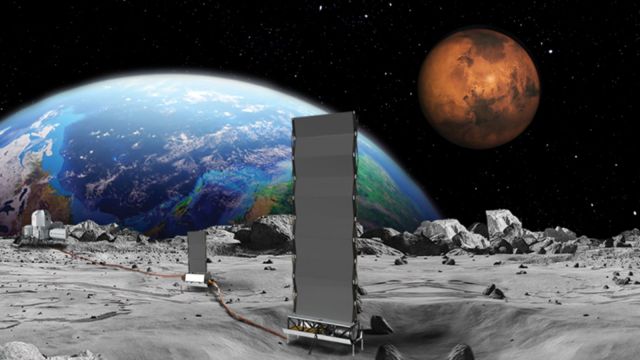
- The United States has announced plans under its Lunar Fission Surface Power Project to deploy a small fission reactor on the Moon by early 2030s, as part of NASA’s Artemis Base Camp.
- If successful, this would be the first permanent nuclear power source beyond Earth orbit, signalling the start of large-scale nuclear energy use for off-Earth habitats.

Background / Present Status
1. Existing Nuclear Technologies in Space
- Radioisotope Thermoelectric Generators (RTGs) – present tech
- Convert heat from decay of plutonium-238 into electricity.
- Power output: few hundred watts – enough for scientific instruments, not for human bases.
- Used on missions like Voyager spacecraft, Mars rovers etc.
- Immune to dust, darkness and long distances from Sun.

Radioisotope Thermoelectric Generators (RTGs)
- Compact Fission Reactors – next step
- Roughly the size of a shipping container.
- Can produce 10–100 kW (NASA’s KRUSTY demo aims at up to 10 kW).
- Suitable for lunar or Martian bases, labs, ISRU units and initial industry.

NASA’s KRUSTY
- Nuclear Thermal Propulsion (NTP)
- A reactor heats a propellant (like liquid hydrogen) and ejects it for thrust.
- Offers much higher efficiency (specific impulse) than chemical rockets, shortening Mars trips by months.
- US DRACO programme to test NTP in lunar orbit by 2026.
- Nuclear Electric Propulsion (NEP)
- Reactor generates electricity, which powers ion or plasma thrusters.
- Provides low but continuous thrust for years → ideal for deep-space probes and cargo missions.
Why Nuclear Power is Needed in Space
Solar Limitations
- Lunar night lasts ~14 Earth days, with temperatures below –170°C → needs huge batteries & heating systems.
- On Mars, planet-wide dust storms can obscure sunlight for weeks, crippling solar arrays.
24×7 Reliability
- Human outposts need continuous power for:
- Life support & habitat heating
- Communications & navigation
- ISRU (fuel & oxygen production), water extraction, manufacturing, agriculture
- Nuclear reactors give reliable base-load power, independent of sunlight or weather.
Location Flexibility
- Nuclear allows operations in permanently shadowed craters (rich in water ice), high latitudes and dust-prone regions, not just sunlit equatorial sites.
Scalability
- Small crews can survive on solar + batteries, but larger bases & industry need hundreds of kW to MW-level power.
- Only fission is currently proven and scalable for such demands beyond Earth orbit.
Mission Architecture
- Many Mars mission designs depend on in-situ fuel production (e.g. methane + oxygen from water ice & CO₂).
- These chemical processes are highly energy-intensive; compact reactors can power this “gas station on Mars”, reducing fuel lifted from Earth and improving safety margins.
Legal & Institutional Framework
1. Existing Treaties & Principles
- Outer Space Treaty (OST), 1967
- Article IV: Prohibits nuclear weapons & other WMDs in orbit, on the Moon or other celestial bodies.
- Does not ban peaceful nuclear power in space.
- UN “Principles Relevant to the Use of Nuclear Power Sources in Outer Space”, 1992 (UNGA Res. 47/68)
- Cover RTGs and fission reactors used for electricity generation.
- Key elements:
- Design to prevent release of radioactive materials in normal & accident conditions.
- Pre-launch safety analyses (low probability of accidents).
- Emergency notification obligations for accidents / re-entry with radioactive materials.
- Nature: Non-binding resolution → guidance, but no enforcement.
- 1972 Liability Convention
- Launching State is absolutely liable for damage on Earth / aircraft; fault-based liability for damage in outer space.
- Not tailored to complex nuclear incidents in cis-lunar or deep space.
- Other instruments: Outer Space Treaty, NPT, and nuclear-safety norms collectively give partial coverage only.
2. Governance Gaps
- 1992 Principles ignore NTP & NEP reactors used for propulsion.
- No binding technical standards for:
- Reactor design & shielding
- Operational limits & shutdown conditions
- End-of-life disposal (e.g., graveyard orbits, surface burial)
- Lack of enforcement or inspection mechanism like IAEA in space context.
Key Concerns & Pitfalls
- Environmental Contamination
- Reactor failure could spread radioactive materials on the Moon/Mars, irreversibly altering pristine scientific environments and potentially affecting future habitability.
- Safety Zones vs. Non-Appropriation
- Nuclear sites need exclusion/safety zones.
- But large, long-term “safety zones” around reactors could effectively give quasi-territorial control over resource-rich areas, violating OST’s ban on national appropriation and restricting access.
- Risk of Conflict & Weaponisation Perception
- Nuclear incidents or opaque deployments may be interpreted as covert weaponisation, fuelling mistrust and even retaliatory measures → a “nuclear twilight” or second Cold War in space.
- Unregulated & Risky Testing
- Without universal safety standards, states or private players might test reactors & propulsion with minimal safeguards, leading to a “race to the bottom” in safety.
- Nuclear Waste & End-of-Life
- No agreed global protocol on reactor shutdown, disposal, or safe parking orbits → long-term space debris + contamination risk.
What a Responsible Space Nuclear Framework Should Include

- Strengthen Legal Regime
- Update 1992 UN Principles under COPUOS (Committee on the peaceful uses of Outer Space) to:
- Explicitly cover NTP & NEP propulsion systems.
- Lay down binding minimum safety standards for design, shielding, launch approval and disposal procedures.
- Update 1992 UN Principles under COPUOS (Committee on the peaceful uses of Outer Space) to:
- Multilateral Oversight
- Create an International Space Nuclear Safety Group (on the lines of IAEA):
- Independent technical certification of reactor designs.
- Oversight of incident reporting & investigation.
- Promote transparent data-sharing & peer review.
- Create an International Space Nuclear Safety Group (on the lines of IAEA):
- Specific Protocols for Key Scenarios
- Temporary, non-discriminatory safety perimeters that:
- Protect crews from radiation
- Do not turn into permanent territorial claims.
- Clarify liability rules for nuclear accidents in lunar orbit, cis-lunar space, Mars etc.
- Joint emergency response mechanisms and notification procedures.
- Temporary, non-discriminatory safety perimeters that:
- Norm-Setting & Confidence Building
- Major spacefaring powers (US, Russia, China, EU, India, Japan) should:
- Lead early negotiations on safe deployment norms.
- Include commercial players (SpaceX, Blue Origin, ISRO-linked firms) in consultations.
- Major spacefaring powers (US, Russia, China, EU, India, Japan) should:
- Ethical & Environmental Safeguards
- Treat certain areas (e.g. historically or scientifically sensitive craters, potential life-bearing regions on Mars) as “nuclear-free conservation zones”.
- Apply precautionary principle where environmental impacts are uncertain.
India’s Stakes & Opportunities
- Technological Edge:
- Potential ISRO–DAE alliance to develop a domestic space reactor:
- Power ISRO’s future lunar base in permanently shadowed craters.
- Enable continuous ISRU (water, oxygen, fuel) on Moon/Mars.
- Potential ISRO–DAE alliance to develop a domestic space reactor:
- Norm-Shaper Role:
- India’s legacy in non-aligned diplomacy and nuclear restraint positions it to:
- Champion safe, peaceful nuclear use in space.
- Push for updated UN Principles, environmental protocols, and transparent norms.
- India’s legacy in non-aligned diplomacy and nuclear restraint positions it to:
- Strategic & Commercial Benefits:
- Leadership in safe space nuclear tech can feed into:
- Export potential in space reactors & related components.
- Stronger role in lunar governance coalitions (e.g. Artemis Accords discussions) while preserving strategic autonomy.
- Leadership in safe space nuclear tech can feed into:
UPSC PYQ
Q. Consider the following countries: (UPSC CSE 2015)
- China
- France
- India
- Israel
- Pakistan
Which among the above are Nuclear Weapons States as recognized by the Treaty on the Non-Proliferation of Nuclear Weapons (NPT)?
- 1 and 2 only
- 1, 3, 4 and 5 only
- 2, 4 and 5 only
- 1, 2, 3, 4 and 5
Answer: A
Explanation:
- Under the NPT, only five countries are recognized as Nuclear Weapon States (NWS):
USA, Russia, UK, France, China. - India, Pakistan, and Israel possess nuclear weapons but are not NPT-recognized NWS because they did not sign the treaty.
→ Therefore, only China and France from the list are NPT-recognized NWS.
Q. What is/are the consequence(s) of a country becoming a member of the Nuclear Suppliers Group (NSG)? (UPSC CSE 2018)
- It will have access to the latest and most efficient nuclear technologies.
- It automatically becomes a member of the Treaty on the Non-Proliferation of Nuclear Weapons (NPT).
Which of the statements given above is/are correct?
- 1 only
- 2 only
- Both 1 and 2
- Neither 1 nor 2
Answer: A
Explanation:
- Correct (1): NSG membership expands access to advanced civilian nuclear technology and material.
- Incorrect (2): NSG membership does not require or grant automatic NPT membership. India seeks NSG membership without signing NPT.
CARE MCQ
Q. With reference to nuclear technologies for space exploration, consider the following pairs:
- RTG (Radioisotope Thermoelectric Generator) – Uses decay heat of plutonium-238 to generate small amounts of electricity
- Nuclear Thermal Propulsion (NTP) – Uses reactor heat to energise propellant for high-thrust, shorter-duration missions
- Nuclear Electric Propulsion (NEP) – Uses electricity from a reactor to power ion engines for long-duration, low-thrust missions
How many of the pairs given above are correctly matched?
(a) Only one
(b) Only two
(c) All three
(d) None
Answer: C
Explanation
1. RTG – Radioisotope Thermoelectric Generator
- Converts heat from radioactive decay of Pu-238 into electricity.
- Powers Voyager, New Horizons, Curiosity, Perseverance.
- Works even in dark, dusty, or distant environments.
2. Nuclear Thermal Propulsion (NTP)
- Nuclear reactor heats hydrogen → expands → expelled through nozzle.
- Provides high thrust, enabling faster Mars missions.
- Example: NASA–DARPA DRACO mission (planned test around 2026).
3. Nuclear Electric Propulsion (NEP)
- Reactor-generated electricity powers ion thrusters.
- Very high fuel efficiency, suitable for deep-space probes.
- Produces low thrust but can run for years continuously.