Why in News?
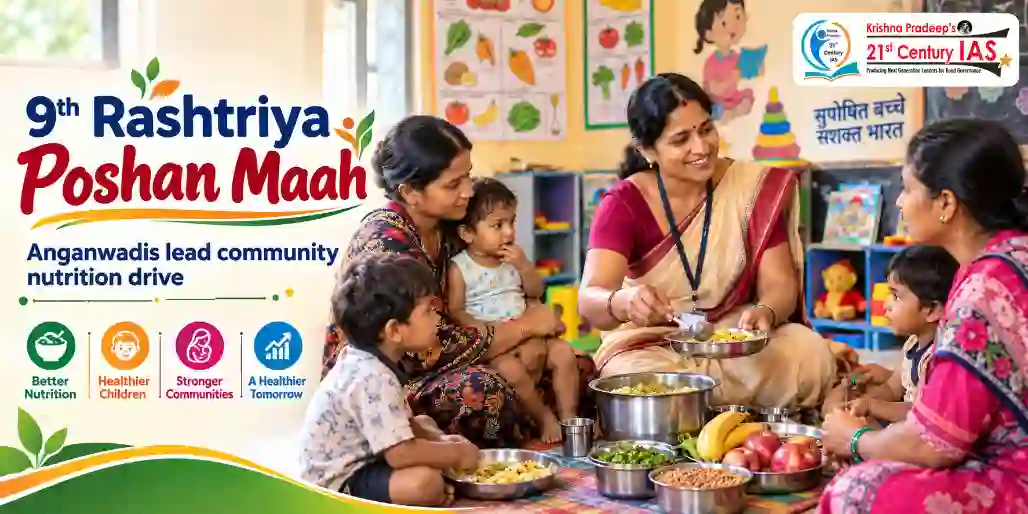
The 9th Rashtriya Poshan Maah was launched on September 9, 2026, at the Rudraksh International Cooperation and Convention Centre in Varanasi. Under the theme “Hamari Anganwadi, Hamari Jimmedari”, the campaign places Anganwadi Centres at the centre of community action for nutrition, caregiving and early childhood development.
Background
- Malnutrition affects physical growth, learning capacity, maternal health and future productivity. Addressing it requires coordinated action on food, health, sanitation, caregiving and social protection.
- The Government launched POSHAN Abhiyaan in March 2018 as a multi-ministerial convergence mission. It combines technology-based monitoring with community mobilisation and behavioural change.
- In the Union Budget 2021–22, major nutrition interventions were integrated under Mission Poshan 2.0, administered by the Ministry of Women and Child Development.
The mission brings together:
- POSHAN Abhiyaan: Digital monitoring, behavioural change and Jan Andolan.
- Anganwadi Services/ICDS: Supplementary nutrition, hot cooked meals and early childhood care.
- Scheme for Adolescent Girls: Nutritional support for eligible adolescent and out-of-school girls.
Rashtriya Poshan Maah is observed every September to mobilise communities around the objectives of Mission Poshan 2.0.
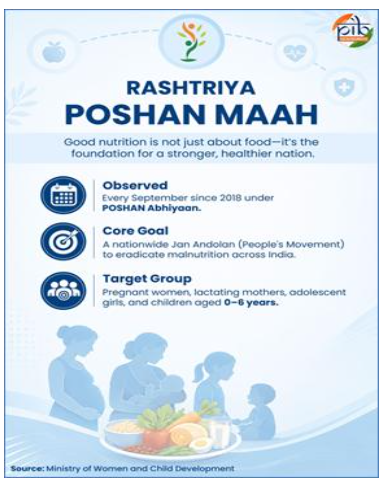
About the 9th Rashtriya Poshan Maah
- The 2026 campaign recognises Anganwadi Centres as the foundation of India’s community-based childcare and nutrition system.
- Its central theme calls upon families, local governments, community organisations and frontline workers to take collective responsibility for Anganwadi functioning.
The campaign is organised around five priorities:
- Dietary diversity and adequate protein
- Fresh and diverse hot cooked meals
- Community ownership and accountability
- Nutrition and early stimulation
- Ten years of the Pradhan Mantri Matru Vandana Yojana
Five Priority Themes
Dietary Diversity and Adequate Protein
- A balanced diet should include cereals and millets, pulses, fruits, vegetables, nuts, seeds, milk products and appropriate animal-source foods.
The campaign promotes affordable and locally available nutrition through:
- Recipe demonstrations at Anganwadi Centres
- Poshan Melas displaying local foods
- Awareness about plant- and animal-based protein
- Use of seasonal produce from Poshan Vatikas
- Counselling on complementary feeding
The objective is to move beyond calorie intake and improve the overall quality of household diets.
Fresh Hot Cooked Meals
The Supplementary Nutrition Programme provides nutrition support through Hot Cooked Meals and Take-Home Rations.
The campaign seeks to improve Hot Cooked Meals through:
- Weekly menu rotation
- Use of millets, pulses and seasonal vegetables
- Hygienic food preparation
- Quality testing in collaboration with FSSAI
- Community tasting sessions involving parents, Panchayats and Self-Help Groups
Fresh and acceptable meals can improve regular attendance and utilisation of Anganwadi services.
Community Ownership and Accountability
- The Ministry issued guidelines for Anganwadi Management Committees on June 23, 2026.
- Chaired by the Anganwadi Supervisor, these committees are expected to promote participatory oversight of nutrition and early childhood services.
Important measures include:
- Activation of AMCs at Anganwadi Centres
- At least one committee meeting during Poshan Maah
- Display of Supplementary Nutrition Programme menu boards
- Monitoring of meal quality, quantity and menu compliance
- Periodic social audits with Mothers’ Committees
Visible menu boards allow families to understand daily meals and beneficiary entitlements.
Nutrition and Early Stimulation
- Nutrition and responsive caregiving during the first 1,000 days are crucial for brain development. Undernutrition during this period can cause lasting cognitive, physical and socio-emotional effects.
- The revised Home Visit Scheduler contains a structured package covering 34 developmental milestones for children aged up to three years.
The campaign promotes:
- Caregiver counselling through home visits
- Early identification of developmental delays
- Referral to health facilities and Rashtriya Bal Swasthya Karyakram teams
- Implementation of Navchetna and Aadharshila curricula
- Age-appropriate learning and school readiness
This approach connects what a child eats with how the child learns and develops.
Ten Years of PMMVY
- The 2026 campaign commemorates ten years of the Pradhan Mantri Matru Vandana Yojana, India’s maternity-benefit programme.
- PMMVY supports maternal nutrition and health-seeking behaviour through income support during pregnancy.
The proposed campaign activities include:
- Saturation drives to identify eligible beneficiaries
- Faster verification and Direct Benefit Transfers
- Monitoring through PMMVY dashboards
- Awareness about eligibility, benefits and instalments
- Release of an implementation toolkit
- Dissemination of information in regional languages
Nutrition as a Jan Andolan
- POSHAN Abhiyaan treats nutrition as a Jan Andolan, or people’s movement, rather than only a government programme.
Community mobilisation seeks to improve behaviour related to:
- Maternal nutrition
- Infant and young child feeding
- Antenatal care
- Hand hygiene
- Growth monitoring
- Institutional healthcare
- Healthy household diets
Poshan Pakhwada 2026
- The two-week Poshan Pakhwada has been observed annually since 2018.
- Its eighth edition was held from April 9 to 23, 2026, under the theme “Maximising Brain Development in the First Six Years of Life.”
- Scientific evidence indicates that more than 85% of brain development occurs by six years of age, with the most rapid development taking place during the first 1,000 days.
Progress of Community Mobilisation
- The eighth Rashtriya Poshan Maah was launched in 2025 from Dhar, Madhya Pradesh, along with the Swasth Nari, Sashakt Parivar Abhiyaan.
- It focused on maternal nutrition, infant and young child feeding, early childhood education and reduction in excessive sugar and oil consumption. About 14.33 crore activities were conducted in convergence with more than 20 Ministries.
Poshan Tracker
Launched on March 1, 2021, the Poshan Tracker is the principal digital platform for monitoring Anganwadi infrastructure and service delivery.
It records:
- Opening of Anganwadi Centres
- Attendance of children
- Growth-monitoring activities
- Early childhood education activities
- Services for pregnant and lactating women
- Coverage of children and adolescent girls
Nutrition Infrastructure
As of July 31, 2026:
- India had nearly 13.99 lakh Anganwadi Centres.
- About 13.30 lakh Anganwadi Workers served at the grassroots.
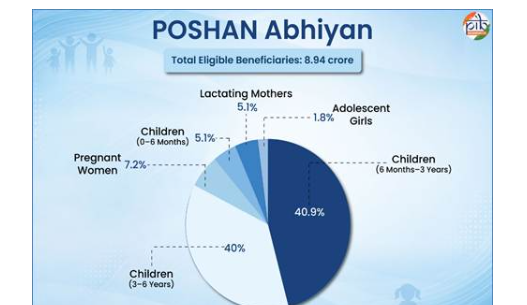
- The network covered approximately 8.94 crore beneficiaries.
- More than 7.2 crore children aged six months to six years received services.
- Pregnant and lactating women together accounted for nearly 1.1 crore beneficiaries.
Significance
Lifecycle Approach
The programme addresses nutrition from adolescence and pregnancy to infancy and early childhood, helping to break the intergenerational cycle of malnutrition.
Integration of Nutrition and Learning
Connecting nutrition with early stimulation recognises that cognitive development depends on both adequate food and responsive caregiving.
Localisation of Diets
Use of millets, pulses, seasonal vegetables and Poshan Vatika produce can make nutritious diets culturally acceptable and affordable.
Social Accountability
AMCs, Mothers’ Committees and menu boards allow communities to monitor entitlements and service quality.
Technology-Based Governance
The Poshan Tracker enables near real-time monitoring, beneficiary identification and administrative review.
Women’s Welfare
PMMVY combines income support with maternal health and nutrition, particularly during pregnancy and the first 1,000 days.
Challenges
- Poverty and food-price pressures restrict access to diverse diets.
- Protein-rich foods may remain unaffordable for vulnerable households.
- Anganwadi infrastructure and basic facilities vary across States.
- Vacancies and heavy workloads can reduce the quality of frontline services.
- Digital reporting may increase paperwork for Anganwadi Workers.
- Errors in beneficiary data can result in exclusion from services.
- Meal quality and Take-Home Ration standards are uneven.
- Social norms can lead to women eating last or receiving inadequate nutrition.
- Coordination among health, sanitation, education and food departments remains difficult.
- Awareness campaigns alone cannot overcome structural food insecurity.
Way Forward
- Upgrade Anganwadi buildings with safe kitchens, drinking water and sanitation.
- Fill frontline vacancies and provide continuous training to workers.
- Procure diverse foods locally through Panchayats, farmer groups and SHGs.
- Conduct independent testing of meals and Take-Home Rations.
- Use Poshan Tracker data for corrective action rather than only reporting.
- Strengthen convergence with healthcare, immunisation, sanitation and social-protection programmes.
- Institutionalise AMC meetings and community social audits.
- Ensure PMMVY saturation through simplified enrolment and timely transfers.
- Provide nutrition counselling in local languages.
- Monitor child-development milestones alongside height and weight.
Conclusion
Rashtriya Poshan Maah 2026 expands nutrition policy from food distribution to dietary quality, early learning and community accountability. Strengthened Anganwadi Centres, reliable data and timely maternal support can help convert public awareness into lasting improvements in human development.