Table of Contents
Relevance: : GS Paper III (Energy, Mining, Environment) | Telangana Economy | Coal Sector
For Prelims:
SCCL, Ramagundam, Opencast Mining, Underground Mining, Coal Grade G-10, Environmental Clearance, MoEFCC, EAC
For Mains:
Energy security, coal dependency, sustainable mining, environmental governance
Why in News?
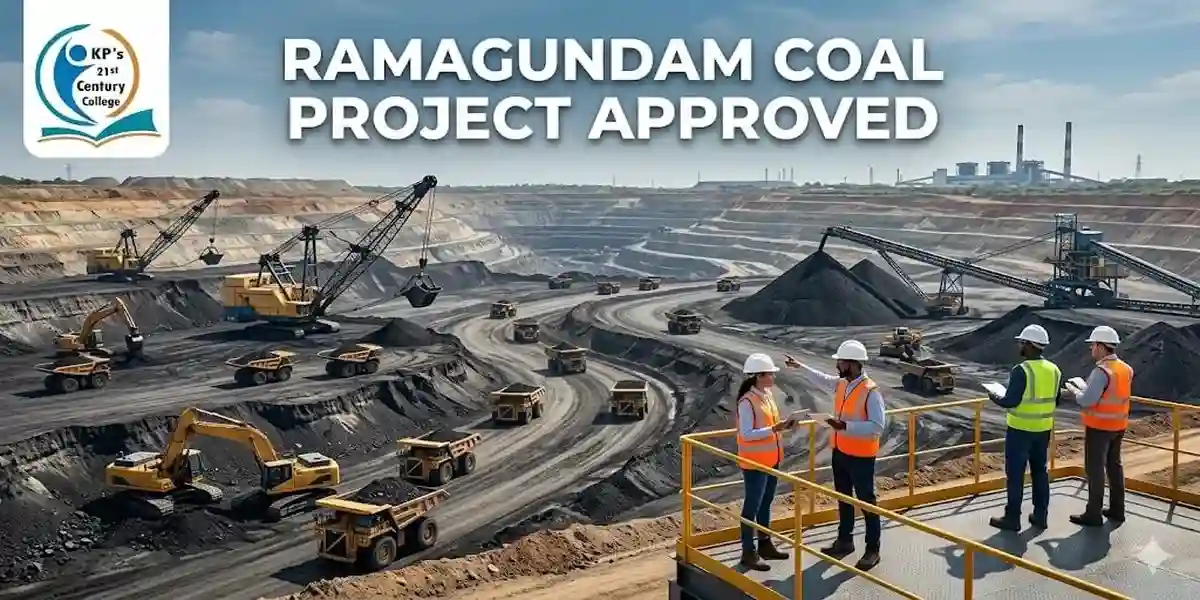
The Expert Appraisal Committee under the Ministry of Environment, Forest and Climate Change has recommended environmental clearance for the Ramagundam Integrated Coal Mine Project of Singareni Collieries Company Limited, located in Telangana.
Key Highlights
- The project has coal reserves of about 315 million tonnes and an annual production target of 21 million tonnes for a period of 25 years.
- It combines two opencast and three underground mines into a single integrated mining system. The coal will primarily supply thermal power plants such as NTPC Ramagundam.
Location and Resource
- The project is located in the Ramagundam coal belt of Peddapalli district in northern Telangana. This region lies in the Godavari Valley coalfields, which form part of the larger Gondwana coal deposits of India.
- The coalfields extend along the Godavari River basin and are known for non-coking coal reserves used in thermal power generation.
- Key regional linkage: Ramagundam is one of India’s major thermal power hubs due to proximity to coal reserves and water availability from the Godavari river.
Structure of the Integrated Mining Model
- The project combines multiple mining blocks into a unified operational system.
It includes:
- Two opencast mines for large-scale surface extraction
Three underground mines for deeper coal seams - A key feature is the conversion of exhausted underground mines into opencast mines to extract residual coal, ensuring maximum resource utilisation.
Coal Extraction Techniques: Opencast vs Underground
Feature | Opencast Mining | Underground Mining |
Depth | Shallow deposits | Deep deposits |
Method | Surface excavation | Tunnels/shafts |
Cost | Lower | Higher |
Environmental impact | High land disturbance | Lower surface impact |
Productivity | Higher | Lower |
The project uses both methods to optimise extraction efficiency and economic viability.
Technical Features of the Project
- The project has recoverable reserves of about 314.98 million tonnes.
- Coal extraction is divided into:
28 million tonnes through opencast mining
132.70 million tonnes through underground mining - The average coal grade is G-10, which is classified as non-coking coal suitable for thermal power generation.
- Mining methods include shovel-dumper techniques for opencast operations.
- The total land requirement is about 4,326 hectares.
Environmental Clearance Mechanism
- Environmental clearance for large projects is granted under the Environment Impact Assessment framework governed by the Ministry of Environment, Forest and Climate Change.
- The Expert Appraisal Committee evaluates:
Environmental impact
Forest diversion
Pollution and rehabilitation measures - Final approval ensures compliance with sustainability norms and mitigation strategies.
Role of Coal in India’s Energy Mix
Coal remains the dominant source of electricity generation in India, contributing around 70% of total power generation.
Thermal power plants such as NTPC Ramagundam depend heavily on nearby coal supply for base-load energy.
Despite renewable expansion, coal continues to be essential for grid stability and industrial energy demand.
Telangana Coal Economy
- Singareni Collieries Company Limited is a joint venture of the Government of Telangana and the Government of India.
- It operates in the Godavari Valley coalfields and is one of the few coal companies in India engaged in both underground and opencast mining.
- The Ramagundam region is one of its major production centres.
Significance of the Project
- The project is expected to compensate for declining output from older mines and extend the life of the Ramagundam coal belt.
- It ensures long-term fuel supply to thermal power plants and supports industrial growth in the region.
Way Forward
There is a need to balance coal extraction with environmental safeguards through afforestation, land reclamation, and adoption of cleaner mining technologies. Gradual integration with renewable energy systems is essential for sustainable energy transition.
Conclusion
The Ramagundam Integrated Coal Mine Project reflects India’s continued reliance on coal for energy security while highlighting the need for efficient and environmentally responsible mining practices.
CARE MCQ
Q. Consider the following statements:
- Ramagundam coalfields are part of Gondwana coal deposits.
- G-10 coal is primarily used for coking purposes.
- Opencast mining generally has higher environmental impact than underground mining.
Which of the statements given above are correct?
(a) 1 and 3 only
(b) 2 and 3 only
(c) 1 and 2 only
(d) 1, 2 and 3
Ans: (a)
Explanation:
Statement 1 is correct: The Ramagundam coalfields in Telangana belong to the Gondwana coal deposits, which are the major source of coal in India, formed during the Permian period.
Statement 2 is incorrect: G-10 coal is a grade of non-coking coal, primarily used for thermal power generation, not for coking (which is required in steel manufacturing).
Statement 3 is correct: Opencast mining involves removal of large areas of surface land, leading to deforestation, land degradation, and pollution, hence it generally has a higher environmental impact compared to underground mining.
Q.Consider the following statements regarding coal and its environmental impact:
Statement 1: India’s coal-fired power plants are significant global contributors to anthropogenic mercury emissions, disproportionate to their share of global coal consumption.
Statement 2: Indian coal is generally characterized by a higher concentration of mercury and other trace elements, coupled with a higher ash content, compared to the average global coal quality.
Which one of the following is correct in respect of the above statements?
a) Both Statement 1 and Statement 2 are correct and Statement 2 is the correct explanation for Statement 1
b) Both Statement 1 and Statement 2 are correct and Statement 2 is not the correct explanation for Statement 1
c) Statement 1 is correct but Statement 2 is incorrect
d) Statement 1 is incorrect but Statement 2 is correct
Ans: (a)
Explanation:
Statement 1 is correct: India’s coal-fired power plants are indeed a major source of global anthropogenic mercury emissions, often attributed to the specific characteristics of Indian coal. Statement 2 is also correct: Indian coal is well-known for its high ash content and, crucially, a higher concentration of various trace elements, including mercury, compared to coal from many other parts of the world.
Statement 2 directly explains Statement 1: the inherent higher mercury content in Indian coal is the primary reason why its combustion leads to significant mercury emissions, even if global consumption share might vary.
Q. Consider the following regulatory frameworks concerning mining operations in India:
- Environmental Impact Assessment Notification, 2006
- Forest (Conservation) Act, 1980
- Mines and Minerals (Development and Regulation) Act, 1957
- Mineral Conservation and Development Rules, 2017
Which of the frameworks listed above primarily govern the environmental clearance process and management of environmental impacts of mining operations?
a) 1, 2 and 3 only
b) 1, 2 and 4 only
c) 1, 3 and 4 only
d) 1, 2, 3 and 4
Ans: (b)
Explanation:
- The Environmental Impact Assessment (EIA) Notification, 2006, issued under the Environment (Protection) Act, 1986, mandates prior environmental clearance (EC) for all new projects, including mining, and expansion/modernization of existing projects. It details the process of EIA, public consultation, and appraisal by expert committees, making it central to the environmental clearance process.
- The Forest (Conservation) Act, 1980, requires prior approval of the Central Government for the diversion of forest land for non-forest purposes, including mining. The approval comes with conditions for compensatory afforestation and other environmental safeguards, effectively integrating environmental management into land-use change for mining.
- The Mines and Minerals (Development and Regulation) Act, 1957 (MMDR Act), is the principal act for mineral administration, granting of mining leases, and overall development of minerals. While it contains provisions that enable the Central Government to make rules for environmental protection (e.g., Section 18 mentions preventing pollution), its primary focus is not on the direct process of environmental clearance or detailed environmental impact management plans.
- These specific processes are primarily governed by other dedicated environmental laws or rules framed under it. The Mineral Conservation and Development Rules, 2017 (MCDR 2017), framed under the MMDR Act, specifically mandate the preparation and approval of mining plans and schemes, which include detailed environmental management plans, progressive mine closure plans, and provisions for land reclamation and rehabilitation during and after mining operations. Thus, they directly govern the management of environmental impacts. Therefore, statements 1, 2, and 4 primarily govern the environmental clearance process and management of environmental impacts, while the MMDR Act itself is more of an enabling framework for overall mineral development.
UPSC CARE MAINS:
Q.Coal remains indispensable for India’s energy security despite global decarbonisation commitments.”
Examine the challenges and opportunities associated with coal mining in India.
[250 Words]
FAQs
Q. Where is Ramagundam coal project located?
Ans: In Peddapalli district of Telangana in the Godavari Valley coalfields.
Q. What is G-10 coal?
Ans: It is non-coking coal used mainly in thermal power generation.
Q. What is opencast mining?
Ans: A method of extracting coal from surface deposits by removing overburden.
Q. Which company operates the project?
Ans: Singareni Collieries Company Limited (SCCL).