Table of Contents
Relevance: : GS Paper III – Internal Security | Space Technology | Cyber Security | International Relations
For Prelims:
Dual-use satellites, GPS spoofing, signal jamming, cyber warfare, Outer Space Treaty 1967, CERT-In guidelines, satellite constellations
For Mains:
space militarisation, cyber warfare in space, attribution problem, legal vacuum, civilian-military overlap, orbital dependency, secure-by-design, grey-zone conflict
Why in News?
- Recent global developments indicate that space warfare is no longer limited to physical destruction of satellites but increasingly involves cyber and electronic interference.
- Incidents such as cyberattacks on satellite communication networks and GPS spoofing have demonstrated how critical infrastructure can be disrupted without kinetic action.
- The growing reliance on satellites for communication, navigation, banking, governance, and military operations has made space systems highly strategic targets.
- The widespread use of dual-use satellites has blurred the distinction between civilian and military assets, creating legal and strategic ambiguity.
Concept of Dual-Use Satellites
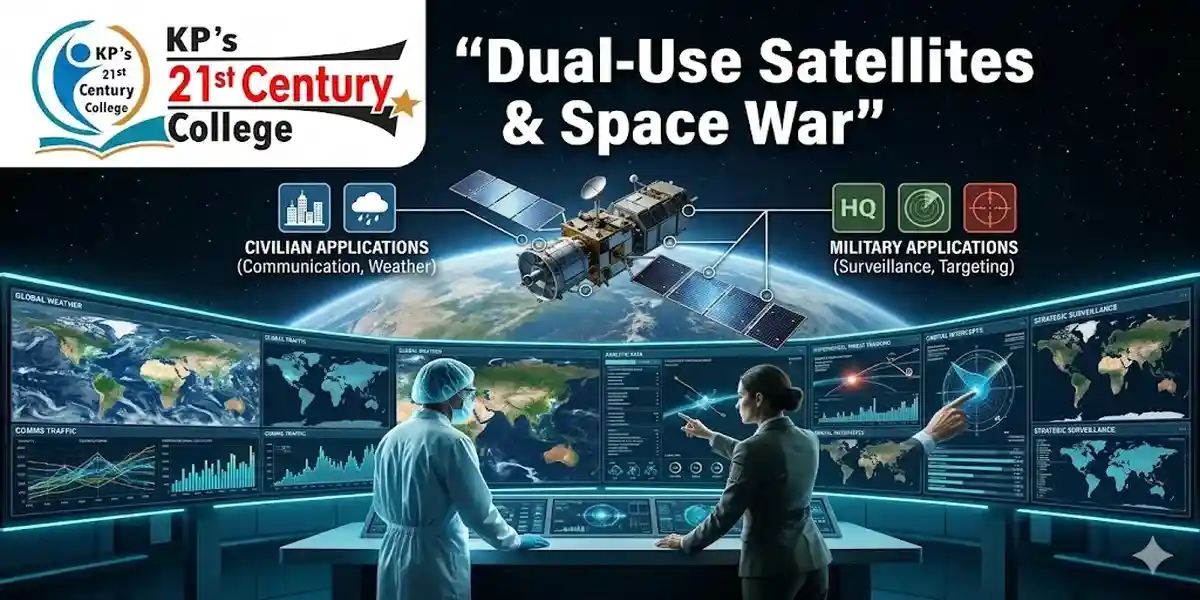
- Dual-use satellites are space assets that are designed for civilian purposes but can also be used for military applications.
- These satellites provide essential services such as communication, navigation, weather forecasting, surveillance, and remote sensing.
- The same satellite system can simultaneously support civilian users (such as airlines, shipping companies, telecom providers) and military users (for intelligence, surveillance, reconnaissance, and command operations).
- For example, GPS satellites guide civilian transport systems while also enabling precision targeting and navigation for military forces.
- This dual functionality creates a situation where any attack on such satellites can affect both civilian life and military operations.
Changing Nature of Space Warfare
- Traditional space warfare focused on kinetic actions such as anti-satellite missile tests aimed at physically destroying satellites.
- Modern space warfare has shifted towards non-kinetic methods that aim to disrupt, degrade, or manipulate satellite systems without causing visible physical damage.
- The objective is to create maximum disruption with minimum escalation, allowing states to avoid direct military confrontation.
- These operations are often covert, continuous, and difficult to detect, forming part of grey-zone warfare strategies.
- Instead of destroying satellites, adversaries aim to disable their functionality, thereby paralysing communication, navigation, and surveillance systems.
Tools and Techniques Used in Space Cyber Warfare
- Jamming refers to the deliberate blocking or interference of satellite signals, which disrupts communication and navigation services.
- Spoofing involves sending false signals to deceive systems, such as misleading GPS receivers into calculating incorrect positions.
- Cyberattacks on ground stations target the control infrastructure on Earth that operates satellites, allowing attackers to manipulate or shut down satellite functions.
- Signal interference degrades the quality and reliability of satellite transmissions, leading to system failures.
- Malware attacks can be introduced into satellite software systems, compromising their operations over time.
- These techniques are particularly dangerous because they do not leave physical evidence and can be executed remotely.
Case Study: KA-SAT Cyberattack
- In 2022, a cyberattack targeted the KA-SAT satellite network operated by Viasat.
- The attack disrupted satellite-based internet and communication services across multiple European countries.
- It affected both civilian infrastructure and military communication systems, demonstrating the vulnerability of dual-use satellite networks.
- The incident showed that cyberattacks can cause widespread disruption without physically damaging satellites.
- It highlighted the increasing importance of cybersecurity in space systems.
Legal Challenges (Outer Space Treaty & UN Charter)
- The Outer Space Treaty provides the basic legal framework for activities in outer space.
- It mandates that outer space should be used for peaceful purposes and prohibits the placement of weapons of mass destruction in orbit.
- However, the treaty does not explicitly address cyber operations or electronic interference in space systems.
- The United Nations Charter prohibits the “use of force” in international relations, but it is unclear whether cyberattacks on satellites fall under this definition.
- This creates a legal vacuum where states can engage in disruptive activities without clearly violating international law.
Attribution Problem in Cyber Space Warfare
- Attribution refers to the ability to identify the origin of an attack and the responsible actor.
- In cyber warfare, attackers can conceal their identity by using proxy servers, encrypted networks, and false digital signatures.
- Attacks can be routed through multiple jurisdictions, making it difficult to trace their source.
- This lack of clear attribution weakens deterrence, as states cannot easily respond or retaliate against attackers.
- It also complicates the enforcement of international law and accountability mechanisms.
Civilian-Military Blurring and Its Implications
- International humanitarian law is based on the principle of distinction, which requires separating civilian targets from military targets.
- Dual-use satellites challenge this principle because they serve both civilian and military functions simultaneously.
- An attack on such a satellite may be justified as a military necessity but can have severe consequences for civilian populations.
- Commercial satellite constellations providing services to militaries further blur the line between private and military assets.
- This creates ethical dilemmas and increases the risk of unintended escalation in conflicts.
India’s Response (CERT-In Guidelines 2026)
- India has introduced space cybersecurity guidelines through CERT-In in collaboration with industry stakeholders.
- These guidelines emphasize a “secure-by-design” approach, which integrates cybersecurity measures at every stage of the satellite lifecycle.
- They cover areas such as satellite communication security, ground station protection, risk assessment, and incident response mechanisms.
- The guidelines aim to enhance resilience against cyber threats and ensure the safety of India’s growing space infrastructure.
- However, challenges remain in real-time monitoring, detection of sophisticated cyberattacks, and attribution of threats
Implications for Global and National Security
- Modern societies are heavily dependent on satellite systems for communication, navigation, financial transactions, weather forecasting, and disaster management.
- Disruption of satellite systems can lead to widespread economic, administrative, and security crises.
- Developing countries are particularly vulnerable due to their dependence on foreign satellite infrastructure, a phenomenon known as orbital dependency.
- The increasing use of cyber tools in space warfare raises the risk of continuous low-intensity conflicts that remain below the threshold of war.
- This shifts global security dynamics towards persistent instability and strategic competition.
- Absence of clear international legal frameworks governing cyber operations in space.
- Difficulty in distinguishing between civilian and military space assets due to dual-use nature.
- Weak attribution mechanisms that allow attackers to operate anonymously.
- Rapid technological advancements outpacing policy and regulatory frameworks.
- Increasing involvement of private companies in space activities complicating accountability.
Way Forward
- Develop comprehensive international norms and agreements to regulate cyber activities in outer space.
- Update existing treaties like the Outer Space Treaty to include provisions for cyber warfare and dual-use challenges.
- Strengthen global cooperation in space cybersecurity, including information sharing and joint response mechanisms.
- Invest in resilient and redundant satellite systems to minimize the impact of disruptions.
- Promote secure-by-design principles across all space missions globally.
- Enhance India’s indigenous satellite capabilities to reduce dependence on external systems
Conclusion
The evolution of space warfare from kinetic destruction to cyber disruption marks a fundamental shift in global security dynamics. Dual-use satellites have blurred the distinction between civilian and military domains, creating complex legal and strategic challenges. Addressing these challenges requires a combination of technological innovation, legal reform, and international cooperation. Ensuring the security of space infrastructure is essential for maintaining stability in an increasingly interconnected and space-dependent world.
CARE MCQ
Q.Which of the following historical contexts primarily influenced the drafting and adoption of the 1967 Outer Space Treaty (OST)?
a) The Cold War rivalry between the United States and the Soviet Union, marked by the Space Race and concerns over the weaponization of outer space.
b) The rise of commercial space tourism and private ventures, necessitating international regulations to ensure safety and fair access.
c) Efforts by newly independent developing nations to ensure equitable access to space resources and technology.
d) The need to establish a framework for international cooperation on Mars exploration missions after the first successful probes.
Ans: (a)
Explanation:
The Outer Space Treaty (OST) was a direct outcome of the Cold War Space Race between the United States and the Soviet Union. Following the launch of Sputnik 1 in 1957, there were growing international concerns about the potential militarization of outer space and the spread of nuclear weapons beyond Earth. Both superpowers, while competing, recognized the mutual benefit of preventing an arms race in space and ensuring its peaceful exploration. This led to negotiations within the United Nations Committee on the Peaceful Uses of Outer Space (COPUOS) and ultimately the treaty’s opening for signature in 1967. The other options describe developments or concerns that either emerged much later or were not the primary driving forces behind the original treaty.
Q.Consider the following statements regarding collaborations and initiatives of National Aeronautics and Space Administration (NASA) with other space agencies:
- NASA and the European Space Agency (ESA) jointly developed and operate the James Webb Space Telescope.
- NASA collaborated with the Indian Space Research Organisation (ISRO) on the NISAR mission, which aims to study Earth’s land and ice surfaces.
- NASA partnered with Roscosmos, the Russian space agency, on the International Space Station until the suspension of cooperation in 2022.
- NASA’s Artemis Accords are a set of guidelines open to any country willing to adhere to them for the peaceful and cooperative exploration of outer space, including the Moon.
Which of the statements given above are correct?
a) 1 and 2 only
b) 1, 2 and 3 only
c) 1, 2 and 4 only
d) None of the above
Ans: (c)
Explanation:
Statement 1 is correct: The James Webb Space Telescope is an international collaboration between NASA, the European Space Agency (ESA), and the Canadian Space Agency (CSA). Statement 2 is correct: The NASA-ISRO Synthetic Aperture Radar (NISAR) is a joint Earth-observing mission to study changes in Earth’s land and ice surfaces using advanced radar imaging.
Statement 3 is incorrect: Despite geopolitical tensions in 2022, the core operational partnership between NASA and Roscosmos on the International Space Station (ISS) was not suspended; it was maintained to ensure crew safety and continued station operations. Statement 4 is correct: The Artemis Accords are a set of non-binding principles to guide civil space exploration, open to any nation willing to adhere to them for peaceful and cooperative purposes.
Q.Consider the following statements regarding the Outer Space Treaty (1967):
- It prohibits the national appropriation of outer space, including the Moon and other celestial bodies.
- It mandates that States shall not place in orbit around the Earth any objects carrying nuclear weapons or any other kinds of weapons of mass destruction.
- It establishes a binding framework for all States to share space technology and data with developing nations for peaceful purposes.
- It declares astronauts as ‘envoys of mankind’ and requires their assistance in case of distress.
a) Only one
b) Only two
c) Only three
d) All four
Ans: (c)
Explanation:
Statement 1 is correct: Article II of the Outer Space Treaty explicitly states that outer space, including the Moon and other celestial bodies, is not subject to national appropriation by claim of sovereignty, by means of use or occupation, or by any other means.
Statement 2 is correct: Article IV of the Treaty prohibits States Parties from placing in orbit around the Earth any objects carrying nuclear weapons or any other kinds of weapons of mass destruction, installing such weapons on celestial bodies, or stationing such weapons in outer space in any other manner.
Statement 3 is incorrect: While the Treaty promotes international cooperation in the exploration and use of outer space (Article I, Article IX), it does not establish a specific ‘binding framework for all States to share space technology and data with developing nations’ as a direct, explicit, legally binding provision within the treaty itself. Such detailed provisions are typically found in subsequent, more specific agreements or resolutions.
Statement 4 is correct: Article V of the Treaty designates astronauts as ‘envoys of mankind’ and requires States to render them all possible assistance in the event of accident, distress, or emergency landing on the territory of another State Party or on the high seas.
UPSC CARE MAINS
Q.“The increasing use of dual-use satellites is blurring the distinction between civilian and military domains in outer space, raising new challenges for global security and governance.”
Discuss with reference to emerging threats such as cyberattacks, GPS spoofing, and legal ambiguities in space warfare.[250 words]
FAQs
Q1. What are dual-use satellites?
Ans: Dual-use satellites are space systems that provide services for both civilian and military purposes simultaneously.
Q2. What is GPS spoofing?
Ans:GPS spoofing is a technique where false navigation signals are transmitted to mislead receivers about their actual location.
Q3. Why is attribution difficult in space cyber warfare?
Ans: Because attackers can hide their identity using proxy networks, encrypted systems, and multi-layered routing techniques.
Q4. What is the major legal gap in space warfare?
Ans: Existing international laws do not clearly define cyberattacks in space as acts of war, creating ambiguity.
Q5. Why is this topic important for UPSC?
Ans: It connects space technology, cybersecurity, and international law, which are key areas in GS Paper III.