Relevance: Paper I – General Studies – Current Affairs, Environment, Public Health, Government Policies and Law Enforcement.
For Prelims:
NCRB, Environment-related Offences, COTPA 2003, Cigarettes and Other Tobacco Products Act, Environment Protection Act 1986, Tobacco-law Violations, Operation Safe School, Global Adult Tobacco Survey 2017, Public Smoking Ban, Pictorial Health Warnings.
For Mains:
Public Health Enforcement, Tobacco Control, Environmental Offences, Youth Addiction, Law Enforcement, Preventable Deaths, Non-Communicable Diseases, School Safety, Regulatory Compliance.
Why in News?
The latest National Crime Records Bureau (NCRB) data shows that 95% of environment-related offences in Telangana during 2024 were linked to violations of tobacco laws.
Out of 591 environment-related offences registered in Telangana, 564 cases were registered under the Cigarettes and Other Tobacco Products Act (COTPA), 2003.
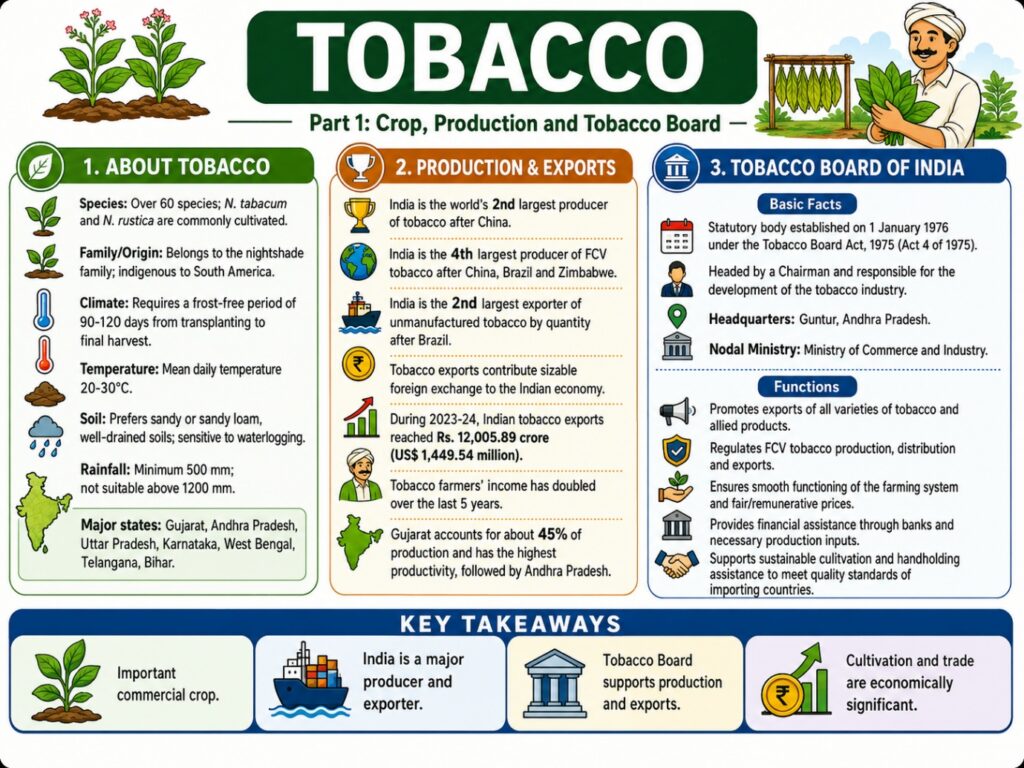
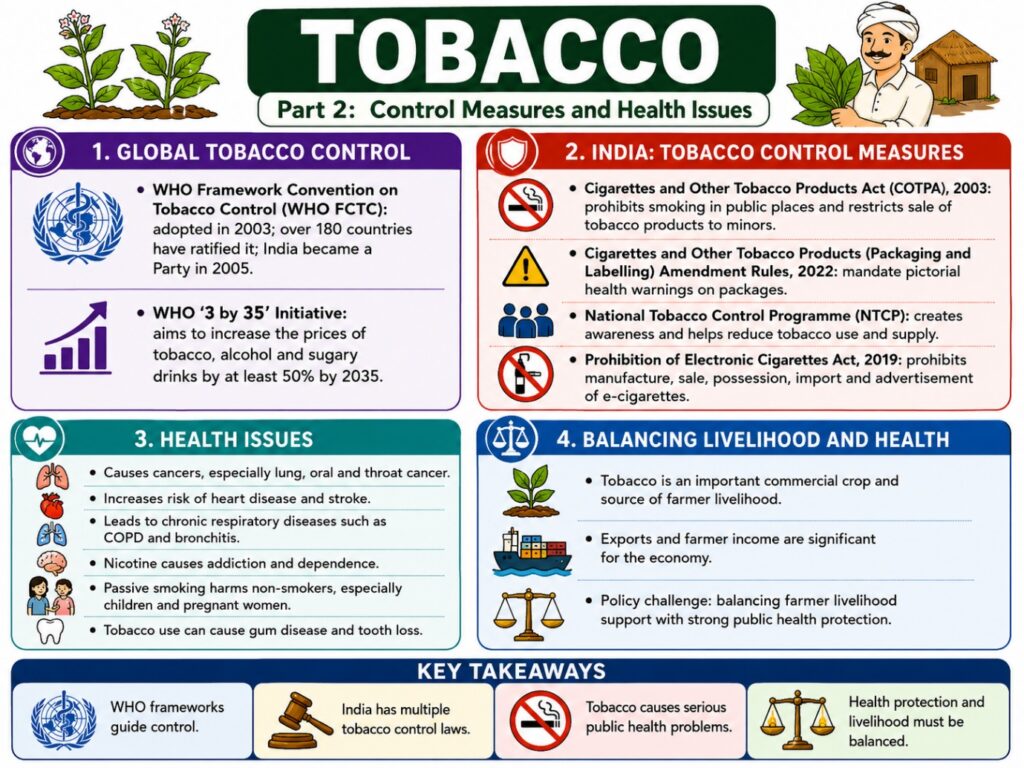
Major Provisions of COTPA, 2003
The Cigarettes and Other Tobacco Products Act, 2003 contains several rules to control tobacco use and protect public health.
Important provisions include:
- Ban on sale of tobacco products to persons below 18 years of age.
- Ban on sale of tobacco products near educational institutions within a 100-yard radius.
- Mandatory pictorial health warnings on all tobacco product packages sold in India.
- Prohibition of smoking in public places and workplaces.
Key Highlights of NCRB Data
- Telangana recorded 591 environment-related offences in 2024.
- Out of these, 564 cases were under COTPA, 2003.
- Only 27 cases were booked under the Environment Protection Act, 1986.
- Telangana reported zero cases under several major environmental laws.
- Telangana ranked sixth in India in environmental offences registered under COTPA in 2024.
Telangana’s Environment-related Offences
According to NCRB’s Environment Related Offences tables, tobacco-law violations formed the largest share of environment-related offences in Telangana.
The data shows that environmental offence registration in the state was overwhelmingly concentrated under COTPA.
Laws With Zero Cases in Telangana
Telangana reported zero cases under several major environmental laws, including:
- Forest Act
- Wildlife Protection Act
- Air Pollution Act
- Water Pollution Act
- Noise Pollution Rules
- National Green Tribunal Act
This shows that registered environment-related offences in Telangana were mainly tobacco-law related.
Comparison with Tamil Nadu
- Tamil Nadu recorded the highest number of COTPA-related environmental offences in the country in 2024.
- It registered 26,451 offences during the year.
- Telangana ranked sixth nationally in COTPA-related environmental offences.
Operation Safe School in Hyderabad
Hyderabad police recently carried out enforcement drives under Operation Safe School.
As part of the drive:
- Nearly 5,000 police personnel participated.
- Raids were conducted on 558 shops near schools and colleges.
- The raids covered Hyderabad city police limits.
- Multiple tobacco products were seized.
- Cases were registered against shops violating COTPA provisions.
The drive focused on pan shops accused of selling tobacco products to minors and operating near educational institutions.
Public Health Concerns
Tobacco use is a leading risk factor for cancer and several other non-communicable diseases.
It remains the single largest cause of preventable deaths globally.
According to the Global Adult Tobacco Survey, 2017, around 28.6% of Indians aged 15 years and above consume tobacco in some form.
Challenges
- High number of tobacco-law violations shows weak compliance.
- Sale of tobacco products near educational institutions remains a concern.
- Minors may be exposed to tobacco products through local shops.
- Enforcement requires continuous monitoring across city limits.
- Public reporting of violations needs active participation.
- Tobacco use remains linked to cancer, non-communicable diseases and preventable deaths.
Way Forward
- Continue strict enforcement of COTPA provisions.
- Monitor shops near schools and colleges regularly.
- Prevent sale of tobacco products to minors.
- Maintain special teams for continuous surveillance.
- Encourage the public to report violations.
- Strengthen action against shops operating within the prohibited 100-yard radius around educational institutions.
- Use NCRB data to identify enforcement gaps and improve public health protection.
Conclusion
The NCRB data shows that tobacco-law violations formed the largest share of environment-related offences in Telangana during 2024. The high number of cases under COTPA highlights the importance of strict enforcement, especially near educational institutions.
Tobacco control is not only a legal issue but also a public health priority. Strong enforcement, public reporting and continuous monitoring are necessary to protect students and reduce the health burden caused by tobacco use.
CARE MCQ
Q.Consider the following statements regarding the Tobacco Board of India:
- The Tobacco Board was established under the Tobacco Board Act, 1975.
- The headquarters of the Tobacco Board is located in Guntur, Andhra Pradesh.
Which of the statements given above is/are correct?
A. 1 only
B. 2 only
C. Both 1 and 2
D. Neither 1 nor 2
Answer: C
Explanation
- Statement 1 is correct: The Tobacco Board of India was established under the Tobacco Board Act, 1975 and came into existence on 1 January 1976.
- Statement 2 is correct: The headquarters of the Tobacco Board is located at Guntur, Andhra Pradesh.
Additional Information
- The Board functions under the Ministry of Commerce and Industry.
- It is headed by a Chairman.
- The Board is responsible for the development and regulation of the tobacco industry, especially FCV tobacco.
FAQs
Q.What is COTPA?
COTPA is the Cigarettes and Other Tobacco Products Act, 2003. It regulates tobacco products and aims to protect public health.
Q.What does COTPA prohibit?
It prohibits sale of tobacco products to minors, sale near educational institutions within 100 yards, and smoking in public places and workplaces.
Q.Which state recorded the highest COTPA-related offences?
Tamil Nadu recorded the highest number, with 26,451 offences in 2024.
Q.What is Operation Safe School?
Operation Safe School is a Hyderabad police drive against shops selling tobacco products to minors and operating near educational institutions.
Relevance:GS Paper III – Indian Economy, External Sector, Balance of Payments, Inflation, Energy Security
For Prelims:
- Forex Reserves, Liberalised Remittance Scheme, Current Account Deficit, Gold Monetisation Scheme, FII Outflows, Crude Oil Imports, Edible Oil Imports, Strait of Hormuz, Oil Marketing Companies, Natural Farming
For Mains:
External Sector Pressure, Import Dependence, Rupee Depreciation, Energy Security, Consumption Behaviour, Self-Reliance, Inflationary Pressure, Sustainable Lifestyle
Why in News?
Prime Minister Narendra Modi urged citizens to reduce spending on gold, petroleum products, edible oils, foreign travel and chemical fertilisers amid rising pressure on India’s foreign exchange reserves. The appeal came in the context of falling forex reserves, high crude oil prices due to the West Asia conflict, rising gold imports, high foreign travel spending under the Liberalised Remittance Scheme, and growing import dependence in key sectors.
External Sector Pressure on India
India’s external sector is facing pressure from several directions. Forex reserves reportedly fell by about $38 billion in two months since the onset of the West Asia conflict, reaching around $691 billion. At the same time, crude oil prices remained above $100 per barrel, adding pressure on India’s import bill.
The pressure is also visible in capital flows and currency movement. Foreign Institutional Investors sold heavily in Indian markets, with FII outflows of about ₹1.97 lakh crore during January–May. The rupee also weakened, falling below the 95 per US dollar level.
This situation has raised concerns because India depends heavily on imports for crude oil, gold, edible oils and fertiliser-related inputs. Higher imports require more dollars, which can weaken the rupee and widen the current account deficit.
PM’s Austerity and Self-Reliance Call
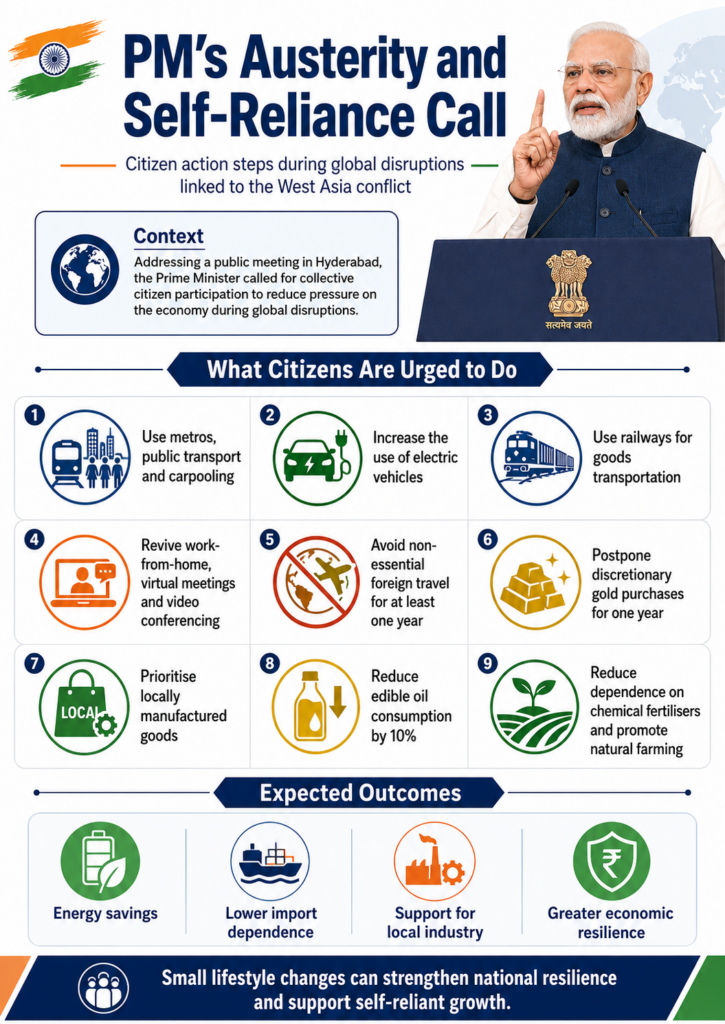
Addressing a public meeting in Hyderabad, the Prime Minister called for collective citizen participation during global disruptions caused by the West Asia conflict.
He urged citizens to:
- Use metros, public transport and carpooling
- Increase use of electric vehicles
- Use railways for goods transportation
- Revive work-from-home, virtual meetings and video conferencing
- Avoid non-essential foreign travel for at least one year
- Postpone discretionary gold purchases for a year
- Prioritise locally manufactured goods
- Reduce edible oil consumption by 10%
- Reduce dependence on chemical fertilisers and promote natural farming
The broader message was linked to foreign exchange conservation, self-reliance, and reduced dependence on imported goods.
Gold Imports and Forex Outflow
Gold has become a major source of foreign exchange outflow. India is not a major gold producer and imports most of its gold. Gold imports rose by about 24% to nearly $71.98 billion in 2025–26. In two years, the gold import bill almost doubled from about $35 billion in 2022–23 to around $72 billion in 2025–26.
India is the world’s second-largest gold consumer after China. The jewellery sector is a major driver of this demand. However, large household gold purchases increase dollar outflows and can add pressure on the current account deficit. India’s current account deficit stood at $13.2 billion, or 1.3% of GDP, in the December quarter.
There is also a distinction between RBI gold reserves and household gold imports. The RBI has added gold as part of reserve management, with gold reserves rising to about 880 tonnes by March 2026. Gold now forms about 16% of India’s forex reserves, compared with 10% earlier. But household gold imports directly increase dollar demand.
Switzerland remained the largest source of India’s gold imports, accounting for around 40%, followed by the UAE and South Africa. Imports from Switzerland rose to about $24.27 billion in 2025–26.
Gold Monetisation as a Solution
The News article highlights the need to unlock the value of idle household gold through the Gold Monetisation Scheme. Instead of keeping gold locked in homes and lockers, it can be brought into the formal economy. This can reduce imports, ease current account pressure and strengthen the financial system.
LRS, Foreign Travel and Tourism Imbalance
Another major source of foreign exchange outflow is overseas spending under the Liberalised Remittance Scheme. A large share of LRS outflows is linked to foreign travel.
Outward remittances under LRS stood at $29.56 billion in FY25, with travel accounting for more than half of the outflow at about $16.96 billion. In the first 11 months of FY26, LRS outflows remained high, with foreign travel accounting for nearly $15 billion, or about 57% of total LRS outgo.
The Prime Minister also pointed to the rising culture of foreign weddings, foreign vacations and overseas travel among the middle class. He urged citizens to postpone non-essential foreign travel during the present period of external pressure.
The tourism data also shows an imbalance. Indian national departures reached about 32.71 million in 2025, up from 30.89 million in 2024. In contrast, foreign tourist arrivals in India fell to about 9.02 million in 2025. Foreign exchange earnings from tourism stood at about ₹2.74 lakh crore, down from the previous year. Tourism remains important because it contributes to GDP and provides employment to crores of people.
Crude Oil and Petroleum Dependence
Crude oil is one of India’s biggest external vulnerabilities. India imports about 89% of its oil needs. With crude prices rising from around $70 per barrel to above $100 per barrel, India’s dollar outflow for oil imports increases sharply.
The West Asia conflict has created uncertainty around oil supply routes, especially the Strait of Hormuz. Even without a direct supply disruption, such uncertainty can keep oil prices high and volatile.
High crude prices affect India in three major ways:
- They widen the current account deficit
- They create inflationary pressure
- They increase losses or under-recoveries for oil marketing companies
State-owned oil marketing companies such as Indian Oil, Bharat Petroleum and Hindustan Petroleum are reportedly facing under-recoveries of about ₹30,000 crore per month on petrol, diesel and cooking gas. If prices are raised, the impact may spread through diesel-based freight transport and raise the prices of daily goods.
The Prime Minister therefore encouraged citizens to use public transport, metros, carpooling and EVs to reduce petroleum consumption.
Edible Oils and Fertilisers as Pressure Points
Edible oils are another major import-dependent category. India imports palm oil mainly from Indonesia and Malaysia, and sunflower oil from Russia and Ukraine. The Prime Minister urged households to reduce edible oil use by 10%, presenting it as both an economic and public health measure.
However, edible oil is a daily essential. Unlike gold, its consumption cannot be postponed easily. Domestic alternatives such as mustard oil exist, but they cannot immediately replace large imports. Regional food habits also make a quick shift difficult.
Fertilisers are another pressure point. The Prime Minister urged reduced use of chemical fertilisers and promotion of natural farming. Imported fertiliser prices have risen sharply. Urea prices rose from about $508 per tonne to $935 per tonne, while DAP and ammonia prices also increased significantly.
India’s fertiliser vulnerability is linked to West Asia. Around 75% of urea imports come from Gulf Cooperation Council countries. Domestic urea plants also depend on LNG, much of which comes from countries such as Qatar, UAE and Oman through the Strait of Hormuz. Any disruption can affect both fertiliser imports and domestic production.
For the coming kharif season, India needs about 19.4 million tonnes of urea, while available stocks in early April were only about 5.5 million tonnes. If supplies are not replenished, higher input costs may eventually increase food prices.
Additional Context from Hyderabad Speech
The Prime Minister also referred to recent election outcomes and political developments during the Hyderabad rally. He stated that Telangana had benefited from central government projects and said the State would develop along with the country. For exam purposes, however, the main relevance of the speech lies in its economic message on austerity, forex conservation, import reduction and self-reliance.
Significance
- External Sector Stability
Reducing unnecessary imports and foreign spending can help conserve foreign exchange reserves and reduce pressure on the rupee.
- Current Account Management
Lower gold, crude and edible oil imports can reduce pressure on the current account deficit.
- Inflation Control
Crude oil, fertilisers and edible oils directly affect transport, agriculture and food prices. Import cost reduction can help contain inflationary pressure.
- Energy Security
Lower petroleum dependence through EVs, public transport and work-from-home can improve energy security.
- Self-Reliance
The call to prefer local goods supports the broader idea of Vocal for Local and domestic manufacturing.
- Public Health Co-benefits
Reducing edible oil consumption and encouraging public transport can also support better health outcomes.
Challenges
- Gold has strong cultural and investment value in Indian households.
- Foreign travel has grown rapidly among the middle class.
- India’s crude oil import dependence is very high.
- Edible oil imports are difficult to reduce quickly due to daily consumption needs.
- Fertiliser supply is vulnerable to West Asian disruptions.
- Public behaviour change is difficult without incentives and awareness.
- Sudden fuel price hikes may increase inflation.
- Tourism imbalance remains a concern as outbound travel is rising faster than inbound arrivals.
Way Forward
- Strengthen and popularise the Gold Monetisation Scheme.
- Encourage public transport, metro use, carpooling and EV adoption.
- Promote responsible foreign travel and reduce non-essential overseas spending.
- Support local manufacturing through Vocal for Local.
- Reduce edible oil consumption through awareness and health campaigns.
- Promote natural farming and balanced fertiliser use.
- Improve domestic capacity in edible oils and fertilisers over time.
- Increase inbound tourism to improve foreign exchange earnings.
- Use work-from-home and virtual meetings where practical to reduce fuel use.
Conclusion
The Prime Minister’s austerity call reflects India’s concern over rising external sector pressure. High gold imports, crude oil dependence, LRS-linked foreign travel spending, edible oil imports and fertiliser vulnerabilities are increasing the demand for foreign currency.
A balanced response requires both citizen participation and structural reforms. Responsible consumption, local production, gold monetisation, energy conservation, EV adoption, natural farming and stronger domestic capacity can help India protect its forex reserves and strengthen economic resilience during global uncertainty.
CARE MCQ
Q.With reference to the Liberalised Remittance Scheme, consider the following statements:
- Overseas travel spending forms a major part of outward remittances under LRS.
- LRS outflows can affect India’s foreign exchange position.
- LRS is related only to domestic cash transactions.
How many of the above statements are correct?
A.Only one
B. Only two
C. All the three
D. None
Answer: B
Explanation:
- Statement 1 is correct: Foreign travel accounts for a large share of LRS outflows.
- Statement 2 is correct: Outward remittances involve foreign exchange outflows.
- Statement 3 is incorrect: LRS deals with remittances abroad, not only domestic cash transactions.
Additional Information:
The Prime Minister urged citizens to avoid non-essential foreign travel for a year to conserve foreign exchange.
FAQs
Q.Why did PM Modi call for austerity?
To conserve foreign exchange amid pressure from gold, crude oil, foreign travel and other imports.
Q.Why are gold imports a concern?
India imports most of its gold, causing large dollar outflows.
Q.What is Liberalised Remittance Scheme (LRS)?
It allows resident Indians to remit money abroad for permitted purposes, including travel.
Q.Why is crude oil important for India’s forex position?
India imports about 89% of its oil needs, so high crude prices increase dollar outflows.

Relevance: UPSC: GS Paper II – Governance, Welfare Schemes, Rural Development and Social Justice
For Prelims:
PMGSY, PMGSY-IV, PM-JANMAN, Rural Connectivity, All-weather Roads, Bhairunda, Sehore, Madhya Pradesh, Funding Pattern, OMMAS, e-MARG, PM Gati Shakti, Green Technology, NRIDA, PMGSY Gram Sadak Survey App, RCPLWEA.
For Mains:
Last-Mile Connectivity, Rural Transformation, Inclusive Development, Rural Infrastructure, Tribal Connectivity, Agricultural Market Access, Social Inclusion, Technology-driven Construction, Sustainable Road Development, Rural Prosperity.
Why in News?
Last-Mile Connectivity, Rural Transformation, Inclusive Development, Rural Infrastructure, Tribal Connectivity, Agricultural Market Access, Social Inclusion, Technology-driven Construction, Sustainable Road Development, Rural Prosperity.
What is PMGSY?
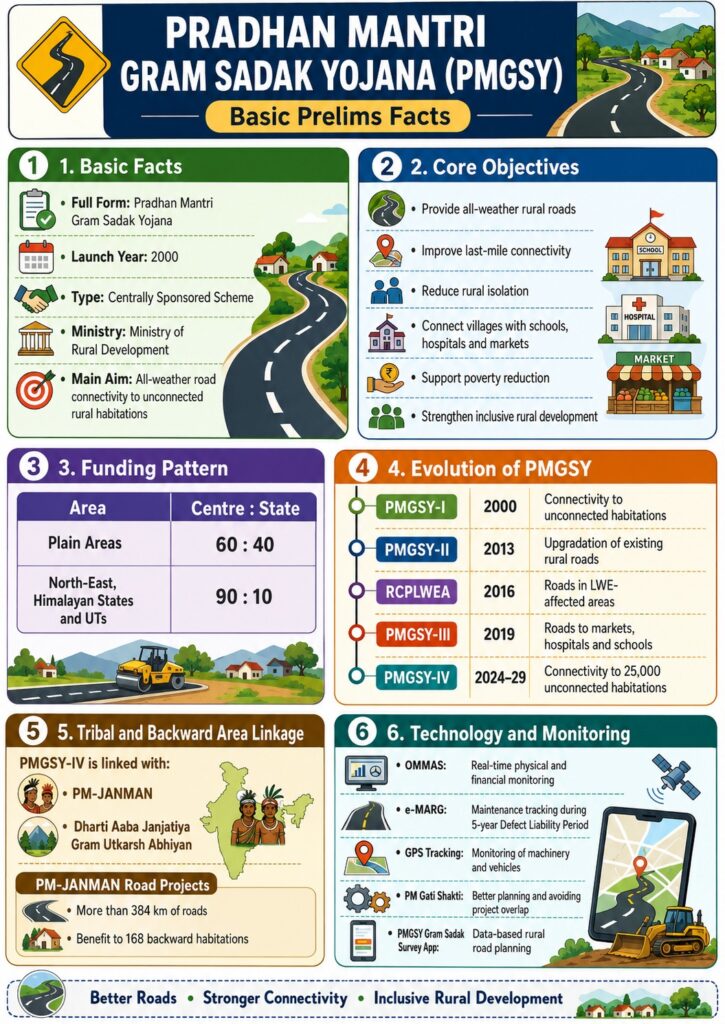
- Pradhan Mantri Gram Sadak Yojana (PMGSY) was launched in 2000.
- It is a Centrally Sponsored Scheme.
- Its main objective is to provide all-weather road connectivity to unconnected rural habitations.
- It is seen as an important scheme for poverty reduction, rural economic integration and last-mile development.
Funding Pattern
- PMGSY follows a Centre-State fund-sharing pattern.
- The usual fund-sharing ratio between the Centre and States is 60:40 for plain areas.
- For North-Eastern States, Himalayan States and Union Territories, the fund-sharing ratio is generally 90:10.
- This funding pattern supports States with difficult terrain and special geographical challenges.
- It helps in connecting unconnected rural habitations with durable, all-weather roads.
Silver Jubilee Celebrations
- The programme marked 25 years of PMGSY.
- It was presented not only as a government event, but also as a celebration of:
- Rural transformation
- Social inclusion
- Infrastructure expansion
- Last-mile connectivity
- Development reaching villages
- Outstanding States in rural road implementation were also to be honoured.
- The event also marked the beginning of a new phase of technology-driven rural road construction.
PM-JANMAN Road Projects
- Road projects under PM-JANMAN were also approved.
- These projects cover more than 384 km.
- They are expected to directly benefit 168 backward habitations.
- This shows special focus on vulnerable and backward habitations.
Financial Allocation for 2026–27
- A symbolic allocation of ₹18,907 crore was announced for PMGSY for the financial year 2026–27.
- Out of this, ₹830 crore was allocated for Madhya Pradesh.
- The allocation is expected to strengthen rural connectivity and improve access to:
- Economic activities
- Education
- Healthcare
- Agricultural markets
Village Roads as Pathways to Prosperity
- Rural roads are not only a means of transport.
- They are pathways to:
- Prosperity
- Education
- Healthcare
- Markets
- Employment
- Dignity
- The silver jubilee celebrations and launch of PMGSY-IV were described as a decisive step towards taking rural India to new heights of development.
Evolution of PMGSY
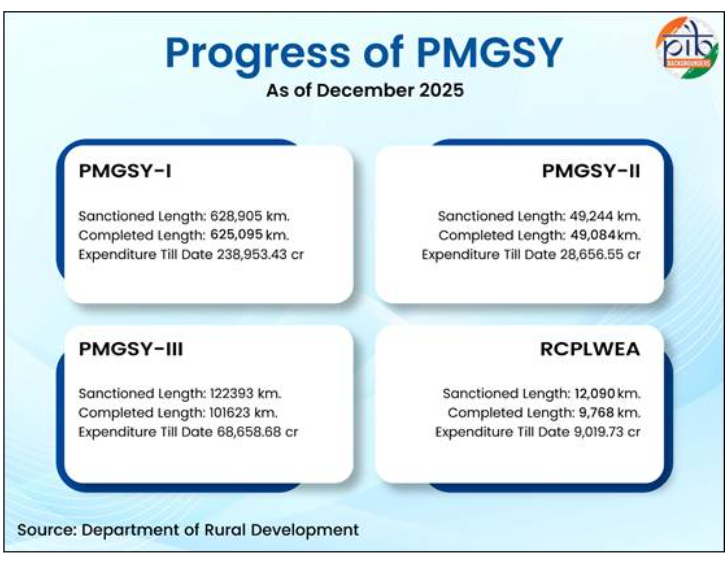
- PMGSY Phase-I, 2000: Focused on providing all-weather road connectivity to previously unconnected habitations.
- PMGSY Phase-II, 2013: Focused on upgrading and consolidating existing rural routes to improve connectivity with rural markets and service hubs.
- RCPLWEA, 2016: Focused on road connectivity in Left Wing Extremism affected areas. It aimed to improve both security mobility and socio-economic development.
- PMGSY Phase-III, 2019: Focused on upgrading “Through Routes” to connect habitations with agricultural markets, hospitals and higher secondary schools.
- PMGSY Phase-IV, 2024–29: Focuses on providing all-weather road connectivity to 25,000 unconnected rural habitations.
Key Features of PMGSY-IV
- PMGSY-IV covers the period 2024–25 to 2028–29.
- It aims to connect 25,000 unconnected rural habitations.
- It proposes construction of 62,500 km of rural roads.
- The total financial outlay is ₹70,125 crore.
- It covers unconnected habitations based on Census 2011 population criteria.
- It includes special focus on:
- Plain areas
- North-Eastern and Himalayan States/UTs
- Tribal areas
- Aspirational Districts and Blocks
- Desert areas
Convergence with Tribal Schemes
- PMGSY-IV is linked with:
- Dharti Aaba Janjatiya Gram Utkarsh Abhiyan
- PM-JANMAN
- This convergence aims to prioritise road connectivity for tribal and backward habitations.
- It supports the goal of inclusive development and last-mile delivery.
Technology and Quality Monitoring
- PMGSY follows a three-tier quality control system.
- First tier: Quality control by the State executing agency.
- Second tier: Independent monitoring by State Quality Monitors.
- Third tier: Independent National Quality Monitors appointed by NRIDA.
- OMMAS provides real-time monitoring of physical and financial progress.
- e-MARG tracks maintenance during the five-year Defect Liability Period.
- GPS-enabled tracking is used for machinery and vehicles in PMGSY works.
- The PMGSY Gram Sadak Survey App and PM Gati Shakti portal support data-driven planning and prevent infrastructure overlap.
Green Technology in Rural Road Construction
- PMGSY-IV gives importance to green technologies.
- These include:
- Waste plastic
- Cell-filled concrete
- Fly ash
- Cold mix technology
- Full Depth Reclamation
- Bio-engineering methods
- These technologies help reduce carbon footprint and make rural roads more sustainable.
Significance
- Strengthens last-mile rural connectivity.
- Improves access to schools, hospitals, markets and employment opportunities.
- Supports farmers by improving access to agricultural markets.
- Helps reduce rural isolation and strengthens rural economic integration.
- Connects tribal, backward and remote habitations.
- Supports development in Left Wing Extremism affected areas.
- Encourages sustainable road construction through green technologies.
- Improves transparency and quality through digital monitoring.
- Promotes the idea that rural roads are linked with dignity and inclusive development.
Challenges
- Ensuring durable road quality in diverse terrains.
- Maintaining roads after construction.
- Connecting hilly, tribal, remote and backward habitations.
- Completing road and bridge works on time.
- Ensuring effective use of green technologies.
- Avoiding duplication of infrastructure projects.
- Strengthening coordination between Centre, States and local agencies.
- Ensuring that roads lead to real improvements in education, health, markets and livelihoods.
Way Forward
- Strengthen quality monitoring through OMMAS, e-MARG and GPS tracking.
- Improve maintenance of rural roads after construction.
- Use PM Gati Shakti for better planning and coordination.
- Promote green technologies in road construction.
- Prioritise tribal, backward and remote habitations.
- Ensure convergence with PM-JANMAN and tribal welfare schemes.
- Link rural roads with schools, health centres, agricultural markets and employment hubs.
- Replicate best practices from well-performing States.
Conclusion
PMGSY has completed 25 years as one of India’s most important rural infrastructure programmes. It has helped transform village roads into pathways of prosperity, education, healthcare, markets, employment and dignity.
The launch of PMGSY-IV marks a renewed commitment to last-mile rural connectivity. With technology-driven construction, green methods and convergence with tribal welfare initiatives, PMGSY-IV can strengthen rural transformation and inclusive development in the coming years.
UPSC PYQ
Q. Which of the following statements about the Pradhan Mantri Gram Sadak Yojana are correct? (CDS-I/2021)
- It is part of Government of India’s poverty reduction strategy.
- It is a Centrally Sponsored Scheme for rural development.
- It provides connectivity in rural areas.
Select the correct answer using the code given below:
A. 1, 2 and 3
B. 1 and 3 only
C. 2 and 3 only
D. 1 and 2 only
Answer: A. 1, 2 and 3
Explanation
- Statement 1 is correct: PMGSY is linked with the Government of India’s poverty reduction strategy because rural roads improve access to markets, schools, health centres and employment opportunities.
- Statement 2 is correct: PMGSY is a Centrally Sponsored Scheme for rural development.
- Statement 3 is correct: The main objective of PMGSY is to provide all-weather road connectivity to unconnected rural habitations.
Additional Information
Pradhan Mantri Gram Sadak Yojana (PMGSY) was launched in 2000. It plays an important role in rural transformation by connecting villages with basic services, markets and livelihood opportunities. It helps reduce rural isolation and supports inclusive development.
CARE MCQ
Q.Which one of the following initiatives was associated with the approval of road projects benefiting backward habitations during the launch of PMGSY-IV?
A. PM-KUSUM
B. PM Gati Shakti
C. PM-JANMAN
D. PM MITRA
Answer:
Explanation:
- During the launch of PMGSY-IV, road projects covering backward habitations were approved under the PM-JANMAN initiative.
- These projects aim to improve last-mile rural connectivity and inclusion.
Additional Information:
- PMGSY stands for Pradhan Mantri Gram Sadak Yojana
- PMGSY focuses on all-weather rural road connectivity
- PM-JANMAN targets development of Particularly Vulnerable Tribal Groups (PVTGs) and backward habitations
FAQs
Q. What is PMGSY?
Pradhan Mantri Gram Sadak Yojana (PMGSY) is a Centrally Sponsored Scheme launched in 2000 to provide all-weather road connectivity to unconnected rural habitations.
Q. Why is PMGSY in news?
PMGSY is in news because its 25-year Silver Jubilee celebrations and the national launch of PMGSY-IV were held at Bhairunda in Sehore district of Madhya Pradesh.
Q.What is the main objective of PMGSY-IV?
PMGSY-IV aims to connect 25,000 unconnected rural habitations and construct 62,500 km of rural roads with a total outlay of ₹70,125 crore.
Q. How is PMGSY-IV linked with tribal development?
PMGSY-IV is linked with PM-JANMAN and Dharti Aaba Janjatiya Gram Utkarsh Abhiyan to improve road connectivity for tribal, backward and vulnerable habitations.
Q.Why is PMGSY important for rural development?
PMGSY improves access to schools, hospitals, markets, employment opportunities and welfare services. It helps reduce rural isolation and promotes inclusive development.