Table of Contents
Relevance: UPSC: GS Paper II – Governance, Welfare Schemes, Rural Development and Social Justice
For Prelims:
PMGSY, PMGSY-IV, PM-JANMAN, Rural Connectivity, All-weather Roads, Bhairunda, Sehore, Madhya Pradesh, Funding Pattern, OMMAS, e-MARG, PM Gati Shakti, Green Technology, NRIDA, PMGSY Gram Sadak Survey App, RCPLWEA.
For Mains:
Last-Mile Connectivity, Rural Transformation, Inclusive Development, Rural Infrastructure, Tribal Connectivity, Agricultural Market Access, Social Inclusion, Technology-driven Construction, Sustainable Road Development, Rural Prosperity.
Why in News?
Last-Mile Connectivity, Rural Transformation, Inclusive Development, Rural Infrastructure, Tribal Connectivity, Agricultural Market Access, Social Inclusion, Technology-driven Construction, Sustainable Road Development, Rural Prosperity.
What is PMGSY?
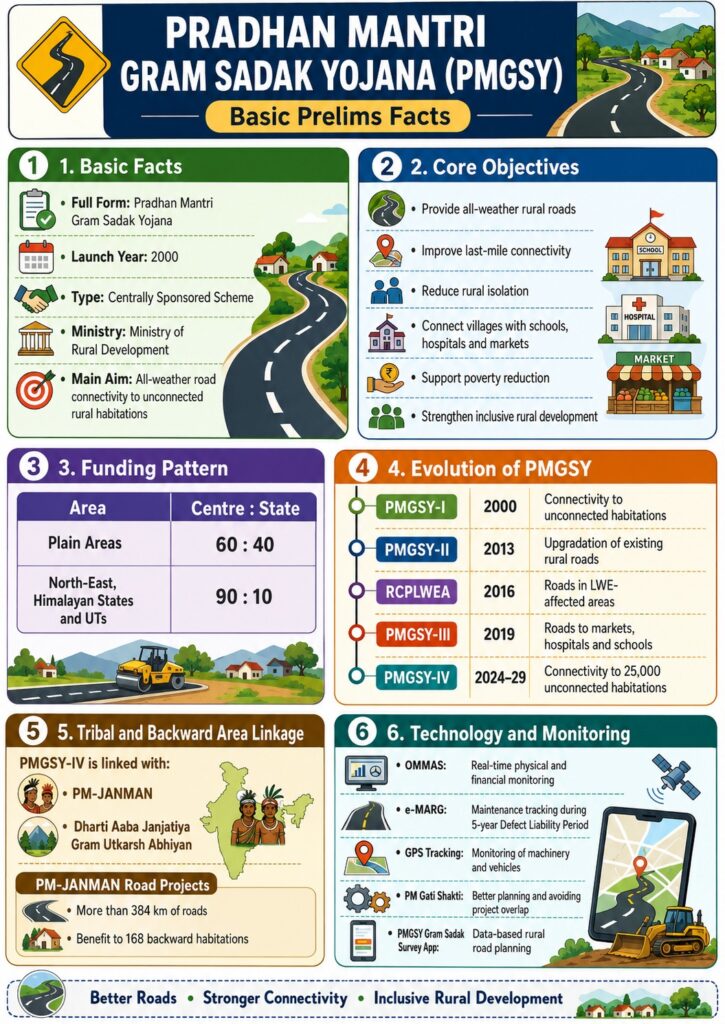
- Pradhan Mantri Gram Sadak Yojana (PMGSY) was launched in 2000.
- It is a Centrally Sponsored Scheme.
- Its main objective is to provide all-weather road connectivity to unconnected rural habitations.
- It is seen as an important scheme for poverty reduction, rural economic integration and last-mile development.
Funding Pattern
- PMGSY follows a Centre-State fund-sharing pattern.
- The usual fund-sharing ratio between the Centre and States is 60:40 for plain areas.
- For North-Eastern States, Himalayan States and Union Territories, the fund-sharing ratio is generally 90:10.
- This funding pattern supports States with difficult terrain and special geographical challenges.
- It helps in connecting unconnected rural habitations with durable, all-weather roads.
Silver Jubilee Celebrations
- The programme marked 25 years of PMGSY.
- It was presented not only as a government event, but also as a celebration of:
- Rural transformation
- Social inclusion
- Infrastructure expansion
- Last-mile connectivity
- Development reaching villages
- Outstanding States in rural road implementation were also to be honoured.
- The event also marked the beginning of a new phase of technology-driven rural road construction.
PM-JANMAN Road Projects
- Road projects under PM-JANMAN were also approved.
- These projects cover more than 384 km.
- They are expected to directly benefit 168 backward habitations.
- This shows special focus on vulnerable and backward habitations.
Financial Allocation for 2026–27
- A symbolic allocation of ₹18,907 crore was announced for PMGSY for the financial year 2026–27.
- Out of this, ₹830 crore was allocated for Madhya Pradesh.
- The allocation is expected to strengthen rural connectivity and improve access to:
- Economic activities
- Education
- Healthcare
- Agricultural markets
Village Roads as Pathways to Prosperity
- Rural roads are not only a means of transport.
- They are pathways to:
- Prosperity
- Education
- Healthcare
- Markets
- Employment
- Dignity
- The silver jubilee celebrations and launch of PMGSY-IV were described as a decisive step towards taking rural India to new heights of development.
Evolution of PMGSY
- PMGSY Phase-I, 2000: Focused on providing all-weather road connectivity to previously unconnected habitations.
- PMGSY Phase-II, 2013: Focused on upgrading and consolidating existing rural routes to improve connectivity with rural markets and service hubs.
- RCPLWEA, 2016: Focused on road connectivity in Left Wing Extremism affected areas. It aimed to improve both security mobility and socio-economic development.
- PMGSY Phase-III, 2019: Focused on upgrading “Through Routes” to connect habitations with agricultural markets, hospitals and higher secondary schools.
- PMGSY Phase-IV, 2024–29: Focuses on providing all-weather road connectivity to 25,000 unconnected rural habitations.
Key Features of PMGSY-IV
- PMGSY-IV covers the period 2024–25 to 2028–29.
- It aims to connect 25,000 unconnected rural habitations.
- It proposes construction of 62,500 km of rural roads.
- The total financial outlay is ₹70,125 crore.
- It covers unconnected habitations based on Census 2011 population criteria.
- It includes special focus on:
- Plain areas
- North-Eastern and Himalayan States/UTs
- Tribal areas
- Aspirational Districts and Blocks
- Desert areas
Convergence with Tribal Schemes
- PMGSY-IV is linked with:
- Dharti Aaba Janjatiya Gram Utkarsh Abhiyan
- PM-JANMAN
- This convergence aims to prioritise road connectivity for tribal and backward habitations.
- It supports the goal of inclusive development and last-mile delivery.
Technology and Quality Monitoring
- PMGSY follows a three-tier quality control system.
- First tier: Quality control by the State executing agency.
- Second tier: Independent monitoring by State Quality Monitors.
- Third tier: Independent National Quality Monitors appointed by NRIDA.
- OMMAS provides real-time monitoring of physical and financial progress.
- e-MARG tracks maintenance during the five-year Defect Liability Period.
- GPS-enabled tracking is used for machinery and vehicles in PMGSY works.
- The PMGSY Gram Sadak Survey App and PM Gati Shakti portal support data-driven planning and prevent infrastructure overlap.
Green Technology in Rural Road Construction
- PMGSY-IV gives importance to green technologies.
- These include:
- Waste plastic
- Cell-filled concrete
- Fly ash
- Cold mix technology
- Full Depth Reclamation
- Bio-engineering methods
- These technologies help reduce carbon footprint and make rural roads more sustainable.
Significance
- Strengthens last-mile rural connectivity.
- Improves access to schools, hospitals, markets and employment opportunities.
- Supports farmers by improving access to agricultural markets.
- Helps reduce rural isolation and strengthens rural economic integration.
- Connects tribal, backward and remote habitations.
- Supports development in Left Wing Extremism affected areas.
- Encourages sustainable road construction through green technologies.
- Improves transparency and quality through digital monitoring.
- Promotes the idea that rural roads are linked with dignity and inclusive development.
Challenges
- Ensuring durable road quality in diverse terrains.
- Maintaining roads after construction.
- Connecting hilly, tribal, remote and backward habitations.
- Completing road and bridge works on time.
- Ensuring effective use of green technologies.
- Avoiding duplication of infrastructure projects.
- Strengthening coordination between Centre, States and local agencies.
- Ensuring that roads lead to real improvements in education, health, markets and livelihoods.
Way Forward
- Strengthen quality monitoring through OMMAS, e-MARG and GPS tracking.
- Improve maintenance of rural roads after construction.
- Use PM Gati Shakti for better planning and coordination.
- Promote green technologies in road construction.
- Prioritise tribal, backward and remote habitations.
- Ensure convergence with PM-JANMAN and tribal welfare schemes.
- Link rural roads with schools, health centres, agricultural markets and employment hubs.
- Replicate best practices from well-performing States.
Conclusion
PMGSY has completed 25 years as one of India’s most important rural infrastructure programmes. It has helped transform village roads into pathways of prosperity, education, healthcare, markets, employment and dignity.
The launch of PMGSY-IV marks a renewed commitment to last-mile rural connectivity. With technology-driven construction, green methods and convergence with tribal welfare initiatives, PMGSY-IV can strengthen rural transformation and inclusive development in the coming years.
UPSC PYQ
Q. Which of the following statements about the Pradhan Mantri Gram Sadak Yojana are correct? (CDS-I/2021)
- It is part of Government of India’s poverty reduction strategy.
- It is a Centrally Sponsored Scheme for rural development.
- It provides connectivity in rural areas.
Select the correct answer using the code given below:
A. 1, 2 and 3
B. 1 and 3 only
C. 2 and 3 only
D. 1 and 2 only
Answer: A. 1, 2 and 3
Explanation
- Statement 1 is correct: PMGSY is linked with the Government of India’s poverty reduction strategy because rural roads improve access to markets, schools, health centres and employment opportunities.
- Statement 2 is correct: PMGSY is a Centrally Sponsored Scheme for rural development.
- Statement 3 is correct: The main objective of PMGSY is to provide all-weather road connectivity to unconnected rural habitations.
Additional Information
Pradhan Mantri Gram Sadak Yojana (PMGSY) was launched in 2000. It plays an important role in rural transformation by connecting villages with basic services, markets and livelihood opportunities. It helps reduce rural isolation and supports inclusive development.
CARE MCQ
Q.Which one of the following initiatives was associated with the approval of road projects benefiting backward habitations during the launch of PMGSY-IV?
A. PM-KUSUM
B. PM Gati Shakti
C. PM-JANMAN
D. PM MITRA
Answer:
Explanation:
- During the launch of PMGSY-IV, road projects covering backward habitations were approved under the PM-JANMAN initiative.
- These projects aim to improve last-mile rural connectivity and inclusion.
Additional Information:
- PMGSY stands for Pradhan Mantri Gram Sadak Yojana
- PMGSY focuses on all-weather rural road connectivity
- PM-JANMAN targets development of Particularly Vulnerable Tribal Groups (PVTGs) and backward habitations
FAQs
Q. What is PMGSY?
Pradhan Mantri Gram Sadak Yojana (PMGSY) is a Centrally Sponsored Scheme launched in 2000 to provide all-weather road connectivity to unconnected rural habitations.
Q. Why is PMGSY in news?
PMGSY is in news because its 25-year Silver Jubilee celebrations and the national launch of PMGSY-IV were held at Bhairunda in Sehore district of Madhya Pradesh.
Q.What is the main objective of PMGSY-IV?
PMGSY-IV aims to connect 25,000 unconnected rural habitations and construct 62,500 km of rural roads with a total outlay of ₹70,125 crore.
Q. How is PMGSY-IV linked with tribal development?
PMGSY-IV is linked with PM-JANMAN and Dharti Aaba Janjatiya Gram Utkarsh Abhiyan to improve road connectivity for tribal, backward and vulnerable habitations.
Q.Why is PMGSY important for rural development?
PMGSY improves access to schools, hospitals, markets, employment opportunities and welfare services. It helps reduce rural isolation and promotes inclusive development.