Table of Contents
Relevance: UPSC GS Paper II – Governance, Government Policies and Local Self-Governance; GS Paper III – Water Resources, Agriculture, Environment and Disaster Management
For Prelims:
- Water Budgeting, Atal Bhujal Yojana, National Water Mission, Varuni Web Application, Jal Shakti Abhiyan, Jal Shakti se Jal Shakti, Participatory Water Governance, Groundwater Recharge, Watershed Management, Gram Sabha,
For Mains:
- Rural water governance, participatory water budgeting, demand-side water management, groundwater depletion, climate-resilient water planning, community-led conservation, water-energy-food nexus, agricultural water demand
Why in News?
The Ministry of Jal Shakti highlighted the importance of water governance in rural India through the idea of participatory water budgeting.Water budgeting is becoming important because India faces rising water demand, uneven water distribution, climate variability, groundwater depletion and increasing pressure from agriculture, domestic use and livestock.The article highlights how community-led planning, supported by schemes such as Atal Bhujal Yojana, National Water Mission, State initiatives and digital tools such as the Varuni Web Application, can improve rural water governance
What is Water Budgeting?
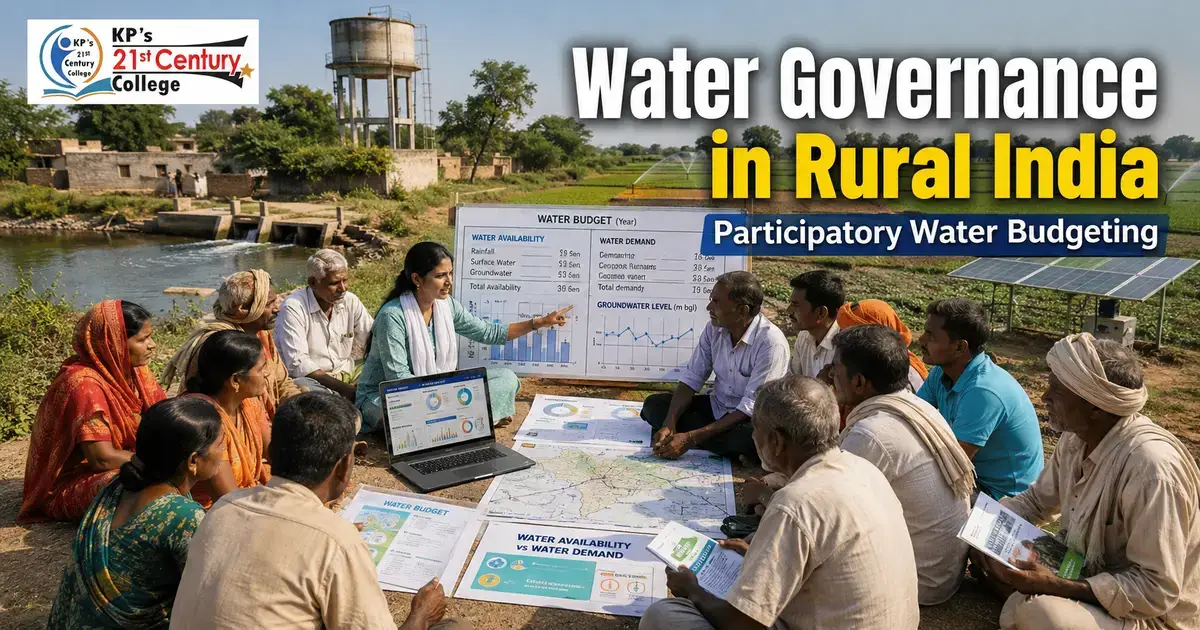
Water budgeting is a systematic assessment of water availability and water demand within a defined geographical unit.This unit may be a village, watershed, block or district.
It compares:
- How much water is available, How much water is needed, Which sectors use water Whether the area has surplus water or water deficit, What actions are needed to manage water better
Need for Water Budgeting in Rural India
- Water budgeting is needed because rural India depends heavily on agriculture and groundwater.
- Agriculture accounts for around 80 to 90 percent of water use in rural areas. Livestock also creates significant water demand for drinking, fodder production and related activities.
Many rural areas face:
- Declining groundwater levels, Seasonal water shortages, uneven rainfall,Droughts and floods, Conflicts over water allocation, Unsuitable cropping patterns, Over-dependence on borewells
Therefore, India needs to move from a supply-driven approach to a demand-based and planned water management system.
Water Resource Dynamics in India
- India has a large population and a large livestock base. It has about 17.5 percent of the global population and around 11.6 percent of the world’s livestock.
- This creates significant pressure on available water resources.
- The average annual water availability depends on rainfall, geology, rivers, aquifers and climate. But per capita water availability depends on population size.
- As population increases, the amount of water available per person declines.
- Climate variability further increases the problem. Some areas may face floods, while others may face droughts in the same season. This makes local-level planning necessary.
Water Availability Includes:
- Rainfall, Surface inflows, Groundwater recharge, Water received from other geographical areas, Stored water in tanks, ponds and reservoirs
Water Demand Includes:
- Drinking water demand, Domestic water demand, Irrigation water demandLivestock water demand, Industrial water demand,Environmental water needs
Water Losses Include:
- Evapotranspiration, Runoff, Groundwater discharge, Leakage, Inefficient irrigation losses
After calculating these elements, the community can identify whether the area is facing a water surplus or water deficit.This helps in choosing suitable crops, planning irrigation, restoring water bodies and regulating groundwater use.
Role in Agriculture and Livestock Management
- Water budgeting is highly useful for agriculture because crop choices must match local water availability.
- If farmers grow water-intensive crops in water-scarce areas, groundwater depletion increases. This creates long-term risk for agriculture.
Water budgeting helps farmers in:
- Selecting suitable crops, Planning sowing based on local water conditions, reducing water-intensive crops in dry regions, promoting drip and sprinkler irrigation, improving productivity with efficient water use,Reducing crop failure risk during droughts
Livestock is also an important part of rural water demand. The livestock census showed an increase in livestock population, which means drinking water and fodder-related water demand also increase.
Therefore, water budgeting must include both agriculture and livestock demand.
Government Initiatives
1. Atal Bhujal Yojana
- The Atal Bhujal Yojana was launched in 2019 to promote community-led groundwater management.
- It focuses on water budgeting at the Gram Panchayat level. The programme is implemented in selected groundwater-stressed States.
- It covers 229 blocks in seven States. The selected States and Gram Panchayats are chosen based on groundwater stress, institutional readiness and willingness to participate.
The scheme promotes:
- Annual water budgeting, Community participation, Groundwater recharge, Water conservation structures, Traditional water system revival ,Demand-side water management
- During assessments conducted in 2023-24 and 2024-25, 180 out of 229 blocks showed measurable improvement in groundwater levels.
- As of March 2026, around 81,700 water conservation and recharge structures were created or restored. Around 8,203 water budgets were completed across participating Gram Panchayats.
2. National Water Mission
The National Water Mission recognises water budgeting as a foundational element of Integrated Water Resources Management.
It focuses on:
- Water conservation, Sustainability, Efficient use of water Long-term water security,Community participation
The Mission also promotes women-led institutions and community groups in water management.
3. Nari Shakti se Jal Shakti
- Under the National Water Mission, Nari Shakti se Jal Shakti promotes women-led water conservation.
- Self-Help Groups, Water Users’ Associations and Village Water and Sanitation Committees are encouraged to participate in water planning and conservation.
4. State-Level Initiatives
Several States have promoted water budgeting and water conservation through local programmes.
Important examples include:
- Mukhya Mantri Jal Swavlamban Abhiyan in Rajasthan
- Jalyukt Shivar Abhiyan in Maharashtra
- Community-led watershed management in Hiware Bazar
- Digital water budgeting using Varuni Web Application
3. Jalyukt Shivar Abhiyan, Maharashtra
- The Jalyukt Shivar Abhiyan was launched in 2014 by the Government of Maharashtra.
- It aims to provide sustainable long-term solutions to rural water scarcity.
- The programme uses geotagging and mobile applications developed by the Maharashtra Remote Sensing Application Centre.
It focuses on:
- Water conservation, Groundwater recharge, Village-level water budgeting, Real-time monitoring
As a result, many villages were declared drought-free. Groundwater levels increased and agricultural productivity improved.
Role of Technology: Varuni Web Application
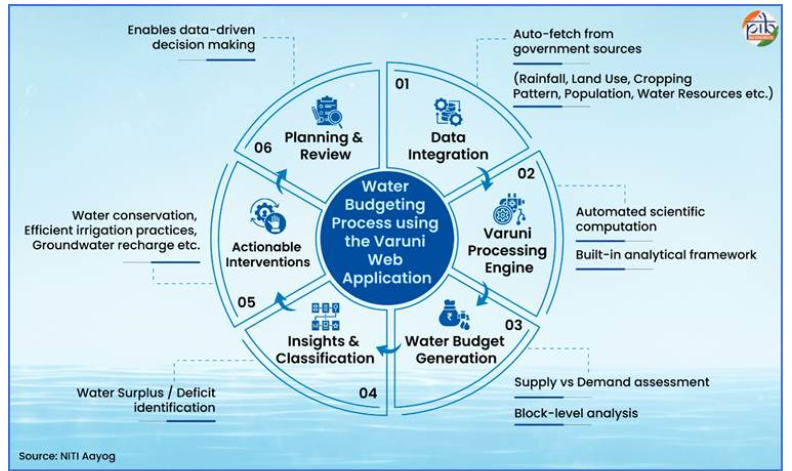
- The Varuni Web Application is a digital tool used for block-level water budgeting.
- It was developed under the Indo-German bilateral project Water Security and Climate Adaptation in Rural India.
- The project is implemented in collaboration with the Ministry of Jal Shakti and the Ministry of Rural Development, with technical support from NITI Aayog.
- The Varuni Web Application uses automatically sourced data from government portals.
It collects data related to:
- Rainfall, Land use, Cropping pattern, Population, Water resources
The application processes this data through an in-built computational framework and generates structured water budget assessments.
Significance
1. Promotes Evidence-Based Governance
Water budgeting helps local bodies make decisions based on data rather than guesswork.
2. Supports Rural Water Security
It helps villages plan water use according to local availability and demand.
3. Improves Agricultural Planning
Farmers can choose crops based on local water conditions, reducing risk and improving productivity.
4. Reduces Groundwater Depletion
Water budgeting encourages groundwater recharge, conservation and regulated extraction.
5. Strengthens Gram Panchayats
It makes Gram Panchayats active institutions in local water governance.
6. Builds Climate Resilience
Water budgeting helps communities prepare for droughts, floods and uncertain rainfall.
7. Promotes Community Participation
The process involves Gram Sabhas, farmers, women’s groups and local institutions.
8. Supports Sustainable Development
It links water conservation with agriculture, livelihoods, food security and environmental protection.
Challenges
1. Fragmented Water Governance
Water is governed by multiple departments such as irrigation, drinking water, rural development and environment. Lack of coordination weakens integrated planning.
2. Overuse of Groundwater
Groundwater extraction remains poorly regulated. In many areas, borewell use has increased without proper recharge.
3. Unsuitable Cropping Patterns
Water-intensive crops such as paddy and sugarcane are often grown in water-stressed areas due to market and policy incentives.
4. Poor Data Availability
Local-level data on rainfall, groundwater, land use and water demand may not always be accurate or updated.
5. Limited Community Capacity
Gram Panchayats and local communities may need training to prepare and use water budgets effectively.
6. Climate Variability
Erratic rainfall, extreme heat, floods and droughts make water planning more difficult.
7. Weak Regulation
Without rules on groundwater extraction and water use, budgeting alone may not produce results.
8. Institutional Silos
Departments often work separately without shared data and common ecological goals.
Way Forward
1. Institutionalise Water Budgeting
Water budgeting should become a regular part of Gram Panchayat development planning.
2. Strengthen Gram Sabhas
Gram Sabhas should be empowered to discuss water availability, crop choices and groundwater use.
3. Promote Demand-Side Management
India must reduce excessive water demand through suitable crop planning, micro-irrigation and efficient water use.
4. Use Digital Tools
Tools such as the Varuni Web Application should be expanded for block-level and village-level water planning.
5. Link Water Budgeting with Agriculture
Crop planning should be aligned with local water availability and agro-climatic conditions.
6. Improve Groundwater Governance
Groundwater should be treated as a common resource and not merely as private property linked to land ownership.
7. Encourage Women’s Participation
Women’s groups, Self-Help Groups and Village Water and Sanitation Committees should be included in water budgeting.
8. Promote Nature-Based Solutions
Traditional tanks, ponds, stepwells, wetlands and watershed structures should be restored.
9. Strengthen Capacity Building
Local officials, Panchayat members and community volunteers should be trained in water accounting and planning.
10. Integrate Climate Adaptation
Water budgeting should include climate risks such as droughts, floods and changing rainfall patterns.
Conclusion
Water budgeting is a practical and community-based tool for improving rural water governance in India. It helps villages understand their water availability, water demand and future risks. By linking water planning with agriculture, livestock, conservation and technology, it supports sustainable rural development. Institutionalising water budgeting at the Gram Panchayat level is essential for ensuring water security, climate resilience and inclusive rural growth.
UPSC PYQ
Q. With reference to ‘Water Credit’, consider the following statements: (2021)
- It puts microfinance tools to work in the water and sanitation sector.
- It is a global initiative launched under the aegis of the World Health Organization and the World Bank.
- It aims to enable the poor people to meet their water needs without depending on subsidies.
Which of the statements given above are correct?
A. 1 and 2 only
B. 2 and 3 only
C. 1 and 3 only
D. 2 and 3
Answer: C
Explanation
Statement 1 is correct:
Water Credit uses microfinance tools to help people access safe water and sanitation facilities.
Statement 2 is incorrect:
Water Credit is not a global initiative launched by the WHO and World Bank. It is an initiative of Water.org.
Statement 3 is correct:
It helps poor households meet their water and sanitation needs through small loans, reducing dependence on subsidies.
CARE MCQ
Q. With reference to water budgeting, consider the following statements:
- It involves assessment of water availability and water demand within a defined geographical unit.
- It helps identify water surplus and water deficit areas.
- It is useful only for urban water management.
How many of the above statements are correct?
A. Only one
B. Only two
C. All the three
D. None
Answer: B
Explanation:
- Statement 1 is correct: Water budgeting compares water availability and water demand in a village, watershed, block or district.
- Statement 2 is correct: It helps identify whether an area has water surplus or water deficit.
- Statement 3 is incorrect: Water budgeting is highly useful in rural areas, especially for agriculture, livestock and groundwater management.
Additional Information:
Water budgeting supports evidence-based and participatory water governance.
FAQs
1. What is water budgeting?
Water budgeting is the assessment of water availability and water demand in a specific area such as a village, watershed or block.
2. Why is water budgeting important in rural India?
It helps villages manage water for drinking, agriculture, livestock and conservation in a planned and sustainable manner.
3. Which scheme promotes groundwater budgeting in India?
The Atal Bhujal Yojana promotes community-led groundwater management and water budgeting.
4. What is the Varuni Web Application?
It is a digital tool that generates block-level water budgets using data on rainfall, land use, cropping pattern, population and water resources.
5. How does water budgeting help farmers?
It helps farmers select crops based on local water availability and reduce the risk of crop failure.