
Why in News?
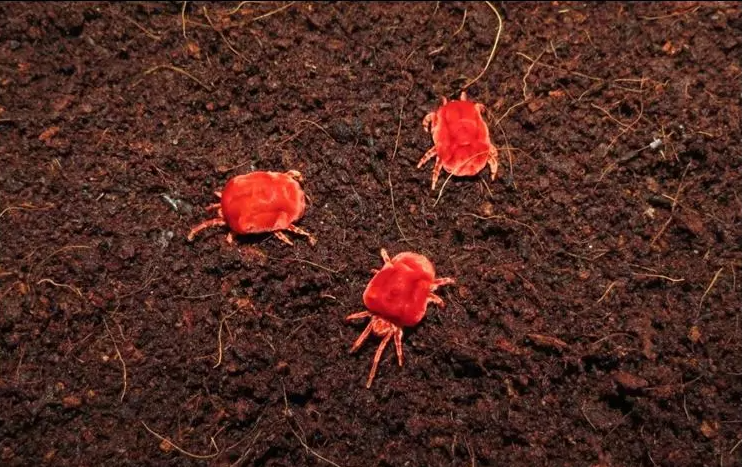
Farmers in Jam and Chincholi villages of Nirmal taluka, Telangana, are celebrating the early appearance of Arudra purugu, also known as red velvet mites or rain bugs.
These insects usually appear during Arudra Karthe, beginning around June 22. However, their early emergence after the first monsoon showers has created optimism among farmers about good rains and healthy crop growth.
What are Rain Bugs?
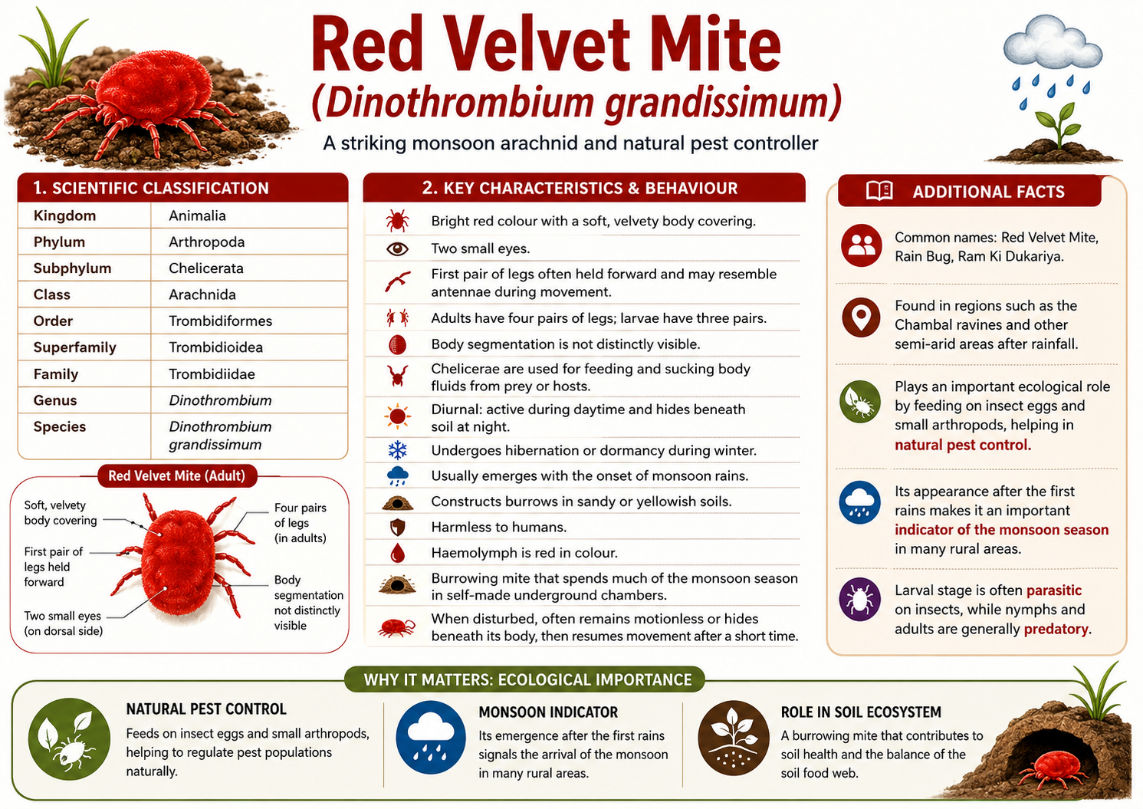
- Rain bugs are commonly known as red velvet mites.
- Locally in Telangana, they are called Arudra purugu.
- They are small red-coloured arthropods that usually appear after the onset of rains.
- They spend most of the year hidden inside the soil.
- They come to the surface mainly during the rainy season for mating.
- They are not crop pests.
Traditional Belief in Telangana
- In Telangana folk belief, the appearance of Arudra purugu is considered an auspicious sign.
- Farmers and elders believe that their appearance indicates:
- Arrival of monsoon rains
- Strengthening of seasonal rainfall
- Better soil moisture
- Favourable conditions for paddy transplanting
- Healthy crop growth
- Farmers often associate their presence with a good agricultural season.
Scientific Importance
- Agricultural extension workers clarified that red velvet mites are beneficial organisms.
- They are non-pest arthropods.
- Their larval stages feed on harmful soil pests.
- This makes them useful in natural pest control.
- Their presence helps maintain ecological balance in agricultural fields.
Link with Soil Health
- High populations of rain bugs are considered an indicator of healthy soil.
- Their emergence suggests that the soil has received enough moisture after rains.
- Their presence is often linked with:
- Organic-rich soil
- Less toxic land conditions
- Moist soil environment
- Better soil biological activity
- In black clay soils, their sudden surfacing may indicate that the soil is sufficiently wet and suitable for sowing preparations.
Importance for Farmers
- The early arrival of rain bugs has raised hopes among farmers after a dry spell.
- Farmers in Nirmal taluka are preparing nurseries and fields.
- The appearance of rain bugs gives confidence for:
- Paddy transplanting
- Sowing operations
- Crop planning
- Monsoon-based farming decisions
- It also strengthens the link between traditional knowledge and agricultural observation.
Significance
- Highlights the role of traditional ecological knowledge in rural farming.
- Shows how farmers observe natural indicators to understand monsoon behaviour.
- Encourages respect for soil organisms and biodiversity.
- Supports the idea of sustainable and ecological farming.
- Demonstrates the importance of natural pest control.
- Helps create awareness that not all insects in fields are harmful.
- Connects agriculture with local culture and folk practices.
Conclusion
The early appearance of Arudra purugu in Telangana reflects the deep relationship between farmers, monsoon and soil biodiversity. While it is seen as a traditional sign of good rains, science also recognises red velvet mites as beneficial organisms that support soil health and natural pest control.
A balanced approach combining local knowledge, scientific advisories and sustainable farming practices can help farmers make better decisions and strengthen climate-resilient agriculture.
Why in News?
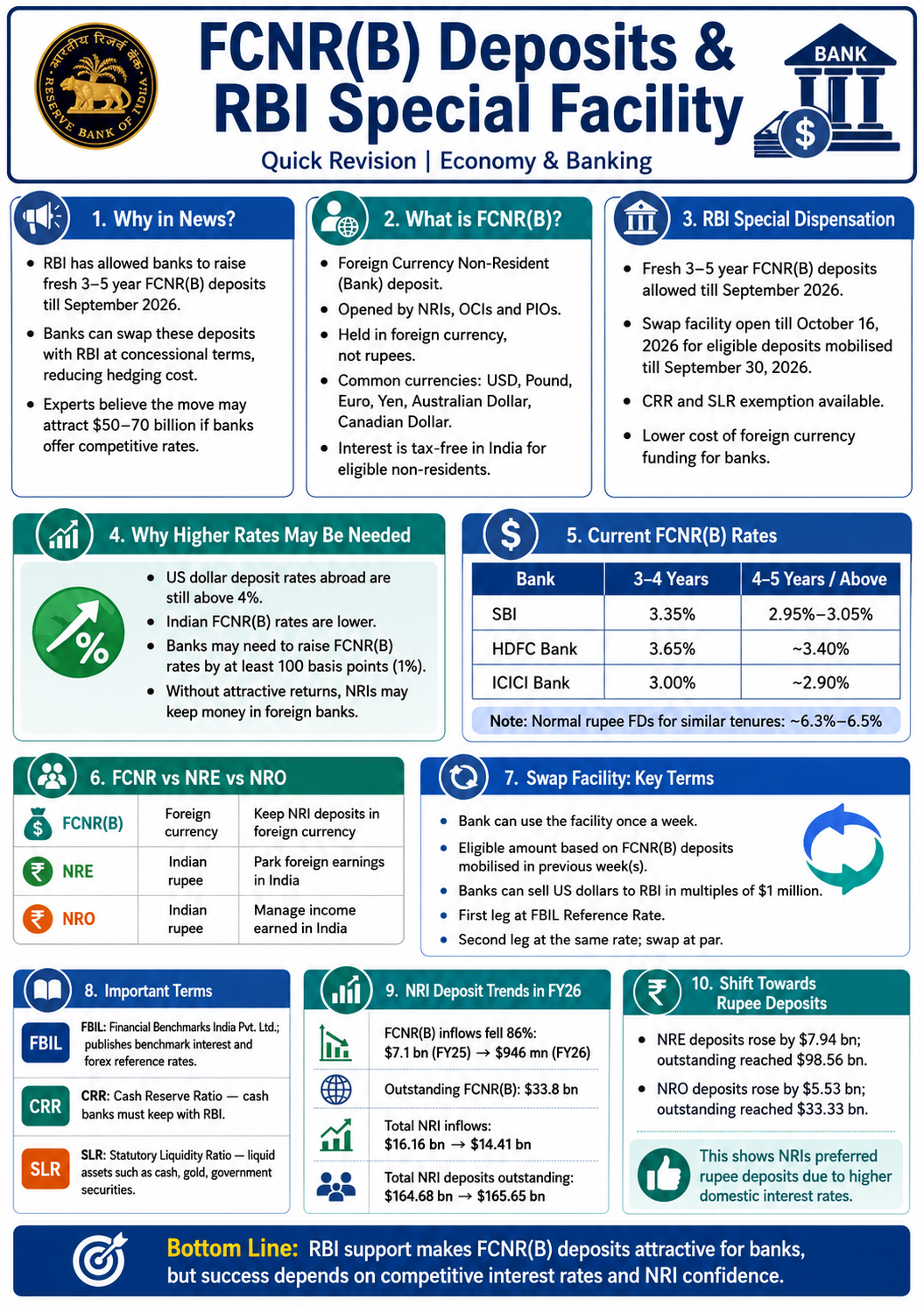
The Reserve Bank of India has announced a special facility allowing banks to mobilise fresh three- to five-year Foreign Currency Non-Resident (Bank) deposits, or FCNR(B) deposits, until September 2026.
The RBI has also allowed banks to swap these deposits with the central bank at a concessional rate. This means the RBI will effectively absorb the hedging cost, making FCNR(B) deposits a more attractive overseas funding source for Indian banks.
Experts believe the move may attract around $50 billion to $70 billion in additional foreign capital, provided banks offer competitive interest rates to Non-Resident Indians.
What are FCNR(B) Deposits?
- FCNR(B) stands for Foreign Currency Non-Resident (Bank) deposits.
- These are fixed-term bank deposits opened in India by:
- Non-Resident Indians
- Overseas Citizens of India
- Persons of Indian Origin
- These deposits are maintained in foreign currencies such as:
- US dollar
- Pound sterling
- Euro
- Japanese yen
- Australian dollar
- Canadian dollar
- Unlike normal rupee deposits, FCNR(B) deposits are held in foreign currency.
- Interest earned on FCNR(B) deposits is exempt from income tax in India as long as the depositor qualifies as a non-resident under Indian tax laws.
RBI’s Special Dispensation
- Banks can mobilise fresh three- to five-year FCNR(B) deposits until September 2026.
- Banks can swap these foreign currency deposits with the RBI at a concessional rate.
- The swap facility will remain open up to October 16, 2026 for eligible deposits mobilised until September 30, 2026.
- Banks are exempted from maintaining Cash Reserve Ratio and Statutory Liquidity Ratio on these deposits.
- This reduces the cost of raising foreign currency resources for banks.
Why Higher Interest Rates May Be Needed
The RBI’s support reduces hedging costs for banks, but it may not be enough to attract large NRI inflows.
- US dollar deposit rates in major markets are still above 4%.
- Indian banks currently offer lower rates on FCNR(B) deposits.
- Bankers believe Indian banks may need to raise FCNR(B) rates by at least 100 basis points.
- 100 basis points = 1 percentage point.
- Without attractive rates, NRIs may prefer to keep their deposits in foreign banks.
- Therefore, regulatory support must be combined with competitive pricing.
Current FCNR(B) Deposit Rates
FCNR(B) rates are lower than regular rupee fixed deposit rates because they are linked to foreign currency interest rate conditions.
| Bank | FCNR(B) Rate for 3–4 Years | FCNR(B) Rate for 4–5 Years / Above |
| SBI | 3.35% | 2.95% to 3.05% |
| HDFC Bank | 3.65% | Around 3.40% |
| ICICI Bank | 3.00% | Around 2.90% |
In comparison, normal rupee fixed deposits for similar tenures offer around 6.3% to 6.5%.
Difference Between FCNR(B), NRE and NRO Accounts
| Account Type | Currency | Main Purpose |
| Foreign Currency Non-Resident (Bank) – (FCNR) Account | Foreign currency | To keep NRI deposits in foreign currency |
| Non-Resident External– (NRE) Account | Indian rupee | To park foreign earnings in India |
| Non-Resident Ordinary– (NRO) Account | Indian rupee | To manage income earned in India |
New Swap Facility: Terms and Conditions
- A bank can use the swap facility only once in a week.
- The maximum amount a bank can swap will be equal to eligible FCNR(B) deposits mobilised during the previous week or weeks.
- Banks can sell US dollars to the RBI in multiples of $1 million.
- Banks will simultaneously agree to buy back the same amount of dollars at the end of the swap period.
- In the first leg, banks will sell dollars to the RBI at the FBIL Reference Rate.
- The second leg will take place at the same rate.
- The swap will be undertaken at par.
What is FBIL?
- FBIL stands for Financial Benchmarks India Private Limited.
- It publishes benchmark interest rates and foreign exchange reference rates for Indian financial markets.
- The FBIL Reference Rate is used for foreign exchange-related transactions.
What are CRR and SLR?
Cash Reserve Ratio
- CRR is the minimum percentage of deposits banks must keep with the RBI as cash.
- Banks cannot lend this amount.
Statutory Liquidity Ratio
- SLR is the minimum percentage of deposits banks must maintain in liquid assets such as:
- Cash
- Gold
- Government securities
- Exemption from CRR and SLR improves the attractiveness of FCNR(B) deposits for banks.
NRI Deposit Trends in FY26
- FCNR(B) deposit inflows fell sharply by 86% in FY26.
- Inflows declined from $7.1 billion in FY25 to $946 million in FY26.
- Outstanding FCNR(B) deposits stood at $33.8 billion at the end of March.
- Total NRI deposit inflows also declined from $16.16 billion in FY25 to $14.41 billion in FY26.
- Total NRI deposits outstanding rose slightly from $164.68 billion to $165.65 billion.
Shift Towards Rupee Deposits
Although FCNR(B) inflows declined, NRE and NRO deposits increased.
- NRE deposits rose by $7.94 billion in FY26.
- NRE outstanding deposits reached $98.56 billion.
- NRO deposits rose by $5.53 billion.
- NRO outstanding deposits reached $33.33 billion.
This shows that NRIs preferred rupee-denominated deposits because domestic interest rates were more attractive.
Significance
- Helps attract foreign currency deposits from NRIs.
- Supports foreign exchange reserves and external sector stability.
- Provides banks with overseas funding.
- Can help stabilise the rupee during external pressure.
- Reduces hedging cost for banks.
- Encourages NRI participation in India’s financial system.
- Supports liquidity and credit availability in the banking system.
Challenges
- FCNR(B) rates are currently lower than overseas dollar deposit rates.
- Higher rates may be needed to attract NRI funds.
- If banks raise rates too much, their cost of funds may increase.
- Foreign currency deposits carry exchange rate and maturity management concerns.
- Inflows may remain weak if global interest rates stay high.
- NRIs may prefer NRE and NRO deposits if rupee returns remain attractive.
- The facility may provide only temporary support unless rates become competitive.
Way Forward
- Banks should offer competitive FCNR(B) rates after factoring in RBI’s hedging support.
- Deposit pricing should balance depositor attraction and bank profitability.
- RBI should monitor foreign currency liquidity and exchange rate risks.
- Banks should promote FCNR(B) deposits among NRIs through transparent communication.
- India should strengthen long-term foreign capital inflows beyond temporary deposit schemes.
- External sector stability should be supported through exports, remittances, FDI and prudent debt management.
Conclusion
The RBI’s special FCNR(B) deposit swap facility is aimed at encouraging NRI dollar inflows and improving foreign currency liquidity. By absorbing hedging costs and exempting banks from CRR and SLR requirements, the RBI has made these deposits more attractive for banks.
However, the success of the move depends on whether banks offer competitive interest rates. With overseas dollar deposits still giving returns above 4%, Indian banks may need to raise FCNR(B) rates meaningfully. A balanced approach is needed to attract NRI funds, support external stability and protect bank margins.
Why in News?
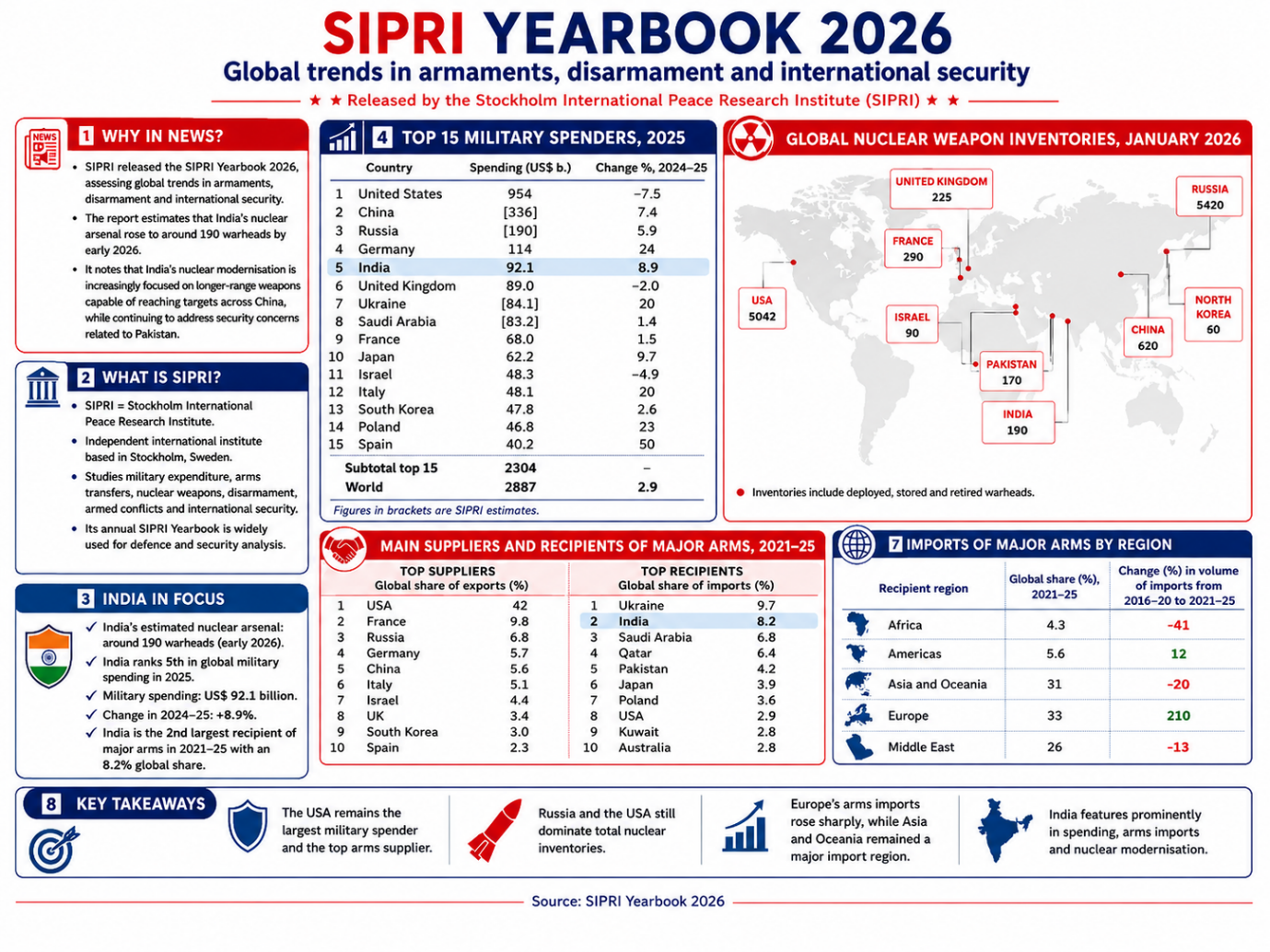
The Stockholm International Peace Research Institute released the SIPRI Yearbook 2026, which assesses global trends in armaments, disarmament and international security.
The report estimated that India’s nuclear arsenal increased to around 190 warheads by early 2026. It also noted that India’s nuclear modernisation is increasingly focused on developing longer-range weapons capable of reaching targets across China, while continuing to address security concerns related to Pakistan.
What is SIPRI?
- SIPRI stands for Stockholm International Peace Research Institute.
- It is an independent international institute based in Stockholm, Sweden.
- It studies:
- Military expenditure
- Arms transfers
- Nuclear weapons
- Disarmament
- Armed conflicts
- International security
- Its annual SIPRI Yearbook is widely used for defence and security analysis.
Global Nuclear Trends
- SIPRI stated that all nine nuclear-armed states continued to modernise their nuclear arsenals.
| Nuclear-Armed States |
|---|
| United States | Russia | United Kingdom | France | China | India | Pakistan | North Korea | Israel |
- The nine countries possessed around 12,187 nuclear warheads at the start of 2026.
- Around 9,745 warheads were in military stockpiles for potential use.
- More than 4,000 warheads were deployed with missiles and aircraft.
- The United States and Russia together held around 86% of global nuclear warheads.
- SIPRI warned that disarmament is slowing because countries are adding new and modernised warheads even as older weapons are dismantled.

Key Findings on India
Nuclear Arsenal
- India’s nuclear stockpile was estimated at around 190 warheads by early 2026.
- India had around 12 deployed warheads and 178 warheads in reserve/storage.
- India’s nuclear modernisation is increasingly focused on longer-range delivery systems.
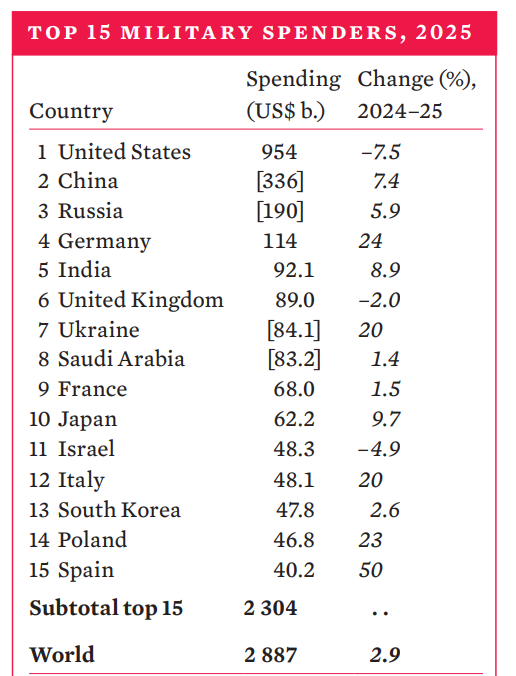
Military Spending
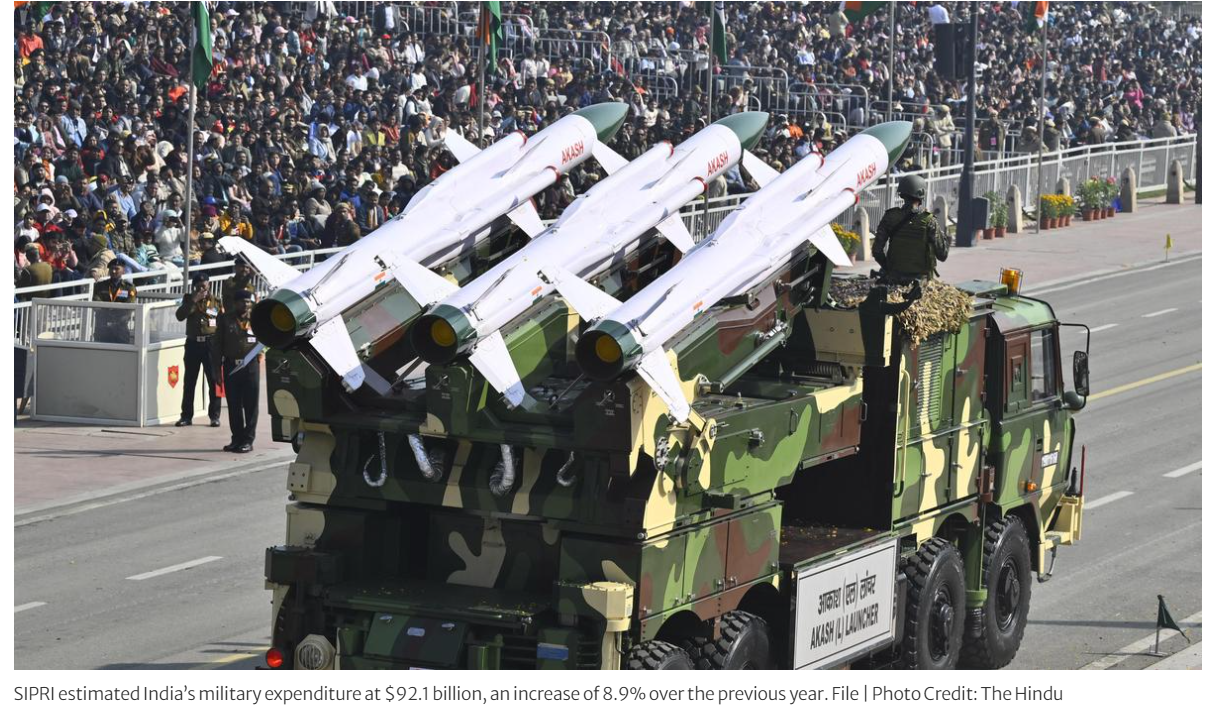
- India was the world’s fifth-largest military spender in 2025.
- India’s military expenditure was estimated at USD 92.1 billion.
- This was an increase of 8.9% over the previous year.
- India ranked after:
- United States
- China
- Russia
- Germany
Arms Imports
- India remained the second-largest importer of major arms during 2021–25.
- India accounted for 8.2% of global arms imports.
- The five largest arms importers were:
- Ukraine
- India
- Saudi Arabia
- Qatar
- Pakistan
India’s Nuclear Modernisation
India’s nuclear modernisation is shaped by two major security concerns.
1. China Factor
- SIPRI noted that India is focusing more on longer-range nuclear delivery systems.
- This reflects India’s strategic need to maintain deterrence against China.
- China’s estimated nuclear stockpile is much larger than India’s.
2. Pakistan Factor
- India also continues to address its long-standing security rivalry with Pakistan.
- SIPRI described the May 2025 India-Pakistan military confrontation, known as Operation Sindoor, as an unusually severe military crisis between two nuclear-armed neighbours.
- The report noted that both sides took measures to prevent further escalation.
Cyber Warfare and Modern Conflict
- SIPRI observed that India and Pakistan integrated cyber operations into active military conflict for the first time during the 2025 crisis.
- This shows that modern warfare is becoming multi-domain.
- Conflicts today may involve:
- Conventional military operations
- Nuclear deterrence
- Cyber attacks
- Drone warfare
- Information warfare
- Space-based systems
- This underlines the need for India to strengthen cyber defence along with conventional and nuclear capabilities.
India’s Nuclear Doctrine
India officially adopted its nuclear doctrine in 2003.
Core Principles
- Credible Minimum Deterrence:
India maintains only the level of nuclear capability needed to deter nuclear threats. - No First Use:
India will use nuclear weapons only in retaliation to a nuclear attack on Indian territory or Indian forces. - Massive Retaliation:
Any nuclear attack on India would invite massive retaliation to cause unacceptable damage to the aggressor. - Civilian Political Control:
Nuclear weapons can be authorised only by civilian political leadership through the Nuclear Command Authority. - Negative Security Assurance:
India has pledged not to use nuclear weapons against non-nuclear weapon states. - Commitment to Disarmament:
India supports universal, verifiable and non-discriminatory nuclear disarmament.
Major Arms Trade Trends, 2021–25
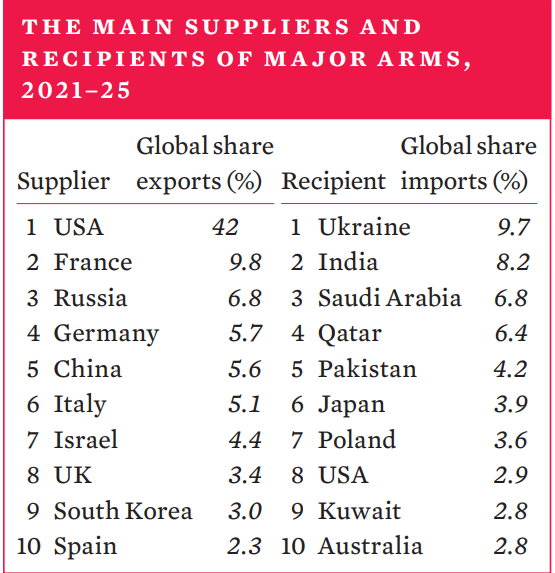
SIPRI identified 162 states as recipients of major arms during 2021–25.
- The USA remained the world’s largest arms exporter.
- Its arms exports increased by 27% between 2016–20 and 2021–25.
- The US share in global arms exports rose from 36% to 42%.
- Russia’s arms exports declined sharply by 64%, reducing its global share to 6.8%.
- Russia’s share is now lower than at any time since 1950.
- European NATO members’ arms exports increased by 36%.
- They accounted for 28% of total global arms exports during 2021–25.
- France’s arms exports rose by 21%, giving it a 9.8% global share.
- Germany’s exports increased by 15%, giving it a 5.7% global share.
Major Arms Importers
- The five largest arms importers were Ukraine, India, Saudi Arabia, Qatar and Pakistan.
- Together, they accounted for 35% of total global arms imports.
- Ukraine became the world’s largest arms importer.
- Ukraine’s arms imports were around 100 times higher in 2021–25 than in 2016–20.
- At least 36 countries supplied major arms to Ukraine, mostly as military aid.
- China’s arms imports declined by 72%, making it the 20th largest arms importer.
Regional Import Trends
Nuclear Command Authority
The Nuclear Command Authority has two councils.
Political Council
- Chaired by the Prime Minister.
- It is the only body authorised to order the use of nuclear weapons.
Executive Council
- Chaired by the National Security Advisor.
- It provides inputs to the Political Council and implements its directions.
Evolution of India’s Nuclear Posture
Peaceful Nuclear Phase: 1947–1974
- India’s nuclear programme initially focused on energy self-reliance.
- It was shaped by leaders such as Homi J. Bhabha and Jawaharlal Nehru.
- China’s nuclear test in 1964 increased India’s security concerns.
Pokhran-I: 1974
- India conducted its first nuclear test on 18 May 1974.
- It was officially described as a Peaceful Nuclear Explosion.
- The test was code-named Smiling Buddha.
Weaponisation Phase: 1974–1998
- India faced international pressure and restrictions after 1974.
- Concerns over China and Pakistan shaped India’s security calculations.
- India did not sign the NPT or CTBT.
Pokhran-II: 1998
- India conducted five underground nuclear tests in May 1998 under Operation Shakti.
- India formally declared itself a nuclear-weapon state.
- National Technology Day is observed on 11 May to commemorate Operation Shakti.
Established Nuclear Power: 1998–Present
- India drafted its nuclear doctrine in 1999.
- It officially operationalised the doctrine in 2003.
- The 2008 India-US Civil Nuclear Agreement and NSG waiver helped India enter global nuclear commerce despite being outside the NPT.
India and Global Nuclear Treaties
NPT
- India has not signed the Nuclear Non-Proliferation Treaty.
- India argues that the NPT is discriminatory because it recognises only some countries as nuclear-weapon states.
CTBT
- India has not signed the Comprehensive Nuclear-Test-Ban Treaty.
- India supports disarmament but wants it to be universal and non-discriminatory.
TPNW
- India opposes the Treaty on the Prohibition of Nuclear Weapons, 2017.
- India argues that it lacks a strong verification mechanism.
Export Control Regimes
India is a member of three major export control regimes:
- Missile Technology Control Regime
- Wassenaar Arrangement
- Australia Group
India continues to seek membership in the Nuclear Suppliers Group.
Significance for India
- Strengthens India’s credible minimum deterrence.
- Reflects India’s response to a two-front nuclear security environment.
- Shows a gradual strategic shift from Pakistan-focused deterrence to a wider China-linked posture.
- Highlights India’s need for advanced delivery systems and command-control capabilities.
- Shows the growing importance of cyber warfare in nuclear crisis management.
- Underlines the need for defence indigenisation because India remains a major arms importer.
- Reinforces the importance of responsible nuclear behaviour and crisis stability.
Challenges
- Nuclear modernisation may intensify arms race concerns in South Asia.
- India faces simultaneous strategic pressure from China and Pakistan.
- Cyber operations may increase the risk of miscalculation during crises.
- Heavy arms import dependence affects strategic autonomy.
- Rising defence expenditure must be balanced with development needs.
- Absence of strong global arms control frameworks increases nuclear risks.
- Expiry of the New START Treaty without replacement may weaken global nuclear stability.
Way Forward
- Maintain India’s doctrine of credible minimum deterrence.
- Strengthen nuclear command, control and communication systems.
- Improve cyber security of military and strategic infrastructure.
- Build crisis communication mechanisms with nuclear neighbours.
- Reduce dependence on arms imports through Atmanirbhar Bharat in defence.
- Invest in drones, AI, cyber defence, space systems and missile defence.
- Continue support for universal and non-discriminatory nuclear disarmament.
- Promote responsible nuclear diplomacy at global platforms.
Conclusion
The SIPRI Yearbook 2026 shows that India’s nuclear and defence posture is evolving in response to a complex security environment involving China, Pakistan, cyber warfare and global nuclear modernisation.
India must maintain credible deterrence while avoiding unnecessary escalation. A balanced strategy based on responsible nuclear policy, defence indigenisation, cyber preparedness, crisis stability and diplomatic engagement is essential for long-term national security.