Why in News?
The Stockholm International Peace Research Institute released the SIPRI Yearbook 2026, which assesses global trends in armaments, disarmament and international security.
The report estimated that India’s nuclear arsenal increased to around 190 warheads by early 2026. It also noted that India’s nuclear modernisation is increasingly focused on developing longer-range weapons capable of reaching targets across China, while continuing to address security concerns related to Pakistan.
What is SIPRI?
- SIPRI stands for Stockholm International Peace Research Institute.
- It is an independent international institute based in Stockholm, Sweden.
- It studies:
- Military expenditure
- Arms transfers
- Nuclear weapons
- Disarmament
- Armed conflicts
- International security
- Its annual SIPRI Yearbook is widely used for defence and security analysis.
Global Nuclear Trends
- SIPRI stated that all nine nuclear-armed states continued to modernise their nuclear arsenals.
| Nuclear-Armed States |
|---|
| United States | Russia | United Kingdom | France | China | India | Pakistan | North Korea | Israel |
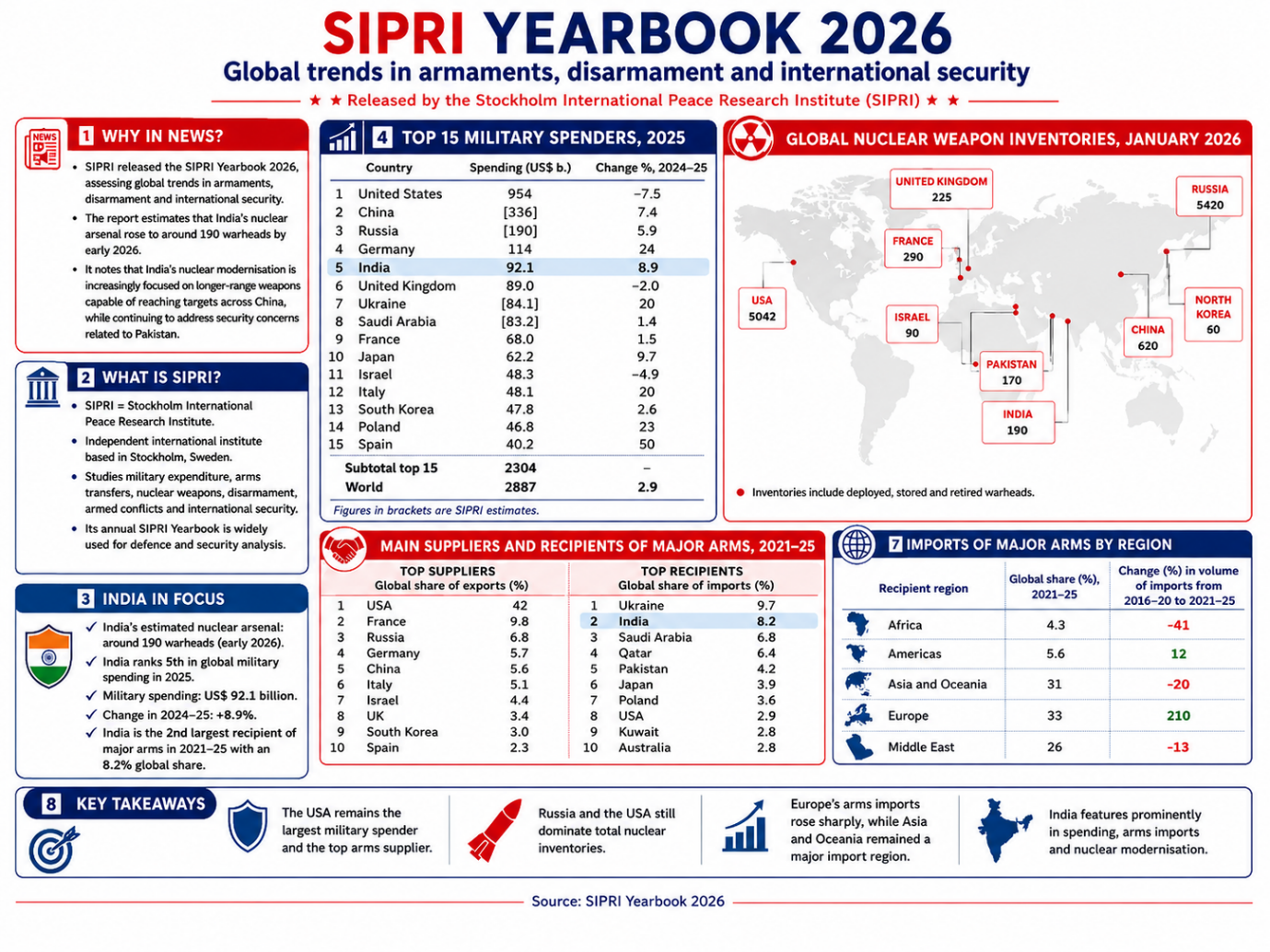
- The nine countries possessed around 12,187 nuclear warheads at the start of 2026.
- Around 9,745 warheads were in military stockpiles for potential use.
- More than 4,000 warheads were deployed with missiles and aircraft.
- The United States and Russia together held around 86% of global nuclear warheads.
- SIPRI warned that disarmament is slowing because countries are adding new and modernised warheads even as older weapons are dismantled.

Key Findings on India
Nuclear Arsenal
- India’s nuclear stockpile was estimated at around 190 warheads by early 2026.
- India had around 12 deployed warheads and 178 warheads in reserve/storage.
- India’s nuclear modernisation is increasingly focused on longer-range delivery systems.
Military Spending
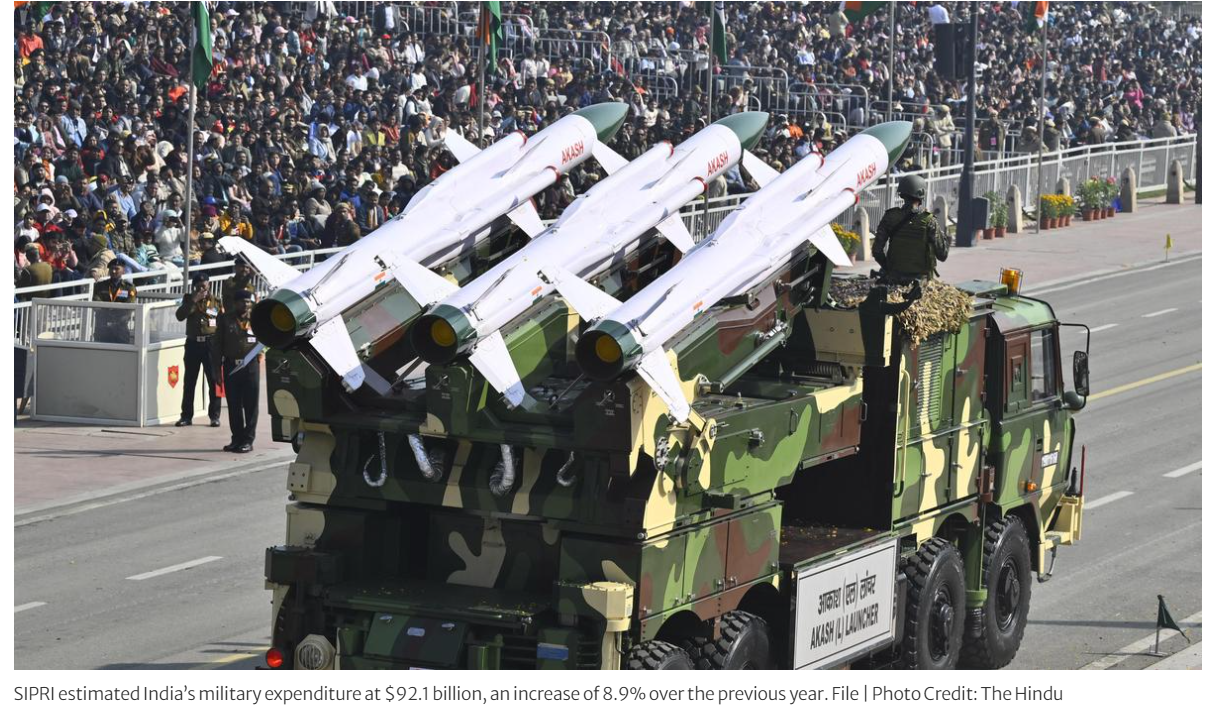
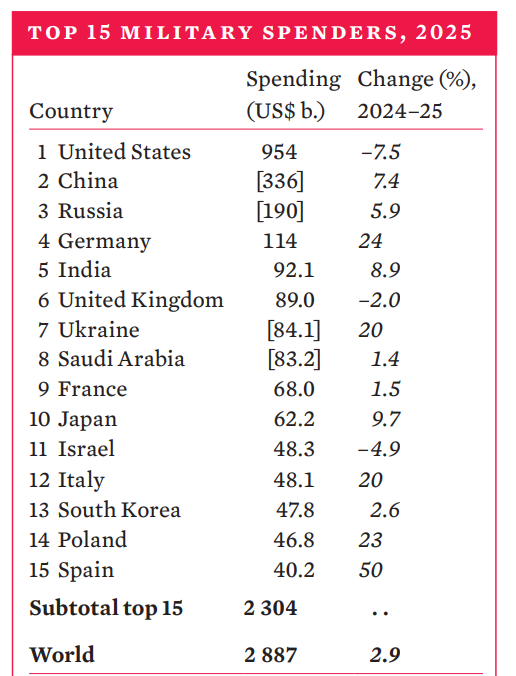
- India was the world’s fifth-largest military spender in 2025.
- India’s military expenditure was estimated at USD 92.1 billion.
- This was an increase of 8.9% over the previous year.
- India ranked after:
- United States
- China
- Russia
- Germany
Arms Imports
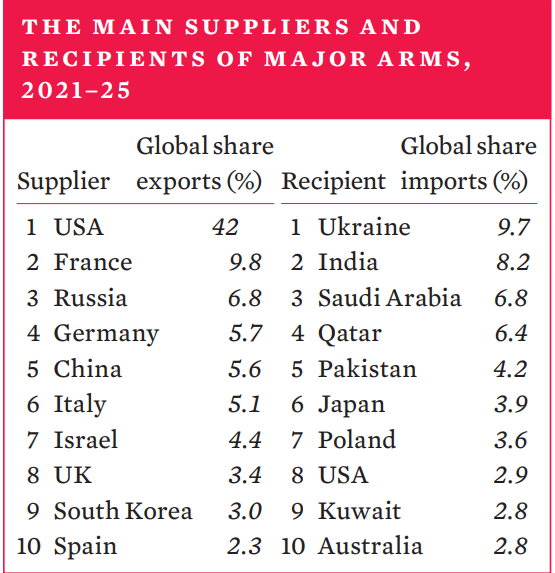
- India remained the second-largest importer of major arms during 2021–25.
- India accounted for 8.2% of global arms imports.
- The five largest arms importers were:
- Ukraine
- India
- Saudi Arabia
- Qatar
- Pakistan
India’s Nuclear Modernisation
India’s nuclear modernisation is shaped by two major security concerns.
1. China Factor
- SIPRI noted that India is focusing more on longer-range nuclear delivery systems.
- This reflects India’s strategic need to maintain deterrence against China.
- China’s estimated nuclear stockpile is much larger than India’s.
2. Pakistan Factor
- India also continues to address its long-standing security rivalry with Pakistan.
- SIPRI described the May 2025 India-Pakistan military confrontation, known as Operation Sindoor, as an unusually severe military crisis between two nuclear-armed neighbours.
- The report noted that both sides took measures to prevent further escalation.
Cyber Warfare and Modern Conflict
- SIPRI observed that India and Pakistan integrated cyber operations into active military conflict for the first time during the 2025 crisis.
- This shows that modern warfare is becoming multi-domain.
- Conflicts today may involve:
- Conventional military operations
- Nuclear deterrence
- Cyber attacks
- Drone warfare
- Information warfare
- Space-based systems
- This underlines the need for India to strengthen cyber defence along with conventional and nuclear capabilities.
India’s Nuclear Doctrine
India officially adopted its nuclear doctrine in 2003.
Core Principles
- Credible Minimum Deterrence:
India maintains only the level of nuclear capability needed to deter nuclear threats. - No First Use:
India will use nuclear weapons only in retaliation to a nuclear attack on Indian territory or Indian forces. - Massive Retaliation:
Any nuclear attack on India would invite massive retaliation to cause unacceptable damage to the aggressor. - Civilian Political Control:
Nuclear weapons can be authorised only by civilian political leadership through the Nuclear Command Authority. - Negative Security Assurance:
India has pledged not to use nuclear weapons against non-nuclear weapon states. - Commitment to Disarmament:
India supports universal, verifiable and non-discriminatory nuclear disarmament.
Major Arms Trade Trends, 2021–25
SIPRI identified 162 states as recipients of major arms during 2021–25.
- The USA remained the world’s largest arms exporter.
- Its arms exports increased by 27% between 2016–20 and 2021–25.
- The US share in global arms exports rose from 36% to 42%.
- Russia’s arms exports declined sharply by 64%, reducing its global share to 6.8%.
- Russia’s share is now lower than at any time since 1950.
- European NATO members’ arms exports increased by 36%.
- They accounted for 28% of total global arms exports during 2021–25.
- France’s arms exports rose by 21%, giving it a 9.8% global share.
- Germany’s exports increased by 15%, giving it a 5.7% global share.
Major Arms Importers
- The five largest arms importers were Ukraine, India, Saudi Arabia, Qatar and Pakistan.
- Together, they accounted for 35% of total global arms imports.
- Ukraine became the world’s largest arms importer.
- Ukraine’s arms imports were around 100 times higher in 2021–25 than in 2016–20.
- At least 36 countries supplied major arms to Ukraine, mostly as military aid.
- China’s arms imports declined by 72%, making it the 20th largest arms importer.
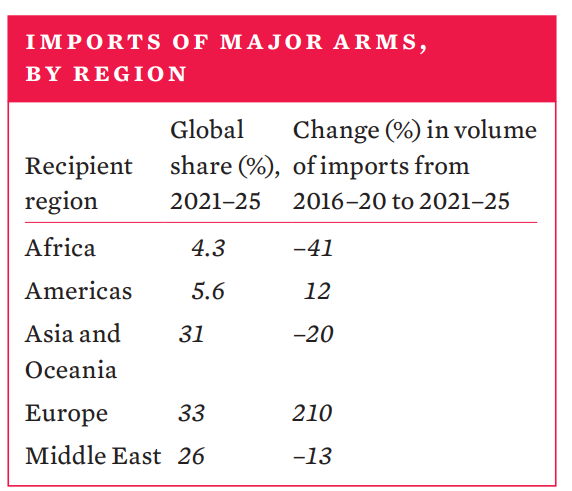
Regional Import Trends
Nuclear Command Authority
The Nuclear Command Authority has two councils.
Political Council
- Chaired by the Prime Minister.
- It is the only body authorised to order the use of nuclear weapons.
Executive Council
- Chaired by the National Security Advisor.
- It provides inputs to the Political Council and implements its directions.
Evolution of India’s Nuclear Posture
Peaceful Nuclear Phase: 1947–1974
- India’s nuclear programme initially focused on energy self-reliance.
- It was shaped by leaders such as Homi J. Bhabha and Jawaharlal Nehru.
- China’s nuclear test in 1964 increased India’s security concerns.
Pokhran-I: 1974
- India conducted its first nuclear test on 18 May 1974.
- It was officially described as a Peaceful Nuclear Explosion.
- The test was code-named Smiling Buddha.
Weaponisation Phase: 1974–1998
- India faced international pressure and restrictions after 1974.
- Concerns over China and Pakistan shaped India’s security calculations.
- India did not sign the NPT or CTBT.
Pokhran-II: 1998
- India conducted five underground nuclear tests in May 1998 under Operation Shakti.
- India formally declared itself a nuclear-weapon state.
- National Technology Day is observed on 11 May to commemorate Operation Shakti.
Established Nuclear Power: 1998–Present
- India drafted its nuclear doctrine in 1999.
- It officially operationalised the doctrine in 2003.
- The 2008 India-US Civil Nuclear Agreement and NSG waiver helped India enter global nuclear commerce despite being outside the NPT.
India and Global Nuclear Treaties
NPT
- India has not signed the Nuclear Non-Proliferation Treaty.
- India argues that the NPT is discriminatory because it recognises only some countries as nuclear-weapon states.
CTBT
- India has not signed the Comprehensive Nuclear-Test-Ban Treaty.
- India supports disarmament but wants it to be universal and non-discriminatory.
TPNW
- India opposes the Treaty on the Prohibition of Nuclear Weapons, 2017.
- India argues that it lacks a strong verification mechanism.
Export Control Regimes
India is a member of three major export control regimes:
- Missile Technology Control Regime
- Wassenaar Arrangement
- Australia Group
India continues to seek membership in the Nuclear Suppliers Group.
Significance for India
- Strengthens India’s credible minimum deterrence.
- Reflects India’s response to a two-front nuclear security environment.
- Shows a gradual strategic shift from Pakistan-focused deterrence to a wider China-linked posture.
- Highlights India’s need for advanced delivery systems and command-control capabilities.
- Shows the growing importance of cyber warfare in nuclear crisis management.
- Underlines the need for defence indigenisation because India remains a major arms importer.
- Reinforces the importance of responsible nuclear behaviour and crisis stability.
Challenges
- Nuclear modernisation may intensify arms race concerns in South Asia.
- India faces simultaneous strategic pressure from China and Pakistan.
- Cyber operations may increase the risk of miscalculation during crises.
- Heavy arms import dependence affects strategic autonomy.
- Rising defence expenditure must be balanced with development needs.
- Absence of strong global arms control frameworks increases nuclear risks.
- Expiry of the New START Treaty without replacement may weaken global nuclear stability.
Way Forward
- Maintain India’s doctrine of credible minimum deterrence.
- Strengthen nuclear command, control and communication systems.
- Improve cyber security of military and strategic infrastructure.
- Build crisis communication mechanisms with nuclear neighbours.
- Reduce dependence on arms imports through Atmanirbhar Bharat in defence.
- Invest in drones, AI, cyber defence, space systems and missile defence.
- Continue support for universal and non-discriminatory nuclear disarmament.
- Promote responsible nuclear diplomacy at global platforms.
Conclusion
The SIPRI Yearbook 2026 shows that India’s nuclear and defence posture is evolving in response to a complex security environment involving China, Pakistan, cyber warfare and global nuclear modernisation.
India must maintain credible deterrence while avoiding unnecessary escalation. A balanced strategy based on responsible nuclear policy, defence indigenisation, cyber preparedness, crisis stability and diplomatic engagement is essential for long-term national security.