TGPSC Current Affairs 14 August 2026 featuring Mulkanoor inscription, energy transition and natural farming

Relevance: TGPSC Telangana History, Deccan Dynasties, Inscriptions and Heritage

Important Keywords for Prelims and Mains

For Prelims:

  • Mulkanoor Inscription | Kalyani Chalukyas | Telugu-Kannada Script | Mahasamanta | Land Grant

For Mains:

  • Epigraphy | Regional history | Heritage preservation | Temple art | Deccan culture

Why in News?

An inscription belonging to the Kalyani Chalukya period was discovered at Mulkanoor in Bheemadevarapalli mandal of Hanamkonda district, Telangana. It records a land donation and gives fresh evidence about the historical links of the Warangal region with the Kalyani Chalukyas.

About the Discovery

  • The inscription was identified during field exploration by G. Kishore, a research member of the Kotha Telangana Charitrabrundam.
  • It is carved on a rock locally known as Katamayya rock, located behind the Mahila Sahakara Dairy in Mulkanoor.
  • The inscription is written in Telugu-Kannada script and Kannada language. However, it is partly damaged and worn out, so only a portion of the text could be deciphered.

What the Inscription Says

  • The readable portion suggests that during the rule of the Kalyani Chalukyas, a Mahasamanta, possibly named Bijjana, made a land donation at Mulkaluru.
  • The donor is said to have held the title “Samadhigata Pancha Mahashabda.”
  • The inscription appears to mention the donation of land with water, referred to as “neer nelanu”, on the 12th day of the bright fortnight of Chaitra. The exact year is not clear because the damaged portion cannot be fully read.
  • The text begins with the customary “Swasti” and ends with an appeal to future rulers to protect the charitable grant.

Sculptures Found at the Site

The same rock also contains sculptures of:

  • Ganesha
  • Shivalinga
  • Nandi
  • Mahishasuramardini
  • Sun and Moon symbols

Nearby Naga stones were also found. These sculptures are described as belonging to the post-Rashtrakuta style.

Historical Significance

1. Link with Kalyani Chalukyas

The inscription shows the political influence of the Kalyani Chalukyas in the Warangal-Hanamkonda region.

2. Evidence of Land Grants

It reflects the practice of donating land, often linked with religious or social institutions.

3. Role of Feudatories

The mention of a Mahasamanta shows the importance of local chiefs in medieval Deccan administration.

4. Script and Language Value

The use of Telugu-Kannada script and Kannada language reflects cultural interaction in the Deccan.

5. Religious Heritage

The presence of Shaivite and other sculptures shows the religious character of the site.

Why Inscriptions Matter

  • Inscriptions are primary historical sources. They help reconstruct political history, administrative titles, land ownership, religious patronage, language and script usage.
  • The Mulkanoor inscription is important because it adds local evidence to Telangana’s medieval history.

Conclusion

The Mulkanoor inscription is a valuable epigraphic discovery for Telangana’s history. It links the Hanamkonda-Warangal region with the Kalyani Chalukyas and provides evidence of land donation, local administration, script usage and religious culture. Its damaged condition highlights the urgent need for systematic documentation and preservation of regional heritage.

CARE MCQ

Q. The recently discovered inscription at Mulkanoor in Hanamkonda district belongs to which historical period?

(a) Satavahana period
(b) Kakatiya period
(c) Kalyani Chalukya period
(d) Vijayanagara period

Answer: (c) Kalyani Chalukya period

Explanation

A 10th-century inscription was discovered at Mulkanoor in Bheemadevarapalli mandal of Hanamkonda district.

It records a land donation and belongs to the Kalyani Chalukya-era. The inscription is written in Telugu-Kannada script and Kannada language.

FAQs

1. Where was the inscription found?

At Mulkanoor, Hanamkonda district, Telangana.

2. Which dynasty is it linked with?

The Kalyani Chalukyas.

3. What does it record?

land donation.

4. What script is used?

Telugu-Kannada script.

5. What language is used?

Kannada language.

Relevance: UPSC GS Paper III: Energy Security, Infrastructure, Renewable Energy, Environment, Climate Change, Industrial Growth

Important Keywords for Prelims and Mains

For Prelims:

  • Non-Fossil Capacity | PM Surya Ghar | Green Hydrogen Mission | GOBARdhan | SHANTI Act

For Mains:

  • Energy security | Clean energy transition | Domestic resource mobilisation | Energy access | Self-reliant energy system

Why in News?

India’s energy sector is undergoing a major transformation, with total installed power capacity reaching around 552 GW in July 2026, compared to 249 GW in 2014. The country’s non-fossil capacity has reached 300.50 GW, forming more than 54% of total installed capacity.

India now ranks third globally in renewable energy installed capacity, reflecting the country’s focus on energy security, clean energy expansion and self-reliance.

India’s Energy Landscape

India’s energy strategy is based on a mixed approach: expanding renewables, strengthening domestic fossil resources, improving energy access and investing in future technologies.

Key highlights include:

  • Total installed power capacity: around 552 GW
  • Non-fossil capacity: 300.50 GW
  • Solar capacity: 164.59 GW
  • Wind capacity: 58.14 GW
  • Hydropower capacity: 57.24 GW
  • Bio-power capacity: 11.75 GW
  • Nuclear capacity: 8.78 GW
  • Coal production: over 1,040 MT in FY2025-26
  • LPG coverage: increased from 55.9% in 2014 to 107.2% in 2026

These figures show that India is not depending on one source alone. It is building a diversified energy system.

Coal and Conventional Energy Security

  • Coal continues to remain important for India’s energy security. It meets nearly 55% of India’s primary energy needs and supports more than 70% of electricity generation.
  • India has around 4,00,715 million tonnes of coal reserves and is the world’s second-largest coal producer and consumer. Coal production increased from 609.18 MT in FY2014-15 to over 1,040 MT in FY2025-26.
  • Coal imports by thermal power plants declined by about 27.4%, from 62.5 MT in FY2024-25 to 45.4 MT in FY2025-26. This indicates an effort to reduce import dependence.
  • The government also approved a ₹37,500 crore scheme in May 2026 to promote surface coal/lignite gasification. It is expected to support the national target of 100 MT coal/lignite gasification by 2030, mobilise investments and generate employment.

Renewable Energy Expansion

1. Solar Energy

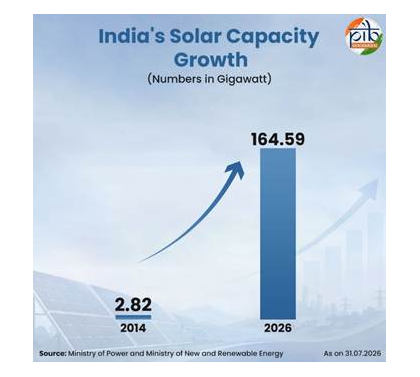
  • Solar power has become the largest component of India’s renewable energy capacity. Installed solar capacity reached 164.59 GW as of 31 July 2026, compared to 2.8 GW in 2014.
  • India also became the world’s second-largest solar growth market in 2025, adding more than 37 GW of solar capacity.
2. PM Surya Ghar: Muft Bijli Yojana

The scheme was launched in February 2024 with an outlay of ₹75,021 crore for 1 crore households.

Major outcomes include:

  • 51.58 lakh households benefiting from rooftop solar
  • around ₹28,024 crore subsidy transferred
  • nearly 19 lakh households receiving zero electricity bills
  • 14.8 GW rooftop solar capacity commissioned

The scheme links clean energy with household savings and decentralised power generation.

3. Pradhan Mantri Surya Sarovar Yojana

The government approved PM Surya Sarovar Yojana on 31 July 2026 with an outlay of ₹5,070 crore.

It targets 5,000 MW floating solar PV projects with energy storage systems. This adds a new dimension to solar growth by using water bodies and supporting storage-based renewable power.

4. Wind Energy

  • India ranks fourth globally in installed wind power capacity. Wind capacity reached 58.14 GW as of 31 July 2026.
  • India added 6.05 GW in FY2025-26, its highest-ever annual wind capacity addition. Around 28 GW of additional wind capacity is under implementation.
  • The wind sector has also achieved 70–80% indigenisation across key components, supporting domestic manufacturing.

About Global Wind Day

  • Observed annually on 15 June.
  • Promotes awareness about wind energy and its role in addressing climate change.
  • India hosted the Global Wind Day 2026 Conference in Goa.
  • Theme: “Wind Energy: From Ambition to Acceleration.”
  • An industry report titled “Elevating India’s Wind Turbine Exports for Global Markets” was released
  • India ranks fourth globally in installed wind power capacity.

International Cooperation

  • India–UK: Offshore Wind Taskforce launched in February 2026 under Vision 2035.
  • India–Belgium: Cooperation in offshore wind, research, technology and green taxonomy.
  • India–Denmark: Cooperation agreement signed in 2019 and renewed in May 2025; focuses on offshore wind, power-system modelling and renewable-energy integration.

5. Hydropower

  • Hydropower capacity, including large and small hydro, reached 57.24 GW. It provides reliable and flexible power and supports grid stability as solar and wind expand.
  • The Small Hydro Power Development Scheme was approved in March 2026 for FY2026-27 to FY2030-31 with an outlay of ₹2,584.60 crore. It aims to add around 1,500 MW of small hydro capacity, especially in hilly and North-Eastern regions.

Bioenergy, GOBARdhan and Waste-to-Energy

  • Bioenergy is becoming an important part of India’s circular energy economy. Bio-power capacity stood at 11.75 GW as of 31 July 2026.
  • The CBG/Bio-CNG ecosystem has also expanded, with 1,929 plants registered, 217 commissioned, and 357 under construction as of August 2026.
  • Waste-to-energy capacity includes both grid-connected and off-grid plants. The National Bioenergy Programme supports waste-to-energy, biomass and biogas projects through financial assistance.

GOBARdhan Scheme

  • The Galvanizing Organic Bio-Agro Resources Dhan — National Circular Bioenergy Scheme was approved on 6 August 2026 with an outlay of ₹23,731 crore for FY2026-27 to FY2035-36.
  • It aims to nearly increase domestic Compressed Biogas production ten-fold and create a circular bioeconomy by converting organic waste, cattle dung, agricultural residue and biomass into clean energy and manure.

Green Hydrogen, Nuclear and Geothermal Energy

1. National Green Hydrogen Mission

  • The National Green Hydrogen Mission was approved in January 2023 with an outlay of ₹19,744 crore. It targets 5 MMT of green hydrogen production by 2030.
  • By February 2026, around 8,000 tonnes per annum of green hydrogen production capacity had been commissioned.
  • In July 2026, the government launched 12 pilot projects for 70 hydrogen-powered vehicles across 21 routes. India’s first indigenous hydrogen fuel cell-powered train began operations on the Jind–Sonipat section in July 2026.

2. Nuclear Energy

  • India’s installed nuclear capacity reached 8.78 GW as of 31 July 2026.
  • The Nuclear Energy Mission aims to increase nuclear power capacity to 100 GW by 2047. Capacity is projected to rise to 22.38 GW by 2031-32.
  • The Mission also provides ₹20,000 crore for Small Modular Reactors, with a target of at least five indigenous SMRs by 2033.
  • The 500 MWe Prototype Fast Breeder Reactor at Kalpakkam achieved first criticality on 6 April 2026, marking an important milestone in India’s three-stage nuclear programme.

What is Nuclear Energy?

Nuclear energy is the use of controlled atomic reactions to produce power. At its core, it relies on splitting atoms in a process called fission, which releases large amounts of heat. This heat is then used to generate electricity without producing greenhouse gases. Globally, nuclear energy is valued as a clean, dependable source that complements renewable options like solar and wind.

Evolution of India’s Nuclear Laws

India’s nuclear power journey has been guided by a series of landmark legislations that ensured the peaceful use of atomic energy while safeguarding national interests. Each step reflected the country’s growing confidence and maturity in managing nuclear technology responsibly.


Ø The Atomic Energy Act, 1962, replaced the earlier 1948 law and laid down the foundation for India’s nuclear programme. It empowered the government to regulate atomic energy for peaceful purposes, ensuring strict control over research, development, and use of nuclear materials.


Ø Amendments in 1986, 1987, and 2015 in the Atomic Energy Act of 1962 gradually opened the sector beyond the Central Government, allowing government companies and joint ventures to participate in nuclear power generation. The amendments reflected India’s intent to expand capacity while keeping strategic oversight intact.


Ø The Civil Liability for Nuclear Damage Act, 2010, introduced a no-fault liability regime, ensuring compensation in case of nuclear incidents. This law provided clarity on responsibility and built public trust by prioritizing safety and accountability in nuclear operations.

3. SHANTI Act, 2025

  • The Sustainable Harnessing and Advancement of Nuclear Energy for Transforming India Act, 2025 enables private-sector participation in nuclear energy under licence.
  • It gives statutory status to the Atomic Energy Regulatory Board, strengthening nuclear regulatory and safety functions.

4. Geothermal Energy

  • The National Policy on Geothermal Energy was notified on 15 September 2025.
  • The Geological Survey of India has estimated India’s geothermal potential at around 10,600 MW, based on exploration across 381 hot springs. The policy promotes partnerships, R&D and pilot projects to test techno-economic viability.

Fuel Access and Offshore Exploration

  • India’s fuel landscape has also evolved. LPG coverage increased from 55.9% in 2014 to 107.2% in 2026, while LPG consumers rose from 14.51 crore to 33.18 crore.
  • Under Pradhan Mantri Ujjwala Yojana, refill delivery reached around 49.21 crore cylinders in FY2025-26. This shows that clean cooking has shifted from being only an access issue to a household energy-use transformation.
  • India is also the world’s fourth-largest crude refiner, with an installed refining capacity of 258.1 million tonnes per annum across 22 operational refineries.
  • The Samudra Manthan National Offshore Exploration Scheme was approved on 31 July 2026 with an outlay of ₹84,084 crore to boost offshore oil and gas exploration.

Significance of India’s Energy Transition

1. Energy Security

India is reducing import dependence by strengthening domestic coal, gas, bioenergy, renewable power and offshore exploration.

2. Clean Energy Expansion

Solar, wind, hydro, nuclear, green hydrogen and geothermal energy support India’s long-term decarbonisation pathway.

3. Household Energy Access

Schemes such as PM Surya Ghar and PMUY connect energy policy with household welfare.

4. Domestic Manufacturing

Wind turbine manufacturing, solar capacity growth, nuclear technology and hydrogen pilots support industrial self-reliance.

5. Grid Stability

Hydropower, storage-based floating solar and nuclear power can support reliable electricity as variable renewable energy expands.

6. Circular Economy

Bioenergy and GOBARdhan convert waste into energy, manure and economic value.

Challenges

India’s energy transition faces multiple challenges. Coal continues to dominate electricity generation, creating pressure to balance energy security with climate goals. Renewable energy expansion needs grid modernisation, storage, land availability and transmission capacity.

Green hydrogen and geothermal energy are still emerging and require cost reduction, technology maturity and market creation. Nuclear expansion needs safety, financing and public trust. Bioenergy depends on reliable feedstock supply and local-level implementation.

Energy affordability also remains important because rapid transition must not create excessive cost burdens on households and industries.

Way Forward

1. Diversified Energy Strategy

India should continue balancing coal, renewables, nuclear, bioenergy and emerging fuels to ensure reliable supply.

2. Grid and Storage Expansion

Battery storage, pumped hydro, floating solar with storage and smart grids are essential for renewable integration.

3. Domestic Manufacturing

Solar modules, wind turbines, electrolysers, nuclear components and energy storage systems should be produced domestically.

4. Stronger Bioenergy Ecosystem

GOBARdhan and CBG plants need better feedstock aggregation, city gas offtake and credit support.

5. Responsible Coal Transition

Coal use should be made cleaner through efficiency, gasification, mine reclamation and gradual diversification.

6. Innovation in Emerging Technologies

Green hydrogen, SMRs, geothermal energy and offshore exploration require research, pilots and public-private partnership.

7. Affordable Energy Access

Energy transition must remain people-centric by ensuring reliable, affordable and clean energy for households, farmers and industries.

Conclusion

India’s energy journey reflects a careful balance between security, sustainability and innovation. The country is expanding renewables rapidly while strengthening domestic resources, energy access and future technologies. Solar, wind, bioenergy, nuclear, green hydrogen, geothermal energy and offshore exploration together indicate a diversified energy strategy. The next phase must focus on grid stability, storage, affordability, domestic manufacturing and responsible transition. A resilient and self-reliant energy system will be central to India’s economic growth and climate commitments.


UPSC PYQ

Q. Consider the following statements: (2019)  

  1. Coal sector was nationalized by the Government of India under Indira Gandhi.
  2. Now, coal blocks are allocated on lottery basis.
  3. Till recently, India imported coal to meet the shortages of domestic supply, but now India is self-sufficient in coal production.

Which of the statements given above is/are correct?  

(a) 1 only

(b) 2 and 3 only

(c) 3 only

(d) 1, 2 and 3

Ans: (a)

CARE MCQ

Q. Consider the following statements regarding India’s energy sector:

  1. India’s total installed power capacity reached around 552 GW in July 2026.
  2. India’s non-fossil capacity crossed 300 GW and accounted for more than half of total installed capacity.
  3. PM Surya Ghar aims to promote rooftop solar among households.
  4. GOBARdhan is designed only for imported crude oil refining.

Which of the statements given above are correct?

(a) 1, 2 and 3 only
(b) 1 and 4 only
(c) 2, 3 and 4 only
(d) 1, 2, 3 and 4

Answer: (a) 1, 2 and 3 only

Explanation

Statements 1, 2 and 3 are correct. India’s installed capacity reached around 552 GW, non-fossil capacity crossed 300 GW, and PM Surya Ghar promotes rooftop solar.

Statement 4 is incorrect because GOBARdhan converts organic waste into bioenergy and supports a circular bioeconomy.

FAQs

1. What is India’s total installed power capacity as of July 2026?

Around 552 GW.

2. What is India’s non-fossil capacity?

300.50 GW, more than 54% of total capacity.

3. What is India’s solar capacity?

164.59 GW as of 31 July 2026.

4. What is PM Surya Ghar?

A rooftop solar scheme for households.

5. What is PM Surya Sarovar Yojana?

A scheme for floating solar projects with energy storage.

6. What is GOBARdhan?

A circular bioenergy scheme to convert organic waste into compressed biogas.

7. What is the target of the National Green Hydrogen Mission?

5 MMT green hydrogen production by 2030.

8. What is the Nuclear Energy Mission target?

To increase nuclear capacity to 100 GW by 2047.

9. What is SHANTI Act, 2025?

A law enabling private participation in nuclear energy and giving statutory status to AERB.

Relevance: UPSC GS Paper III: Agriculture, Food Security, Climate Change, Sustainable Development, Environmental Degradation

Important Keywords for Prelims and Mains

For Prelims:

  • Natural Farming | National Mission on Natural Farming | PM-PRANAM | Jeevamrutha | Waaphasa

For Mains:

  • Climate-resilient agriculture | Input sovereignty | Soil health | Agroecology | Farmer income security

Why in News?

Natural farming has gained renewed attention after concerns over global energy and fertiliser market vulnerability, climatic stress linked to El Niño, and the need to reduce dependence on costly external farm inputs.

The Prime Minister’s recent appeal for greater resource consciousness and a shift towards natural farming reflects the need to make Indian agriculture more resilient against external shocks such as fertiliser price rise, fossil fuel dependence, groundwater stress and climate variability.

What is Natural Farming?

  • Natural farming, also called Prakritik Kheti, is a chemical-free and ecologically regenerative farming system. It relies on local biodiversity, on-farm biomass, natural biological processes and indigenous knowledge, instead of synthetic fertilisers, chemical pesticides and heavy external inputs.
  • It treats the farm as a living ecosystem where soil organisms, crops, livestock, trees, water and biomass interact with each other. The core philosophy is to work with nature, rather than controlling agriculture only through market-bought inputs.

Key Practices in Natural Farming

1. Zero Synthetic Inputs

Natural farming avoids synthetic fertilisers such as urea and DAP, chemical pesticides, herbicides and growth regulators. Soil fertility is improved through organic residues, mulching and microbial activity.

2. Minimum Soil Disturbance

Deep tillage is reduced so that earthworms, soil microbes and natural soil structure are protected.

3. Multicropping and Biodiversity

Instead of monocropping, farmers are encouraged to grow cereals, pulses, oilseeds, vegetables, trees and livestock-based systems together. This reduces pest risk and improves income diversity.

4. Mulching and Soil Cover

Crop residues, dried leaves and live cover crops are used to protect the soil, retain moisture and reduce erosion.

5. Indigenous Livestock Integration

Cow dung and cow urine are used as base materials for microbial formulations. However, individual ownership of cattle is not compulsory if community-level bio-input systems are available.

Core Indian Natural Farming Inputs

Jeevamrutha

A fermented microbial solution prepared from cow dung, cow urine, jaggery, pulse flour, local soil and water. It helps revive beneficial microbes in the soil.

Bijamrutha

A seed-treatment mixture prepared from cow dung, cow urine, lime and local soil. It protects seeds from fungal and soil-borne diseases.

Acchadana

Mulching with crop residues, straw, leaves or live intercrops to reduce water loss and maintain soil temperature.

Waaphasa

Maintaining a balance of air and moisture in the root zone, reducing the need for frequent irrigation.

Why Natural Farming is Becoming Important

1. Reduces External Vulnerability

India’s agriculture depends heavily on imported fertilisers, fossil fuels and external inputs. Natural farming reduces dependence on these inputs and improves input sovereignty at the village level.

2. Improves Soil Health

Natural farming promotes soil organic carbon, microbial activity, earthworms and nutrient recycling. This is important because soil degradation is a major threat to long-term farm productivity.

3. Lowers Cost of Cultivation

Small and marginal farmers often face debt due to expensive chemical inputs. Natural farming can reduce purchased-input expenditure by using local biomass and bio-inputs.

4. Builds Climate Resilience

Mulching, crop diversity, soil cover and water conservation help farms withstand drought, heat stress and rainfall variability.

5. Supports Public Health

Chemical-free food systems can reduce exposure of farmers, consumers, livestock, soil organisms and water bodies to hazardous agrochemicals.

6. Empowers Rural Women

Natural farming is knowledge-intensive. Women’s Self-Help Groups, Krishi Sakhis, Community Resource Persons and Farmer Master Trainers can play an important role in training, bio-input preparation and local extension.

7. Promotes Circular Agriculture

Farm waste, dung, crop residue and biomass are recycled within the farming system, reducing stubble burning and improving resource efficiency.

Policy Push in India

  • The Centre has launched the National Mission on Natural Farming to promote natural farming practices. PM-PRANAM was also conceived to encourage States to reduce dependence on chemical fertilisers.
  • Several States, including Andhra Pradesh, Himachal Pradesh, Gujarat, Kerala and parts of the North-East, have announced policies related to natural farming, agroecology or organic transition.
  • However, policy announcements alone are not enough. Natural farming needs institutional preparation, scientific support, field-level extension, bio-input systems, market linkages and transition finance.

Lessons from Andhra Pradesh Model

  • Andhra Pradesh’s natural farming programme has shown both the possibilities and complexities of large-scale transition. Its recognition through the Food Planet Prize 2026 brought international attention to the State’s efforts.
  • The main lesson is that natural farming cannot be scaled only through slogans or acreage targets. It requires long-term support, handholding, local institutions, trained facilitators and farmer networks.
  • The success of the Green Revolution was not due to seeds alone. It was supported by a complete ecosystem of irrigation, fertilisers, extension services, agricultural universities, procurement, MSP, rural credit and markets. Natural farming also needs a comparable support architecture.

Institutional Ecosystem Needed

Natural farming should be promoted through cluster-based and landscape-level planning. Each State can identify a few contiguous clusters, such as a block or 20–30 villages, and saturate them with support.

Such clusters should include:

  • trained field facilitators
  • Bio-input Resource Centres
  • Farmer Producer Organisations
  • demonstration plots
  • soil-health monitoring
  • transition finance
  • Krishi Vigyan Kendra support
  • market linkages
  • certification and traceability systems

These “living landscapes” can generate evidence across different agro-climatic zones and cropping systems.

Challenges

1. Yield Uncertainty

Natural farming outcomes may vary across crops, soils and regions. Some crops may perform well, while others may show yield decline during transition.

2. Transition Risk

Soil biology takes time to recover. During this period, farmers may face yield fluctuations, weed pressure, labour demand and market uncertainty.

3. Nutrient Management Issues

A paddy field, cotton crop, orchard and pulse crop do not have identical nutrient needs. Natural farming must be supported by scientific nutrient budgeting and location-specific protocols.

4. Labour and Gender Burden

Bio-input preparation, mulching, manual weeding and livestock care may increase labour demand. Since women already perform large amounts of unpaid farm work, natural farming may increase their time burden if not supported properly.

5. Certification and Market Gaps

Farmers may not automatically get premium prices for chemical-free produce. Weak certification, consumer confusion and fraudulent labelling can reduce farmer benefits.

6. Food Security Concerns

India must avoid abrupt, large-scale shifts without preparation. The lesson from Sri Lanka’s sudden fertiliser ban is that ecological transition must be phased, evidence-based and institutionally supported.

7. Unequal Access to Resources

Tenant farmers, landless cultivators and livestock-deficient regions may find it difficult to access cattle-based inputs unless community-level bio-input systems are developed.

Way Forward

1. Prepare a Natural Farming Suitability Atlas

India should map crops, soils, rainfall patterns, biomass availability, livestock resources and transition risks across agro-climatic regions.

2. Adopt a Phased Transition

Farmers should initially convert part of their land and gradually reduce chemical inputs instead of shifting suddenly.

3. Provide Transition Finance

A three-to-five-year support package should include working capital, crop insurance, income support and risk protection.

4. Build Farmer-Led Extension

Practising natural farmers, Krishi Sakhis, Community Resource Persons, KVKs, State Agricultural Universities and ICAR institutions should provide continuous support.

5. Strengthen Bio-input Resource Centres

BRCs should be run through FPOs, cooperatives, women’s SHGs and rural youth enterprises with quality testing and transparent pricing.

6. Promote Diversified Farming Systems

Natural farming should include crop rotation, intercropping, pulses, agroforestry, livestock integration, residue recycling and water harvesting.

7. Ensure Market Linkages

Natural, organic, chemical-free and residue-free produce should be clearly distinguished. QR-based traceability, participatory certification and residue testing can improve consumer trust.

8. Create Strong Research Evidence

ICAR, State Agricultural Universities and KVKs must conduct long-term trials comparing natural, organic, integrated and conventional systems on yield, income, soil health, water use, labour and nutrition.

Conclusion

Natural farming is not merely an ideological alternative to chemical farming; it is becoming a resilience imperative for India. It can reduce input dependence, improve soil health, conserve water, empower rural institutions and protect farmers from external shocks. But it cannot succeed through abrupt transition or policy declarations alone. India must build a Green Revolution-like ecosystem for natural farming — with research, extension, finance, markets, certification and community institutions. A phased, science-backed and farmer-centred approach can make natural farming a pathway to sustainable agriculture and rural resilience.

CARE MCQ

Q. Consider the following pairs regarding core practices under Zero Budget Natural Farming (ZBNF):

PracticePurpose
1. JeevamruthaRevives beneficial soil microbes
2. BijamruthaProtects seeds from fungal and soil-borne diseases
3. AcchadanaCovers topsoil to reduce irrigation requirement
4. WaaphasaMaintains air-moisture balance in the root zone

How many of the above pairs are correctly matched?

(a) Only one
(b) Only two
(c) Only three
(d) All four

Answer: (d) All four

Explanation

  • Pair 1 is correct: Jeevamrutha is a fermented microbial culture that improves beneficial soil microbes and helps nutrient availability.
  • Pair 2 is correct: Bijamrutha is used as a seed-treatment mixture to protect sprouting seeds from fungal and soil-borne diseases.
  • Pair 3 is correct: Acchadana means mulching, where straw, leaves or live intercrops cover the soil and reduce irrigation needs.
  • Pair 4 is correct: Waaphasa refers to maintaining the right balance of air and moisture in the root zone.

Therefore, all four pairs are correctly matche

FAQs

1. What is natural farming?

It is a chemical-free farming system based on local biodiversity, biomass recycling and natural biological processes.

2. What is Jeevamrutha?

A fermented microbial solution prepared from cow dung, cow urine, jaggery, pulse flour, local soil and water.

3. What is Bijamrutha?

A seed-treatment mixture used to protect seeds from fungal and soil-borne diseases.

4. What is Waaphasa?

It refers to maintaining air and moisture balance in the soil root zone.

5. Why is natural farming important now?

Because rising fertiliser costs, climate stress and external shocks have made low-input agriculture important.

6. Which national mission promotes it?

The National Mission on Natural Farming.

7. What is PM-PRANAM linked with?

It encourages States to reduce dependence on chemical fertilisers.

TGPSC Current Affairs August 17th 2026
TGPSC Current Affairs August 13th 2026

Enroll Now for Unlimited UPSC Utsav

Start Date

22/03/2026

Timings

08 AM – 4 PM

    Courses

    Scroll to Top