Why in News?
India’s energy sector is undergoing a major transformation, with total installed power capacity reaching around 552 GW in July 2026, compared to 249 GW in 2014. The country’s non-fossil capacity has reached 300.50 GW, forming more than 54% of total installed capacity.
India now ranks third globally in renewable energy installed capacity, reflecting the country’s focus on energy security, clean energy expansion and self-reliance.
India’s Energy Landscape
India’s energy strategy is based on a mixed approach: expanding renewables, strengthening domestic fossil resources, improving energy access and investing in future technologies.
Key highlights include:
- Total installed power capacity: around 552 GW
- Non-fossil capacity: 300.50 GW
- Solar capacity: 164.59 GW
- Wind capacity: 58.14 GW
- Hydropower capacity: 57.24 GW
- Bio-power capacity: 11.75 GW
- Nuclear capacity: 8.78 GW
- Coal production: over 1,040 MT in FY2025-26
- LPG coverage: increased from 55.9% in 2014 to 107.2% in 2026
These figures show that India is not depending on one source alone. It is building a diversified energy system.
Coal and Conventional Energy Security
- Coal continues to remain important for India’s energy security. It meets nearly 55% of India’s primary energy needs and supports more than 70% of electricity generation.
- India has around 4,00,715 million tonnes of coal reserves and is the world’s second-largest coal producer and consumer. Coal production increased from 609.18 MT in FY2014-15 to over 1,040 MT in FY2025-26.
- Coal imports by thermal power plants declined by about 27.4%, from 62.5 MT in FY2024-25 to 45.4 MT in FY2025-26. This indicates an effort to reduce import dependence.
- The government also approved a ₹37,500 crore scheme in May 2026 to promote surface coal/lignite gasification. It is expected to support the national target of 100 MT coal/lignite gasification by 2030, mobilise investments and generate employment.
Renewable Energy Expansion
1. Solar Energy
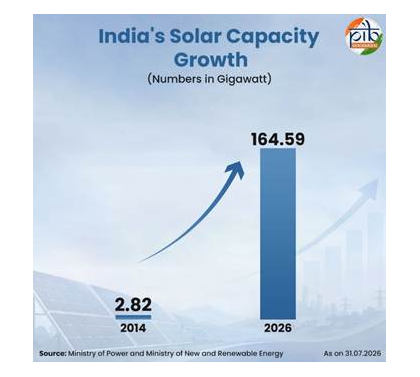
- Solar power has become the largest component of India’s renewable energy capacity. Installed solar capacity reached 164.59 GW as of 31 July 2026, compared to 2.8 GW in 2014.
- India also became the world’s second-largest solar growth market in 2025, adding more than 37 GW of solar capacity.
2. PM Surya Ghar: Muft Bijli Yojana
The scheme was launched in February 2024 with an outlay of ₹75,021 crore for 1 crore households.
Major outcomes include:
- 51.58 lakh households benefiting from rooftop solar
- around ₹28,024 crore subsidy transferred
- nearly 19 lakh households receiving zero electricity bills
- 14.8 GW rooftop solar capacity commissioned
The scheme links clean energy with household savings and decentralised power generation.
3. Pradhan Mantri Surya Sarovar Yojana
The government approved PM Surya Sarovar Yojana on 31 July 2026 with an outlay of ₹5,070 crore.
It targets 5,000 MW floating solar PV projects with energy storage systems. This adds a new dimension to solar growth by using water bodies and supporting storage-based renewable power.
4. Wind Energy
- India ranks fourth globally in installed wind power capacity. Wind capacity reached 58.14 GW as of 31 July 2026.
- India added 6.05 GW in FY2025-26, its highest-ever annual wind capacity addition. Around 28 GW of additional wind capacity is under implementation.
- The wind sector has also achieved 70–80% indigenisation across key components, supporting domestic manufacturing.
About Global Wind Day
International Cooperation
|
5. Hydropower
- Hydropower capacity, including large and small hydro, reached 57.24 GW. It provides reliable and flexible power and supports grid stability as solar and wind expand.
- The Small Hydro Power Development Scheme was approved in March 2026 for FY2026-27 to FY2030-31 with an outlay of ₹2,584.60 crore. It aims to add around 1,500 MW of small hydro capacity, especially in hilly and North-Eastern regions.
Bioenergy, GOBARdhan and Waste-to-Energy
- Bioenergy is becoming an important part of India’s circular energy economy. Bio-power capacity stood at 11.75 GW as of 31 July 2026.
- The CBG/Bio-CNG ecosystem has also expanded, with 1,929 plants registered, 217 commissioned, and 357 under construction as of August 2026.
- Waste-to-energy capacity includes both grid-connected and off-grid plants. The National Bioenergy Programme supports waste-to-energy, biomass and biogas projects through financial assistance.
GOBARdhan Scheme
- The Galvanizing Organic Bio-Agro Resources Dhan — National Circular Bioenergy Scheme was approved on 6 August 2026 with an outlay of ₹23,731 crore for FY2026-27 to FY2035-36.
- It aims to nearly increase domestic Compressed Biogas production ten-fold and create a circular bioeconomy by converting organic waste, cattle dung, agricultural residue and biomass into clean energy and manure.
Green Hydrogen, Nuclear and Geothermal Energy
1. National Green Hydrogen Mission
- The National Green Hydrogen Mission was approved in January 2023 with an outlay of ₹19,744 crore. It targets 5 MMT of green hydrogen production by 2030.
- By February 2026, around 8,000 tonnes per annum of green hydrogen production capacity had been commissioned.
- In July 2026, the government launched 12 pilot projects for 70 hydrogen-powered vehicles across 21 routes. India’s first indigenous hydrogen fuel cell-powered train began operations on the Jind–Sonipat section in July 2026.
2. Nuclear Energy
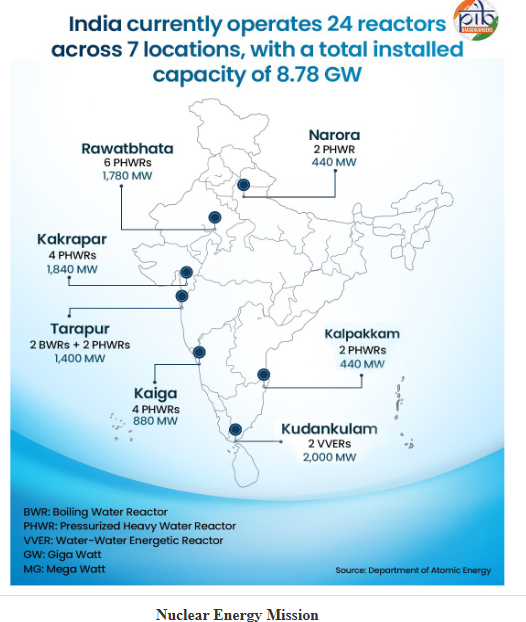
- India’s installed nuclear capacity reached 8.78 GW as of 31 July 2026.
- The Nuclear Energy Mission aims to increase nuclear power capacity to 100 GW by 2047. Capacity is projected to rise to 22.38 GW by 2031-32.
- The Mission also provides ₹20,000 crore for Small Modular Reactors, with a target of at least five indigenous SMRs by 2033.
- The 500 MWe Prototype Fast Breeder Reactor at Kalpakkam achieved first criticality on 6 April 2026, marking an important milestone in India’s three-stage nuclear programme.
What is Nuclear Energy? Nuclear energy is the use of controlled atomic reactions to produce power. At its core, it relies on splitting atoms in a process called fission, which releases large amounts of heat. This heat is then used to generate electricity without producing greenhouse gases. Globally, nuclear energy is valued as a clean, dependable source that complements renewable options like solar and wind. Evolution of India’s Nuclear Laws India’s nuclear power journey has been guided by a series of landmark legislations that ensured the peaceful use of atomic energy while safeguarding national interests. Each step reflected the country’s growing confidence and maturity in managing nuclear technology responsibly.
Ø The Atomic Energy Act, 1962, replaced the earlier 1948 law and laid down the foundation for India’s nuclear programme. It empowered the government to regulate atomic energy for peaceful purposes, ensuring strict control over research, development, and use of nuclear materials.
Ø Amendments in 1986, 1987, and 2015 in the Atomic Energy Act of 1962 gradually opened the sector beyond the Central Government, allowing government companies and joint ventures to participate in nuclear power generation. The amendments reflected India’s intent to expand capacity while keeping strategic oversight intact.
Ø The Civil Liability for Nuclear Damage Act, 2010, introduced a no-fault liability regime, ensuring compensation in case of nuclear incidents. This law provided clarity on responsibility and built public trust by prioritizing safety and accountability in nuclear operations. |
3. SHANTI Act, 2025
- The Sustainable Harnessing and Advancement of Nuclear Energy for Transforming India Act, 2025 enables private-sector participation in nuclear energy under licence.
- It gives statutory status to the Atomic Energy Regulatory Board, strengthening nuclear regulatory and safety functions.
4. Geothermal Energy
- The National Policy on Geothermal Energy was notified on 15 September 2025.
- The Geological Survey of India has estimated India’s geothermal potential at around 10,600 MW, based on exploration across 381 hot springs. The policy promotes partnerships, R&D and pilot projects to test techno-economic viability.
Fuel Access and Offshore Exploration
- India’s fuel landscape has also evolved. LPG coverage increased from 55.9% in 2014 to 107.2% in 2026, while LPG consumers rose from 14.51 crore to 33.18 crore.
- Under Pradhan Mantri Ujjwala Yojana, refill delivery reached around 49.21 crore cylinders in FY2025-26. This shows that clean cooking has shifted from being only an access issue to a household energy-use transformation.
- India is also the world’s fourth-largest crude refiner, with an installed refining capacity of 258.1 million tonnes per annum across 22 operational refineries.
- The Samudra Manthan National Offshore Exploration Scheme was approved on 31 July 2026 with an outlay of ₹84,084 crore to boost offshore oil and gas exploration.
Significance of India’s Energy Transition
1. Energy Security
India is reducing import dependence by strengthening domestic coal, gas, bioenergy, renewable power and offshore exploration.
2. Clean Energy Expansion
Solar, wind, hydro, nuclear, green hydrogen and geothermal energy support India’s long-term decarbonisation pathway.
3. Household Energy Access
Schemes such as PM Surya Ghar and PMUY connect energy policy with household welfare.
4. Domestic Manufacturing
Wind turbine manufacturing, solar capacity growth, nuclear technology and hydrogen pilots support industrial self-reliance.
5. Grid Stability
Hydropower, storage-based floating solar and nuclear power can support reliable electricity as variable renewable energy expands.
6. Circular Economy
Bioenergy and GOBARdhan convert waste into energy, manure and economic value.
Challenges
India’s energy transition faces multiple challenges. Coal continues to dominate electricity generation, creating pressure to balance energy security with climate goals. Renewable energy expansion needs grid modernisation, storage, land availability and transmission capacity.
Green hydrogen and geothermal energy are still emerging and require cost reduction, technology maturity and market creation. Nuclear expansion needs safety, financing and public trust. Bioenergy depends on reliable feedstock supply and local-level implementation.
Energy affordability also remains important because rapid transition must not create excessive cost burdens on households and industries.
Way Forward
1. Diversified Energy Strategy
India should continue balancing coal, renewables, nuclear, bioenergy and emerging fuels to ensure reliable supply.
2. Grid and Storage Expansion
Battery storage, pumped hydro, floating solar with storage and smart grids are essential for renewable integration.
3. Domestic Manufacturing
Solar modules, wind turbines, electrolysers, nuclear components and energy storage systems should be produced domestically.
4. Stronger Bioenergy Ecosystem
GOBARdhan and CBG plants need better feedstock aggregation, city gas offtake and credit support.
5. Responsible Coal Transition
Coal use should be made cleaner through efficiency, gasification, mine reclamation and gradual diversification.
6. Innovation in Emerging Technologies
Green hydrogen, SMRs, geothermal energy and offshore exploration require research, pilots and public-private partnership.
7. Affordable Energy Access
Energy transition must remain people-centric by ensuring reliable, affordable and clean energy for households, farmers and industries.
Conclusion
India’s energy journey reflects a careful balance between security, sustainability and innovation. The country is expanding renewables rapidly while strengthening domestic resources, energy access and future technologies. Solar, wind, bioenergy, nuclear, green hydrogen, geothermal energy and offshore exploration together indicate a diversified energy strategy. The next phase must focus on grid stability, storage, affordability, domestic manufacturing and responsible transition. A resilient and self-reliant energy system will be central to India’s economic growth and climate commitments.