Why in News?
The first Rural AI Lab in Telangana was inaugurated at Zilla Parishad High School, Adavisrirampur village (Peddapalli district). This initiative, powered by T-Fiber connectivity, was launched by the IT Minister to ensure equitable access to AI-powered learning tools for rural students.
Key Features of the Initiative
- AI for Rural Education: Students can now use AI-based tools for interactive learning, bridging the digital divide.
- Digital Infrastructure Backbone: Powered by T-Fiber, Telangana’s optical fiber network project, ensuring high-speed internet in villages.
- CCTV Surveillance: Enhances village-level safety and monitoring, showcasing holistic tech adoption.
- Pilot Internet Project: Aims for universal digital connectivity in Adavisrirampur before scaling across Telangana.
Significance
1. Educational Empowerment
- Democratizes access to advanced learning tools (AI tutors, language learning apps, STEM models).
- Enhances rural students’ competitiveness in exams and digital literacy.
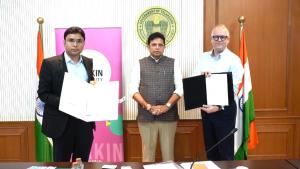
Image Source: The Hindu
2. Bridging the Digital Divide
- Rural Telangana becomes part of the state’s Digital Inclusion Strategy, reducing urban-rural disparities.
- Supports Digital India vision at the grassroots.
3. Community Benefits
- CCTV surveillance contributes to better law and order in villages.
- Internet access creates opportunities for telemedicine, e-governance, and online markets.
4. Policy Alignment
- Complements National Education Policy (NEP 2020) focus on digital education.
- Supports AI for All Strategy (NITI Aayog), integrating AI into education and governance.
- Advances UN SDGs – particularly Goal 4 (Quality Education) and Goal 9 (Industry, Innovation & Infrastructure).
Challenges
- Digital Literacy Gaps – Teachers and students need training to effectively use AI tools.
- Data Privacy & Security – AI-based systems require safeguards against misuse of data.
- Scalability & Maintenance – Extending such labs to thousands of villages will need sustained funding and monitoring.
- Infrastructure Reliability – Consistent power supply and internet speed are crucial.
Way Forward
- Capacity building for teachers and local communities.
- Public–Private Partnerships to expand AI learning content in local languages.
- Integration with skill development programs to prepare rural youth for AI-driven job markets.
- Strengthen cybersecurity and ethical guidelines for rural AI usage.
CARE MCQ
Q1. Consider the following statements about Telangana’s first Rural AI Lab:
- It has been established in Adavisrirampur village of Peddapalli district.
- The project is powered by T-Fiber, Telangana’s optical fiber network initiative.
- The AI Lab was launched under the “National Digital University” scheme.
Which of the statements given above is/are correct?
A) 1 and 2 only
B) 2 and 3 only
C) 1 and 3 only
D) 1, 2 and 3
Answer 1- A
Explanation
- Statement 1 is correct – The Rural AI Lab was inaugurated at Zilla Parishad High School, Adavisrirampur village in Peddapalli district of Telangana. This makes it the state’s first AI facility specifically designed for rural education and digital empowerment.
- Statement 2 is correct – The project is powered by T-Fiber (Telangana Fiber Grid), a state-led optical fiber connectivity initiative aimed at providing broadband to every household, institution, and government office. By integrating AI labs with T-Fiber, the state seeks to ensure seamless access to digital learning resources in villages.
- Statement 3 is incorrect – The initiative is a state-driven pilot under Telangana’s “Internet for Every Household” programme, not part of the Union government’s National Digital University scheme. The AI Lab is a localized digital inclusion measure rather than a central higher-education project.
Why in News?
Housing Minister inaugurated a toll-free call centre at the Housing Board Corporation in Hyderabad to receive and redress grievances of beneficiaries of the Indiramma Housing Scheme
Key Features of the Initiative
Helpline Operation: The toll-free grievance redressal helpline for the Indiramma Housing Scheme beneficiaries will function daily from 7 am to 9 pm, ensuring accessibility for the public throughout the day.
Beneficiary Tracking: Complaints will be registered and tracked using the beneficiary’s phone number and Aadhaar number, enabling accurate identification and follow-up action.
Types of Issues Addressed:
- Complaints related to delay in bill payments will be recorded and resolved.
- Problems in uploading photographs to the housing database will be handled through the call centre.
- Technical glitches in the Indiramma Housing App will be identified and forwarded to technical teams for correction.
- Allegations of corruption in the housing scheme will be received directly from the public and forwarded to higher authorities for appropriate action.
Use of Technology: The AI-enabled Indiramma Housing App has already demonstrated positive results in improving efficiency, and digital monitoring mechanisms will ensure speedy redressal of grievances.
Ministerial Oversight: To symbolise citizen-centric governance, the Housing Minister personally attended a live call from a beneficiary during the inauguration of the call centre, reflecting accountability at the highest level.
Significance

(Image Source: Deccan Chronicle)
1. Good Governance & Transparency
- Direct grievance redressal reduces middlemen and scope for corruption.
- Builds public trust in welfare schemes through responsive administration.
2. Technology Integration
- Extensive use of Artificial Intelligence (AI) in monitoring and processing complaints.
- Digitisation ensures real-time tracking of grievances.
3. Citizen-Centric Welfare Delivery
- Empowers beneficiaries, especially rural poor, to directly communicate with authorities.
- Enhances social accountability by providing status updates on grievances.
4. Policy Alignment
- Complements Digital India’s e-governance mission.
- Supports SDG 11 (Sustainable Cities & Communities) by ensuring better housing governance.
- Reflects constitutional principles of social justice and the directive principle of adequate housing.
Challenges
- Digital Divide: Rural poor may face difficulty in accessing helpline/app due to low digital literacy.
- Call Volume Management: Centre must be well-staffed to avoid delays.
- Follow-up Implementation: Field-level officials must act swiftly, else trust deficit will persist.
- Data Privacy: Aadhaar-linked tracking needs strong safeguards.
Way Forward
- Capacity Building: Train officials and beneficiaries in using AI-enabled grievance systems.
- Multi-Lingual Support: Ensure accessibility in regional languages.
- Integration: Link call centre with other welfare databases for holistic monitoring.
- Periodic Audits: Independent monitoring to ensure corruption-free functioning.
CARE MCQ
Q2. Which of the following statements are correct regarding Telangana’s new call centre for the Indiramma Housing Scheme?
- It operates daily from 7 am to 9 pm.
- Grievances are tracked using beneficiaries’ Aadhaar and phone numbers.
- The initiative is implemented under the Union Ministry of Housing and Urban Affairs.
Options:
A) 1 and 2 only
B) 2 and 3 only
C) 1 and 3 only
D) 1, 2 and 3
Answer 2- A
Explanation
- Statement 1 is correct
The call centre established at the Telangana Housing Board Corporation in Hyderabad operates daily from 7 am to 9 pm. This ensures that beneficiaries have a wide time window to register complaints and seek support. - Statement 2 is correct
The system links grievances to beneficiaries through their registered phone number and Aadhaar number, which helps in authenticating the complaint and providing individualised redressal. - Statement 3 is incorrect
The call centre is a Telangana State government initiative under the Indiramma Housing Scheme. It is not implemented under the Union Ministry of Housing and Urban Affairs; therefore, attributing it to a central-level scheme is factually wrong.
Why in News?
The Ministry of Statistics and Programme Implementation (MoSPI) has announced that it will conduct two nationally representative surveys — the All-India Debt and Investment Survey (AIDIS) and the Situation Assessment Survey (SAS) of Agricultural Households — between July 2026 and June 2027.
Introduction
- The government will undertake two major economic surveys in 2026–27 to provide granular insights into the financial condition of Indian households and farmers.
- These surveys are critical for policy planning, financial regulation, and agricultural development, and will guide institutions like the RBI, Ministry of Agriculture, and NITI Aayog.
About AIDIS (All-India Debt and Investment Survey)
- Provides critical data on household indebtedness and asset ownership across rural and urban areas.
- Findings help in:
- Shaping national accounts
- Assessing inequality in asset distribution
- Understanding credit markets
- Used by institutions such as the RBI, MoSPI, and other government bodies for framing financial policies.

(Image Source: Asian Age)
About SAS (Situation Assessment Survey of Agricultural Households)
First launched in 2003, it evaluates the economic condition of farmers. Covers:
- Household income & expenditure
- Indebtedness & credit access
- Land & livestock ownership
- Crop & livestock production
- Use of technology
- Access to government schemes & crop insurance
Findings are utilised by the Ministry of Agriculture, NITI Aayog, researchers, and financial institutions for agriculture and rural development policies.
Significance of the Surveys
- For Economic Planning: Provides foundational data for RBI, MoSPI, and Finance Ministry.
- For Agriculture: Helps Ministry of Agriculture and NITI Aayog design targeted farmer welfare policies.
- For Financial Inclusion: Identifies credit gaps and regional disparities in indebtedness.
- For Social Policy: Informs rural development and poverty alleviation strategies.
Public Consultation
- Draft concept notes and schedules of both surveys are uploaded on the MoSPI website.
- Inputs invited from policymakers, researchers, farmer groups, and the public to strengthen survey design.
Way Forward
Implementation from July 2026 – June 2027 with nationwide coverage. Expected to produce critical evidence for:
- Rural financial resilience policies
- Agricultural reforms
- Targeted social protection schemes
CARE MCQ
Q1. Consider the following statements regarding the upcoming economic surveys to be conducted by MoSPI in 2026–27:
- The All-India Debt and Investment Survey (AIDIS) provides household-level data that is crucial for shaping national accounts and analysing credit markets.
- The Situation Assessment Survey (SAS) of Agricultural Households focuses exclusively on land ownership patterns and excludes information on income, expenditure, and access to credit.
Which of the statements given above is/are correct?
- 1 only
- 2 only
- Both 1 and 2
- Neither 1 nor 2
Answer 1- A
Explanation
- Statement 1 – Correct: AIDIS is a core survey on household finance, covering indebtedness, assets, and investments, and its results are vital for national accounts and credit policy.
- Statement 2 – Incorrect: SAS is not limited to land ownership. It provides a comprehensive picture of farm households, including income, expenditure, indebtedness, production practices, access to technology, and government schemes.
- Therefore, option A is the correct answer.
UPSC PYQ
Q. Consider the following statements: (2020)
- The weightage of food in Consumer Price Index (CPI) is higher than that in Wholesale Price Index (WPI).
- The WPI does not capture changes in the prices of services, which CPI does.
- The Reserve Bank of India has now adopted WPI as its key measure of inflation and to decide on changing the key policy rates.
Which of the statements given above is/are correct?
- 1 and 2 only
- 2 and 3 only
- 1 and 3 only
- 1, 2 and 3 Ans: (a)
Why in News?
During the bilateral meeting held in Varanasi on September 11, 2025, Prime Minister Narendra Modi and his Mauritius counterpart, Navinchandra Ramgoolam, announced new initiatives to strengthen India–Mauritius ties across economic, cultural, healthcare, and strategic domains.
Introduction
- PM Modi emphasised that India and Mauritius share civilisational and diaspora bonds, calling
the two nations “not just partners but a family.”
- Both leaders highlighted the importance of a free, open, and secure Indian Ocean, reflecting convergence under India’s Neighbourhood First and SAGAR (Security and Growth for All in the Region) policies.
- The visit gained significance against the backdrop of China’s growing presence in the Indian Ocean, with India seeking to reinforce its role as Mauritius’s most trusted development and security partner.

Image Source: The Times of India
Major Announcements and Agreements
- Development & Healthcare Cooperation
- India announced a special economic package for Mauritius, including:
- Establishment of a 500-bed Sir Seewoosagur Ramgoolam National Hospital
- The first Jan Aushadhi Kendra outside India
- A veterinary school and animal hospital
- An AYUSH Centre of Excellence
- Education & Capacity Building
- Launch of Mission Karmayogi training modules in Mauritius.
- MoUs: IIT Madras and Indian Institute of Plantation Management with the University of Mauritius.
- Focus: capacity building, digital governance, and innovation.
- Technology & Oceanographic Cooperation
- Agreements in science, technology, power, and small development projects (Phase II).
- Hydrography project for joint surveys, navigation charts, and EEZ mapping.
- Cultural & Civilisational Linkages
- Strong emphasis on diaspora ties (Bhojpuri community linkages).
- PM Ramgoolam participated in Ganga Aarti and visited Kashi Vishwanath Dham.
China Factor in the Indian Ocean
- Mauritius has been a key site of strategic competition between India and China.
- China has increased its influence through infrastructure projects, port access, and financial loans.
- India’s new initiatives – healthcare projects, Mission Karmayogi, hydrography cooperation, and Jan Aushadhi Kendra – directly counterbalance China’s “checkbook diplomacy” by offering development with cultural and civilisational depth.
- The recent India–Mauritius meeting reaffirmed Mauritius’s alignment with India on security issues, ensuring that the island remains within the sphere of India’s SAGAR framework, even amid Beijing’s outreach in the region.
Significance of the Visit
- Strategic: Reinforces India’s leadership in the Indian Ocean Region (IOR) amidst growing Chinese assertiveness.
- Diplomatic: Mauritius remains a steadfast partner in India’s Neighbourhood First Policy.
- Economic & Health: Expands India’s model of developmental diplomacy via healthcare, education, and infrastructure.
- Soft Power: Strong civilisational bonds provide India an edge over China’s transactional
approach.
Way Forward
- Strengthen blue economy cooperation (fisheries, marine research, renewable ocean energy).
- Broaden digital public infrastructure linkages with Mauritius.
- Explore trilateral partnerships (India–Mauritius–France) for IOR security.
- Institutionalise people-to-people ties via diaspora engagement, cultural exchanges, and higher education links.
CARE MCQ
Q2 . With reference to India–Mauritius relations, consider the following statements:
- India has announced a special economic package that includes establishing the first Jan Aushadhi Kendra outside India in Mauritius.
- India and Mauritius will cooperate on hydrography involving joint surveys and EEZ mapping.
- The University of Mauritius has signed MoUs with IIT Madras and the Indian Institute of Plantation Management.
- China’s recent strategic investments in Mauritius were explicitly mentioned in the joint press
statement.
Which of the above statements is/are correct?
- 1 and 2 only
- 1, 2, and 3 only
- 2, 3, and 4 only
- 1, 2, 3, and 4
Answer 2: B
Explanation:
- Statement 1 – Correct – India has announced a special economic package for Mauritius, which includes the establishment of the first Jan Aushadhi Kendra outside India. This move is
intended to enhance access to affordable medicines in Mauritius, while also projecting India’s
pharmaceutical diplomacy.
- Statement 2 – Correct –Both countries agreed to work together on a hydrography project, which will involve joint surveys, preparation of navigation charts, and mapping of Mauritius’s Exclusive Economic Zone (EEZ). This initiative strengthens maritime cooperation and enhances India’s role in ensuring a secure and rule-based order in the Indian Ocean.
- Statement 3 – Correct – The University of Mauritius signed MoUs with IIT Madras and the Indian
Institute of Plantation Management (IIPM). These academic collaborations focus on research, education, capacity building, and innovation, thereby deepening India–Mauritius knowledge partnerships and extending India’s higher education influence abroad.
- Statement 4 – Incorrect – Although the China factor is an important strategic backdrop for
India’s outreach to Mauritius, it was not explicitly referenced in the joint press statement made by the two Prime Ministers. The statements focused instead on civilisational ties, economic cooperation, and Indian Ocean security.
Therefore, 1, 2, and 3 are correct → Option B. UPSC PYQ
Q. With reference to ‘Indian Ocean Rim Association for Regional Cooperation (IOR-ARC)’,
Consider the following statements: (2015)
- It was established very recently in response to incidents of piracy and accidents of oil spills
- It is an alliance meant for maritime security only
Which of the following statements given above is/are correct?
- 1 only
- 2 only
- Both 1 and 2
- Neither 1 nor 2 Answer: (d)
Why in News?
Countries like Spain, Ireland, and Norway have formally recognised the State of Palestine, with France and other nations signalling readiness to follow.
Introduction
- The recognition is seen as an attempt to preserve the two-state solution, which is under threat
after Israel’s rejection of the framework.
- It represents a symbolic but powerful shift in Europe’s foreign policy, signalling growing
discomfort with being passive observers of the conflict.
Why Recognition Now?
- War in Gaza: The humanitarian catastrophe post–October 7 attacks has shocked Europe, making the status quo untenable.
- Rejection of Two-State Solution: Israel’s official stance under PM Netanyahu has been to reject
the two-state solution, pushing Europe to act to keep it alive.
- ICJ Proceedings: South Africa’s case accusing Israel of violating the Genocide Convention has
added legal pressure.
- Recognition is no longer seen as a “final reward” after peace, but as a necessary step to keep
peace viable.

Image Source: The Hindu
Ukraine Factor and International Law
- Europe’s strong stand against Russia’s invasion of Ukraine (2022) highlighted the principle of
sovereignty and inadmissibility of land acquisition by force.
- Critics pointed out Europe’s double standards in ignoring Israel’s occupation.
- Recognition of Palestine is partly to close this “consistency gap” and restore Europe’s credibility
on international law.
Domestic Political Pressures
- Public Opinion: Eurobarometer survey (2023) – 72% of Europeans support upholding international law in all conflicts.
- Protests: Large-scale demonstrations, student encampments, and human rights campaigns demanding recognition.
- Electoral Pressure: Ruling centre-left and green parties, reliant on youth and progressive voters, risk backlash if they remain passive.
Why Some Move Faster than Others?
- Spain, Ireland, Norway: Tradition of supporting Palestinian cause; Norway hosted Oslo Accords (1993). Recognition signals frustration with failed negotiations.
- Germany, Austria: Reluctant due to Holocaust legacy and strong pro-Israel commitments.
- Eastern Europe (Poland, Hungary): Recognised Palestine decades ago under Soviet influence, but now prioritise alignment with U.S. policy.
EU Coordination Challenge
- The EU’s Common Foreign and Security Policy requires unanimity, which is currently impossible.
- Recognition is thus left to individual states.
- However, coordinated actions by groups (Spain, Ireland, Norway) amplify political impact and encourage others to follow.
Significance of the Shift
- Symbolic Power: Recognition will not end occupation but signals Europe’s discomfort with
dismantling of the two-state solution.
- Pressure on Israel: Reinforces the idea that international legitimacy requires negotiation, not unilateralism.
- Global Standing: Positions Europe as a moral voice in global diplomacy, despite divisions.
Way Forward
- Push for EU-wide consensus even if gradual.
- Strengthen humanitarian aid and reconstruction efforts in Gaza.
- Align recognition with revival of peace talks under international frameworks (UN, Quartet).
- Balance between supporting Palestine and ensuring Israel’s legitimate security concerns.
CARE MCQ
Q3. With reference to the recent recognition of Palestine by European nations, consider the following statements:
- Countries like Spain, Ireland, and Norway have formally recognised Palestine, while France has expressed conditional readiness.
- The move has been partly shaped by Europe’s response to Russia’s invasion of Ukraine and
the principle of inadmissibility of land acquisition by force.
- Recognition of Palestine requires unanimous approval under the EU’s Common Foreign and
Security Policy, which has already been achieved.
- Domestic political pressure, including youth protests and human rights activism, has contributed significantly to this shift.
Which of the above statements is/are correct?
- 1, 2, and 4 only
- 2 and 3 only
- 1 and 3 only
- 1, 2, 3, and 4
Answer 3- A
Explanation
- Statement 1 – Correct- Spain, Ireland, and Norway have formally recognised Palestine; France
has expressed readiness at a “useful moment.”
- Statement 2 – Correct- The Ukraine war highlighted principles of sovereignty and exposed Europe’s double standards in ignoring Israel’s occupation while opposing Russia’s annexation of Ukrainian territory.
- Statement 3 – Incorrect- The EU’s Common Foreign and Security Policy requires unanimity, but such consensus has not been achieved; recognitions are being undertaken individually by member states.
- Statement 4 – Correct- Domestic protests, civil society activism, and youth-led demonstrations have fuelled political pressure on European governments to act.
UPSC PYQ
Q. The term “two-state solution” is sometimes mentioned in the context of the affairs of: (2018)
- China
- Israel
- Iraq
- Yemen Ans: b

Why in News?
The GST Council has rolled out wide-ranging tax reforms in the health-care sector under GST 2.0, effective from September 22, 2025. These reforms aim to make health care more affordable and strengthen India’s progress toward universal health coverage.
Key Provisions of the GST Health-Care Reforms
- Insurance and Reinsurance
- Zero GST on individual health and life insurance premiums.
- Covers all forms of life insurance — term, ULIP, endowment — and health insurance plans like
family floaters and senior citizen policies.
- Reinsurance also exempt, benefiting the entire insurance chain.
- Aims to boost India’s low insurance penetration (3.7% of GDP vs global average 6.8%).

Image Source: Outlook India
- Hospital Room Charges
- Exempt: Rooms below ₹5,000 per day.
- Taxed: Non-ICU rooms above ₹5,000 → 5% GST without input tax credit.
- Exempt: All critical care units (ICU, CCU, ICCU, NICU) remain fully GST-free.
- Core medical services by doctors, hospitals, paramedics remain GST-exempt.
- Medicines and Medical Devices
- Life-saving drugs: GST reduced to 0%.
- Most medicines: Shifted to a uniform 5% GST slab.
- Medical devices & diagnostics: Now taxed at 5% (earlier 12–18%).
- Example: CT scan machine GST cut from 18% → 5%.
- Expected to lower procurement costs for hospitals and reduce patient charges for diagnostic tests.
- Preventive and Wellness Services
- GST reduced from 18% to 5% on:
- Gyms, fitness centres, yoga studios, wellness services, salons, barbers.
- Cigarettes: Remain taxed at 28% GST + cess (52–88%).
- Sugary drinks: Shifted to new 40% sin goods slab.
- Personal care items (shampoo, toothpaste, soap, shaving cream, etc.): GST cut from 12–18% →
5%.
Significance of the Reforms
- Financial Relief: Eliminates GST burden on insurance premiums and reduces treatment costs.
- Equity: Protects middle- and lower-income groups via room rent exemptions.
- Industry Impact: Simplifies compliance, reduces procurement costs, and improves competitiveness for hospitals and labs.
- Public Health: Encourages preventive health and discourages harmful consumption (tobacco, sugary drinks).
- Policy Alignment: Supports Viksit Bharat 2047 vision of affordable and accessible health care.
Challenges and Concerns
- Pass-through of Benefits: Savings may not reach consumers unless monitored
- Revenue Loss: Lower GST collections for states; may need compensation.
- Implementation: Ensuring uniform compliance by insurers, hospitals, and diagnostic labs.
Way Forward
- Stronger regulatory oversight to ensure insurers and hospitals pass on GST benefits to patients.
- Use of GST reforms to incentivise preventive health and insurance adoption.
- Integration with Ayushman Bharat and state health schemes to maximise impact.
CARE MCQ
Q5. With reference to the recent GST 2.0 reforms in the health-care sector, consider the following statements:
- All individual health and life insurance premiums are now exempt from GST.
- Non-ICU hospital rooms above ₹5,000 per day are taxed at 5% GST without input tax credit.
- All critical care units, such as ICU and NICU, remain fully exempt from GST.
- Cigarettes and sugary drinks have been moved to the same 40% “sin goods” GST slab.
Which of the statements given above is/are correct?
- 1, 2, and 3 only
- 2 and 4 only
- 1, 2, 3, and 4
- 1 and 3 only
Answer 5- A
Explanation
- Statement 1 is correct: Under GST 2.0 reforms, all individual health and life insurance premiums are exempt from GST. This includes term insurance, ULIPs, endowment plans, and health insurance schemes such as family floaters and senior citizen policies. The move reduces costs and supports wider insurance penetration.
- Statement 2 is correct: Non-ICU hospital rooms costing above ₹5,000 per day are taxed at 5% GST without input tax credit (ITC). This continues the policy from July 2022 and ensures that premium accommodation in hospitals attracts a limited tax while keeping core treatment costs affordable.
- Statement 3 is correct: All critical care units — ICU, CCU, ICCU, NICU — remain fully exempt from GST irrespective of room tariff. This guarantees that life-saving and emergency care services remain tax-free.
- Statement 4 is incorrect: Cigarettes continue to attract 28% GST plus a compensation cess, leading to an effective tax burden of 52% to 88%. In contrast, sugary drinks have been shifted to a new 40% “sin goods” slab, not the same as cigarettes.
Therefore, option A is the correct answer. UPSC PYQ
Q. In India, which of the following reviews the independent regulators in sectors like telecommunications, insurance, electricity etc.? (2019)
- Ad Hoc Committees set up by the Parliament.
- Parliamentary Department Related Standing Committees
- Finance Commission
- Financial Sector Legislative Reforms Commission
- NITI Aayog
Select the correct answer using the code given below.
- 1 and 2
- 1, 3 and 4
- 3, 4 and 5
- 2 and 5 Ans: (a)
Why in News?
Mazagon Dock Shipbuilders Limited (MDL) has begun formal contract negotiations with procurement authorities for Project 75(I), a flagship programme under Atmanirbhar Bharat, aimed at building six next-generation submarines in India with German technology support.
Introduction
- Project 75(I) is part of India’s plan to modernise the Indian Navy’s underwater fleet.
- The collaboration involves MDL (India) and ThyssenKrupp Marine Systems (TKMS), Germany.
- The programme focuses on technology transfer, indigenisation, and regional maritime security.

Image Source: The Financial Express
About MDL and TKMS
Mazagon Dock Shipbuilders Limited (MDL):
- India’s premier defence public sector shipyard, headquartered in Mumbai.
- Known for building warships and submarines, including Scorpene-class submarines under Project 75 in collaboration with France.
- Plays a central role in India’s self-reliance in naval manufacturing. ThyssenKrupp Marine Systems (TKMS), Germany:
- Among the world’s leading submarine and naval system manufacturers.
- Known for advanced diesel-electric submarines such as the Type 214 and Type 218 with proven Air Independent Propulsion (AIP) technology.
- Has decades of expertise in stealth technology, sonar systems, and modular submarine design.
Key Features of Project 75(I)
- Construction of six conventional submarines in India.
- Use of Air-Independent Propulsion (AIP) systems to enhance underwater endurance.
- Technology transfer from TKMS to MDL, building indigenous shipbuilding capacity.
- Focus on stealth, endurance, and strike capability for modern naval warfare.
Strategic and Industrial Significance
- For India:
- Strengthens indigenous capacity in submarine design and manufacturing.
- Supports Atmanirbhar Bharat and Make in India by boosting local supply chains, jobs, and skills.
- Enhances India’s position as a net security provider in the Indian Ocean Region (IOR).
- For Germany:
- Reinforces its role as a trusted defence technology partner in Asia.
- Consolidates industrial cooperation with India in high-technology defence manufacturing.
- Regional Security:
- Counters China’s expanding naval footprint in the IOR.
- Boosts India’s deterrence and maritime domain awareness.
India–Germany Defence Relations
- The partnership has deepened in the last decade, focusing on maritime security, defence technology transfer, and joint R&D.
- 2019 Defence Cooperation Agreement set the foundation for stronger collaboration.
- Germany supports India’s role in maintaining freedom of navigation in the Indo-Pacific.
- Naval cooperation has expanded to include joint exercises, training exchanges, and high-level dialogues.
- Project 75(I) represents a landmark Indo-German defence collaboration, highlighting mutual trust.
Challenges Ahead
- Technology absorption: Effective transfer and integration of advanced German submarine technology.
- Timelines and costs: Preventing delays and overruns in one of India’s costliest defence projects.
- Operational training: Building Indian expertise to manage advanced AIP-based platforms.
Way Forward
- Strengthen public–private ecosystem to build submarine components domestically.
- Position India as a submarine manufacturing hub with export potential.
- Create lifecycle maintenance infrastructure within India to reduce foreign dependence.
CARE MCQ
Q. With reference to Project 75(I), consider the following statements:
- It envisages construction of six conventional submarines in India with German technology.
- The submarines under this project will include Air-Independent Propulsion (AIP) systems.
- MDL is India’s leading shipyard for submarine construction and has earlier built Scorpene-class submarines.
- TKMS of Germany is a global leader in submarine design and is known for Type 214 submarines.
Which of the above statements are correct?
- 1 and 2 only
- 1, 2, and 3 only
- 2, 3, and 4 only
- 1, 2, 3, and 4
Answer 6- D
Explanation
- Statement 1 is correct – Project 75(I) aims to construct six advanced conventional submarines in India. This will be done through collaboration with Germany under the Atmanirbhar Bharat framework.
- Statement 2 is correct – The submarines will be equipped with Air-Independent Propulsion
(AIP) systems. This technology enables longer underwater endurance and enhances stealth.
- Statement 3 is correct – Mazagon Dock Shipbuilders Limited (MDL) is India’s premier submarine shipyard. It has earlier constructed the Scorpene-class submarines under Project 75 with French assistance.
- Statement 4 is correct – ThyssenKrupp Marine Systems (TKMS), Germany, is a global leader
in submarine design. It is especially renowned for its Type 214 and Type 218 submarines with proven AIP technology.
Therefore, option D is the correct answer. UPSC PYQ
Q. Which one of the following is the best description of INS Astradharini? (2016)
- Amphibious warfare ship
- Nuclear-powered submarine
- Torpedo launch and recovery vessel
- Nuclear-powered aircraft carrier Ans: (c)