
Relevance: Welfare Schemes, Education, Governance, DBT, Social Sector Development
For Prelims:
- Talliki Vandanam, Direct Benefit Transfer, DBT, Aadhaar-seeded bank account, NPCI mapping, Rice Card, NBM Portal, Gram/Ward Sachivalayam, 75% attendance, Class 1 to Class 12, Intermediate
For Mains:
- Education welfare, dropout reduction, mother-centric DBT, human capital formation, school infrastructure, digital governance, targeted welfare, beneficiary verification, inclusive education
Why in News?
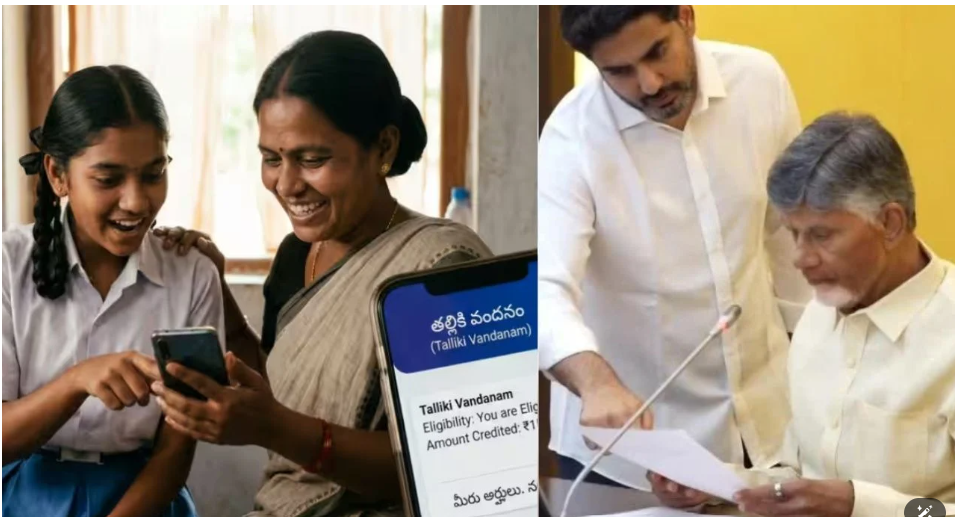
The Andhra Pradesh government has begun disbursing benefits under the Talliki Vandanam Scheme 2026 through Direct Benefit Transfer to eligible mothers or guardians. Reports state that beneficiaries have started receiving ₹13,000 in their bank accounts from 22 July 2026, after deduction of ₹2,000 from the total annual assistance of ₹15,000 per student.
What is Talliki Vandanam Scheme?
- Talliki Vandanam is an education-support welfare scheme of the Andhra Pradesh government. It provides annual financial assistance to mothers or guardians of eligible school-going children to support continuation of education and reduce dropout risks.
- The scheme covers students from Class 1 to Class 12, including Intermediate, studying in recognised institutions. It applies across government, aided, private and residential schools, subject to eligibility conditions.
- The scheme is significant because it provides support per eligible child, meaning the benefit is not restricted to only one child in a family. This makes it broader than schemes that follow a one-beneficiary-per-household model.
Amount and Disbursal Pattern
The Andhra Pradesh government has sanctioned ₹10,120.78 crore for implementation of the scheme during Academic Year 2026–27, covering 67,47,190 students and 42,70,802 eligible mothers or guardians.
| Details | Information |
| Total annual assistance | ₹15,000 per student |
| Amount credited to mother/guardian | ₹13,000 |
| Amount deducted | ₹2,000 |
| Use of deducted amount | School maintenance, hygiene, sanitation and educational ecosystem development |
| Mode of payment | Direct Benefit Transfer |
| Bank requirement | Aadhaar-seeded and NPCI-mapped account |
The ₹2,000 deduction is meant for school-level needs such as sanitation, maintenance and essential educational infrastructure.
Eligibility Criteria
Income Criteria
| Category | Income Limit |
| Rural family | Below ₹10,000 per month |
| Urban family | Below ₹12,000 per month |
Household Conditions
| Requirement | Eligibility Rule |
| Rice Card | Mandatory |
| Landholding | Wet land up to 3 acres or dry land up to 10 acres |
| Vehicle ownership | No private four-wheeler, subject to applicable exceptions |
| Electricity consumption | Below 300 units per month |
| House size | Less than 1,000 sq. ft. |
| Employment / tax status | Families with government or public sector job/income-tax status are generally excluded, subject to rules |
The mother or guardian’s bank account must be Aadhaar-seeded and NPCI-mapped for DBT release. Reports also advise beneficiaries to keep their bank or post office savings account active and properly linked to avoid payment failure.
Student Eligibility and Exclusions
Eligible Students
Students are generally eligible if they:
- study in Class 1 to Class 12, including Intermediate
- are enrolled in a recognised school or junior college
- belong to an eligible household
- maintain at least 75% attendance
- have valid records verified through school and government databases
Orphans and highly vulnerable children, including street children studying under recognised voluntary organisations, may be considered under special provisions as per reported scheme details.
Excluded Students
The scheme does not cover:
- students admitted to ITI
- students admitted to Polytechnic institutions
- students covered under specified fee reimbursement programmes, subject to scheme rules
Conclusion
The Talliki Vandanam Scheme 2026 is a major education welfare initiative of Andhra Pradesh. By providing ₹15,000 per eligible student, with ₹13,000 transferred through DBT and ₹2,000 used for school infrastructure and sanitation, the scheme attempts to combine household support with institutional improvement. Its success will depend on transparent verification, timely payment, effective grievance redressal and measurable educational outcomes.
CARE MCQ
Q. Consider the following statements regarding the Talliki Vandanam Scheme 2026:
- The scheme provides annual financial assistance of ₹15,000 per eligible student.
- Out of the total amount, ₹13,000 is credited through DBT and ₹2,000 is deducted for school maintenance and sanitation.
- The scheme is limited to only one child per eligible family.
- Beneficiary bank accounts must be Aadhaar-seeded and NPCI-mapped.
Which of the statements given above are correct?
(a) 1, 2 and 4 only
(b) 1 and 3 only
(c) 2, 3 and 4 only
(d) 1, 2, 3 and 4
Correct Answer: (a) 1, 2 and 4 only
Explanation
Statement 1 is correct: The scheme provides ₹15,000 per eligible student annually.
Statement 2 is correct: ₹13,000 is credited to the mother/guardian’s account, while ₹2,000 is deducted for school-related purposes.
Statement 3 is incorrect: The benefit is available for every eligible child in the household, not only one child.
Statement 4 is correct: The beneficiary account must be Aadhaar-seeded and NPCI-mapped for DBT.access, reduce dropout risks and improve human capital formation in Andhra Pradesh.
FAQs
1. What is Talliki Vandanam Scheme?
It is an Andhra Pradesh education welfare scheme providing annual financial assistance to mothers or guardians of eligible students.
2. How much assistance is provided?
The total assistance is ₹15,000 per eligible student per year.
3. How much is credited to the beneficiary account?
Generally, ₹13,000 is credited through DBT.
4. Why is ₹2,000 deducted?
It is used for school maintenance, sanitation, hygiene and educational ecosystem development.
5. Who is eligible under the scheme?
Students from Class 1 to Class 12, including Intermediate, studying in recognised institutions and satisfying household eligibility criteria.
Relevance: UPSC GS Paper III: Infrastructure, Aviation Sector, Regional Connectivity, Inclusive Growth
For Prelims:
- UDAN, Ude Desh ka Aam Nagrik, Regional Connectivity Scheme, RCS, Modified UDAN, Viability Gap Funding, RCS Levy, Unserved Airports, Underserved Airports, Helipads, Water Aerodromes, HAL Dhruv, HAL Dornier
For Mains:
- Affordable air travel, regional connectivity, last-mile connectivity, inclusive infrastructure, balanced regional development, tourism promotion, aviation sustainability, public-private participation
Why in News?
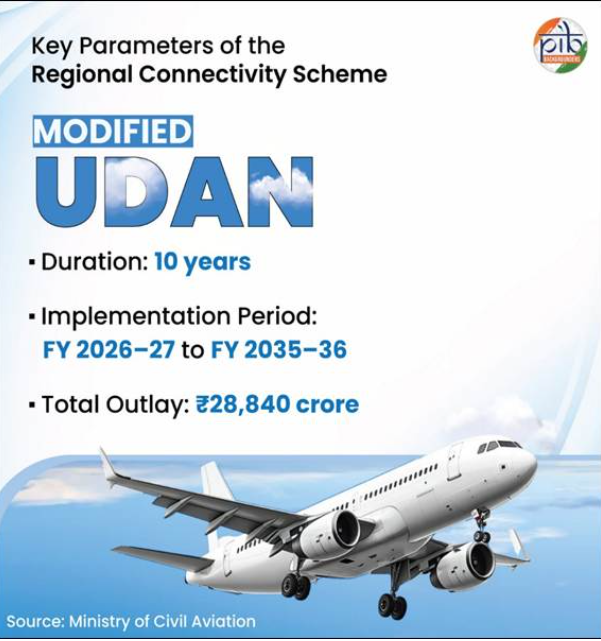
The Government recently launched the Modified UDAN Scheme to deepen regional connectivity and build on the achievements of the original UDAN programme. Modified UDAN will operate from FY 2026–27 to FY 2035–36 with an outlay of ₹28,840 crore, focusing on airport infrastructure, operational support, airline viability and specialised connectivity in remote regions.
What is UDAN Scheme?
- UDAN stands for Ude Desh ka Aam Nagrik. It is a Regional Connectivity Scheme launched to make air travel affordable and accessible for common citizens.
- The scheme aims to connect small and medium cities with bigger cities through air services. It focuses on bringing unserved and underserved airports into the national aviation network.
- Under UDAN, the airfare for a one-hour journey by fixed-wing aircraft or around 500 km air travel was fixed at about ₹2,500. This made regional air travel cheaper and more accessible for ordinary passengers.
How UDAN Started
- UDAN was launched in October 2016 under the National Civil Aviation Policy, 2016.
- The basic idea was to fulfil the common citizen’s dream of air travel and extend aviation beyond metro cities. The first UDAN flight was operated on the Shimla–Delhi route in April 2017.
- The scheme became an important policy instrument to democratise air travel and integrate smaller towns into India’s aviation map.
How UDAN Works
UDAN follows a market-driven bidding model.
Airline companies bid for regional air routes. The airline that asks for the lowest subsidy is generally awarded the route.
To make the service affordable and viable:
- fares are capped for selected seats
- airlines receive Viability Gap Funding
- airport charges and operational costs are reduced
- States provide support through concessions
- limited route exclusivity is provided
Under the fare-linked arrangement, airlines are required to reserve a specified number of seats for affordable travel on UDAN routes.
What Changed After UDAN?
Before UDAN, India’s aviation growth was largely concentrated in a few big metro cities. Smaller towns and medium cities did not receive equal benefits.
| Before UDAN | After UDAN |
| Air connectivity was concentrated mainly in big metro cities. | Connectivity began shifting towards small and medium cities. |
| Small towns had limited access to regular flights. | More regional routes were opened. |
| Passengers depended on long road or rail journeys. | Travel time reduced significantly on many regional routes. |
| Aviation benefits were unevenly distributed. | Air travel became more inclusive and citizen-oriented. |
| Regional economic activity was restricted by poor connectivity. | Tourism, local trade, healthcare access and mobility improved. |
The provided classroom material also notes that after UDAN, air traffic became more regionally distributed, airline operating costs reduced due to support mechanisms, and passenger numbers from smaller cities increased.

Key Achievements of UDAN
UDAN has expanded India’s regional aviation network in a major way.
Key achievements include:
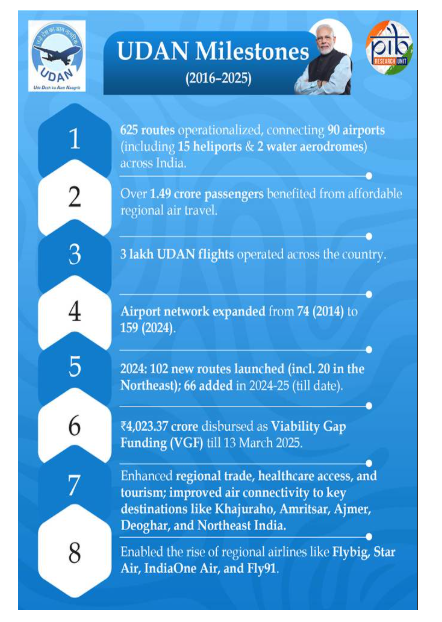
- 679 routes operationalised.
- 95 airports, heliports and water aerodromes connected.
- More than 1.68 crore passengers benefited.
- India’s operational airports increased from 74 in 2014 to 165 by July 2026.
- India has emerged as the third-largest domestic aviation market globally.
The scheme has improved connectivity to remote, hilly and island regions such as Tezpur, Pasighat, Diu, Pithoragarh and Rourkela.
UDAN has also supported:
- tourism
- local economic activity
- healthcare access
- emergency services
- faster movement of people and goods
Passenger-friendly initiatives such as UDAN Yatri Cafés, Flybrary and free Wi-Fi services have improved the travel experience.
Need for Modified UDAN
The original UDAN scheme achieved major success, but it also faced sustainability challenges.
1. Route Viability Issue
Many regional routes had low passenger demand in the initial years. Some routes struggled to remain commercially viable after the subsidy period ended.
2. Short Subsidy Period
The earlier subsidy period was often not sufficient for airlines to build stable passenger markets in smaller cities.
3. Disused Routes and Airports
Some routes and revived airports became inactive due to low demand, high operating costs and weak commercial viability.
4. Difficult Terrain
Remote, hilly and island regions need specialised aircraft, helicopters and helipads rather than conventional airport infrastructure alone.
Therefore, Modified UDAN was introduced to strengthen long-term sustainability, airport infrastructure and airline viability.
Key Features of Modified UDAN
Modified UDAN is a revamped version of the UDAN scheme, aimed at improving connectivity to Tier-2 and Tier-3 cities and difficult regions.
| Feature | Details |
| Implementation period | FY 2026–27 to FY 2035–36 |
| Total outlay | ₹28,840 crore |
| Main focus | Infrastructure, operational support and airline viability |
| Special focus | Remote and geographically difficult regions |
| Approach | Affordable air travel with long-term operational sustainability |
The scheme supports helicopters, helipads and specialised aircraft to improve last-mile connectivity.
Components of Modified UDAN
1. Development of Aerodromes
The scheme proposes the development of 100 airports from existing unserved airstrips. This will help connect smaller towns and remote regions with the national transport network.
2. Operation and Maintenance Support
Small airports, heliports and water aerodromes often face high recurring costs and low revenue. Modified UDAN provides O&M support to help them continue operations during the initial years.
3. Development of Modern Helipads
The scheme proposes 200 modern helipads in priority regions where airports may not be feasible. This is especially important for hilly, remote and difficult areas.
4. Viability Gap Funding
Regional air routes often need support because passenger demand is initially low. Viability Gap Funding helps airlines operate such routes until they become commercially sustainable.
5. Atmanirbhar Aviation Capacity
The scheme proposes the use of HAL Dhruv helicopters and HAL Dornier aircraft. This supports indigenous aviation capacity and improves operations in remote terrain.
Funding Mechanism and Institutional Support
- UDAN uses an innovative RCS levy mechanism. A small fee is levied on selected domestic flights to fund regional connectivity.
- This helps create financial support from within the aviation sector itself.
- Government participation also improves coordination among airlines, airports and State governments. Non-monetary concessions reduce the operational cost for airline operators and make regional routes more viable.
Significance of UDAN and Modified UDAN
1. Democratisation of Air Travel
UDAN makes air travel accessible to ordinary citizens and smaller towns.
2. Regional Development
The scheme connects smaller cities with larger markets, improving trade, mobility and services.
3. Tourism Promotion
Air connectivity to remote, hilly and island destinations supports tourism and local employment.
4. Healthcare and Emergency Services
Helipads and regional air services improve access to emergency care and administrative support.
5. Last-Mile Connectivity
Modified UDAN strengthens connectivity in difficult regions where ordinary airports may not be practical.
6. Employment Generation
The scheme creates jobs in aviation, airport services, tourism, logistics and allied sectors.
7. Atmanirbhar Bharat
Use of indigenous aircraft and helicopters strengthens domestic aviation manufacturing and operational capability.
Challenges
1. Commercial Sustainability
Many regional routes may not become profitable immediately after subsidy support ends.
2. Low Passenger Demand
Smaller towns may initially have limited passenger traffic.
3. High Operating Costs
Regional routes and small airports often face high fuel, maintenance and operational costs.
4. Infrastructure Gaps
Some areas need better airports, road links, terminal facilities and passenger services.
5. Aircraft Availability
Regional aviation requires suitable small aircraft and helicopters.
6. Balanced Planning
Air connectivity must be linked with tourism, business, healthcare and cargo demand to become sustainable.
Way Forward
India should make UDAN routes commercially viable by integrating them with tourism circuits, healthcare networks, business travel, cargo services and regional economic planning. Regional airports should be connected with road, rail and bus networks. Modified UDAN should ensure timely airport development, efficient use of VGF, modern helipad construction, passenger facilities and indigenous aviation capacity.
Conclusion
UDAN has transformed India’s aviation sector by shifting air connectivity from a metro-centric model to a more inclusive regional network. Modified UDAN marks the next phase by focusing on infrastructure, helipads, operational support, airline viability and indigenous aviation capacity. If implemented effectively, it can make India’s aviation network more inclusive, resilient and economically sustainable.
UPSC PYQ
Q. Consider the following airports: [2024]
1. Donyi Polo Airport
2. Kushinagar International Airport
3. Vijayawada International Airport
In the recent past, which of the above have been constructed as Greenfield projects?
a) 1 and 2 only
b) 2 and 3 only
c) 1 and 3 only
d) 1, 2 and 3
Ans: (a)
CARE MCQ
Q. Consider the following statements regarding UDAN and Modified UDAN:
- UDAN stands for Ude Desh ka Aam Nagrik.
- UDAN was launched under the National Civil Aviation Policy, 2016.
- Modified UDAN focuses on airport infrastructure, operational support and airline viability.
- Modified UDAN supports helicopters, helipads and specialised aircraft for remote regions.
Which of the statements given above are correct?
(a) 1, 2 and 3 only
(b) 1 and 4 only
(c) 2, 3 and 4 only
(d) 1, 2, 3 and 4
Correct Answer: (d) 1, 2, 3 and 4
Explanation
Statement 1 is correct: UDAN stands for Ude Desh ka Aam Nagrik.
Statement 2 is correct: UDAN was launched under the National Civil Aviation Policy, 2016.
Statement 3 is correct: Modified UDAN focuses on infrastructure, operational support and commercial viability.
Statement 4 is correct: It supports helicopters, helipads and specialised aircraft for remote and difficult regions.
FAQs
1. What is UDAN?
UDAN is a Regional Connectivity Scheme aimed at making air travel affordable and accessible to ordinary citizens.
2. What is the full form of UDAN?
Ude Desh ka Aam Nagrik.
3. When was UDAN launched?
It was launched in October 2016.
4. What was the first UDAN flight route?
The first UDAN flight operated on the Shimla–Delhi route.
5. What is Modified UDAN?
It is the next phase of UDAN focused on airport infrastructure, helipads, operational support and airline viability.
6. Why was Modified UDAN needed?
It was needed because some regional routes and airports faced sustainability challenges after initial subsidy support.
7. What is Viability Gap Funding?
It is financial support given to airlines to operate regional routes that are not commercially viable in the initial period.
Relevance: UPSC: GS Paper II: Governance, Civil Society, NGOs, Transparency, Accountability GS Paper III: Internal Security, Foreign Influence, National Security
For Prelims:
- FCRA, Foreign Contribution, Foreign Source, Ministry of Home Affairs, SBI New Delhi Main Branch, Form FC-4, Form FC-6F, Section 3, Section 15, Designated Authority, Prior Permission, FCRA Registration, FARA, FITS, FIRS
For Mains:
- Foreign funding regulation, civil society accountability, national sovereignty, public order, donor transparency, democratic accountability, foreign influence regulation, judicial review, state capacity
Why in News?
The Government released a detailed FAQ on the Foreign Contribution (Regulation) Act, explaining its purpose, evolution, compliance requirements and the changes proposed through the FCRA Amendment Bill, 2026 and revised Rules. The central theme is that FCRA is a framework for transparency, sovereignty and democratic accountability, not a blanket ban on civil society or foreign donations.
What is FCRA?
The Foreign Contribution (Regulation) Act governs the acceptance and utilisation of foreign contribution received from a foreign source.
Foreign contribution may include:
- article
- currency
- foreign security
- income arising from such foreign contribution
The Act is administered by the Ministry of Home Affairs.
In simple terms, FCRA does three things:
- Identifies who may accept foreign contributions and under what conditions.
- Specifies how such money must be received, accounted for and reported.
- Regulates foreign-funded activities that may affect India’s sovereignty, security or public order.
The law originated in 1976, was replaced by a new law in 2010, and has been amended over time to strengthen compliance and accountability.
Core Objectives of FCRA
FCRA is based on five broad principles.
1. Transparency
Organisations receiving foreign contribution must register, receive funds through a verifiable banking channel and disclose donors, amounts and purposes.
2. Accountability
Recipients must file annual audited returns online.
3. Sovereignty
Foreign contributions that may adversely affect India’s sovereignty, democratic institutions, electoral processes, public order or national security are regulated.
4. Enabling Genuine Work
Foreign funding is allowed for genuine work in education, healthcare, poverty alleviation, disaster relief, cultural exchange, scientific research and environmental activities.
5. Public Confidence
Disclosure and audit build trust in voluntary organisations and the wider civil society sector.
Does FCRA Ban Foreign Donations?
No. FCRA does not impose a general ban on foreign donations.
It permits eligible associations to receive foreign contribution after obtaining:
- FCRA registration, or
- prior permission for a defined project.
The source states that in 2024–25, around 16,200 associations were actively registered and received approximately ₹22,963 crore in foreign contribution. This shows that the law operates as a registration and disclosure regime, not as a prohibition on civil society.
| Evolution of FCRA
1976 Act India enacted the first FCRA in 1976 to regulate foreign contributions. 1984 Amendment Registration with the Home Ministry became mandatory for NGOs receiving foreign funds. FCRA 2010 The 1976 Act was replaced by the FCRA, 2010, creating a stronger compliance architecture. 2020 Amendment The amendment introduced stricter identification and financial controls. It required identification of office-bearers, confined foreign contribution to a single SBI New Delhi account, prohibited sub-granting, reduced administrative expense limits and extended suspension powers. 2022 Rules The limit for contributions from relatives abroad was raised. 2024–25 Rules Unspent administrative-expense allocations were allowed to be carried forward, and renewal documentation was strengthened. 2026 Amendment and Rules The 2026 changes seek to improve purpose-based monitoring, donor transparency, asset management and coordinated enforcement. |
Registration and Compliance Framework
An organisation wishing to receive foreign contribution must either obtain FCRA registration or apply for prior permission.
Registration Route
Registration is available to organisations operational for at least three years.
Prior Permission Route
Prior permission is available for a defined project.
Single Banking Channel
All foreign contributions must first arrive in a single designated FCRA account at the State Bank of India, New Delhi Main Branch. This creates one auditable entry point.
Validity and Renewal
FCRA registration certificates are valid for five years and must be renewed after compliance review.
Annual Return
Every registered organisation must file Form FC-4 with audited details of receipts, donors, amounts and utilisation.
Financial Discipline Under FCRA
- FCRA-registered organisations must use foreign contribution only for declared purposes.
- A maximum of 20% of annual foreign contribution may be used for administrative expenses. The remaining amount must be used for the activities for which the funding was received.
- This ensures that foreign funding primarily supports programme work and not excessive administrative expenditure.
Permitted Activities Under FCRA
Foreign contributions may be used for several legitimate activities.
Permitted Areas
- education
- healthcare
- rural development
- social welfare
- environment conservation
- culture and heritage
- disaster relief and rehabilitation
- faith-based welfare
- scientific research
This indicates that FCRA allows genuine international cooperation in social, educational, humanitarian, religious, environmental and research sectors.
Who Cannot Receive Foreign Contribution?
FCRA contains a fixed list of persons and entities that cannot receive foreign contribution.
These include:
- candidates for election
- members of legislatures
- judges
- public servants
- political parties and their office-bearers
- organisations of a political nature
- specified persons connected with newspapers, news and current-affairs media
The reason is that these categories are directly linked to constitutional institutions, electoral processes, governance and public opinion.
Key Changes in FCRA Amendment Bill and Rules, 2026
The 2026 reforms aim to address operational gaps in a governance-focused manner.
1. Provisional and Permanent Vesting of Assets
Assets created from foreign contribution may vest provisionally when registration ceases. If registration is restored, the assets and unused funds are returned. If registration is not restored within the prescribed time, assets may vest permanently and be used for public purposes.
2. Right of Revision and Judicial Appeal
Orders of the Designated Authority can be challenged through revision and further appeal before the District Judge.
3. Rationalised Penalties
Penalties have been rationalised, including reduction of maximum imprisonment in certain cases.
4. Coordinated Investigations
State agencies must obtain Central Government approval before initiating FCRA probes. This is because FCRA deals with foreign relations and national security under a central legal framework.
5. Purpose and Geography-Based Registration
Registration certificates must specify the exact purpose and State/UT of operation.
6. Religious Purpose Clarity
Permissible religious purposes are explicitly listed to provide clarity for faith-based organisations.
7. Minimum Utilisation Requirement
Organisations seeking renewal must demonstrate utilisation of at least ₹10 lakh in foreign contribution over the prior two years.
8. Enhanced Reporting
Annual reporting must include project-wise, activity-wise and ultimate-donor disclosure, along with website and social media details.
Vesting of Assets and Designated Authority
- The concept of vesting of assets created out of foreign contribution was first introduced in the FCRA 2010.
- Under the proposed 2026 framework, when registration ends through cancellation, surrender or non-renewal, assets created from foreign contribution vest provisionally in the Designated Authority.
Important Safeguards
- If registration is restored, assets and unused funds are returned.
- If registration is not restored, assets vest permanently.
- Permanently vested assets are applied towards public purposes.
- Places of worship retain their religious character.
- No official benefits personally.
- Orders are subject to revision and judicial appeal.
The source clarifies that cancellation of FCRA registration does not mean that an organisation’s entire assets are seized. Only assets created from foreign contributions are covered.
Cessation of Registration Does Not Always Mean Wrongdoing
Expiry, surrender, refusal of renewal or cancellation of registration should not automatically be equated with fraud or criminal wrongdoing.
An organisation may lose registration due to:
- expiry without renewal
- voluntary surrender
- refusal of renewal
- cancellation after statutory process
The source states that statutory remedies and constitutional judicial review remain available.
Purpose-Based and Geography-Based Monitoring
Under the 2026 Rules, FCRA registration certificates will mention the approved purpose and State/UT of operation.
Existing registered associations are not required to apply afresh. They are given a transition period to furnish details through Form FC-6F.
This reform aims to improve:
- clarity of permitted activities
- location-based monitoring
- activity-wise accountability
- better regulatory oversight
Religious and Faith-Based Activities
The source clearly states that FCRA does not target any particular religion, community or ideology.
Faith-based welfare activities continue to be eligible for foreign funding. These include:
- religious education
- maintenance of places of worship
- meditation programmes
- charitable work by organisations of all faiths
The 2026 Rules explicitly list permissible religious purposes to provide clarity across communities.
At the same time, the restriction on proselytisation applies equally across all faiths and follows the principle that foreign contributions should not be used to alter India’s social and demographic fabric through conversion-oriented activity.
International Comparison
India is not alone in regulating foreign contribution or foreign influence.
Several democracies have similar legal frameworks:
| Country | Framework |
| United States | Foreign Agents Registration Act |
| Australia | Foreign Influence Transparency Scheme |
| United Kingdom | Foreign Influence Registration Scheme |
| Canada | Foreign Influence Transparency and Accountability Act |
| European Union | Comparable foreign influence regulation under consideration |
The global trend is moving towards greater foreign-influence regulation, not less. The common democratic principle is that foreign funding or influence affecting domestic institutions and public processes should be subject to disclosure and accountability.
Significance of FCRA
1. Protects Sovereignty
FCRA ensures that foreign money does not adversely influence national security, public order or democratic institutions.
2. Strengthens Transparency
Mandatory registration, banking channels and annual returns improve traceability of foreign contributions.
3. Builds Public Trust
Audited disclosures increase public confidence in civil society organisations.
4. Enables Genuine Welfare Work
The Act permits foreign funding for education, health, social welfare, environment, disaster relief and research.
5. Prevents Foreign Influence in Sensitive Areas
Restrictions on political actors, election candidates, public servants and certain media-linked entities safeguard constitutional processes.
6. Improves Donor Traceability
The 2026 reporting changes strengthen identification of the ultimate foreign donor, especially where funds move through intermediary channels.
Concerns and Safeguards
Possible Concerns
- Compliance burden on smaller organisations
- Risk of delays in registration or renewal
- Need for clarity in purpose and geographical classification
- Fear of over-regulation among civil society actors
- Coordination issues between central and state agencies
Built-in Safeguards
- FCRA does not ban foreign donations.
- Genuine welfare activities remain permitted.
- Registration cessation is not automatically wrongdoing.
- Orders can be challenged through revision and judicial appeal.
- Assets are restored if registration is renewed.
- Religious character of places of worship must be preserved.
Way Forward
The FCRA framework should balance national security and civil society autonomy. India should ensure transparent, time-bound and technology-enabled registration, renewal and reporting processes. Smaller organisations should receive clear guidance on compliance. Enforcement must remain objective, consistent and legally reviewable. At the same time, organisations receiving foreign contribution must maintain high standards of disclosure, audit, donor transparency and purpose-based utilisation.
Conclusion
FCRA is best understood as a framework for regulating foreign contributions in the interest of transparency, sovereignty and democratic accountability. It does not prohibit civil society activity or genuine foreign-funded welfare work. The 2026 reforms seek to strengthen purpose-based monitoring, donor transparency, asset management and coordinated enforcement. The success of the framework will depend on maintaining a careful balance between national interest, civil society space, legal safeguards and public trust.
CARE MCQ
Q. Consider the following statements regarding the Foreign Contribution (Regulation) Act:
- FCRA regulates the acceptance and utilisation of foreign contribution received from a foreign source.
- FCRA imposes a complete ban on NGOs and civil society organisations receiving foreign donations.
- All foreign contributions must first be received in a designated FCRA account at SBI New Delhi Main Branch.
- The 2026 Rules require enhanced reporting with project-wise, activity-wise and ultimate-donor disclosure.
Which of the statements given above are correct?
(a) 1, 3 and 4 only
(b) 1 and 2 only
(c) 2, 3 and 4 only
(d) 1, 2, 3 and 4
Correct Answer: (a) 1, 3 and 4 only
Explanation
Statement 1 is correct: FCRA governs acceptance and utilisation of foreign contribution from foreign sources.
Statement 2 is incorrect: FCRA does not impose a general ban on foreign donations; it permits eligible associations through registration or prior permission.
Statement 3 is correct: Foreign contributions must first arrive in the designated FCRA account at SBI New Delhi Main Branch.
Statement 4 is correct: The 2026 changes strengthen donor transparency through project-wise, activity-wise and ultimate-donor disclosure.
FAQs
1. What is FCRA?
FCRA is a law that regulates the acceptance and utilisation of foreign contribution received from foreign sources.
2. Which ministry administers FCRA?
It is administered by the Ministry of Home Affairs.
3. Does FCRA ban NGOs from receiving foreign donations?
No. Eligible organisations can receive foreign contribution through registration or prior permission.
4. What is the main purpose of FCRA?
Its main purpose is to ensure transparency, accountability, sovereignty and public confidence in foreign-funded activities.
5. Where must foreign contribution first be received?
It must first be received in the designated FCRA account at SBI New Delhi Main Branch.
6. What is the administrative expense limit under FCRA?
No more than 20% of annual foreign contribution may be used for administrative expenses.
7. What is Form FC-4?
It is the annual return filed by FCRA-registered organisations, containing audited details of foreign contribution received and used.