

Table of Contents
Relevance: Telangana Development, Health, Human Resource Development, Social Sector Indicators.
For Prelims:
- Infant Mortality Rate, Sample Registration System, Birth Rate, Death Rate, Total Fertility Rate, Replacement Level Fertility, Natural Growth Rate.
For Mains:
- Public Health, Maternal and Child Health, Rural-Urban Gap, Gender Gap, Low Fertility Phase, Human Development, Health Infrastructure
Why in News?
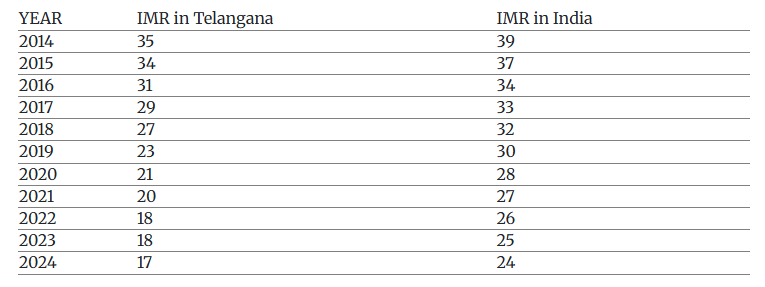
Telangana reduced its Infant Mortality Rate to 17 deaths per 1,000 live births in 2024, according to the latest Sample Registration System report.
The State performed better than the national average of 24 and continued its decade-long improvement in infant survival. Telangana has remained below the national average every year since 2014.
What is Infant Mortality Rate?
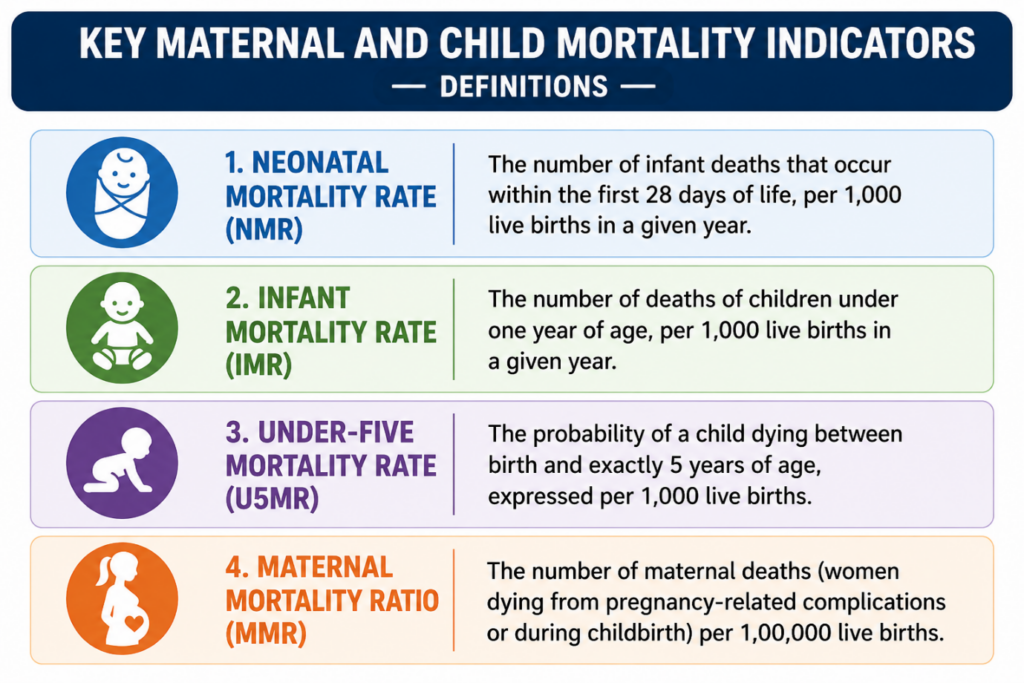
- Infant Mortality Rate means the number of deaths of infants below one year of age per 1,000 live births in a year.
- It is an important indicator of:
- Public health
- Nutrition
- Maternal care
- Child survival
- Quality of healthcare services
- A lower IMR generally shows better health services, immunisation, nutrition and institutional care.
Telangana’s Performance
- Telangana’s IMR in 2014 was 35, while India’s IMR was 39.
- In 2024, Telangana’s IMR fell to 17, while the national average declined to 24.
- Telangana recorded an 18-point reduction in 10 years.
- India recorded a 15-point reduction during the same period.
- This shows that Telangana has improved faster than the national average.
Comparison with Other States
- Telangana performed better than many large States.
- Higher IMR was recorded in:
- Chhattisgarh – 36
- Uttar Pradesh – 35
- Assam – 29
- Rajasthan – 28
- Odisha – 28
- Better-performing large States include:
- Kerala – 8
- Delhi – 11
- Tamil Nadu – 11
Rural-Urban Difference
- Telangana’s rural IMR stood at 19.
- Urban IMR stood at 14.
- This shows that urban areas have better infant survival than rural areas.
- At the national level, the rural-urban gap was wider:
- Rural India – 27
- Urban India – 17
- Telangana’s rural-urban gap is smaller than the national rural-urban gap.
Gender Difference
- In rural Telangana:
- Female IMR – 20
- Male IMR – 18
- In urban Telangana:
- Male IMR – 16
- Female IMR – 12
- The rural female IMR being higher shows that special attention is needed for girl children in rural areas.
Other Demographic Indicators
- Telangana has entered a low-fertility phase.
- Birth rate:
- Telangana – 15.7 per 1,000 population
- India – 18.3
- Total Fertility Rate:
- Telangana – 1.5
- India – 1.9
- Replacement level – 2.1
- Death rate:
- Telangana – 6.5
- India – 6.4
- Natural growth rate:
- Telangana – 9.1
- India – 11.9
These indicators show that Telangana has lower fertility and slower population growth compared to the national average.
Challenges
- Rural IMR is still higher than urban IMR.
- Rural female infant mortality needs special attention.
- Malnutrition and anaemia can affect infant health.
- Quality of primary healthcare must be improved in remote areas.
- Neonatal deaths require stronger care during the first 28 days after birth.
- Tribal and backward regions may need targeted health interventions.
- Low fertility also requires planning for future ageing and workforce changes.
Way Forward
- Strengthen primary health centres and rural health services.
- Improve maternal nutrition and antenatal care.
- Expand institutional deliveries and skilled birth attendance.
- Focus on neonatal intensive care and early newborn care.
- Improve immunisation coverage.
- Give special attention to girl children in rural areas.
- Strengthen ASHA, Anganwadi and community health worker systems.
- Use district-level data to identify high-risk areas.
- Improve nutrition programmes for mothers and infants.
Conclusion
Telangana’s reduction of IMR to 17 is an important achievement in public health and human development. It shows progress in infant survival, maternal care and health service delivery.
However, rural-urban and gender gaps still need attention. The next stage of progress should focus on rural healthcare, nutrition, neonatal care and targeted support for vulnerable groups.
CARE MCQ
Q. With reference to Infant Mortality Rate, consider the following statements:
- It refers to deaths of infants below one year of age per 1,000 live births.
- Telangana’s IMR in 2024 was lower than the national average.
- A higher IMR generally indicates better health outcomes.
Which of the above statements are correct?
A. 1 and 2 only
B. 2 and 3 only
C. 1 and 3 only
D. 1, 2 and 3
Answer: A
Explanation:
- Statement 1 is correct: IMR measures infant deaths below one year per 1,000 live births.
- Statement 2 is correct: Telangana’s IMR was 17, lower than India’s 24.
- Statement 3 is incorrect: A higher IMR indicates poorer health outcomes.
FAQs
1. What is Infant Mortality Rate?
Infant Mortality Rate is the number of deaths of infants below one year of age per 1,000 live births.
2. What is Telangana’s IMR in 2024?
Telangana’s IMR is 17 deaths per 1,000 live births.
3. What is India’s national IMR?
India’s national IMR is 24 deaths per 1,000 live births.
4. What was Telangana’s IMR in 2014?
Telangana’s IMR was 35 in 2014.
5. Which State has the lowest IMR among large States mentioned?
Kerala has the lowest IMR at 8.