Table of Contents
Relevance: UPSC: GS Paper III – Science and Technology, Artificial Intelligence, Digital Infrastructure and Inclusive Growth.
For Prelims:
- Neuro-Symbolic AI, Large Language Models, Neural Networks, Symbolic Reasoning, Knowledge Graphs, Ontology, NEP 2020, DIKSHA, Bhashini, PrahelikaAI, CREST Framework, C3AN Framework, PAL System.
For Mains:
- Explainable AI, AI in Education, Personalised Learning, Digital Divide, Rote Learning, Multilingual Education, Inclusive Growth, Teacher-AI Collaboration, Responsible AI, Data Privacy.
Why in News?
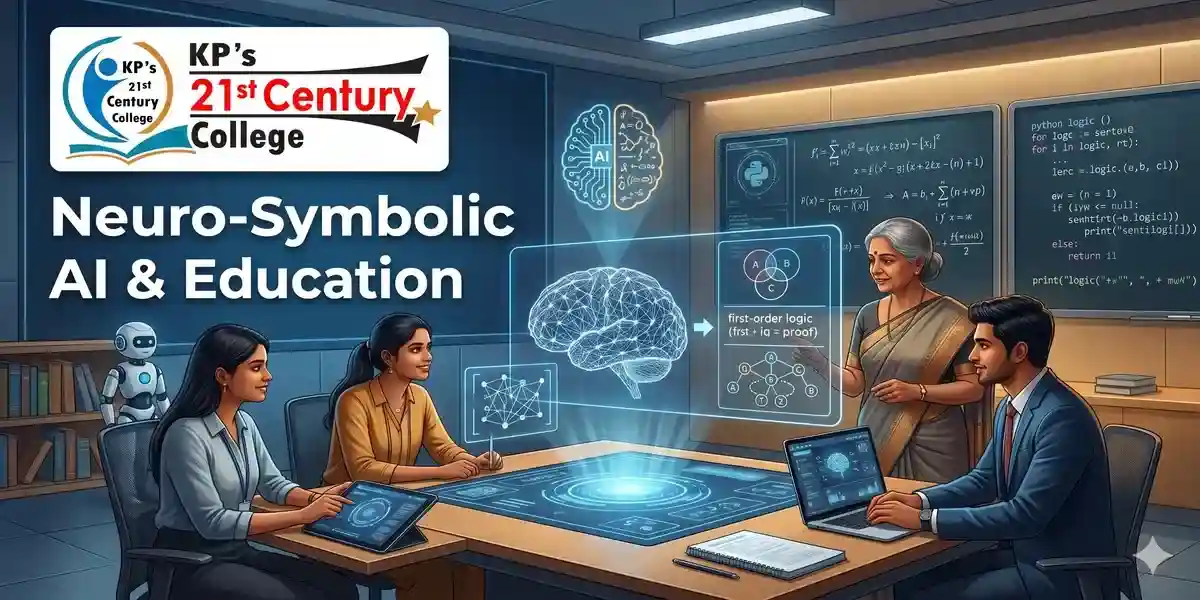
Technology experts and education researchers have highlighted Neuro-Symbolic Artificial Intelligence as a more suitable framework for Indian education than traditional generative AI models.It is gaining attention because it can provide logic-based, explainable, multilingual and affordable learning support. Unlike standard AI tools that often give direct answers, Neuro-Symbolic AI can help students understand the reasoning behind an answer.
What is Neuro-Symbolic AI?
- Neuro-Symbolic AI is a hybrid form of Artificial Intelligence.
- It combines two systems:
- Neural networks: They identify patterns from images, text, speech, handwriting and diagrams.
- Symbolic reasoning: It uses rules, logic, constraints, knowledge graphs and verified facts.
- In simple words:
- The neural part works like the “eyes and ears” of the system.
- The symbolic part works like the “logical brain” of the system.
- This helps AI give answers that are not only correct but also explainable.
Difference Between Standard AI and Neuro-Symbolic AI
- Standard Large Language Models work mainly through next-word prediction.
- They generate fluent answers based on patterns in large datasets.
- But they may not always understand rules of mathematics, science or logic.
- Neuro-Symbolic AI goes beyond prediction.
- It follows:
- Pattern recognition
- Logical reasoning
- Rule-based verification
- Curriculum-based factual checking
- Step-by-step explanation
- Therefore, it is more suitable for education, where understanding the process is as important as getting the answer.
Why Indian Education Needs Neuro-Symbolic AI
- Indian education still faces the problem of rote learning.
- Many students remember answers but struggle to explain concepts.
- Standard AI tools may increase shortcut-based learning.
- Neuro-Symbolic AI can help students move from memorisation to reasoning.
- It is especially useful in India because of:
- High pupil-teacher ratio
- Limited personalised teaching
- Rural digital divide
- Regional language diversity
- Need for affordable EdTech tools
- NEP 2020 focus on conceptual learning
Limitations of Traditional AI in Indian Classrooms
1. Infrastructure and Energy Mismatch
- Large AI models need strong internet, cloud infrastructure and high computing power.
- Such systems are difficult to use in rural and semi-urban schools.
- The content notes that only 47% of rural schools have functional computers, showing the seriousness of the digital divide.
2. High Cost
- Premium global AI models may be expensive at India’s scale.
- A global model request may cost around $0.09, while compact specialised models may cost around $0.0004 per request.
- For a country with nearly 1.4 million schools, this cost difference becomes very important.
3. Language Barrier
- Standard AI models are largely English-dominant.
- India has 22 constitutionally recognised languages and many dialects.
- Direct translation from English may distort meaning and reduce conceptual clarity.
4. Hallucination Problem
- AI hallucination means giving wrong information confidently.
- In education, this is dangerous because students may learn wrong facts, dates, formulas or explanations.
5. Black Box Problem
- Many AI systems cannot clearly explain how they reached an answer.
- This makes it difficult for teachers to identify the exact learning gap of a student.
Strategic Significance for Indian Education
1. Supports NEP 2020
Neuro-Symbolic AI supports the goals of National Education Policy 2020, such as:
- Conceptual understanding
- Critical thinking
- Experiential learning
- Multilingual education
- Reduced rote learning
- Technology-enabled learning
2. Reduces AI Hallucinations
- Neuro-Symbolic AI can use knowledge graphs based on verified curriculum content.
- Example: NCERT science chapters can be converted into structured knowledge maps.
- The symbolic layer checks whether the answer follows verified facts.
- If the system cannot verify the answer, it can safely say it does not know.
3. Enables Knowledge Tracing
- The system can track where a student is making mistakes.
- Example: In algebra, it can identify whether the student misunderstood signs, brackets or distributive property.
- This helps provide personalised feedback.
4. Supports Indian Languages
- Neuro-Symbolic AI can reason in Indian languages instead of merely translating English responses.
- It can combine neural translation with symbolic grammar rules.
- This can support initiatives like Bhashini.
5. Promotes Frugal Innovation
- These models are smaller and cheaper than large AI systems.
- They can be made offline-friendly.
- They can work on low-cost smartphones and tablets.
- This is useful for rural students with weak internet access.
Indigenous Case Studies
PrahelikaAI – IIT Kharagpur
- PrahelikaAI is being developed by IIT Kharagpur.
- It uses puzzles to improve reasoning and problem-solving.
- The model works on three major pillars:
- A large-scale puzzle dataset
- Translation of problems into Indian languages like Hindi and Bengali
- Neuro-symbolic algorithms and vision-language models
- It acts like a 24/7 digital tutor.
- It gives hints when students are stuck.
- It simplifies the problem first, then gives examples, and reveals the final answer only after repeated attempts.
- It also builds a personalised learning profile by tracking recurring mistakes.
CREST Framework
- The CREST framework uses knowledge graphs as factual guardrails.
- It helps verify AI-generated answers against trusted curriculum content.
- This makes AI more reliable for classrooms.
PAL System
- The Personal Adaptive Learner system uses neuro-symbolic guardrails.
- It converts static lessons into interactive learning.
- It asks questions at different difficulty levels without fabricating feedback.
C3AN Framework and Edge Deployment
- The C3AN framework supports lightweight, reliable and offline-friendly AI.
- It allows AI tools to run on low-end devices.
- This can help students in rural areas learn even without continuous internet.
Inclusive Growth Potential
- Neuro-Symbolic AI can support students who cannot access expensive private tutoring.
- It can help learners in government schools, rural areas and technical institutions.
- A student with a second-hand smartphone and weak internet can still access offline AI-based learning.
- It can support learning in mother tongue, such as Odia, Hindi, Bengali or other regional languages.
- It can also help teachers by showing:
- Which textbook section was used
- Which rule was applied
- Where the student made a mistake
- Which concept needs revision
Link with DIKSHA and Digital Public Infrastructure
- Neuro-Symbolic AI can be integrated with DIKSHA, India’s digital platform for school education.
- This can democratise access to personalised learning.
- India can also build a Bharat Ontology, an open-source curriculum knowledge graph.
- It can include:
- NCERT content
- State Board content
- Technical education content
- Regional language learning material
Significance
- Promotes reasoning-based learning.
- Helps reduce rote memorisation.
- Provides explainable answers.
- Reduces hallucination risks.
- Supports regional language education.
- Helps teachers identify learning gaps.
- Makes AI more affordable for Indian classrooms.
- Supports rural and low-resource learners.
- Aligns with NEP 2020 and SDG 4 on quality education.
- Encourages India’s indigenous educational technology development.
Challenges
- Building curriculum-based knowledge graphs is complex and time-consuming.
- India’s linguistic and dialect diversity needs localised datasets.
- Rural schools still face electricity, internet and device shortages.
- Teachers need training to use AI diagnostics.
- AI may increase teachers’ workload if not designed simply.
- Student data privacy must be protected.
- AI cannot fully understand emotional, family or socio-economic problems affecting a child.
- Risk of bias exists if knowledge graphs encode caste, gender, regional or language bias.
Way Forward
- Integrate Neuro-Symbolic AI with DIKSHA.
- Build open-source curriculum knowledge graphs under the IndiaAI Mission.
- Develop Indian language datasets and grammar-based AI tools.
- Make systems lightweight, offline-friendly and smartphone-compatible.
- Upgrade teacher training through NISHTHA 2.0.
- Use AI to support teachers, not replace them.
- Ensure strict compliance with the Digital Personal Data Protection Act, 2023.
- Conduct regular bias audits by independent educational bodies.
- Use AI for hints, explanation and diagnosis, not just answer generation.
- Focus on rural, government and regional-language schools.
Conclusion
Neuro-Symbolic AI can become an important tool for Indian education because it combines pattern recognition with logical reasoning. It can make AI more explainable, affordable, multilingual and reliable.
However, AI cannot replace teachers. Its real value lies in supporting teachers, identifying learning gaps and helping students understand concepts step by step. If implemented with proper infrastructure, teacher training, data protection and Indian-language support, Neuro-Symbolic AI can help India move from rote learning to true conceptual learning.
UPSC PYQ
Q. Which one of the following is the characteristic of Artificial Intelligence?
[CDS-I – 2025]
A. Replicates human decision making
B. Stores relevant information
C. Stores similar kind of data for a specific purpose
D. Allows user to interact with media
Answer: A
Explanation
- Option A is correct: Artificial Intelligence refers to the ability of computer systems to perform tasks that normally require human intelligence. These include decision-making, reasoning, learning, problem-solving, perception and planning.
Additional Information
AI systems are designed to imitate certain human cognitive abilities. Examples include speech recognition, image recognition, language translation, recommendation systems, autonomous vehicles and medical diagnosis tools. Advanced AI systems can learn from data and improve their performance over time.
CARE MCQ
Q. Project Prahelika, recently mentioned in the context of indigenous educational technology, was developed by
A. IIT Delhi
B. IIT Kharagpur
C. IISc Bengaluru
D. IIT Madras
Answer: B
Explanation:
Project Prahelika is an initiative of IIT Kharagpur. It uses logic puzzles to stimulate cognitive reasoning among students. It also includes a 24/7 digital tutor that tracks student delays and provides localized hints in Hindi and Bengali.
Additional Information:
Project Prahelika represents a logic-first architecture in educational technology. Such models help in building a personalized learning profile of students by identifying recurring misconceptions and supporting step-by-step learning.
FAQs
1. What is Neuro-Symbolic AI?
Neuro-Symbolic AI is a hybrid AI system that combines neural networks with symbolic reasoning. It helps machines not only recognise patterns but also explain answers using logic and verified rules.
2. Why is Neuro-Symbolic AI considered better for Indian education?
It promotes conceptual understanding instead of rote learning and can provide step-by-step explanations. It is also more suitable for multilingual, low-cost and rural learning environments.
3. How does Neuro-Symbolic AI reduce AI hallucinations?
It uses knowledge graphs and rule-based verification to check whether answers match trusted curriculum content. If facts cannot be verified, the system can avoid giving misleading responses.
4. What is Project PrahelikaAI developed by Indian Institute of Technology Kharagpur?
PrahelikaAI is an indigenous educational AI project that uses puzzles and neuro-symbolic reasoning to improve students’ logical thinking. It also provides personalised hints and tracks recurring mistakes.
5. How does Neuro-Symbolic AI support the goals of NEP 2020?
It supports critical thinking, experiential learning, multilingual education and technology-enabled learning. It also helps reduce rote memorisation by focusing on reasoning-based education.