
Table of Contents
Relevance: UPSC GS Paper II: Governance, Government policies, regulation of digital platforms, Centre-State coordination
For Prelims:
- Promotion and Regulation of Online Gaming Act, 2025, Promotion and Regulation of Online Gaming Rules, 2026, Online Gaming Authority of India, MeitY, Online Money Game, Online Social Game, E-sports, Section 19, Rule 9, Rule 10, Rule 12–19, Rule 20, Rule 21–22, User Safety Features, VPN, Proxy Server, Mirror Site, Mule Account, Telegram Fraud, CUTS International
For Mains:
- Blanket ban vs strong regulation, offshore gambling platforms, consumer protection, youth vulnerability, financial irregularities, money laundering, terror financing, cybercrime, digital enforcement challenges, harm-prevention safeguards, Centre-State coordination, regulatory sandbox
Why in News?
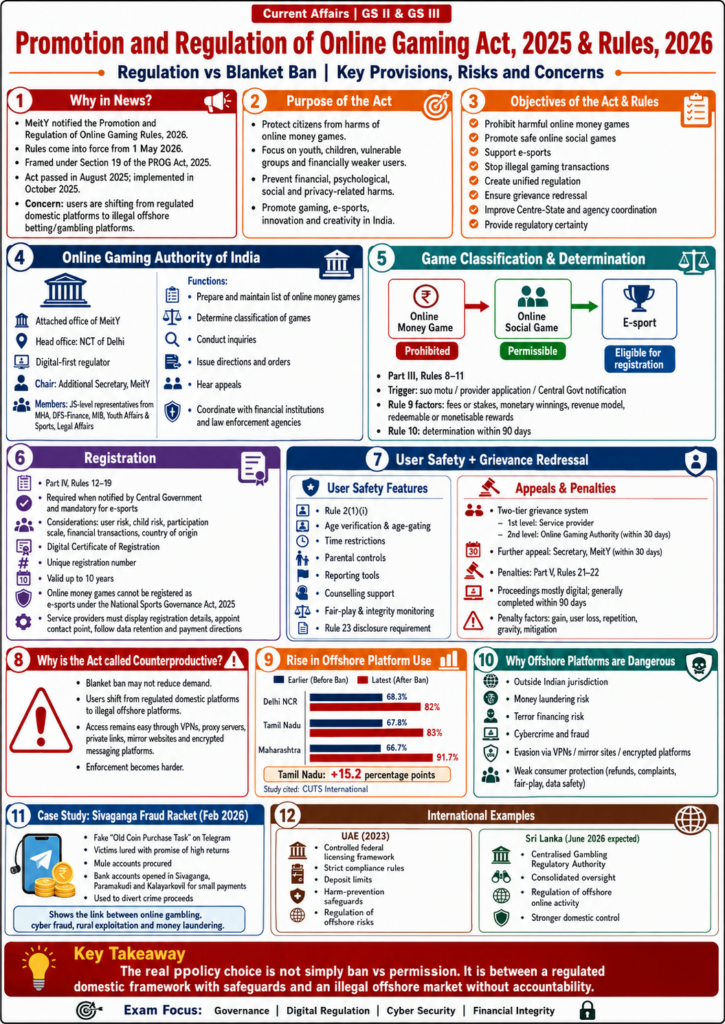
The Promotion and Regulation of Online Gaming Rules, 2026 were notified by the Ministry of Electronics and Information Technology, and are set to come into force from 1 May 2026.
The Rules have been framed under Section 19 of the Promotion and Regulation of Online Gaming Act, 2025. The Act was passed by Parliament in August 2025 and implemented in October 2025.
At the same time, concerns have been raised that the Act may be proving counterproductive. According to reports and surveys, many users have shifted from regulated domestic real-money gaming platforms to illegal offshore betting and gambling platforms after the ban.
Background of the PROG Act, 2025
The Promotion and Regulation of Online Gaming Act, 2025 was enacted to protect citizens from the harmful effects of online money games.
The Act aims to protect:
- Youth
- Children
- Vulnerable populations
- Financially weaker users
- Users exposed to addictive online games
The government’s objective is two-fold:
- First, to protect society from the financial, psychological, social and privacy-related harms caused by predatory online money gaming platforms.
- Second, to make India a global hub for gaming, innovation, e-sports and creativity.
Objectives of the Act and Rules
The Act and Rules aim to:
- Prohibit harmful online money games
- Promote safe online social games
- Support the growth of e-sports
- Protect users from addictive design and misleading promises of quick wealth
- Prevent banks and payment systems from facilitating illegal gaming transactions
- Provide regulatory certainty to the online gaming industry
- Create a unified regulatory authority
- Ensure grievance redressal and appellate mechanisms
- Strengthen coordination between the Centre, States, financial regulators and law enforcement agencies
Promotion and Regulation of Online Gaming Rules, 2026
The PROG Rules, 2026 are described as the operational architecture of the parent Act.
The Rules are organised into 6 Parts and 26 Rules.
They provide a legal and institutional framework for:
- Determining whether a game is an online money game
- Registering e-sports and notified online social games
- Establishing the Online Gaming Authority of India
- Ensuring user safety features
- Providing grievance redressal
- Imposing penalties
- Creating an appellate mechanism
| Online Gaming Authority of India
Institutional Structure
Composition The Authority will be chaired by the Additional Secretary, MeitY as an ex officio chairperson. It will include Joint Secretary-level representatives from:
Functions The Authority will:
|
Determination of an Online Game
Relevant Rules
The classification of online games is provided under Part III, Rules 8–11.
The Rules provide a determination test to decide whether a game is:
- An online money game, which is prohibited
- A permissible online social game
- An e-sport
When Determination is Triggered
Determination can be triggered in three situations:
- Suo motu action by the Authority
- Application by a service provider offering a game as an e-sport
- Notification by the Central Government requiring a category of online social games to be determined
Rule 9: Objective Factors
Under Rule 9, the Authority will examine factors such as:
- Whether users pay fees or stakes
- Whether there is an expectation of monetary winnings
- Revenue model of the platform
- Whether rewards or in-game assets can be redeemed
- Whether rewards can be monetised outside the game
Rule 10: Time Limit
The determination process should, as far as practicable, be completed within 90 days of a complete application or notice.
The result will be recorded in a determination order. This order will be specific to the particular game and the particular service provider.
Registration of Online Games
Relevant Rules
Registration is covered under Part IV, Rules 12–19.
Registration is required only where the Central Government notifies such requirement.
This may be done after considering:
- Risk to users
- Risk to children
- Scale of participation
- Financial transactions
- Country of origin of the game
Registration is also mandatory for every online game intended to be offered as an e-sport.
Certificate of Registration
After successful determination and registration, the Authority will issue a digital Certificate of Registration.
This certificate will have:
- A unique registration number
- Validity of up to 10 years
Important Restriction
An online money game cannot be recognised or registered as an e-sport under the National Sports Governance Act, 2025.
Obligations of Registered Service Providers
Registered service providers must:
- Prominently display determination or registration details
- Display the unique registration number
- Designate a point of contact
- Comply with data retention directions
- Follow directions related to payment facilitation
- Observe user safety and transparency requirements
User Safety Features
Rule 2(1)(i)
Rule 2(1)(i) introduces the concept of user safety features.
These are technical, procedural, operational, behavioural and system-related safeguards according to the risk profile of the game.
Major User Safety Features
The Rules mention:
- Age verification
- Age-gating
- Time restrictions
- Parental controls
- User reporting tools
- Counselling support
- Fair-play monitoring
- Integrity monitoring
- Internal grievance mechanisms
Under Rule 23, service providers must disclose user safety features and internal grievance redressal mechanisms while applying for determination or registration.
Grievance Redressal and Appellate Mechanism
The Rules provide a two-tier grievance redressal and appellate mechanism.
First Level: Service Provider
- Every online game service provider offering an online social game or e-sport must maintain a functional grievance redressal mechanism.
Second Level: Online Gaming Authority
- If the user is dissatisfied with the service provider’s decision, or if the complaint is not resolved, the user may approach the Online Gaming Authority of India within 30 days.
The Authority should try to dispose of the appeal within another 30 days.
Further Appeal
- A second appeal lies before the Appellate Authority, that is, the Secretary, MeitY.
- The Secretary, MeitY should dispose of appeals, as far as possible, within 30 days of receipt.
Penalties and Enforcement
Relevant Rules
- Penalties and enforcement are covered under Part V, Rules 21–22.
- Proceedings may be conducted in digital mode, unless physical presence is required.
- Proceedings should generally be completed within 90 days of receiving a complaint.
Factors for Penalty
Penalties must be proportionate. The Authority must consider:
- Gain from non-compliance
- Loss caused to users
- Repeated violations
- Gravity of the violation
- Mitigation efforts by the service provider
Why the Act is Being Called Counterproductive
The editorial argues that the implementation of the PROG Act is proving counterproductive because users are shifting from domestic regulated platforms to illegal offshore platforms.
A blanket ban may reduce visible domestic real-money gaming activity. But it may not reduce user demand. Instead, it may push users towards underground, illegal and more dangerous platforms.
This is a major concern because digital products are not physical goods. Users can access them through:
- VPNs
- Private links
- Proxy servers
- Mirror websites
- Encrypted messaging platforms
Therefore, enforcement becomes more difficult.
Rise in Offshore Platform Use
According to the editorial, early studies suggest that offshore online betting and gambling platforms have seen increased usage after the PROG Act.
A study by CUTS International reportedly found a significant rise in offshore participation after implementation of the Act.
Data on Offshore Platform Use
- Delhi NCR: increased from 68.3% to 82%
- Tamil Nadu: increased from 67.8% to 83%
- Maharashtra: increased from 66.7% to 91.7%
Tamil Nadu Example
In Tamil Nadu, 67.8% of users reported using offshore platforms before the ban, often along with domestic real-money gaming platforms.
After the ban, this increased to 83%.
This shows an increase of 15.2 percentage points.
Why Offshore Platforms are Dangerous
1. They Operate Outside Indian Jurisdiction
Offshore platforms are difficult to regulate because they are located outside India. Indian authorities cannot easily ensure compliance, consumer protection or grievance redressal.
2. They May Support Money Laundering
Illegal online betting networks can be used to transfer illegal money through hidden digital channels.
3. They May Create Terror Financing Risks
If funds are routed through suspicious or illegal channels, offshore platforms may create national security risks.
4. They Increase Cybercrime
Fraudsters may use fake betting apps, Telegram links, WhatsApp groups and investment traps to cheat users.
5. They Use Advanced Evasion Techniques
Illegal operators use:
- VPNs
- Proxy servers
- Encrypted platforms
- Mirror sites
- Private invitation links
When one domain is blocked, users are quickly shifted to another domain.
6. They Weaken Consumer Protection
Users on offshore platforms cannot easily access:
- Refund systems
- Complaint mechanisms
- Fair-play protection
- Data protection safeguards
- Responsible gaming tools
Case Study: Sivaganga Online Gambling and Fraud Racket
A recent inter-State online gambling and fraud racket came to light in Sivaganga, Tamil Nadu, in February 2026.
The fraud involved a fake “Old Coin Purchase Task” promoted on Telegram.
How the Fraud Worked
- Victims were promised high returns through fake old-coin bidding schemes.
- They were lured into investing money.
- The accused procured mule accounts.
- Villagers in Sivaganga, Paramakudi and Kalayarkovil were persuaded to open bank accounts in exchange for small payments.
- These accounts were then used to divert proceeds of crime.
Importance of the Case
This case shows that online gambling fraud is not limited to urban areas. It can also affect rural and semi-urban communities.
It also shows the link between online gambling, cyber fraud and financial crime.
International Examples
United Arab Emirates
The UAE had a long-standing prohibition on gambling. However, in 2023, it moved towards a tightly controlled federal licensing framework.
The framework includes:
- Strict compliance requirements
- Deposit limits
- Harm-prevention safeguards
- Regulation to address offshore risks
This shows that even countries with restrictive systems are exploring controlled regulation to manage offshore gambling risks.
Sri Lanka
Sri Lanka is moving towards establishing a centralised Gambling Regulatory Authority.
It is expected to become operational by June 2026.
The aim is to:
- Consolidate gambling oversight
- Bring offshore online activity under a clear domestic framework
- Improve regulatory control
Significance of the PROG Framework
The PROG Act and Rules are significant because they attempt to create a structured regulatory framework for a fast-growing digital sector.
1. Protection of Youth and Vulnerable Users
The Rules provide safeguards such as age verification, age-gating, parental controls and counselling support.
2. Regulatory Certainty
The Rules create a clear process to determine whether a game is prohibited or permissible.
3. Promotion of E-sports
The framework allows lawful e-sports to grow under a registration regime.
4. Consumer Protection
Grievance redressal and appellate mechanisms give users a formal route to raise complaints.
5. Financial System Protection
The Rules aim to prevent banks, payment systems and financial institutions from facilitating transactions linked to prohibited online money games.
6. Enforcement Coordination
The Authority can coordinate with law enforcement agencies, financial institutions and State governments.
7. Digital Governance
The Authority is designed as a digital-first regulator, which is important for a digital sector like online gaming.
Major Challenges
1. Blanket Ban May Push Users Underground
A ban may not eliminate demand. It may shift users from domestic regulated platforms to illegal offshore platforms.
2. Offshore Platforms are Difficult to Control
They operate outside India and can avoid domestic regulation.
3. Technology-Based Evasion
VPNs, proxy servers, private links and mirror websites make enforcement difficult.
4. Encrypted Platforms
WhatsApp and Telegram can be used to circulate betting links and fraud schemes.
5. Consumer Protection Gap
Users on illegal offshore platforms have limited access to grievance redressal and legal remedies.
6. Financial Crime Risks
Illegal platforms may be used for money laundering, mule accounts and suspicious cross-border transactions.
7. Centre-State Coordination
Gaming, betting, police action, financial regulation and cybercrime enforcement involve multiple authorities. Coordination is necessary.
8. Risk to Legitimate Gaming Industry
Over-regulation may affect genuine gaming innovation, online social games and e-sports.
9. Difficulty in Identifying Real Money Games
Some games may use rewards, tokens, in-game assets or indirect monetisation. Classification may become complex.
10. Protection of Children
Children are especially vulnerable to addictive design, online manipulation and misleading reward systems.
Way Forward
1. Move from Blanket Ban to Strong Regulation
India should consider whether a regulated domestic framework with safeguards may work better than a complete ban.
The real policy choice is not simply between allowing and banning. It is between:
- A regulated domestic system with accountability
or - An illegal offshore ecosystem without oversight
2. Strengthen Online Gaming Authority of India
The Authority must have technical experts, cybercrime experts, financial intelligence support and adequate staff.
3. Improve Centre-State Coordination
There should be coordination between:
- MeitY
- Ministry of Home Affairs
- RBI
- Banks
- Payment gateways
- State police
- Cybercrime units
- Financial Intelligence Unit
4. Stronger Action Against Offshore Platforms
India should strengthen domain blocking, payment blocking, transaction monitoring and international cooperation.
5. Regulate Payment Channels
Banks and payment systems must be prevented from facilitating transactions linked to prohibited online money games.
6. Use Technology for Enforcement
Artificial intelligence and data analytics can be used to detect suspicious gaming platforms, payment flows and repeated fraud patterns.
7. Public Awareness Campaigns
Users should be educated about:
- Fake betting links
- Telegram frauds
- Mule accounts
- Online money traps
- VPN-based illegal platforms
- Risks of offshore gambling
8. Introduce Harm-Prevention Measures
Possible safeguards include:
- Deposit limits
- Time limits
- Self-exclusion options
- Warning messages
- Counselling support
- Parental controls
- Age verification
9. Test Controlled Regulatory Sandbox
Policymakers may test a controlled regulatory model to understand user behaviour, platform risk and enforcement challenges.
10. Use Tax Revenue for Enforcement
If a regulated ecosystem is developed, tax revenue may be used for:
- Offshore monitoring
- Cybercrime enforcement
- Awareness campaigns
- Rehabilitation support
- Player protection systems
Conclusion
The Promotion and Regulation of Online Gaming Act, 2025 and the PROG Rules, 2026 are important steps towards regulating India’s online gaming sector. They aim to prohibit harmful online money games while promoting safe online social games and e-sports.
However, evidence of rising offshore platform use shows that a blanket ban alone may not solve the problem. It may push users towards illegal platforms that are beyond domestic oversight.
India needs a balanced and practical framework. Strong regulation, user safety, digital enforcement, financial monitoring and Centre-State coordination are necessary to protect citizens while supporting lawful gaming innovation.
UPSC PYQ
Q. Which of the following is/are the aim/aims of “Digital India” Plan of the Government of India? (2018)
- Formation of India’s own Internet companies like China did.
- Establish a policy framework to encourage overseas multinational corporations that collect Big Data to build their large data centres within our national geographical boundaries.
- Connect many of our villages to the Internet and bring Wi-Fi to many of our schools, public places and major tourist centres.
Select the correct answer using the code given below:
(a) 1 and 2 only
(b) 3 only
(c) 2 and 3 only
(d) 1, 2 and 3
Ans: (b)
CARE MCQ
Q. With reference to the Promotion and Regulation of Online Gaming Rules, 2026, consider the following statements:
- The Rules were framed under Section 19 of the Promotion and Regulation of Online Gaming Act, 2025.
- The Rules establish the Online Gaming Authority of India as an attached office of MeitY.
- The Rules allow online money games to be registered as e-sports.
Which of the statements given above is/are correct?
A. 1 and 2 only
B. 2 and 3 only
C. 1 and 3 only
D. 1, 2 and 3
Answer: A
Explanation:
Statement 1 is correct: Section 19 of the Act empowers the Central Government to make rules for carrying out the provisions of the Act.
Statement 2 is correct: The Online Gaming Authority of India is constituted as an attached office of MeitY.
Statement 3 is incorrect: Online money games cannot be recognised or registered as e-sports.
Additional Information:
The Rules aim to distinguish between prohibited online money games and permissible online social games or e-sports.
FAQs
1. What is the PROG Act, 2025?
It is a law enacted to regulate online gaming, prohibit harmful online money games and promote e-sports and online social games.
2. What are online money games?
Online money games involve payment of money or stakes with the expectation of monetary winnings.
3. Why are offshore gambling platforms dangerous?
They operate outside Indian regulation and may be used for fraud, money laundering, addiction and cybercrime.
4. What is the Online Gaming Authority of India?
It is the proposed regulatory authority under MeitY to classify games, register permissible games, handle grievances and support enforcement.