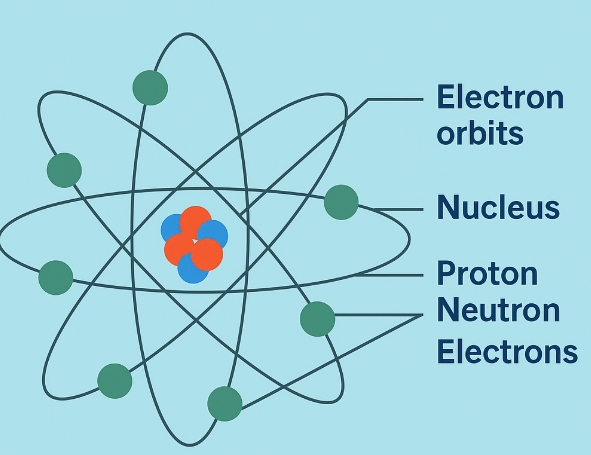
Fundamental Subatomic Particles: Electrons, Protons, and Neutrons
While the Standard Model of Particle Physics describes the ultimate, indivisible building blocks of the universe (like quarks and leptons), classical chemistry and atomic physics primarily focus on the three subatomic particles that make up every atom: the electron, the proton, and the neutron.
The Electron (e^-)
The electron is the negatively charged particle that orbits the nucleus of an atom. It is the fundamental particle responsible for chemical bonding, electricity, and magnetism.
- Discovery: The discovery of the electron is credited to J. J. Thomson in 1897 through his famous cathode ray tube experiments. He proved that cathode rays were actually streams of negatively charged particles. While Thomson successfully measured the mass-to-charge ratio, it was Robert Millikan in 1909 who determined the exact electrical charge of an electron using his renowned Oil Drop Experiment.
- Physical Properties:
- Charge: It carries a negative charge of -1.60210 This perfectly balances the positive charge of a proton, ensuring the atom remains electrically neutral overall.
- Mass: The mass of an electron is exceptionally small, approximately 9.1 kilograms (which is considered negligible when calculating the total mass of an atom).
- Location and Behaviour: Initially, Ernest Rutherford proposed that electrons revolve around the nucleus like planets. In 1913, Niels Bohr improved this by postulating that electrons move in fixed, circular orbits with specific, quantized energy levels. Today, under modern quantum mechanics, the idea of fixed paths has been replaced by Orbitals—three-dimensional regions of space around the nucleus (designated as s, p, d, and f) where the probability of finding an electron is at its maximum.
The Proton (p^+)
The proton is the positively charged particle located deep within the center of the atom. It is the defining particle that gives an element its unique identity.
- Discovery: The first evidence of a positively charged particle was observed by Eugene Goldstein in 1886 using canal ray experiments. However, the actual formal discovery and naming of the proton is credited to Ernest Rutherford in 1919, following his groundbreaking alpha particle scattering experiments.
- Physical Properties:
- Charge: It carries a positive charge that is exactly equal in magnitude to the electron’s negative charge (-1.60210coulombs).
- Mass: The mass of a proton is (1.67kilograms, making it approximately 1,840 times heavier than an electron.
- Role in the Atom: Protons are concentrated entirely within the dense central nucleus. The total number of protons in an atom is known as the Atomic Number (Z). This number determines the chemical identity of the element and dictates its exact position on the Modern Periodic Table.
- Example: Any atom with exactly 1 proton is Hydrogen (Z=1). Any atom with exactly 2 protons is Helium (Z=2).
The Neutron (n^0)
The neutron is the electrically neutral particle that resides alongside protons in the nucleus. It acts as the “nuclear glue” that helps hold the positively charged protons together.
- Discovery: While Rutherford’s model successfully placed protons in the nucleus, the math did not add up; the protons alone could not account for the total mass of the atom. He theorized a neutral particle must exist. This missing particle was finally discovered by James Chadwick in 1932.
- Physical Properties:
- Charge: Neutrons have absolutely no electrical charge (they are neutral).
- Mass: Their mass is almost perfectly identical to that of a proton. Because protons and neutrons make up nearly 100% of an atom’s weight and share the nucleus, they are collectively referred to as Nucleons.
- Role in the Atom: The total combined number of protons and neutrons in a nucleus is called the Mass Number (A).
- Isotopes: While all atoms of a specific element must have the same number of protons, they can have varying numbers of neutrons. These variations are called isotopes. For example, Hydrogen has three natural isotopes: Protium (0 neutrons), Deuterium (1 neutron), and Tritium (2 neutrons).
- Nuclear Stability: The ratio of neutrons to protons is the primary factor that determines if a nucleus is stable. If there is a severe imbalance, the atom becomes unstable and radioactive, leading to nuclear decay.