Why in News?
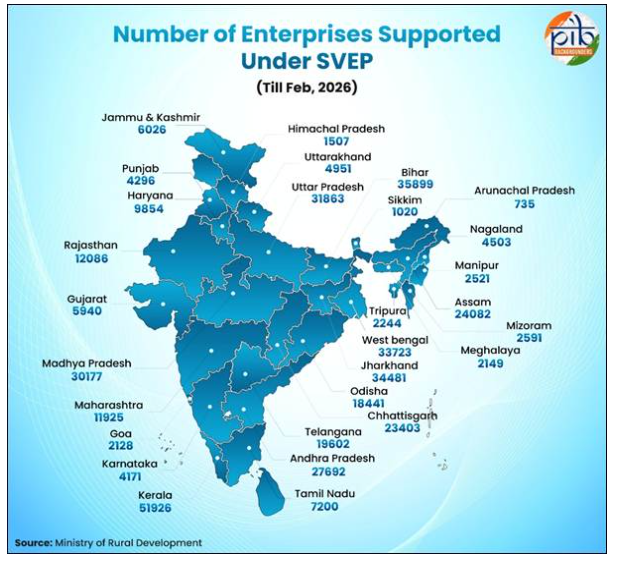
The Start-up Village Entrepreneurship Programme (SVEP) has emerged as an important grassroots model for poverty reduction, local employment generation and rural economic development. By June 2026, the programme had supported over 4.32 lakh rural enterprises across the country, with a strong focus on women and socially disadvantaged groups.
What is SVEP?
The Start-up Village Entrepreneurship Programme is a rural entrepreneurship initiative launched in 2016 as a sub-scheme of the Deendayal Antyodaya Yojana–National Rural Livelihoods Mission.
It supports Self-Help Groups and their family members in establishing small non-farm enterprises in rural areas.
SVEP provides:
- financial assistance
- institutional support
- business management training
- soft skill development
- mentoring
- business development services
- bank linkage support
The programme aims to promote sustainable livelihoods and self-employment in rural India.
Link with DAY-NRLM
- SVEP operates under DAY-NRLM, one of the world’s largest livelihood initiatives.
- DAY-NRLM mobilises rural poor households into Self-Help Groups, predominantly women. Its focus is on:
- sustainable livelihoods
- financial inclusion
- skill development
- institutional support
As of mid-June 2026, more than 10.29 crore rural households had been mobilised into SHGs under DAY-NRLM.
How SVEP Works
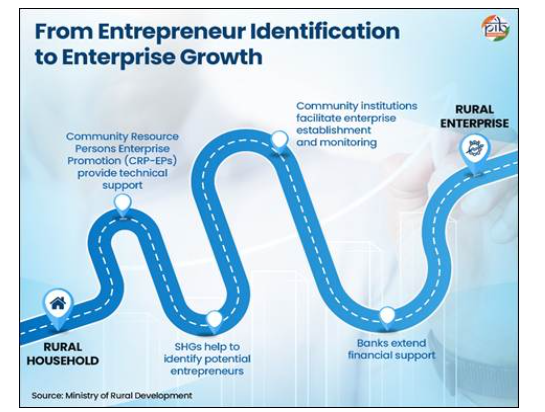
SVEP follows a community-led enterprise promotion model.
1. Identification of Entrepreneurs
Community institutions identify potential entrepreneurs based on:
- need
- poverty status
- entrepreneurial potential
2. Enterprise Viability Assessment
Before support is provided, the proposed enterprise is assessed for viability.
3. Training and Mentoring
Entrepreneurs receive business-related training and continuous handholding support.
4. Finance and Credit Support
Financial support is provided through community institutions, bank linkages and convergence with schemes such as Pradhan Mantri Mudra Yojana.
5. Monitoring and Tracking
Digital tools support business planning, loan appraisal and enterprise tracking.
Institutional Architecture
SVEP is implemented through State Rural Livelihoods Missions.
Block Resource Centres–Enterprise Promotion
- At the block level, BRC-EPs coordinate programme implementation.
Community Resource Persons–Enterprise Promotion
- CRP-EPs provide technical assistance, mentoring, training and credit facilitation support to entrepreneurs.
Important features of CRP-EPs:
- selected through testing, training and certification
- preference given to local residents
- many are selected from SHG households
- women form a major part of the cadre
- each CRP-EP mentors several enterprises
Community Enterprise Fund
Community institutions manage loans through the Community Enterprise Fund, enabling local decision-making and financial support.
Social Inclusion under SVEP
SVEP has adopted an inclusive approach by focusing on:
- women
- marginalised communities
- persons with disabilities
- individuals with limited educational attainment
- first-generation entrepreneurs
The programme mandates that at least 60% of beneficiaries are women, while ensuring representation of SC/ST/minority communities and persons with disabilities. Around 86% of entrepreneurs under the programme belong to SC, ST, Minority and OBC communities.
Impact on Rural Livelihoods
The Quality Council of India conducted a mid-term evaluation of SVEP for the Ministry of Rural Development. The findings indicated positive outcomes in enterprise development, income generation and social inclusion.
Key findings include:
- most SVEP-supported enterprises were profitable
- enterprises became a major source of household income
- women played a significant role in ownership and management
- entrepreneurs reported higher savings
- improved access to finance helped enterprises grow
- continuous mentoring improved business sustainability
The programme also improved confidence, livelihood security, financial skills and social standing among rural entrepreneurs.
Significance
1. Shift from Welfare to Enterprise-Led Development
SVEP shows that rural poverty reduction can be supported through entrepreneurship, not only through welfare transfers.
2. Strengthening Non-Farm Rural Economy
By supporting small enterprises outside agriculture, the programme diversifies income sources in villages.
3. Women-Led Economic Empowerment
The SHG-based model enables rural women to become entrepreneurs, mentors and community leaders.
4. Community-Based Implementation
Funding and enterprise decisions are rooted in local institutions, making the programme more responsive to rural needs.
5. Local Employment Generation
Small enterprises create livelihood opportunities within villages and reduce dependence on migration.
6. Inclusive Start-up Ecosystem
SVEP extends India’s start-up culture beyond urban centres and builds a rural entrepreneurship base.
Way Forward
SVEP should continue strengthening SHG federations, CRP-EP cadres, bank linkages and digital monitoring systems. Greater convergence with schemes such as MUDRA can improve access to credit. Rural entrepreneurs also need continued support in business planning, market linkages, product quality, financial literacy and enterprise scaling.
Conclusion
The Start-up Village Entrepreneurship Programme has shown that entrepreneurial talent exists in rural India and can grow when supported by community institutions, finance, training and mentoring. By empowering women, marginalised communities and first-generation entrepreneurs, SVEP is laying the foundation for a vibrant rural start-up ecosystem and contributing to the vision of a self-reliant and developed India